
A deal postmortem is a short, structured review you run after a loan closes, stalls or dies, to find out what actually happened and which one thing you will change next time. For a commercial loan broker, the useful version is a written record, a 30-minute review and one owner-assigned change to your lender list, your submission or your follow-up. Anything looser turns into a vague feeling that the lender was slow.
TL;DR
- Review every lost or stalled deal within days, while the emails and call notes are fresh, and write the result down in one standard record.
- Sort each failure into one of four buckets: the file, the deal, the borrower or the lender. Each bucket has a different fix.
- Ask lenders an open question first, then a multiple-choice one, because a polite one-line decline rarely states the real reason.
- Review your wins too. Patterns in lender response time and submission quality only show up when you compare both outcomes.
- Finish with one change, one owner and one review date, not a list of lessons.
Table of Contents
- What a deal postmortem is, and when to run it
- What to capture in the record
- Find the real reason the deal failed
- Run the review in 30 minutes
- Failure patterns worth tracking
- Measures that teach you the most
- Turn findings into changes
- Run your postmortems inside BrokersConnect
- Our perspective
- FAQ
- Sources
What a deal postmortem is, and when to run it
The term comes from engineering and medicine. In sales and finance it means reconstructing a deal from first contact to outcome and separating what you can prove from what you assume. It is the opposite of a premortem, which imagines a plan has failed before it starts. Most pages that rank for this phrase cover premortems or software incident reviews. A broker needs something narrower: a review of one loan request that moved through lenders, a borrower and a closing clock.
Run one in four situations:
- Closed-lost: the borrower went elsewhere, or every lender passed.
- Stalled: the file sits with a lender and nobody is deciding.
- Closed-won, but painful: it funded, but only after a re-trade, a missed date or a second lender.
- Closed-won, clean: it is worth knowing why, so you can repeat it.
Timing matters. One practitioner firm recommends scheduling a structured, unemotional review with the core team while details are fresh, tracing the timeline from discovery to termination and separating market shifts from execution failures. For a solo broker, the "team" is you plus whoever handled processing. Keep it blame-free in either case. The goal is a better process, and a review that hunts for a culprit produces defensive notes and no change.
What to capture in the record
An analysis is only as good as the record behind it. One published lost-deal framework recommends separating what the buyer reported, what the deal record supports, what you infer and what remains unknown. That split carries over well to lending, where borrowers and lenders both give tidy explanations that the file does not always back up.
Use one template for every deal so the records can be compared later:
| Field | What to write | Why it matters |
|---|---|---|
| Outcome and date | Funded, declined, withdrawn, stalled or still open | Stops "stalled" deals from hiding as pipeline |
| Deal facts | Property type, loan amount, leverage, location, purpose, structure | Lets you see which deal types fail most often |
| Borrower facts | Credit profile, liquidity, experience, guarantor position | Separates sponsor problems from deal problems |
| Lenders approached | Who, when, in what order, how many | Shows whether the list was too narrow or poorly matched |
| Lender responses | Dates of each request and each reply | Exposes slow responders and re-trades |
| Stated reason and source | The exact words, and who said them | Keeps quotes apart from your interpretation |
| Supporting evidence | Dated emails, term sheets, missing documents | Shows what the file actually supports |
| Inference and unknowns | What you believe, and what you could not confirm | Prevents guesses from becoming "lessons" |
| Next change | One action, an owner, a review date | Turns the review into behavior |
If your notes live across inboxes, spreadsheets and texts, this is where reviews break down. You cannot reconstruct a timeline you never recorded.
Find the real reason the deal failed
Most declines arrive as a single polite line. The Commercial Loan Broker Institute suggests asking the open question first, something like "Why isn't it a fit? Can you tell me more?", then offering a menu: was it the leverage, the coverage, the industry or the sponsor. Per the same guidance, most declines trace to one of those four. Then sort the real reason into one of four buckets, each with its own remedy:
| Bucket | Typical signs | Typical fix |
|---|---|---|
| The file | Missing or inconsistent documents, a weak narrative, unanswered obvious questions | Rebuild the package before it goes out |
| The deal | Leverage too high, coverage too thin, asset or industry outside appetite | Restructure, or target lenders whose appetite fits |
| The borrower | Liquidity, credit, experience or guarantor issues | Set milestones and resubmit later |
| The lender | Capital constraints, changed appetite, slow or silent desk | Replace the lender and keep a backup |
Read the lender's behavior, not just its words
When financing stalls, a financing adviser at Greenfield suggests working out who is reviewing, what decision is outstanding and what would let that person make it. Compare each request with each response. A pass on loan size is different from a cash-flow concern. A request for guarantor financials means something different from a lender avoiding construction risk. Your timeline will usually show which of three problems you had: the structure, the lender choice or missing information.

Use the right test for each loss
Two questions cut through most of the noise:
- Did the lender ever see a file that answered its likely questions? If not, the loss starts with you.
- Was this lender ever a realistic fit? If the deal sat outside its actual appetite, the match was wrong from the first email.
Also check for the failure that has nothing to do with lenders. A well-documented case is the failed bid for the HSBC Building in New York, where the buyer told the seller and lender he had secured equity he had not. He then could not raise roughly $200 million by the deadline and lost his deposit. Your version is smaller: a borrower says the cash is there, you pass it on without verification, and the deal collapses at the worst moment. Put "what did we verify, and what did we take on trust?" in every record.
Run the review in 30 minutes
- Gather the evidence first. Pull the email thread, call notes, lender replies, term sheets and the document list. Do not start the meeting until the timeline is on one page.
- Build the timeline. Mark first contact, submission, each lender touch, each reply, each document request and the date momentum faded. Gaps tell you more than events.
- Write the stated reason and the evidence side by side. If the lender said "credit committee passed" but the file shows three unanswered requests for guarantor financials, record both.
- Assign the bucket. File, deal, borrower or lender. If you cannot decide, write the unknown and name the one question that would settle it.
- Separate external from internal causes. A rate move or a lender pulling out of a sector is not an execution failure. A missing rent roll is.
- Pick one change. One lost-deal framework asks what you would do differently, and says the answer should be a specific behavior change rather than a platitude. "Communicate better" fails that test. "Send a follow-up with a named question on day four if the lender is silent" passes.
- Set the owner and review date. Check the change against your next two or three similar deals.
A qualification checklist can double as the postmortem. A CRE coaching newsletter describes Allen Buchanan's QUALIFY framework, covering need, urgency, authority, loyalty, intentions, fuel and yearning, and says that when a deal fails, one of the seven items was not properly addressed. Treat it as a prompt, not a law, but it is a quick way to ask whether the right decision maker and the real motivation were ever on the table.
Failure patterns worth tracking
After ten or twenty records, the same causes repeat. A hard-money broker guide lists the recurring ones: lender mismatch, slow response while the contract clock runs, re-trading after approval, a thin network with no alternative and lender capital constraints. Map those to what you record:
- Mismatch: the lender's stated appetite and your deal did not line up. Tag it by property type, size and leverage.
- Silence: days between your submission and the first substantive reply. Our guide to tracking lender feedback with response-time expectations shows how to make that measurable.
- Drift: the file did not die, it just stopped moving. A lender follow-up cadence keeps stalled deals from aging into dead ones.
- Re-trade: terms changed after approval. Record what changed and what the lender said caused it.
- No plan B: the first lender failed and you had nobody queued. This one is a sourcing problem, covered in how brokers find commercial lenders that actually close.
Measures that teach you the most
Do not track fifteen metrics. Start with these, all calculated from the same record:
| Measure | How to calculate | What it tells you |
|---|---|---|
| Submit-to-first-response time | Days from submission to first substantive reply, by lender | Which desks are worth your next deal |
| Lenders per funded deal | Lenders approached divided by deals funded | Whether matching is precise or scattershot |
| Loss reason mix | Share of losses in each of the four buckets | Where your effort should go first |
| Stall rate | Share of deals with no activity for 14 days | Early warning before a deal dies |
| Document completeness at submission | Required items present on day one | Whether your package invites questions |
The comparison with wins is the point. If funded deals averaged a short response time from a given lender and lost deals averaged a long one, you have a pattern. If your wins and losses share the same weak spot, such as thin borrower financials, you have found something the closings had been hiding.
Turn findings into changes
A postmortem only pays when it changes a standing process. Practitioners suggest embedding findings into standard procedures: moving third-party reports earlier if diligence delays caused a failure, or building secondary debt options and a wider capital network when financing complications derailed a closing.
Map each bucket to a concrete change:
- File: update your checklist. Our loan document checklist and loan submission guide are good starting points. A recurring issue with rent rolls can be solved with a one-hour rent roll analysis before the package leaves your desk.
- Deal: restructure earlier, or screen for appetite before the first call.
- Borrower: set milestones and a target date rather than forcing a bad fit.
- Lender: drop or demote slow responders, and always queue a backup.
- Closing: if the loss happened late, compare it with a 45 to 60 day closing timeline.
An industry piece quotes a capital provider saying effective brokers analyze their own transactions and anticipate what capital providers will ask, poking holes before a deal goes out. Your postmortem library is a list of the holes you have already found.
Close the loop with the borrower
The borrower conversation is part of the review. The Commercial Loan Broker Institute advises calling with feedback, not a decline: "we got feedback from a lender" rather than "we got declined", never without a plan attached. The plan covers the lender's actual feedback, which of the four things has to change and where the file goes next. If the honest answer is "not yet," give a target date and the milestones to hit first. The same source notes that pushing a borrower who is not ready into an expensive loan is the worst move. If you want a model for clearer client updates, a short, predictable rhythm of contact does most of the work.
Run your postmortems inside BrokersConnect

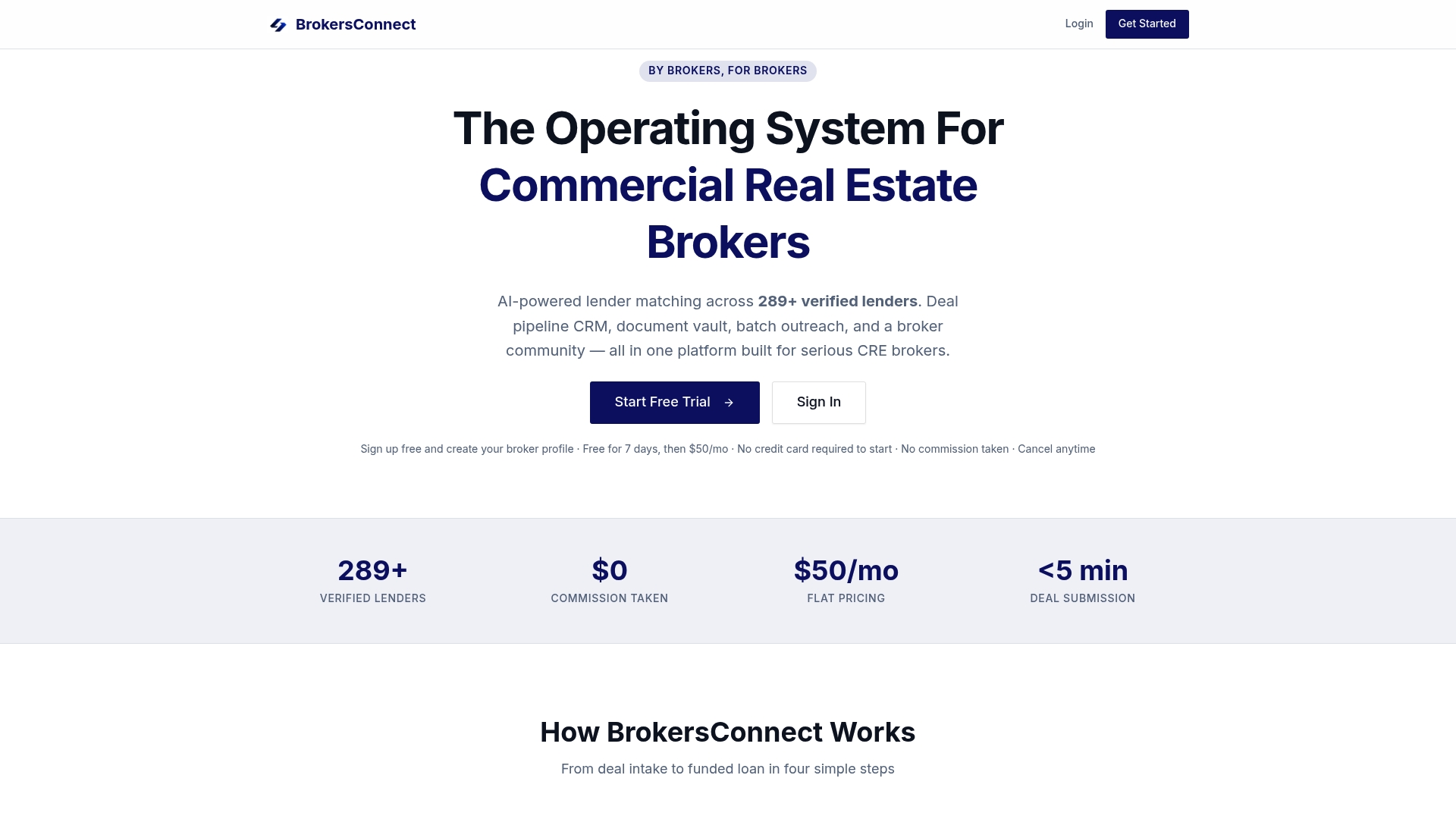
A postmortem depends on records, and records depend on where the deal lives. BrokersConnect is the commercial real estate broker operating system: a deal pipeline, tools to track lender conversations, a secure document vault and AI-powered lender matching against a database of 289+ verified lenders, with a lender responsiveness leaderboard. Matching is based on property type, loan amount, location, leverage, credit profile, loan purpose and transaction structure, so the lender and mismatch questions in your review start from better data.
The plan is $50 per month with a free trial, and there are no commissions or transaction fees. You can start at BrokersConnect.
Our perspective
Most broker losses are not dramatic. They are a lender who went quiet in week two, a file that left without a current rent roll, a deal sent to a desk that never funded that asset type. Each was visible at the time and forgotten a month later, because the evidence sat in five different places.
That is why we built BrokersConnect as one workspace: matching, submissions, lender conversations, documents and pipeline together. When the record is a by-product of working the deal, the postmortem takes minutes, and the patterns, which lenders respond and which deal types stall, appear on their own.
Our view is that a broker's lender list should improve with every deal, won or lost. A flat monthly fee and no commissions mean you can review every file without worrying what it costs, because the platform is designed to make the next submission better than the last.
Theron
FAQ
How soon after a deal dies should I run the postmortem?
Within days, while the emails, call notes and lender comments are fresh. Practitioner guidance recommends reviewing while details are still clear. If a borrower might return in several months, add a milestone date to the record at the same time.
Should I also review deals that closed?
Yes. Clean wins show which lenders, documents and timelines work, and painful wins show near-misses. Comparing funded and lost deals on response time, lenders approached and document completeness is what turns individual reviews into a pattern.
How do I get an honest reason from a lender who just said no?
Ask an open question first, then offer a short menu: leverage, coverage, industry or sponsor. Most declines trace to one of those four. Record the lender's words exactly and keep your interpretation in a separate field.
What is the difference between a postmortem and a premortem?
A premortem imagines a plan has failed and reasons backward before work begins. A postmortem examines a deal after the outcome. Brokers benefit from both, and their postmortem records are the best input for what to check before the next submission goes out.
Sources
- Turning a Lost Deal Into Your Greatest Business Asset
- Lost Deal Analysis: Improve the Next Conversation
- Why Lenders Say No... And How Good Brokers Fix It
- Behind Andrew Chung's Botched Bid to Acquire the HSBC Building
- Stalled Business Financing: What to Check
- Hard Money Broker Guide 2026
- The Lost Deal Debrief: A B2B Sales Framework
- The 8-Step SEQUENCE behind 2,000+ Deals
- What capital providers want commercial brokers to understand about deal preparation
- Mortgage Client Communication: A Broker's Guide to Clearer Updates