
A lender-ready CRE submission is a reconciled loan package plus a concise cover memo and attachment map. Lenders expect a reconciled T-12 and NOI alongside that memo before they will engage seriously. Organize your files first, then submit to the lenders whose credit boxes actually fit the deal.
TL;DR:
- Tie the rent roll, trailing twelve month operating statement, and pro forma together, explain collection gaps, and separate one time expenses before submission.
- Keep the cover memo to one page, or two for complex deals, number matching exhibits, and disclose pending documents with expected delivery dates.
- Screen each lender by property type, loan size, geography, leverage, and guarantor requirements; confirm trailing NOI clears its DSCR floor without projected income.
- Track each submission’s date, lender, status, and open items; follow up every three to five business days and add dates to revised exhibits.
Table of Contents
- Complete loan submission checklist and file organization
- Underwriting metrics, financial reconciliation, and common red flags
- Writing the cover memo and building the attachment map
- Tailoring submissions for lender credit boxes and lender-specific requirements
- Submission workflow: timelines, tracking, follow-up and version control
- How BrokersConnect and practitioner templates speed placement
- Practitioner perspective: what experienced originators do differently
- How BrokersConnect helps you pack and submit lender-ready opportunities
- FAQ
- Sources
Complete loan submission checklist and file organization
A lender opens your file expecting two things first: a cover memo that tells the story in under a page, and an attachment map that tells them exactly where to verify every claim in that memo. Everything else supports those two documents.
Build your folder in this order:
- Executive summary and cover memo, placed first so it sets context before numbers appear.
- Rent roll, trailing 12-month operating statement (T-12), and a pro forma reconciled to each other.
- Lease abstracts or full leases for anchor and major tenants.
- Borrower financials, entity documents, and a personal financial statement for guarantors.
- Title commitment, survey, and existing insurance policy.
- Environmental reports and, when applicable, appraisal materials or a prior valuation.
Name files by category and date (for example, "T12_2025_Property.pdf") rather than generic labels like "financials final." Underwriters moving through dozens of submissions a week rely on consistent naming to find what they need without opening every attachment. For smaller deals, a single indexed PDF often reviews faster than a scattered folder; for larger or more document-heavy transactions, a structured folder with a clear index page works better, especially when exhibits run long. When an item is still pending, such as a final survey or updated insurance certificate, say so directly in the cover memo rather than leaving a silent gap, and note the expected delivery date.
Pro Tip: List pending items in the memo itself, with a date attached, so underwriters do not assume the package is incomplete by omission.
Underwriting metrics, financial reconciliation, and common red flags
Every lender's first read runs through the same core numbers: net operating income (NOI), debt service coverage ratio (DSCR), loan-to-value (LTV), and loan-to-cost (LTC). NOI is gross income minus operating expenses, excluding debt service and capital items. DSCR divides NOI by annual debt service, and most lenders want trailing (actual, in-place) NOI for stabilized assets, with stabilized pro forma figures used only when clearly labeled as projections. LTV and LTC measure leverage against value and cost, respectively, and both shift depending on whether you are using as-is or as-stabilized valuations.
Reconciliation is where most packages break down before they reach a credit committee. A practical approach:
- Crosswalk the rent roll against T-12 collections line by line, explaining any tenant whose actual collections do not match the stated lease rate.
- Normalize one-time expenses (a roof repair, a legal settlement) and flag them separately rather than burying them in operating costs.
- Build a one-page reconciliation table that bridges rent roll, T-12, and pro forma figures side by side.
Unreconciled NOI figures between the T-12 and pro forma are among the most common reasons underwriters send a file back with questions instead of a term sheet, according to a lender package checklist resource built around common submission gaps. Pre-empting that question with a labeled reconciliation table, rather than waiting for it, is one of the most reliable ways to keep a file moving instead of stalling in review.
Writing the cover memo and building the attachment map
A cover memo earns a second read when it answers a lender's questions in order, without forcing them to hunt through exhibits. Structure it as:
- Deal snapshot: property type, location, loan amount requested, and purpose.
- Borrower summary: sponsorship experience, entity structure, and credit profile.
- Loan summary: requested terms, proposed structure, and timeline.
- Collateral highlights: occupancy, tenant mix, condition, and any capital improvements.
- Key metrics and exit plan: NOI, DSCR, LTV, LTC, and how the loan gets repaid or refinanced.
Keep it to one page, two at most for complex deals, and write it the way you would brief a colleague who has thirty seconds. Number your attachments to match the memo's bullets so a lender reading "DSCR of 1.35x based on trailing twelve-month NOI" can flip straight to Exhibit 4 for the backup. For a ready-made structure, sample cover letter and attachment map language built for this exact handoff can save you from drafting one from scratch each time.
Pro Tip: Write the executive summary last, after the attachments are finalized, so every number in it matches what the exhibits actually show.
Tailoring submissions for lender credit boxes and lender-specific requirements

A credit box is the set of parameters a lender screens deals against before anyone reads your memo: property type, loan size, geography, leverage ceiling, DSCR floor, and sponsor net worth requirements.
Before you submit, check these fields against each target lender:
- Minimum and maximum loan size, and whether your request sits comfortably inside that range.
- DSCR floor and whether your trailing NOI clears it without relying on pro forma assumptions.
- Preferred property types and any asset classes they actively avoid.
- Guarantor net worth and liquidity requirements relative to loan size.
- Appraiser panel preferences, since some lenders require their own approved list.
Small packaging changes often move the needle more than the deal itself. Leading with a strong sponsor's track record if a lender is known to weight experience heavily, or reordering the memo to put occupancy and tenant credit quality first for a lender focused on cash flow stability, can shift a file from a pass to a term sheet. A quick lender credit box screening approach helps narrow your target list before you spend time tailoring anything.
Submission workflow: timelines, tracking, follow-up and version control
Batch platform submissions reach more qualified lenders at once; direct email works better when you already have a strong relationship with a specific credit officer. Either way, build the process around these steps:
- Submit to a prioritized list of lenders whose credit box fits, rather than a mass blast to everyone in your contacts.
- Track four fields minimum for every submission: date sent, lender name, current status, and outstanding items.
- Follow up within 3 to 5 business days if you have not heard back, and again at the same interval until you get a clear yes, no, or specific ask.
- Version-control every updated exhibit (a revised rent roll, a new appraisal draft) with a date stamp, and resend a short note flagging exactly what changed.
A complete package on day one, with no pending items trailing behind it, is consistently the biggest accelerator toward a fast term sheet.
How BrokersConnect and practitioner templates speed placement
Matching a deal to the right lender and assembling the package are two separate jobs, and most delays come from doing the second one without finishing the first.
- Lender matching narrows your target list by property type, loan amount, geography, leverage, and loan purpose before you spend an hour tailoring a memo.
- A pipeline view keeps every active submission visible, with status and outstanding items in one place instead of scattered across inboxes.
- Deal templates and a document vault give you a starting structure for the cover memo and attachment map described above, rather than rebuilding one from scratch each time.
- A lender responsiveness view helps you prioritize follow-up toward lenders who actually reply, instead of chasing every name on a list equally.
Pairing a platform built around this workflow with a standardized template, like the cover letter and attachment map structure referenced earlier, turns the checklist in this guide into something you can execute repeatedly instead of reinventing per deal.
Practitioner perspective: what experienced originators do differently
Originators who place deals consistently reconcile financials before a lender ever sees them, keep a one-page reconciliation on hand for every file, and use the same naming convention every time so nothing gets lost in review. They also follow up on a fixed cadence rather than waiting to be chased, and they protect relationships with appraisers and underwriters the same way they protect lender relationships, because a reliable appraiser who answers calls quickly can be the difference between a 30-day close and a 60-day one.
— Theron
How BrokersConnect helps you pack and submit lender-ready opportunities
Everything in this guide, the checklist, the memo structure, the lender tailoring, works faster when the matching and tracking happen in one place instead of across spreadsheets and email threads. We built BrokersConnect around that exact workflow: AI-powered lender matching against a large verified lender database, deal templates that mirror the cover memo and attachment map structure above, batch outreach, and a pipeline that tracks every submission's status automatically.
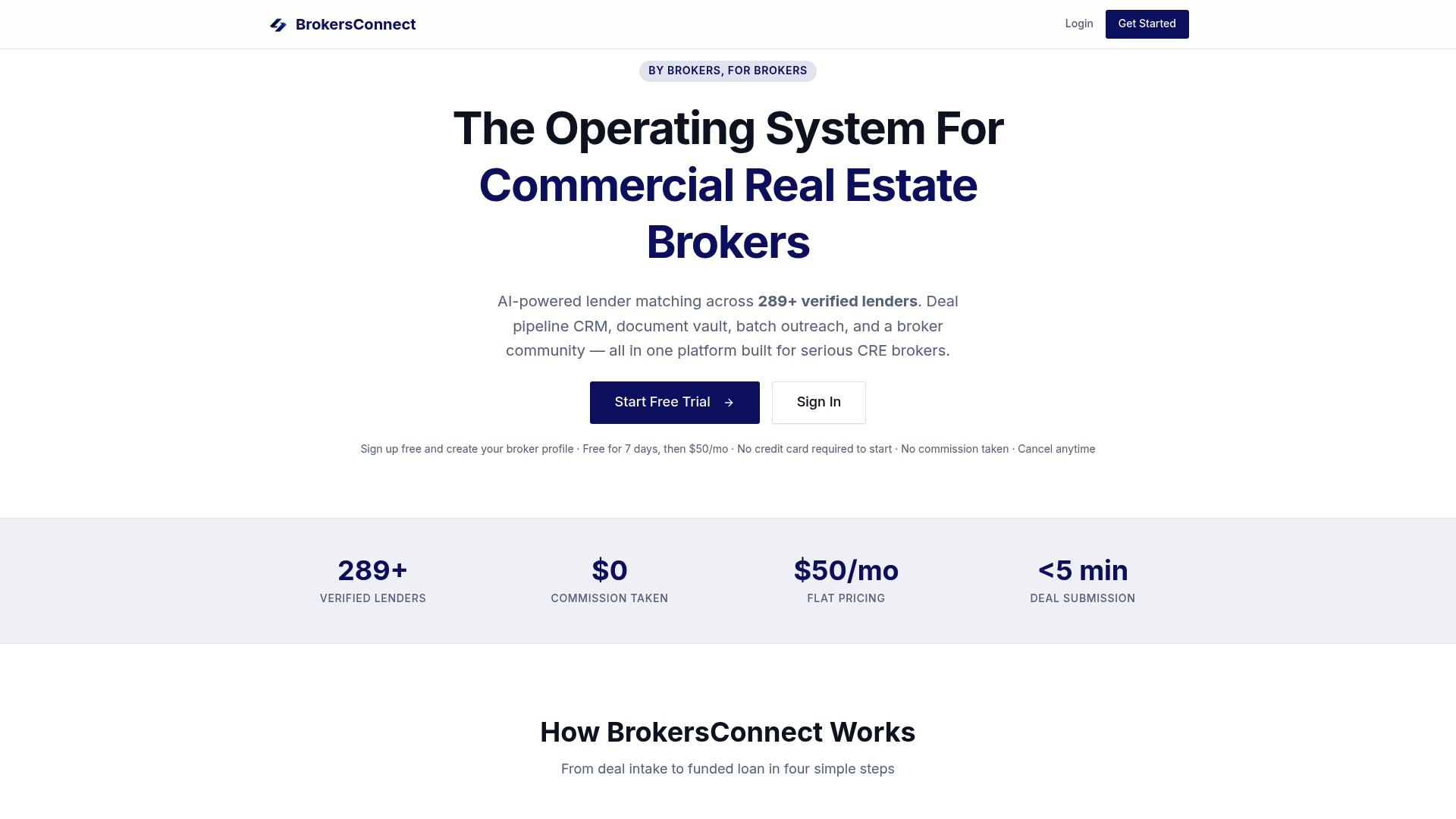
If you are packaging a deal this week, start a free trial and pull a template directly from the platform rather than building your cover memo from a blank page.
FAQ
What makes a CRE loan package "lender-ready"?
A lender-ready package pairs reconciled financials (T-12, pro forma, and rent roll tied together) with a concise cover memo and a numbered attachment map. Underwriters move faster on files where the numbers already agree and every claim points to a specific exhibit, according to a lender package checklist resource focused on common submission gaps.
How long should a loan submission cover memo be?
One page is standard, with two pages acceptable for complex or multi-property deals. Keep it structured around the deal snapshot, borrower summary, loan terms, collateral highlights, and exit plan, since lenders are scanning for those specific points first.
What appraisal standards apply to CRE loan packages?
Appraisals included in a submission generally need to comply with USPAP, the recognized appraisal standard in the United States, though USPAP does not require a single report format since the appraiser, not the form, carries the compliance obligation. For green or high-performance properties, Valuation Advisory #9 outlines additional documentation worth including when those features affect value.
What are the most common reasons a loan submission gets delayed?
Unreconciled figures between the T-12 and pro forma, missing or unexplained one-time expense adjustments, and incomplete attachment indexing are the most frequent causes of back-and-forth with underwriters. Building a one-page reconciliation table and flagging pending items upfront in the cover memo heads off most of these questions before they are asked.
How do I know which lenders to prioritize for a specific deal?
Match the deal's property type, loan amount, leverage, and location against each lender's credit box before submitting, rather than sending to every contact on your list. A quick credit box screening process narrows that list to lenders who are actually likely to engage with your specific scenario.