
A lender credit box is the lender's set of hard underwriting parameters that decide which loans they'll actually finance, covering borrower quality, collateral strength, and loan structure. It has nothing to do with lender credit, the pricing tool that offsets closing costs at a higher rate. Screen a deal against a lender's box before you submit it, and you skip weeks of dead-end conversations.
TL;DR:
- Different lender types have significantly varied credit box parameters, with banks prioritizing lower LTV and higher DSCR floors compared to private debt funds.
- Submitting a deal to the wrong lender's box can cost months of delay, increased costs, and deal restructuring, especially if core metrics miss by more than a minor margin.
- Pre-submission screening questions focus on leverage, DSCR, debt yield, property type, and recourse, helping to identify deal modifications before shopping.
- Automated underwriting matches speeds up lender discovery but requires checking data consistency and outlier flags to avoid incorrect approvals.
- Using a platform that automates lender fit checks and streamlines outreach can save time, improve accuracy, and reduce rework in the borrowing process.
Table of Contents
- What Is a Lender Credit Box, and What's Actually Inside It
- How Credit Boxes Shift by Lender Type and Market Cycle
- What a Mismatched Deal Actually Costs You
- The Five-Question Pre-Submission Screen
- How AUS Scoring and AI Matching Validate the Fit
- A Broker Workflow That Puts This Into Practice
- When to Fix the Deal Versus Find a New Lender
- Where BrokersConnect Fits Into Your Submission Workflow
- Sources
- FAQ
What Is a Lender Credit Box, and What's Actually Inside It
A credit box groups a lender's underwriting rules into three buckets: borrower characteristics, collateral characteristics, and loan-structure metrics. Together they form a repeatable filter, so two loan officers at the same shop reach consistent yes or no decisions on a given deal. That consistency is also what makes the box auditable inside a securitization pool or a bank's portfolio review.
Borrower metrics typically include:
- FICO thresholds usually start around mid-600s to low 700s, varying by program
- Liquidity and post-closing reserves typically range from several to a dozen months of debt service
- Sponsor experience with the specific asset type and deal size (see our guide on DSCR for Commercial Real Estate: Loan Sizing)
- DSCR expectations at the guarantor level, not just the property level
Collateral metrics cover:
- LTV or LTC ceilings, which run roughly 60 to 65% for bank balance-sheet loans and 70 to 80% for private debt funds
- Debt yield floors, commonly 8 to 10% for stabilized assets
- Approved property types and excluded uses
- Appraisal standards and geographic footprint
Loan-structure metrics set the shape of the deal itself: loan-size sweet spots, amortization schedules, recourse posture, and seasoning requirements on refinances. A deeper breakdown of how debt yield and LTV interact in real submissions is worth bookmarking before you send your next package.
How Credit Boxes Shift by Lender Type and Market Cycle
No two lender classes run the same box, and the gap between them is bigger than most brokers assume.
- Banks favor DSCR floors typically range from about 1.3 to 1.4 times, LTV capped near 60 to 65%, and they lean heavily on existing relationships for exceptions.
- CMBS conduits underwrite to a fixed formula with little room to negotiate, since the loan gets pooled and sold.
- Private debt funds push LTC to 70 to 80%, tolerate lower DSCR on business-plan deals, and price the extra risk into the rate.
- HUD and agency lenders carry regulatory floors that function as hard walls, not guidelines, as seen in construction lending programs.
Credit cycles move all of these numbers at once. When capital tightens, reserve requirements climb and DSCR floors rise even at lenders that were flexible six months earlier. Loan-officer discretion also matters more than published guidelines suggest. A relationship lender will stretch its box for a repeat sponsor, while a first-time borrower gets held to the letter of the program.
What a Mismatched Deal Actually Costs You
Submitting to the wrong lender isn't a neutral mistake. It has a price, and that price compounds the longer the deal sits.
- Time. A decline that surfaces after third-party reports and legal review can cost three to six weeks that a properly routed deal never loses. Routing correctly can shrink a full close from 90-plus days down to roughly 30 to 45 days.
- Pricing. A rate lock expires while you scramble for a new lender, and the replacement quote often comes in worse than the original.
- Deal risk. Sponsors lose confidence in a broker who burns a 45-day window on a lender that was never going to close, and some walk before a second attempt gets underway.
- Forced restructuring. A deal that misses on debt yield might survive with less leverage or a rate buydown, but only if that adjustment happens before submission, not after a decline.
Exceptions are reasonable when the miss is minor and offset by strength elsewhere. A DSCR that lands at 1.22x against a 1.25x floor can still work if the sponsor brings extra reserves or a partial guarantee to the table.
The Five-Question Pre-Submission Screen
Before a package leaves your desk, assemble the numbers that let you answer five questions in under ten minutes.
Documents to have ready:
- Trailing 12-month NOI and a current rent roll
- Sponsor liquidity and net worth statement
- Recent appraisal or a credible value opinion
- Capex plan if the property needs stabilization work
Five screening questions:
- Does the requested leverage sit inside the lender's LTV or LTC range?
- Does trailing or projected DSCR clear the lender's floor?
- Does debt yield clear the minimum, especially on cash-out refinances?
- Does the property type or geography fall on an exclusion list?
- Is the deal recourse or non-recourse, and does that match what the lender actually offers?
If two or more answers come back no, look at restructuring before you shop further: trim leverage, add a partial guarantee, or extend the interest-only period to lift DSCR on paper. A commission credit memo template built around these fields keeps every submission consistent.
Pro Tip: Lead with compensating factors, not apologies. If DSCR is thin, put the extra reserves and sponsor track record on page one of the memo, not buried in an appendix the underwriter might skip.
How AUS Scoring and AI Matching Validate the Fit

Automated underwriting systems and matching platforms now run the same five-question screen brokers do, just faster and across hundreds of lenders at once. Most output one of three flags: approve, refer, or ineligible, based on how the deal's inputs compare to each lender's published ranges.
AI-driven matching speeds up discovery by cutting the "spray and pray" habit of blasting a deal to every contact in your phone. It does not replace judgment. Before trusting an automated match, check:
- Data normalization. Confirm NOI, DSCR, and leverage were calculated the same way the lender calculates them, not just pulled raw from your file.
- Outlier review. A deal that clears every threshold by a wide margin sometimes signals a data entry error, not a great fit.
- Exception flags. A refer status usually means one metric missed narrowly. That is exactly where a documented compensating factor turns a maybe into a yes.
A Broker Workflow That Puts This Into Practice
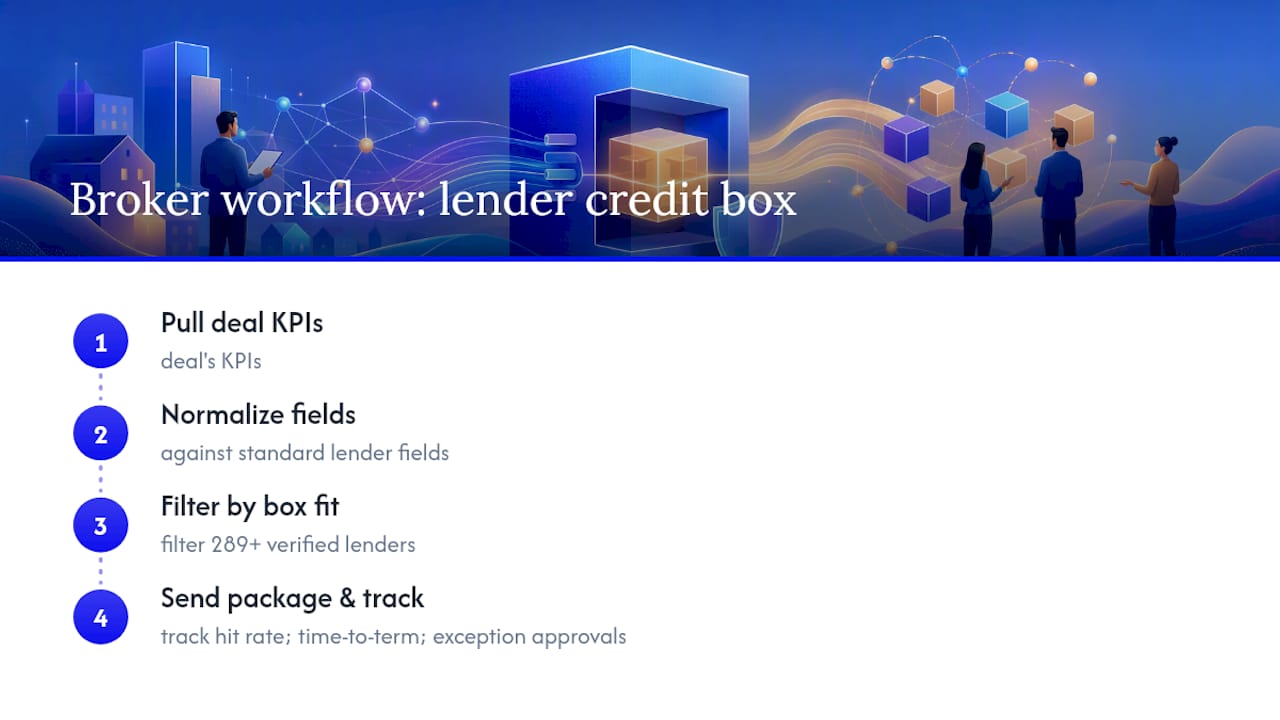
In practice, this looks like four steps: pull the deal's KPIs, normalize them against standard lender fields, filter the 289+ verified lenders by box fit, then send a lender-ready package to the top matches. Track hit rate, time to term sheet, and exception approvals over time. Verified lender parameter data cuts the rework that comes from guessing at ranges nobody has confirmed recently.
When to Fix the Deal Versus Find a New Lender
If two or more core metrics miss, stop tweaking and find a different lender instead. One soft miss deserves a documented compensating factor. Two or more usually means the box, not the deal, needs to change, and protecting your sponsor's reputation means knowing the difference.
— Theron
Where BrokersConnect Fits Into Your Submission Workflow
A platform is built around the exact screening problem this article just walked through: matching deal metrics to lender parameters before you waste a submission. Instead of manually checking LTV, DSCR, and debt yield against dozens of lender guidelines, you can run the deal through AI-powered matching against a large database of verified lenders across major CRE asset classes.
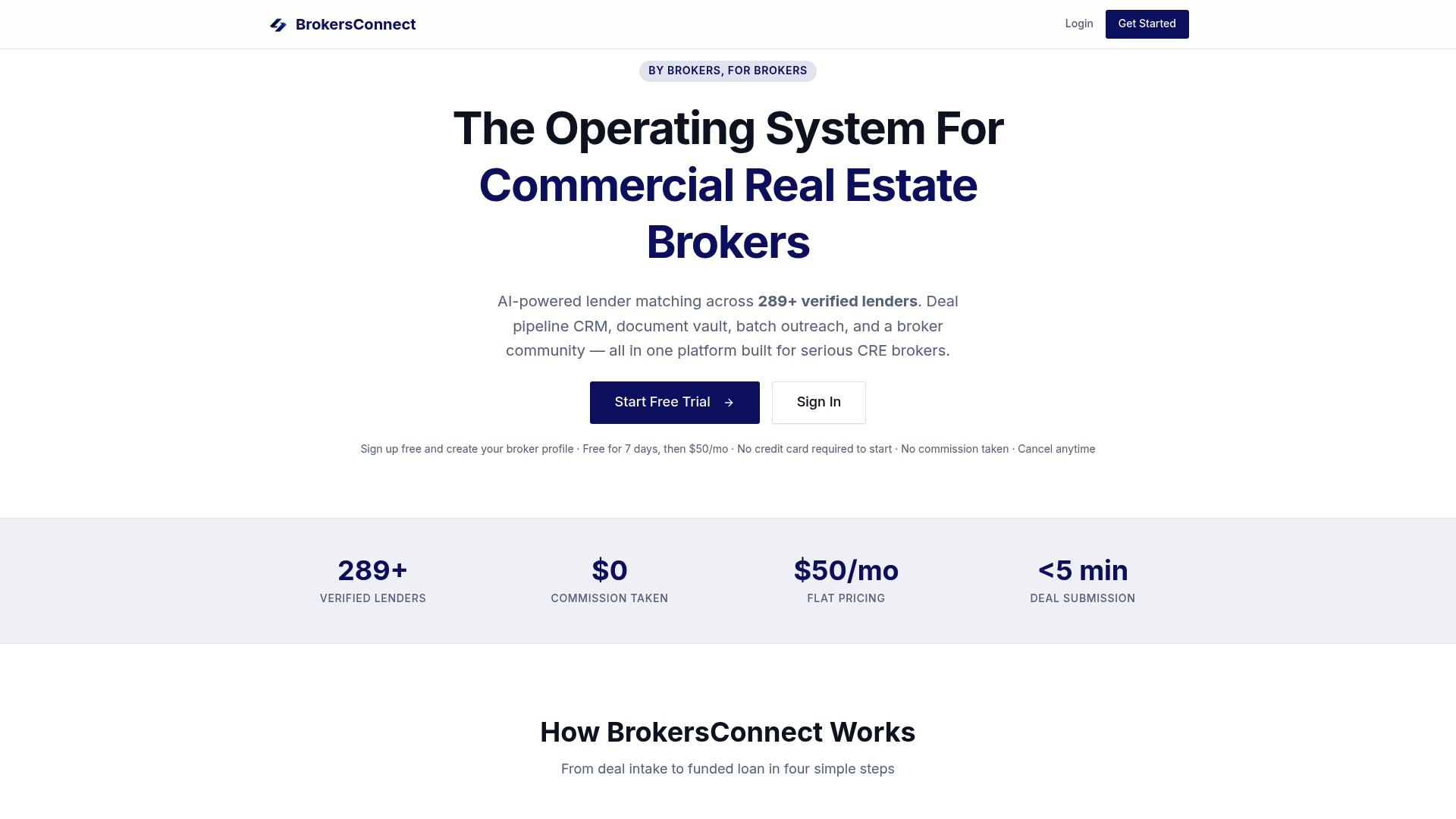
The platform also handles what comes after the match: batch outreach to multiple lenders at once, a deal pipeline CRM to track every conversation, and a secure document vault so your NOI statements and rent rolls don't live in scattered email threads. For brokers comparing commercial mortgage lenders deal by deal, that structure alone saves hours per submission. Thecrebrokersconnect runs at $50 per month with a free trial, no commissions or transaction fees attached. Start the free trial and run your next deal through the matching engine before you send it anywhere else.
Sources
The CFPB's lender credit explainer and LegalClarity's credit box overview anchor the definitions used throughout this piece.
This article is general information, not a substitute for advice from a qualified financial advisor. Consult a qualified financial professional about your own circumstances before acting on anything here.
- What Is a Credit Box in Lending and Securitization? - LegalClarity
- PeerSense - What Is a Lender Credit Box? CRE Underwriting glossary
- Understanding Lender Credit Boxes for Construction Loans - HUD Loans
- Zillow - What are lender credits?
FAQ
What Can a Lender Credit Be Used For?
A lender credit offsets eligible closing costs in exchange for a higher interest rate. It cannot be used for a down payment and shows up as a negative figure on the Loan Estimate or Closing Disclosure.
What Is a Credit Box?
A credit box is a lender's set of underwriting parameters covering borrower quality, collateral strength, and loan structure. Lenders use it to decide which loans they'll finance and to keep decisions consistent and auditable across underwriters.
Is Lender Credit Worth It?
It depends on how long you plan to hold the loan. A lender credit lowers upfront cash needed at closing, but the higher rate can cost more in interest over time if you keep the loan past the break-even point.
Do I Have to Pay Back Lender Credit?
Not directly. You "pay" for a lender credit through a higher interest rate over the life of the loan rather than a separate repayment, and the credit itself is applied only to eligible closing costs, never refunded as cash.