
DSCR loan approvals come down to one thing: property-level NOI that holds up under stress, paired with a file that removes every soft-credit doubt before the underwriter finds it. Deals die in committee not because the math is wrong, but because the bank statements have unexplained deposits, the appraised market rent sits below in-place rents, or reserves are thin on paper. Fix those four items first, and most institutional lenders can price quickly.
The four highest-impact items underwriters inspect on every DSCR submission:
- DSCR math pre-stressed: Run the ratio at the contract rate and at a stressed rate before shopping the deal. Lenders will re-run it anyway.
- Bank reconciliation: Every deposit line tied to a rent-roll entry, large non-rent inflows explained with source letters.
- Appraisal rent support: Confirm appraised market rent supports in-place rents; if it doesn't, size the loan to the lower figure.
- Reserves evidence: Liquid reserves documented in full bank statement pages, not summary screenshots.
Thecrebrokersconnect is built to speed exactly this process, matching your deal to verified lenders by underwriting criteria and managing the submission pipeline in one place.
Key Takeaways
Winning DSCR approvals requires stress-tested NOI, a reconciled bank file, and outreach targeted to lenders whose underwriting boxes match the deal's actual metrics.
| Point | Details |
|---|---|
| Stress-test DSCR before outreach | Run DSCR at contract rate and +100–200 bps; present both figures in the one-pager. |
| Reconcile bank deposits to rent roll | Map every deposit to a rent-roll line; explain non-rent inflows with source letters before submission. |
| Order insurance and appraisal on day one | Both have lead times that push closings past 30 days when ordered late. |
| Match deals to lender tiers | Score lenders on DSCR floor, LTV cap, property type, recourse, and loan size before outreach. |
| Thecrebrokersconnect speeds placement | 289+ verified lenders, AI matching, batch outreach, and pipeline CRM reduce time-to-offer on DSCR deals. |
Table of Contents
- What is a DSCR loan? Core metrics every broker must calculate
- What documents does a clean DSCR submission require?
- How to reconcile bank statements so the underwriter trusts your NOI
- How do you match a deal to the right lender underwriting tier?
- A one-page deal submission template brokers can send today
- What timeline and pricing should you set for a DSCR deal?
- Which tools reduce friction in a DSCR placement workflow?
- Step-by-step workflow from intake to clear-to-close
- What causes DSCR loan denials and how do you fix them?
- A broker's point of view: what actually separates placed deals from dead ones
- Thecrebrokersconnect cuts your time-to-offer on DSCR placements
- Sources
What is a DSCR loan? Core metrics every broker must calculate
The DSCR formula is straightforward: DSCR = NOI ÷ Annual Debt Service. What trips brokers up is what goes into each side of that equation.
NOI starts with effective gross income (EGI): gross potential rent minus vacancy and credit-loss assumptions, plus ancillary income. From EGI, subtract operating expenses: real estate taxes, insurance, management fees, maintenance, and replacement reserves. Lenders normalize these figures, often adding a vacancy assumption even on fully occupied properties and applying a reserve line whether or not the borrower funds one.
Annual debt service is PITIA or ITIA depending on the loan structure: principal, interest, taxes, insurance, and any HOA or ground-lease payments. Insurance cost matters more than most brokers budget for. A late flood-zone certification can push PITIA up and drop DSCR below threshold at the last minute.
Most institutional lenders target 1.20x–1.25x DSCR on stabilized deals, but that number alone doesn't set proceeds. Debt yield and LTV are binding constraints that run in parallel, and the lowest constraint wins.
Example: A small-bay industrial property with $180,000 NOI. The broker either reduces the loan request to ~$1.72M or presents a structure with interest-only payments to clear the threshold.
Lenders also stress-test at rate +100–200 bps and apply vacancy/expense stress. Pre-run both scenarios before you send the deal anywhere.
What documents does a clean DSCR submission require?
DSCR loans skip personal tax returns and W-2s, but the property file is non-negotiable. Missing even one item below triggers a condition that adds days to your timeline.
Core document checklist:
- Purchase contract or payoff statement
- Full appraisal with appraiser's market rent schedule
- Current rent roll (signed, dated) and all executed leases
- 60–90 days of complete bank statements (every page, no redactions)
- Entity documents: operating agreement, articles, EIN letter, certificate of good standing
- Insurance quote or binder (property, liability, flood if applicable)
- Reserves evidence: separate account statements showing liquid funds
- Title commitment or preliminary report
- Borrower personal financial statement (assets/liabilities, not income)
What underwriters actually expect from each item:
- Bank statements: full pages, not PDFs with pages missing. Lenders flag incomplete sets immediately.
- Appraisal: the rent schedule section is what the underwriter uses to size income. If in-place rents exceed appraised market rent, the lender uses the lower figure.
- Leases: expiration dates, rent amounts, and any concessions must match the rent roll exactly.
- Insurance: get a real quote, not an estimate. A flood zone determination that comes back positive after submission can reset the entire underwrite.
Pro Tip: Organize the submission folder in the same order as this checklist. Underwriters work through files sequentially; a logical folder structure reduces the chance they stop and send a conditions list before finishing the review.
How to reconcile bank statements so the underwriter trusts your NOI
Bank statement reconciliation is where most files stall. The goal is simple: every rental deposit on the bank statement maps to a line on the rent roll, and every large non-rent deposit has a written explanation.
Step-by-step reconciliation:
- Pull full-page statements for 60–90 days, all accounts receiving rental income.
- Highlight each deposit that corresponds to a tenant payment. Label it with the tenant name and lease period.
- Build a reconciliation table (see below) that links each deposit to the rent roll.
- For any deposit not on the rent roll, attach a one-paragraph source letter: what it is, where it came from, and why it won't recur.
Common red flags that kill files: transfers from unknown accounts, blacked-out pages, deposits that don't match any tenant, and month-to-month gaps in the statement sequence. Fix all of these before submission. AI document extraction tools can automate the mapping step and flag anomalies before a lender sees them.
Pro Tip: Attach tenant payment ledgers or payment histories alongside the reconciliation table. Ledgers show a 12-month payment pattern, which is far more persuasive than three months of bank statements alone.
How do you match a deal to the right lender underwriting tier?
Tier matching is the fastest way to improve your response rate.
Lender tiers generally break down by credit score, property type, DSCR floor, and recourse preference. Credit tiers and property type materially change available LTV caps and loan structures.
Matching checklist before outreach:
- Minimum DSCR: does the deal clear the lender's stated floor at the stressed rate?
- Max LTV: does the requested LTV fit the lender's cap for this property type?
- Property type exclusions: many lenders exclude hospitality, gas stations, or special-use assets.
- Recourse preference: institutional lenders often require recourse on sub-$5M deals; portfolio lenders may not.
- Loan size: confirm the deal falls within the lender's stated range.
For deals that don't fit institutional boxes, private money lenders often carry more flexible DSCR floors and shorter decision timelines. Use them as a parallel track, not a last resort.
Pro Tip: Score each target lender against the deal on five criteria: DSCR floor, LTV cap, property type fit, recourse, and loan size. Outreach the top three first. You'll get faster, more competitive responses than blasting 20 lenders with a generic package.
A one-page deal submission template brokers can send today
The one-pager is what gets a lender to price. It needs to answer their first five questions without them opening a single attachment.
Required fields:
- Property address, type, and year built
- Purchase price or current value
- Gross potential rent, vacancy assumption, EGI
- Operating expenses (itemized) and NOI
- Proposed loan amount, term, amortization, and rate assumption
- DSCR at contract rate and stressed rate
- Appraised market rent vs. in-place rent
- Insurance estimate and flood zone status
- Reserves (amount and account type)
- Borrower entity name and credit score range
- Broker contact and preferred response method
Sample NOI bridge and DSCR calculation:
Email template:
Subject: DSCR Submission — [Property Type], [City, State] — $[Loan Amount]
Hi [Lender Name], attached is a one-page summary for a [property type] in [city]. NOI is $[X], DSCR is [X]x at the contract rate and [X]x stressed at +150 bps. LTV is [X]%. Full package available on request. Can you confirm fit and expected pricing by [date]?
Follow up on day 3 if no response. A second touch at day 5. After that, move to the next lender on your tier list.
What timeline and pricing should you set for a DSCR deal?
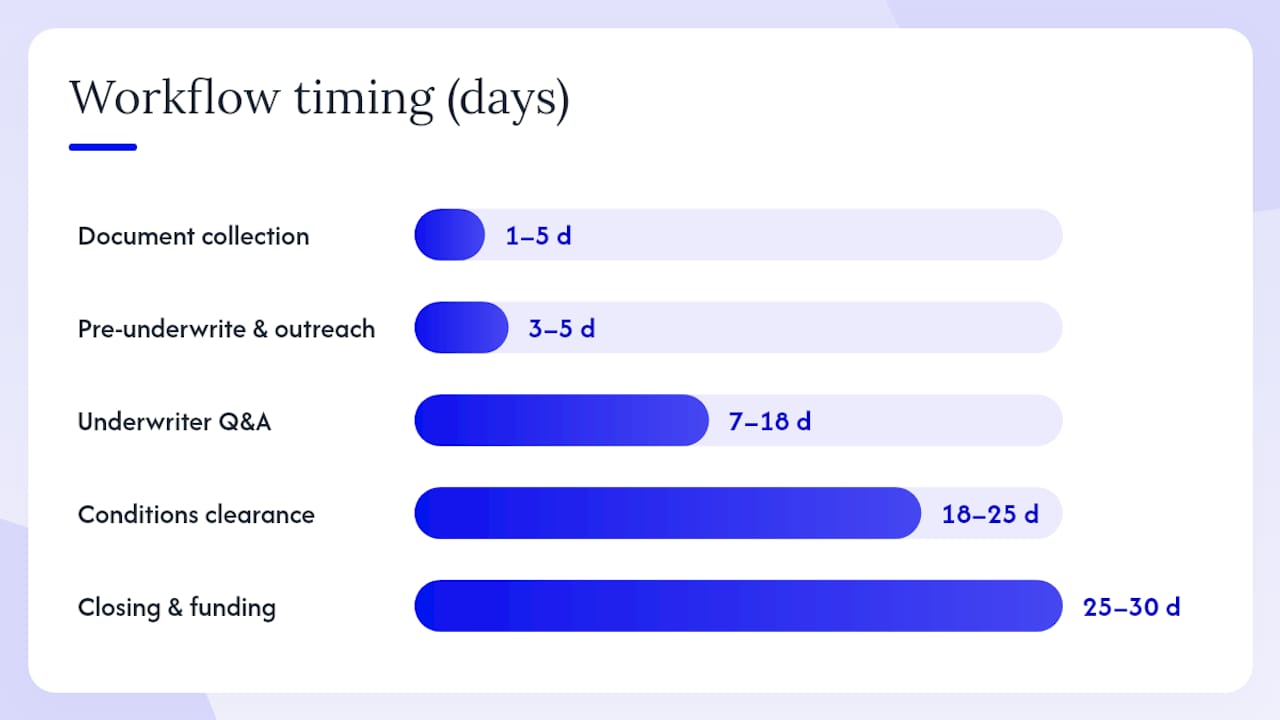
A complete file closes in 20–30 days. The single biggest cause of extension: incomplete bank statements and missing insurance documentation. Both are avoidable.
Typical stage timeline:
- Application and intake: days 1–3
- Appraisal ordered and insurance confirmed: days 3–7
- Underwriting review: days 7–18
- Conditions clearance: days 18–25
- Closing and funding: days 25–30
Pricing bands shift with DSCR and credit tier. Thin DSCR deals may also face interest-only requirements or shorter amortization windows to keep debt service manageable.
Common structures: 5/1 or 7/1 ARM with 25–30 year amortization for permanent DSCR loans; 12–24 month interest-only bridge loans for assets in lease-up or renovation. Bridge-to-permanent structures are worth presenting when in-place DSCR is thin but the stabilized pro forma clears the threshold.
Pro Tip: Order insurance and the appraisal on day one, not after the term sheet. Both have lead times that routinely push closings past 30 days when ordered late.
Which tools reduce friction in a DSCR placement workflow?
The fastest placements run on a standard intake form, a pre-underwrite stress test, a one-pager that auto-populates from deal data, and batch outreach to a pre-scored lender list. Manual versions of each step work, but they don't scale.
Thecrebrokersconnect centralizes all of it: a verified database of 289+ lenders, AI-powered matching by underwriting criteria (property type, DSCR floor, LTV, loan size, recourse), batch submission to target lender lists, a secure document vault, and a pipeline CRM that tracks every lender conversation. The lender responsiveness leaderboard shows which lenders are actually engaging, so you stop chasing the ones who aren't.
Recommended workflow:
- Intake form captures property type, loan amount, DSCR, LTV, credit score, and recourse preference
- Pre-underwrite runs stress DSCR and flags document gaps
- One-pager auto-populates from intake data
- Batch outreach goes to the top-matched lenders
- Conditions tracked in the CRM until clear-to-close
Must-have integrations for scale: AI underwriting tools for NOI validation and stress testing, OCR-based document extraction for bank statement reconciliation, e-sign for borrower authorizations, and appraisal management system connections.
Step-by-step workflow from intake to clear-to-close
- Intake and eligibility check (Broker, Day 1): Confirm property type, loan size, DSCR floor, and credit score meet at least three target lenders' minimum criteria before collecting documents.
- Document collection (Broker/Borrower, Days 1–5): Deliver the full checklist. Flag missing items immediately; don't wait until underwriting.
- Appraisal and insurance ordered (Broker, Day 1–3): Both have lead times. Order them the same day as intake.
- Pre-underwrite and one-pager (Broker, Days 3–5): Run stressed DSCR, reconcile bank statements, build the submission package.
- Batch outreach to top-tier lenders (Broker, Day 5): Send one-pager to three to five matched lenders simultaneously.
- Underwriter Q&A (Broker, Days 7–18): Respond to conditions within 24 hours. Delays here are the second-biggest cause of timeline extension.
- Conditions clearance (Broker/Borrower, Days 18–25): Track each open condition in the CRM. Close them in batches, not one at a time.
- Closing and funding (Title/Escrow, Days 25–30): Confirm wire instructions, title commitment, and final insurance binder are in place before scheduling.
Pro Tip: Gate step 5 on a complete document set. Sending an incomplete package to lenders and promising to follow up with missing items costs you credibility and often resets the underwriting clock.
What causes DSCR loan denials and how do you fix them?
Most denials are predictable. The underwriter's job is to find the weakness in your file before the credit committee does.
Common denial triggers:
- Unexplained bank deposits that inflate apparent NOI
- Tenant concentration: one tenant representing 60%+ of income with a lease expiring within 12 months
- Appraised market rent below in-place rents, forcing a lower NOI
- Reserves below the lender's minimum (often 6–12 months PITIA)
- Insurance or flood certification issues that increase PITIA and compress DSCR
- Blacked-out or missing bank statement pages
Mitigation playbook:
- For unexplained deposits: attach a source letter for every non-rent inflow over $2,000.
- For tenant concentration: provide a lease extension letter of intent or evidence of renewal negotiations.
- For market rent gaps: present the appraiser's rent comp analysis and any recent comparable lease signings.
- For thin reserves: propose a conditional escrow funded at closing to meet the lender's requirement.
- For insurance issues: get a flood elevation certificate early and shop multiple carriers before submission.
Pro Tip: Address tenant concentration, lease rollover risk, and deferred capital in your submission memo. Underwriters who discover these issues on their own treat them as red flags. Underwriters who see them disclosed upfront with a mitigation plan treat them as managed risks.
A broker's point of view: what actually separates placed deals from dead ones
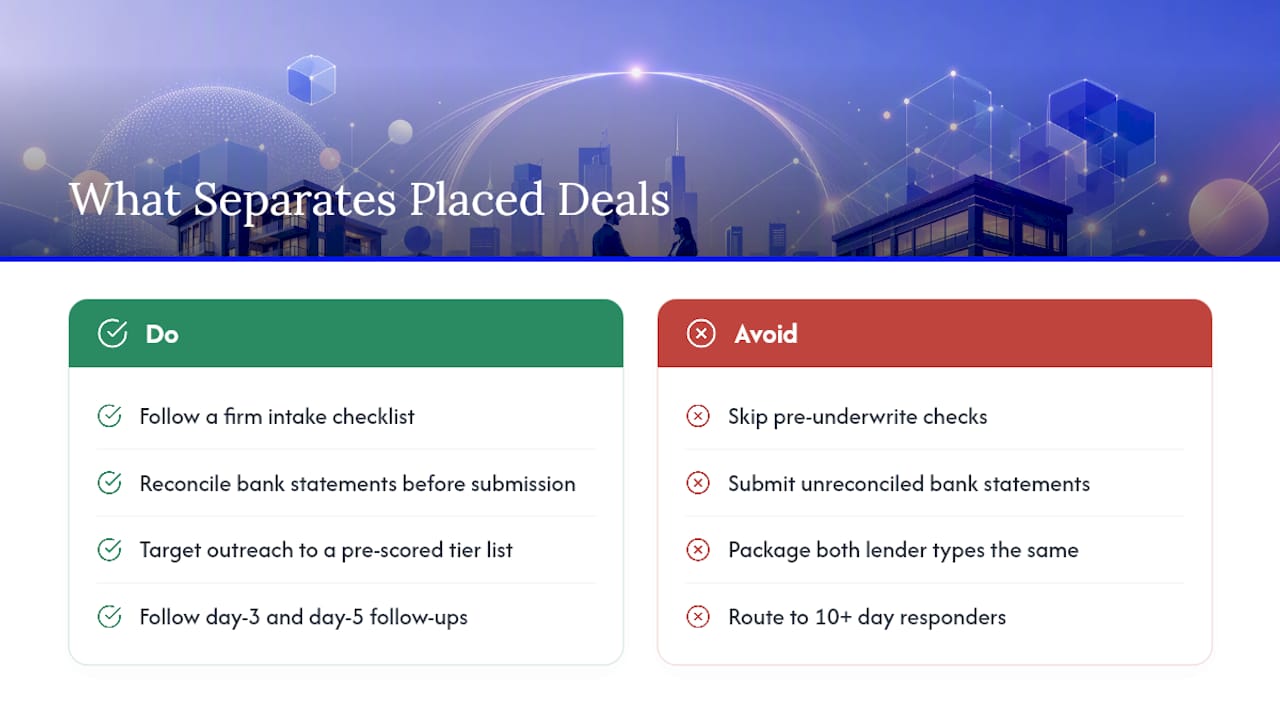
The brokers who place DSCR deals consistently aren't necessarily working harder. They're running a tighter process. Every deal goes through the same intake checklist, every bank statement gets reconciled before submission, and every lender outreach is targeted to a pre-scored tier list. The deals that stall are almost always the ones where someone skipped the pre-underwrite step and hoped the lender wouldn't notice the thin DSCR or the unexplained deposit.
Institutional lenders and portfolio lenders need different packaging. Institutional lenders want a clean, conservative NOI story with stress scenarios already run. Portfolio lenders often care more about the borrower's track record and the asset's market position. Knowing which audience you're writing for changes how you frame the one-pager.
The follow-up cadence matters more than most brokers admit. A day-3 and day-5 follow-up on a submitted one-pager isn't aggressive; it's professional. Lenders who are actively quoting respond. Lenders who don't respond after two touches usually aren't the right fit for this deal. Move on and use that time on the next lender in your tier list.
Platform metrics tell you which lenders are worth your time. If a lender consistently takes 10+ days to respond and rarely issues a term sheet, that's data. Thecrebrokersconnect's responsiveness leaderboard surfaces exactly this, so you can stop routing deals to lenders who aren't actually active.
Thecrebrokersconnect cuts your time-to-offer on DSCR placements
Brokers who place DSCR deals at volume need one thing the manual process can't deliver: a pre-scored lender list that updates in real time, paired with a submission workflow that doesn't require rebuilding the one-pager from scratch on every deal.
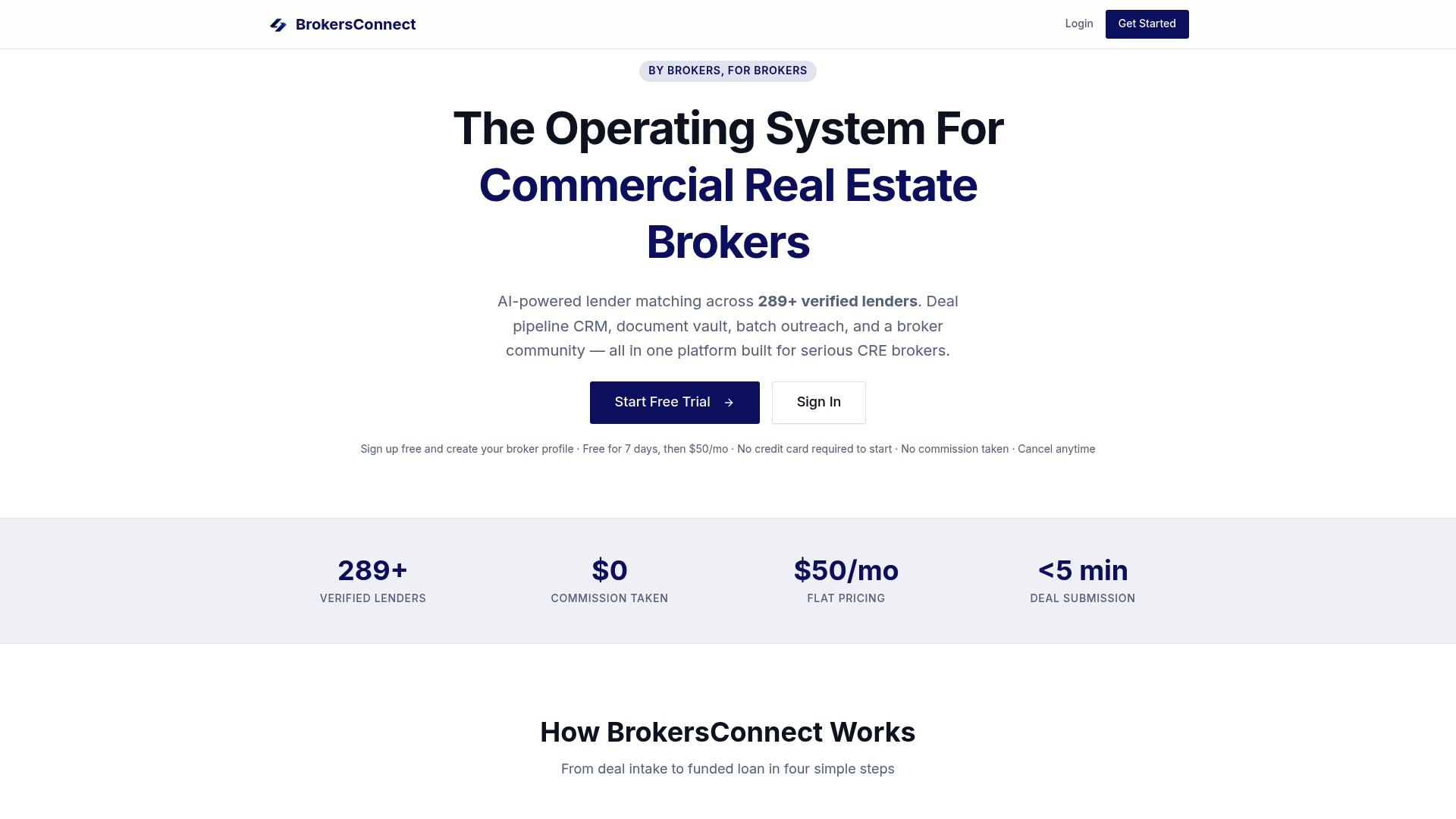
Thecrebrokersconnect gives you a verified database of 289+ lenders, AI-powered matching by DSCR floor, LTV, property type, and recourse preference, plus batch outreach to your top-matched lenders in a single send. The secure document vault keeps your file organized and shareable. The pipeline CRM tracks every condition and lender conversation. The lender responsiveness leaderboard shows you who's actually quoting. Start a free trial at Thecrebrokersconnect and run your next DSCR submission through the platform.
Sources
- How to Calculate DSCR for a CRE Loan: Formula | Aloan
- How DSCR Loans Are Underwritten | Lendmire
- How to Apply for a DSCR Loan: Step-by-Step Guide (2026)
This article is general information, not a substitute for advice from a qualified financial advisor. Consult a qualified financial professional about your own circumstances before acting on anything here.