
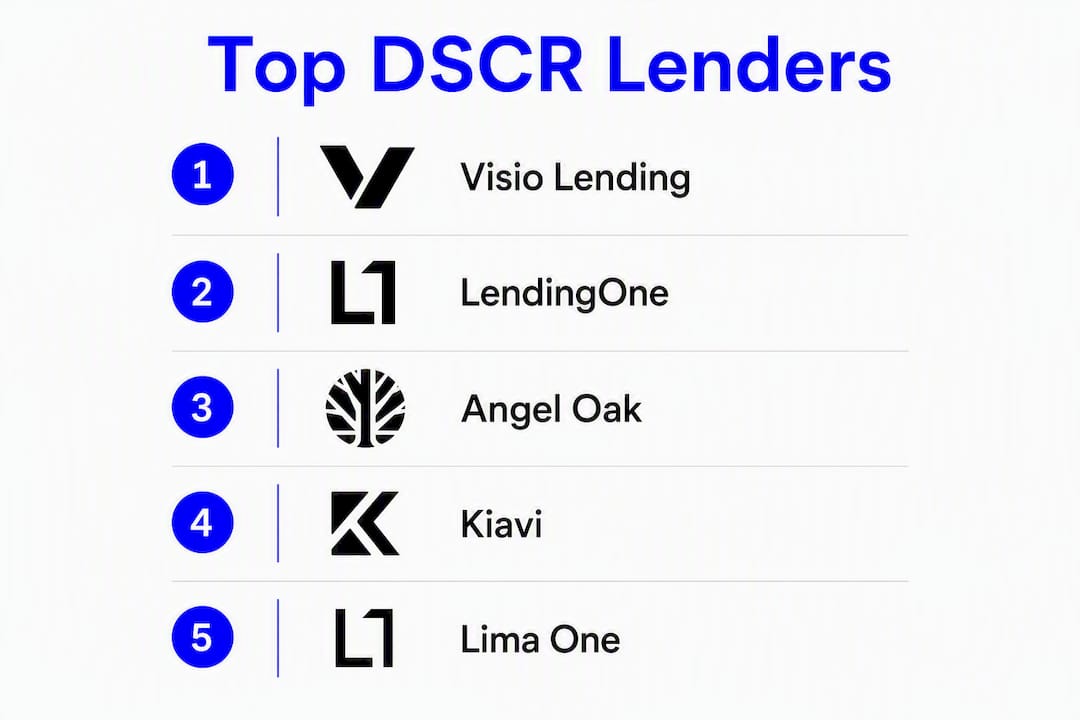
For most U.S. buy-and-hold investors, Visio Lending is the strongest starting point — a DSCR specialist with top submitted volume in Scotsman Guide rankings and deep short-term rental underwriting that generalist lenders simply cannot match. For speed, Kiavi wins on automation. For low-FICO flexibility, Easy Street Capital sets the industry floor. For investors who need a broad private-lender product set, LendingOne and Lima One Capital round out the shortlist.
A few things worth knowing before you dig in:
- Visio Lending — best for buy-and-hold and STR portfolios; multiple securitizations back its consistency
- Kiavi — best for repeat borrowers who need fast pre-approval and automated close tracks
- Easy Street Capital — best for sub-700 FICO borrowers and STR-heavy deals; 640 FICO floor with AirDNA acceptance
- LendingOne — best for investors needing a 0.75 DSCR floor or a broad product menu; CNBC Select calls it out for customer service
- Lima One Capital — best for institutional-scale deals backed by public-company transparency via parent MFA Financial
- Angel Oak Mortgage Solutions — best for non-QM channels with active securitization shelf financing
TL;DR: Standard DSCR floors run 1.00; competitive lenders drop to 0.75–0.80 with compensating factors. These loans are exempt from CFPB Ability-to-Repay rules under the TILA business-purpose exemption, which is why no tax returns are required. Scotsman Guide publishes annual volume rankings — a reliable production-based trust signal for any lender on this list.
Table of Contents
- How the top DSCR lenders compare at a glance
- Lender profiles: what each one actually offers
- How to compare DSCR lenders before you submit
- How we evaluated and ranked these lenders
- What is a DSCR loan and how is it calculated?
- Key Takeaways
- What the DSCR market is telling brokers right now
- Thecrebrokersconnect cuts the time it takes to find and submit DSCR deals
- Sources and further reading
How the top DSCR lenders compare at a glance
| Lender | Best For | DSCR Floor | Typical Rate Type | Max LTV | Min FICO | Speed to Close | Underwriting Flexibility | Property Types |
|---|---|---|---|---|---|---|---|---|
| Visio Lending | Buy-and-hold, STR portfolios | 1.00 (case-by-case) | Fixed / IO | 80% | 680 | Standard | STR/AirDNA accepted | SFR, 2–4 unit, STR |
| LendingOne | Low-DSCR flexibility, broad product set | 0.75 w/ comp. factors | Fixed / IO | 80% | 620 | Fast | Compensating factors accepted | SFR, multifamily, mixed-use |
| Kiavi | Speed, repeat borrowers | 1.00 | Fixed | 80% | 660 | Very fast (automated) | Automated workflow | SFR, 2–4 unit |
| Easy Street Capital | Low-FICO, STR, newer investors | Flexible (minimum can be below 1.00 case-by-case) | Fixed | 80% | 640 | Fast | STR/AirDNA, flexible DSCR | SFR, STR, 2–4 unit |
| Lima One Capital | Institutional scale, combined products | 1.00 | Fixed / IO | 80% | 660 | Standard | Public-company backed | SFR, multifamily, ground-up |
| Angel Oak Mortgage Solutions | Non-QM, securitization channels | 1.00 (flex w/ factors) | Fixed / IO | 80% | 660 | Standard | Non-QM compensating factors | SFR, 2–4 unit, condo |
| Griffin Funding | Brokers, mid-market investors | 1.00 | Fixed / IO | 80% | 660 | Standard | Wholesale flexibility | SFR, multifamily |
| RCN Capital | Atypical properties, private-lender range | 1.00 | Fixed | 75–80% | 660 | Standard | Private-lender flexibility | SFR, multifamily, mixed-use |
| theLender | Straightforward buy-and-hold | 1.00 | Fixed | 80% | 660 | Standard | Simplified flows | SFR, 2–4 unit |
| Renovo Financial | Portfolio/multi-property, brokers | 1.00 | Fixed | 80% | 660 | Standard | Wholesale matrix options | SFR, multifamily |
| Conventus | Mid-sized loans, multi-state | 1.00 | Fixed | 75–80% | 660 | Standard | Diversified private lending | SFR, small multifamily |
| Dominion Financial | Established private-lender volume | 1.00 | Fixed | 80% | 660 | Standard | Demonstrated DSCR volume | SFR, multifamily |
| Constructive Capital | Non-standard credit/structures | 1.00 | Fixed | 80% | 640+ | Standard | Non-QM investor focus | SFR, 2–4 unit |
| Logan Finance | Experienced brokers, wholesale | 1.00 | Fixed / IO | 80% | 660 | Standard | Wholesale program grids | SFR, multifamily |
| CV3 Financial Services | Mid-market, multi-state private | 1.00 | Fixed | 80% | 660 | Standard | Private-lender DSCR | SFR, multifamily |
Rate-range note: DSCR rates vary by funding channel. Securitization-backed lenders (Visio, Angel Oak, Lima One) tend to price more consistently because they pass funding costs to capital markets. Warehouse-funded private lenders may move rates faster with market conditions. Prepayment structure — 3/2/1 step-down vs. 5-year lockout — also shifts the rate by 25–75 basis points depending on the lender.
Lender profiles: what each one actually offers
1. Visio Lending
Visio is the closest thing DSCR lending has to a category creator. The lender pioneered the modern 30-year amortizing investor DSCR product and consistently ranks at the top of Scotsman Guide's DSCR volume list. Its STR underwriting is the real differentiator: Visio accepts AirDNA projections for short-term rental income, which most generalist lenders still won't touch. Typical FICO floor sits around 680, LTV up to 80% on purchases, and the securitization shelf behind the program means pricing stays relatively stable. If your client runs a vacation rental portfolio, start here.
2. LendingOne
LendingOne's headline feature is its advertised 0.75 DSCR floor, which opens the door for properties that fall just short of breakeven on paper. That flexibility comes with compensating factors — strong credit, lower LTV, reserves — but it's a real option when a deal is close. CNBC Select highlights LendingOne for customer service, which matters when a broker needs a live underwriter to explain a conditional approval. The product menu spans buy-and-hold, bridge, and fix-and-flip, making it a useful single-lender relationship for investors who rotate strategies. Minimum FICO around 620.

3. Angel Oak Mortgage Solutions
Angel Oak is a securitization machine. Its non-QM shelf is one of the most active in the country, which gives DSCR programs a stable funding source even when warehouse lines tighten. The DSCR program can flex with compensating factors, and the non-QM infrastructure means underwriters are comfortable with complex borrower profiles — foreign nationals, recent credit events, self-employed investors with unusual income structures. Not the fastest close, but the institutional depth is hard to match for investors who need a lender that won't pull the rug mid-transaction.
4. Kiavi
Speed is Kiavi's product. Its fintech platform offers automated pre-approval and a fast-track close process for repeat borrowers that few traditional private lenders can replicate. The DSCR program is more straightforward than some competitors — standard 1.00 floor, SFR and 2–4 unit focus — but the automation means less friction from submission to funding. Investors who have already closed with Kiavi report significantly faster subsequent closings. If your client is a repeat buyer who values predictability over maximum flexibility, Kiavi is the right call.

5. Lima One Capital
Lima One sits at the institutional end of the private-lender spectrum. Backed by MFA Financial, a publicly traded mortgage REIT, it brings public-company transparency and securitization support that smaller private lenders can't offer. The Rental30 product line covers standard buy-and-hold DSCR, and Lima One also handles ground-up construction — useful for investors who build and then hold. Typical LTV up to 80%, FICO around 660, and the parent-company backing provides a level of operational stability worth noting in a market where smaller lenders occasionally exit programs without warning.
6. Griffin Funding
Griffin operates through wholesale and correspondent channels, which means brokers often get competitive pricing that retail borrowers won't see. The DSCR program covers standard SFR and multifamily, with underwriting flexibility that suits mid-market investors. Griffin's BBB profile and NMLS registration are publicly verifiable, which matters for brokers doing due diligence on a new lender relationship. Not the most specialized DSCR shop on this list, but a solid wholesale option for brokers who want consistent pricing and a flexible product grid.
7. RCN Capital
RCN's value is breadth. Beyond DSCR, it offers bridge loans, fix-and-flip, and new construction — which means a broker can bring multiple deal types to one relationship. The DSCR program handles atypical properties and seasoning scenarios that stricter lenders decline. Private-lender flexibility is the trade-off for slightly less pricing consistency than securitization-backed shops. Good fit for investors with mixed portfolios or properties that don't fit a standard box.
8. theLender
theLender keeps it simple: a clean DSCR term product aimed at buy-and-hold investors who want straightforward underwriting without layers of non-QM complexity. The simplified workflow reduces back-and-forth on documentation, which speeds up the process even if the lender isn't a fintech. Typical DSCR floors for many lenders are around 1.00, focusing on single-family and small multi-unit properties, and investor-first positioning throughout the product. A good fit for experienced investors who know exactly what they need and want a lender that won't overcomplicate it.
9. Renovo Financial
Renovo is a wholesale non-QM lender with a product matrix built for brokers packaging multi-property or portfolio deals. The flexible matrix options mean a broker can structure a deal across multiple properties with different DSCR profiles and still find a path to approval. Not a retail-facing lender, so investors need to work through a broker. For brokers who regularly handle portfolio transactions, Renovo's wholesale distribution model is worth adding to the lender panel.
10. Conventus
Conventus covers small multifamily and SFR across multiple states, with loan amounts that fit mid-market investors who have outgrown small private lenders but don't need institutional-scale financing. Product breadth across private lending channels means it can handle a range of transaction structures. Availability varies by state, so confirm licensing before submitting.
11. Dominion Financial
Dominion appears in published DSCR volume rankings, which is a meaningful signal in a market where many private lenders overstate their production. The DSCR program covers standard SFR and multifamily, and the demonstrated volume history gives brokers confidence that the lender has actually funded deals at scale. A reliable private-lender option for borrowers who want an established name with a track record.
12. Constructive Capital
Constructive Capital targets investors with non-standard credit or transaction structures — recent credit events, unusual property types, complex ownership structures — who still need DSCR underwriting rather than a bridge loan. The non-QM capabilities are tuned specifically to investor scenarios, not consumer mortgage edge cases. FICO floors can go as low as 640 depending on the deal structure.
13. Logan Finance
Logan operates through wholesale and correspondent channels with program grids that experienced brokers can navigate efficiently. The investor product lines include DSCR alongside other non-QM options, giving brokers flexibility to pivot if a deal doesn't fit the DSCR box. Best suited to brokers who already have a wholesale relationship and want to add a DSCR-capable lender to their panel.
14. Easy Street Capital
Easy Street's EasyRent program sets one of the lowest FICO floors in the DSCR market at 640, and the STR underwriting via AirDNA inputs makes it the go-to for vacation rental investors who can't get approved elsewhere. The flexible DSCR minimums accommodate deals that other lenders would decline outright. Newer investors and borrowers with sub-700 credit profiles who own or are buying STR properties should put Easy Street at the top of their list.
15. CV3 Financial Services
CV3 serves mid-market investors and brokers across multiple states with DSCR-eligible programs that have earned recognition in private-lender industry circles. The private-lender structure allows for deal-specific flexibility that agency-adjacent programs can't offer. A practical option for brokers who need a multi-state private lender with a demonstrated DSCR track record.
How to compare DSCR lenders before you submit
The rate on the term sheet is not the number that matters most. Here's what actually determines whether a deal closes and at what cost:
DSCR floor and calculation rules. Ask every lender: how do you calculate DSCR? Some use gross rent minus vacancy; others use net operating income after management fees and reserves. A lender with a 1.00 floor using a generous income calculation may approve a deal that a 0.90-floor lender rejects using a stricter one. Also confirm whether the lender accepts ADU income or basement-unit rent on the schedule — that can move a marginal deal into approval territory.
Securitization vs. warehouse funding. Securitization-backed lenders tend to offer steadier pricing because their funding costs are locked at issuance. Warehouse-funded lenders may reprice between term sheet and closing if market conditions shift. Ask: "Is pricing locked at term sheet or at underwriting?"
Prepayment schedule. A 5-year step-down prepayment lowers your rate but raises refinancing risk. A 3/2/1 step-down costs more in rate but gives the investor an exit ramp sooner. Match the prepay structure to the investor's exit strategy — this is one of the most overlooked cost drivers in DSCR financing. For a deeper look at prepayment economics, the yield maintenance vs. defeasance breakdown covers the mechanics in detail.
STR acceptance. Not all lenders accept AirDNA or Form 1007 for short-term rental income. If the property is an Airbnb or VRBO, confirm STR underwriting capability before submitting — otherwise you're wasting time on a lender who will decline on income methodology alone.
Questions to ask an underwriter before submitting:
- Do you accept Form 1007 or AirDNA projections for STR income?
- What compensating factors allow DSCR below 1.00?
- Is pricing locked at term sheet or at underwriting?
- Do you include ADU or accessory unit income in the DSCR calculation?
- What is your servicing transfer policy after closing?
- What states are you currently licensed in for this program?
- What is the typical timeline from complete file to funding?
Red flags to watch for:
- Large spread between term sheet rate and conditional approval rate (more than 50 basis points without a market-rate move)
- "No minimum DSCR" claims with no documented compensating factor matrix
- Unclear or undisclosed servicing transfer policy
- State licensing that doesn't cover the subject property's location
Pro Tip: Before submitting to any lender, pull their NMLS profile at nmlsconsumeraccess.org to confirm active licensing in the subject property's state. A lender who isn't licensed in that state cannot close the loan, no matter how good the term sheet looks.
How we evaluated and ranked these lenders
The ranking weights five operational signals that brokers actually use to decide where to submit a deal:
- DSCR floor flexibility — lenders who can approve sub-1.0 deals with documented compensating factors rank higher for investor utility
- Securitization depth and frequency — lenders with active securitization shelves (Visio, Angel Oak, Lima One) demonstrate funding consistency; Scotsman Guide rankings provide a production-based cross-check
- Lender responsiveness — measured via broker feedback and the BrokersConnect lender responsiveness leaderboard, which tracks response times and deal-stage communication across the verified lender database
- Speed-to-close history — fintech-enabled lenders (Kiavi) score higher for repeat-borrower tracks; traditional private lenders are assessed on documented turnaround norms
- NMLS and regulatory status — all lenders on this list are NMLS-registered; public-company disclosures (Lima One via MFA Financial) add a transparency layer that private-only lenders can't match
Data sources used: Scotsman Guide 2025 Top DSCR rankings, lender product pages and wholesale matrices, issuer securitization disclosures, and BrokersConnect verified lender database. Where exact program parameters weren't publicly listed, ranges are noted as estimates and should be confirmed directly with the lender or through a wholesale matrix.
This article is reviewed and updated when material program changes are identified. If you find a data error, submit a correction note through the BrokersConnect platform or contact the editorial team directly.
What is a DSCR loan and how is it calculated?
A DSCR loan underwrites a rental property on its own cash flow, not the borrower's personal income. The lender asks one question: does the property generate enough rent to cover its debt payments? That's it. No W-2s, no tax returns, no personal DTI calculation.
The formula:
DSCR = Net Operating Income (NOI) ÷ Annual Debt Service (PITIA)
PITIA = Principal + Interest + Taxes + Insurance + Association dues (if applicable)
Example: A single-family rental generates $2,400/month in gross rent. After a 10% vacancy factor and management fee, NOI is roughly $2,160/month, or $25,920 annually. The annual PITIA on a proposed loan is $24,000. DSCR = $25,920 ÷ $24,000 = 1.08 — above the standard 1.00 floor, so the deal qualifies at most lenders.
Drop the rent to $2,200/month and the adjusted NOI falls to roughly $23,760 annually. DSCR = $23,760 ÷ $24,000 = 0.99 — below the standard floor. That's where lenders like LendingOne (0.75 floor with compensating factors) or Easy Street Capital become relevant. You can model these scenarios quickly with a DSCR calculator before committing to a lender.
Why no income docs? DSCR loans for investor-use properties are exempt from CFPB Ability-to-Repay requirements under the TILA business-purpose exemption (12 CFR § 1026.3(a)). Because the loan is a business-purpose transaction, the lender isn't required to verify personal income or calculate consumer DTI. That's the legal basis for the streamlined documentation model.
Typical use cases and timelines:
- Purchase — standard close timeline is 21–30 days for most private lenders; fintech lenders (Kiavi) can compress to 14–21 days for repeat borrowers
- Cash-out refinance — typically 30–45 days; seasoning requirements vary (often 6–12 months from acquisition)
- Rate-and-term refinance — fastest of the three; 21–30 days with a clean file
This article is general information, not legal or financial advice. Confirm current program parameters, state licensing, and regulatory requirements with the lender or a qualified professional before proceeding.
Key Takeaways
The single most important step before submitting a DSCR deal is confirming how the lender calculates DSCR and whether their program is licensed in the subject property's state.
| Point | Details |
|---|---|
| Top pick for most investors | Visio Lending leads on DSCR specialization, securitization depth, and STR underwriting capability. |
| Low-DSCR flexibility | LendingOne and Easy Street Capital offer floors as low as 0.75–0.80 with compensating factors or flexible DSCR minimums. |
| Speed matters for repeat borrowers | Kiavi's automated platform is the fastest close track in the market for investors with prior loan history. |
| Verify before submitting | Confirm DSCR calculation method, prepayment structure, and state licensing before sending a package to any lender. |
| Thecrebrokersconnect for brokers | Thecrebrokersconnect matches DSCR deal scenarios to verified lenders, tracks responsiveness, and speeds up submissions via AI lender matching and batch outreach. |
What the DSCR market is telling brokers right now
The DSCR market has matured faster than most people expected. Three years ago, a handful of lenders dominated the space. Today, there are dozens of credible programs, and the real differentiator has shifted from product availability to execution quality. Lenders who securitize consistently, respond quickly, and publish transparent pricing grids are winning broker relationships. The ones who reprice at underwriting or go quiet after a term sheet are losing them.
The low-FICO niche is the most interesting development right now. Easy Street Capital's 640 FICO floor and STR acceptance via AirDNA represent a genuine expansion of who can access DSCR financing. That's not a gimmick — it's a structural shift driven by private securitization appetite for yield. Brokers who learn to package STR deals with proper AirDNA documentation and third-party rent comps are accessing a borrower pool that most of their competitors are still turning away.
One thing I'd push back on: the obsession with rate. Brokers spend enormous energy chasing the lowest rate on a term sheet, then lose the deal when the lender reprices at underwriting or takes 60 days to close. Operational transparency and lender responsiveness frequently beat headline rate promotions. A lender who closes at 8.25% in 21 days is worth more to most investors than one who quotes 7.75% and takes 45 days with two repricings.
The practical move for 2026: include ADU income and STR supporting data in every submission package where it applies. Knowing which lenders accept those schedules is a competitive edge. Build that into your submission template, not as an afterthought.
Thecrebrokersconnect cuts the time it takes to find and submit DSCR deals
Finding the right DSCR lender for a specific deal — the right DSCR floor, the right state, the right FICO tolerance — used to mean hours of cold calls and stale spreadsheets. Thecrebrokersconnect changes that math.
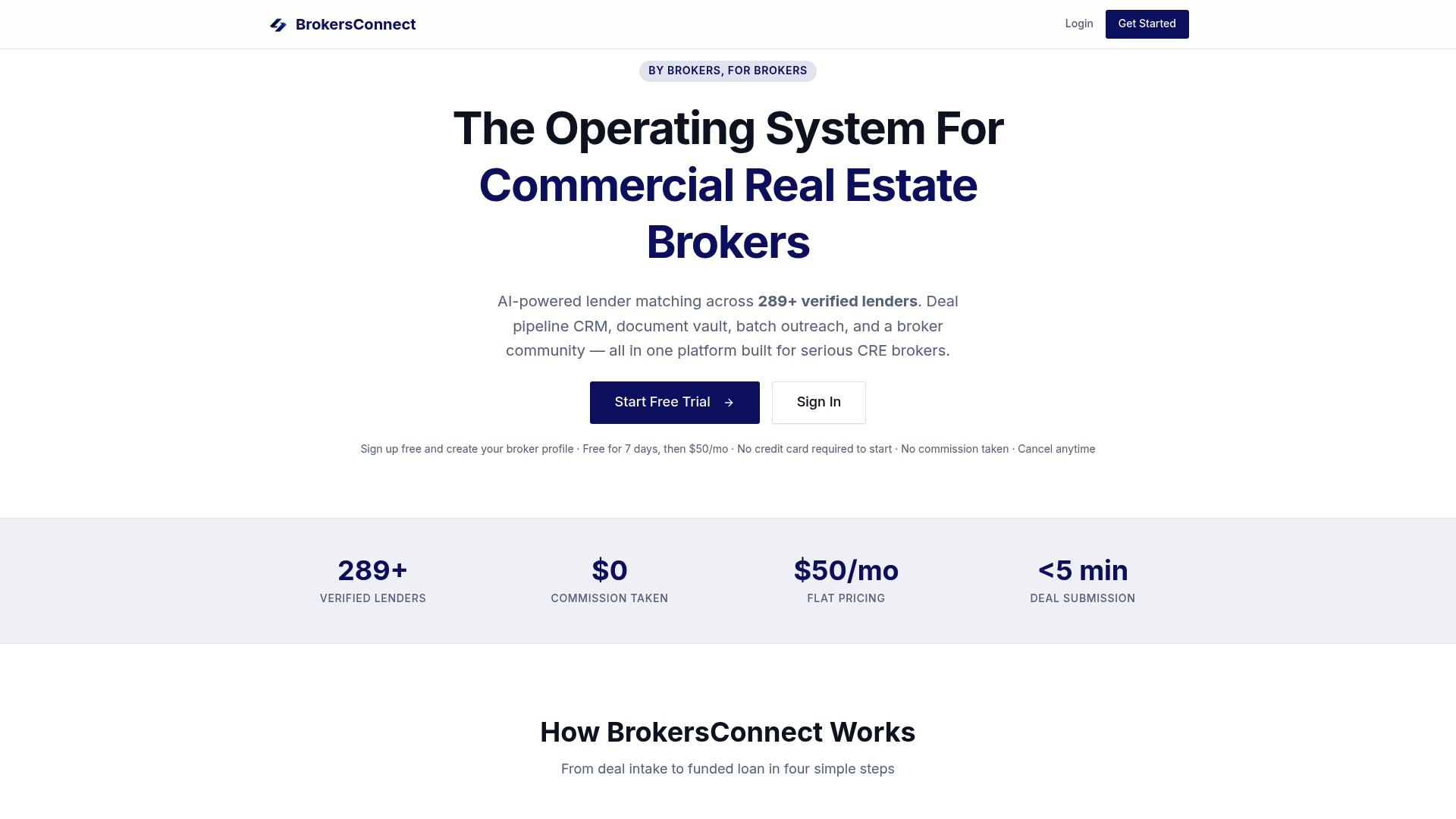
Submit a DSCR scenario on the platform and the AI lender matching engine surfaces verified lenders from a database of 289+ options, filtered by property type, loan amount, location, leverage, and credit profile. The lender responsiveness leaderboard shows which lenders are actually responding to brokers right now, not just which ones have a nice website. Batch outreach, a secure document vault for lender-ready packages, and a deal pipeline CRM keep everything in one place from first submission to funded loan.
Brokers who want a more efficient path to DSCR financing solutions can start a free trial and run their first deal scenario through the platform today.
Sources and further reading
- Scotsman Guide 2025 Top DSCR Rankings — production-based volume rankings used as a primary trust signal in this roundup
- Federal Register — TILA Business-Purpose Exemption — statutory basis for the no-income-verification structure of DSCR loans
- Spring EQ Wholesale DSCR Program — wholesale matrix example showing DSCR floors, LTV caps, and state licensing parameters
- CNBC Select — Best Investment Property Lenders — mainstream corroboration for Visio and LendingOne market positioning
- NMLS Consumer Access — verify active state licensing for any lender before submitting a deal
- Crowdfunded Wealth — DSCR Lender Comparison 2026 — forensic comparison used for Kiavi, Easy Street, and Visio profile cross-checks
- Best Private Money Lenders for CRE Brokers — complementary coverage for brokers expanding their private-lender panel
Update cadence: This article is reviewed when material program changes are identified in the BrokersConnect lender database or Scotsman Guide publishes updated rankings. If you find an error or a program parameter that has changed, contact the BrokersConnect editorial team through the platform.