
The fastest way to find private lenders is through three channels: verified member directories like the AAPL member directory, lender marketplaces like PrivateLenderLink, and warm professional referrals from real estate attorneys or title officers who see active funders on recent recordings. For a verified match you can act on within 48–72 hours, Thecrebrokersconnect gives brokers direct access to 289+ vetted lenders filtered by property type, loan amount, and location.
Where to start right now:
- AAPL member directory — search for verified private lenders by state; membership signals a baseline of professional accountability
- PrivateLenderLink — browse lender profiles by deal type and geography without a cold call
- Local REIA or BiggerPockets meetups — the fastest way to build relationships with individual capital holders
- Real estate attorneys and title officers — ask which lenders they see on recent closings; professional referrals are often the highest-yield leads in any local market
- Thecrebrokersconnect — submit a deal scenario and match against 289+ verified lenders in one workflow
Your next step in the next 24–72 hours: Write a one-page loan summary (property address, purchase price, rehab budget, ARV, loan amount requested, LTV, exit strategy) and submit it through Thecrebrokersconnect or email it to two referral contacts you already know.
Table of Contents
- Where can you find private lenders reliably?
- How do private lenders differ from banks?
- What loan types do private lenders offer?
- What do private lenders actually look for in a deal?
- How do you prepare a loan request that lenders actually read?
- How do you vet a private lender before you sign anything?
- What does a private loan actually cost, and how fast does it close?
- How do you submit a loan request and what happens next?
- How Thecrebrokersconnect speeds up lender introductions
- Key Takeaways
- What most guides get wrong about finding private lenders
- Thecrebrokersconnect gives brokers a faster path to verified lenders
- Useful sources and directories to start your search
Where can you find private lenders reliably?
Private lenders are typically individuals or small firms managing their own capital. They rarely advertise the way banks do, which means the channel you use to reach them matters as much as the pitch itself.
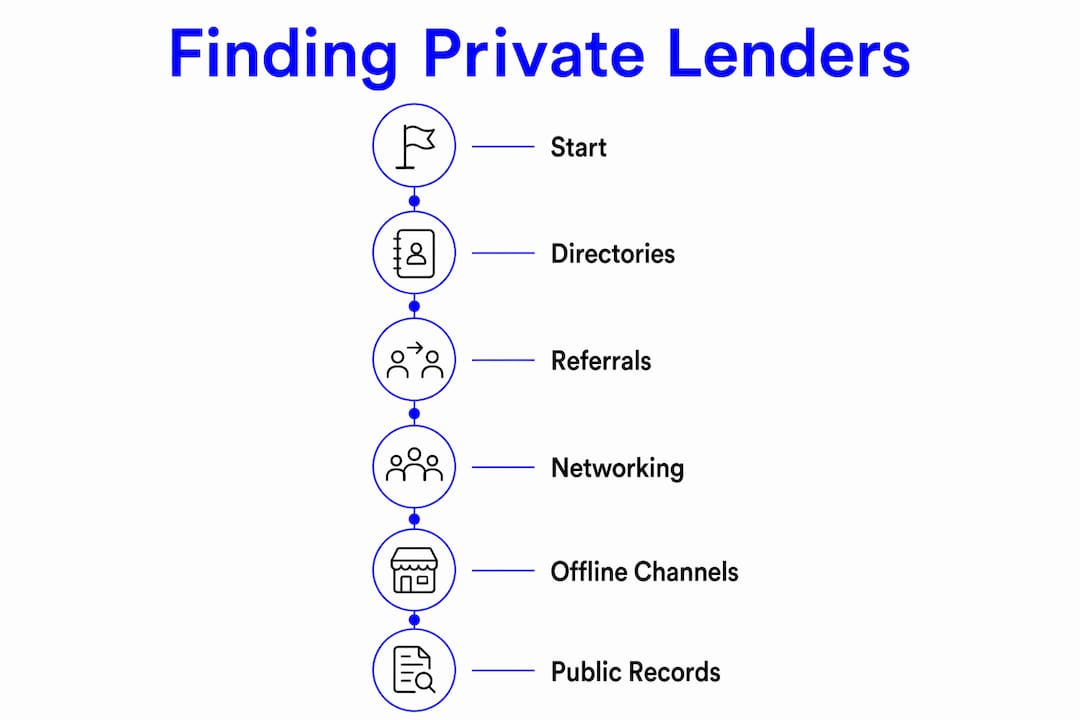
Verified directories and lender marketplaces
The AAPL member directory is the most credible starting point for vetting. AAPL does not license lenders, but membership signals a commitment to industry standards. PrivateLenderLink lists direct lenders by deal type and geography, letting you filter for bridge, fix-and-flip, or DSCR-focused capital without cold outreach. Both directories let you verify a lender's profile before you ever pick up the phone.
Professional referrals: attorneys, title officers, and escrow agents
Ask a real estate closing attorney or title officer which lenders they see on recorded mortgages. They have real-time visibility into who is actively funding deals in your market, and their referral carries implicit credibility on both sides. This channel tends to produce the highest-quality leads for market-specific deals because the lender has already proven they can close.

REIA meetups, BiggerPockets, and investor networks
Local Real Estate Investor Associations and online communities like BiggerPockets are best for sourcing individual private lenders and building long-term relationships. BiggerPockets recommends starting with your primary circle (friends, family, warm contacts), then expanding to secondary and third-party networks. Bring a one-page deal summary to every meetup. You are not pitching; you are starting a conversation.

High-net-worth offline channels
Chambers of commerce, professional associations (physicians, dentists, CPAs), and charity boards are where family-office capital and high-net-worth individuals often sit. These contacts rarely respond to cold email, but a warm introduction from a mutual connection can open a conversation about passive income through private notes. Deals funded through this channel tend to be larger and more relationship-dependent.
Public records and direct mail
County recorder offices list every recorded mortgage, including the lender's name and address. Pull recent recordings on investment properties in your target market, identify repeat lenders, and reach out directly. This approach takes more time but surfaces lenders who have already funded deals like yours in the exact geography you are working.
How do private lenders differ from banks?
The short answer: speed, flexibility, and cost. A bank underwrites the borrower. A private lender underwrites the deal.
Banks require full income documentation, strong FICO scores, debt-to-income compliance, and weeks of processing. Private lenders focus on the collateral value, the exit strategy, and whether the borrower has demonstrated they can execute. That shift in underwriting logic is why private lenders operate with more flexible criteria than banks, but it also means the borrower carries more responsibility for verifying the lender's reputation and financial stability.
Practical tradeoffs at a glance:
- Speed: Private loans can close in days to two weeks; bank loans typically take 30–60 days or longer
- Documentation: Private lenders want a deal summary, property photos, and an exit plan; banks want two years of tax returns, W-2s, and full appraisals
- Underwriting focus: Collateral value and ARV drive approval; FICO and DTI are secondary
- Cost: Higher interest rates and origination points reflect the speed and flexibility premium
- Regulatory posture: Commercial and private loan pricing follows different risk frameworks than residential mortgages, which is why rates feel materially higher
When does private money make sense? When a deal has a short hold period, a distressed property that won't qualify for conventional financing, a time-sensitive acquisition, or a construction component that banks won't touch.
Pro Tip: When negotiating terms, lenders are most likely to flex on points and fees rather than rate. If you have a strong track record and a clean exit, lead with that and ask for a reduction in origination points first.
What loan types do private lenders offer?
Private lenders cover a range of deal structures. Knowing which product fits your scenario saves time and sets realistic expectations before you submit anything.
| Loan Type | Typical Use Case | Common Rate Range | Typical LTV | Term Length |
|---|---|---|---|---|
| Fix & Flip | Acquire and renovate for resale | 8%–12% | Up to 65%–75% of ARV | 6–12 months |
| Bridge Loan | Short-term gap financing between acquisition and refi | 8%–12% | 65%–75% | 6–24 months |
| Construction Loan | Ground-up builds or major additions | 10%–12% | 60%–70% of completed value | 12–24 months |
| DSCR Rental Loan | Long-term hold; qualifies on property cash flow | 7%–10% | 70%–75% | 30 years (amortized) |
| Rehab-to-Rent (BRRRR) | Renovate, stabilize, then refinance into long-term debt | 8%–12% (rehab phase) | 65%–75% | 12 months |
| Short-Term Bridge-to-Refi | Stabilize asset, then refi into agency or bank debt | 8%–12% | 65%–70% | 6–12 months |
Rate and LTV ranges reflect common private-money pricing for short-term deals based on typical benchmarks of 8%–12% interest and 65%–75% LTV. DSCR loans sit at the lower end because they carry longer terms and stabilized cash flow as collateral.
The exit strategy shapes everything. A fix-and-flip lender wants to see a realistic ARV and a sale timeline. A bridge lender wants to know what permanent financing replaces the bridge. A construction lender wants a draw schedule and a certificate-of-occupancy plan. Match your exit to the loan type before you pick up the phone.
What do private lenders actually look for in a deal?
Getting a "yes" faster comes down to presenting the right information in the right order. Here is how most private lenders and lender-matching platforms rank their evaluation criteria:
- Collateral and LTV — the property value relative to the loan amount is the first filter. Most private lenders cap at 65%–75% LTV; anything above that requires exceptional borrower strength or additional collateral.
- Exit strategy — how and when does the lender get repaid? A vague "I'll sell it eventually" is a deal-killer. A specific "list at $X in month 9, with a backup refi at $Y" is a green light.
- Borrower track record — experienced investors get better rates and faster approvals. If you are newer, a detailed business plan and a strong referral from a known contact compensate for limited history.
- Proof of funds and reserves — lenders want to see that you can cover carrying costs, unexpected overruns, and closing costs without coming back to ask for more money.
- Deal economics — purchase price, rehab budget with line items, ARV, and projected profit margin. Lenders run their own numbers; give them clean inputs.
- Title and insurance status — a clean title report and a commitment to use title insurance are non-negotiable for serious lenders. Any title cloud needs a resolution plan before submission.
- Local market fundamentals — comparable sales, days on market, and absorption rate for the subject property's neighborhood. A lender unfamiliar with your market will want to see that you know it.
Thecrebrokersconnect uses these same dimensions as match filters: property type, loan amount, location, leverage, credit profile, loan purpose, and transaction structure. That means a deal submitted through the platform reaches lenders already pre-filtered for the criteria above, which cuts the back-and-forth significantly.
How do you prepare a loan request that lenders actually read?
Most lenders decide in the first 60 seconds whether a submission is worth a call. A clean, one-page package does more work than a 40-page PDF.
Document checklist
- Property address and legal description
- Executed purchase contract (or LOI for pre-contract submissions)
- Itemized rehab budget with contractor bids or line-item estimates
- Pro forma showing purchase price, rehab cost, ARV, and projected profit or cash flow
- Recent property photos (exterior, interior, any major deficiencies)
- Title report or preliminary title commitment
- Borrower resume: past deals closed, current portfolio, relevant experience
- Proof of funds or equity (bank statement, brokerage account, or equity in another property)
- Sources and uses statement showing where every dollar comes from and where it goes
One-page loan request template
Loan Request Summary Property: [Address, City, State] Purchase Price: $[X] | Rehab Budget: $[X] | ARV: $[X] Loan Amount Requested: $[X] | LTV: [X]% | Rate Requested: [X]% Term: [X months] | Exit Strategy: [Sale / Refi — timeline and basis] Borrower Equity: $[X] | Proof of Funds: [Attached] Borrower Experience: [# of deals closed, deal types] Contact: [Name, Phone, Email]
Outreach message to initiate contact
That framing works because it asks for advice rather than money. Experienced investors consistently report that this approach generates more referrals and more genuine conversations than leading with a funding request.
How do you vet a private lender before you sign anything?
Private lenders are not subject to the same regulatory oversight as banks, which means the due-diligence burden falls on you. Most fraud in private lending follows a predictable pattern, and most of it is avoidable.
Due-diligence checklist:
- Verify membership in the AAPL member directory — not a guarantee, but a meaningful baseline signal
- Request proof of funds or a recent funding statement before you share sensitive deal documents
- Ask for references from two or three borrowers on recently closed deals and actually call them
- Confirm the lender uses a licensed title company and requires title insurance on every closing
- Search the lender's business name in your state's secretary of state database and check for public records
- Review online reputation: Google, BBB, and any state licensing board complaints
Red flags to walk away from:
- Any claim of a "private lender license" issued by AAPL or a similar trade association. AAPL does not issue licenses; that claim is a fraud signal.
- Refusal to use a title company or title insurance
- Pressure to wire funds to a personal bank account before closing
- References that cannot be verified or who seem scripted
- Inconsistent business addresses or no verifiable physical presence
Pro Tip: The single most reliable check in most markets is asking a local closing attorney or title officer which lenders they see on recent recordings. They know who actually funds deals and who disappears at the table.
What does a private loan actually cost, and how fast does it close?
Speed and cost move in opposite directions. The faster you need money, the more it typically costs.
Typical timeline from inquiry to funding
| Stage | Typical Duration |
|---|---|
| Initial contact and deal review | 1–3 days |
| Document submission and underwriting | 3–7 days |
| Property inspection or drive-by | 1–3 days |
| Title search and commitment | 5–10 days |
| Loan approval and term sheet | 1–3 days |
| Closing and funding | 1–2 days |
| Total (expedited) | 7–14 days |
| Total (standard) | 14–30 days |
Cost ranges
Private loan pricing reflects deal risk, borrower experience, and market conditions. Common benchmarks for short-term deals:
- Interest rate: 8%–12% for most private and hard money loans; DSCR loans may range from 7%–10%
- Origination points: 1–3 points (1 point = 1% of the loan amount), paid at closing
- LTV caps: 65%–75% for most deal types; construction loans often cap lower at 60%–70% of completed value
- Other fees: appraisal, title, legal, draw fees on construction loans, and extension fees if the loan runs past its term
State-level differences matter. Some states have usury caps that affect maximum rates; others have specific disclosure requirements for private loans. Always confirm the governing state's rules with a real estate attorney before signing.
Deal size and borrower track record move pricing materially. A first-time borrower on a $150,000 flip in a secondary market will pay more in points and rate than a repeat borrower closing a $2M bridge deal with 10 prior closings on record. The total cost of financing goes beyond the interest rate — factor in all fees, carry costs, and extension risk when modeling a deal.
How do you submit a loan request and what happens next?
Submission is not the finish line. It is the start of a short sprint.
Channels for submission:
- Marketplace upload: platforms like PrivateLenderLink let you submit deal criteria and receive lender responses directly
- Broker platform submission: Thecrebrokersconnect lets brokers submit a deal scenario and batch-match against verified lenders filtered by property type, amount, location, and leverage
- Direct email: use the one-page template above; follow up in 48 hours if no response
- Referral introduction: the warmest path; ask your attorney or title officer to make the introduction directly
- Title-assisted introductions: some title companies maintain lender relationships and will facilitate introductions for deals they are handling
Follow-up cadence:
- Day 1: submit the one-page summary
- Day 3: follow up with a brief email referencing the deal and asking if they need anything else
- Day 7: a second follow-up with one new piece of information (updated ARV comp, signed contract, or contractor bid)
- Day 14: if no response, move to the next lender on your list
Post-submission steps:
Once a lender expresses interest, expect a Q&A call, requests for additional documents (full appraisal, contractor license, insurance binder), and a term sheet within a few days. After you accept the term sheet, the lender orders title, you open escrow, and the closing process runs its standard course. Keep a checklist of outstanding items and respond to lender requests within 24 hours. Delays on your side are the most common reason closings slip.
How Thecrebrokersconnect speeds up lender introductions
Manual outreach to private lenders means cold calls, scattered email threads, and no visibility into which lenders are actually responsive. Thecrebrokersconnect replaces that with a structured workflow built specifically for commercial real estate brokers.
Platform capabilities:
- Verified lender database: 289+ lenders covering all major CRE asset classes and loan types, each with documented specialties
- AI-powered match filters: submit a deal scenario and the platform filters by property type, loan amount, location, leverage, credit profile, loan purpose, and transaction structure
- Batch lender outreach: reach multiple matched lenders in one submission instead of one email at a time
- Secure document vault: store and share deal documents without emailing sensitive files
- Lender responsiveness leaderboard: see which lenders are actively responding to submissions before you spend time on outreach
- Deal pipeline CRM: track every submission, conversation, and outstanding item in one place
- AI tools for deal packaging: generate deal summaries, underwriting inputs, and submission templates faster
Where it fits in practice: A broker with a fix-and-flip scenario in Dallas can submit the deal, filter for lenders active in Texas with a 70% LTV tolerance, and have matched introductions within 48–72 hours. The same workflow handles a multifamily bridge deal or a construction loan without rebuilding the process from scratch.
The platform is built for both experienced commercial mortgage brokers and newer originators who want a more efficient path to capital. No commission, no transaction fees. A flat monthly subscription with a free trial.
Key Takeaways
The most reliable path to private capital combines verified directories, warm professional referrals, and a structured submission process that gives lenders exactly what they need to say yes quickly.
| Point | Details |
|---|---|
| Start with verified channels | Use the AAPL member directory and PrivateLenderLink to identify lenders before cold outreach. |
| Referrals outperform cold contact | Real estate attorneys and title officers know which lenders are actively funding in your market right now. |
| Prepare a one-page loan summary | Include address, purchase price, rehab budget, ARV, LTV, exit strategy, and proof of funds before any outreach. |
| Vet every lender before signing | Confirm AAPL membership, request proof of funds, call references, and insist on title-insured closings. |
| Thecrebrokersconnect | Submit a deal scenario to match against 289+ verified lenders filtered by deal type, location, and leverage. |
What most guides get wrong about finding private lenders
The standard advice is to "build relationships" and "network at meetups." That is not wrong, but it misses the part that actually determines whether a lender funds your deal.
Private lenders are not looking for charming borrowers. They are looking for borrowers who make their capital work predictably. The relationship matters, but it is built on execution, not conversation. A lender who funds your first deal at 11% and 2 points will fund your fifth deal at 9% and 1 point, not because you stayed in touch, but because you paid back the first four on time and gave them clean numbers every step of the way.
The mistake most new investors make is leading with enthusiasm instead of evidence. They show up to a meetup, explain their vision, and wonder why nobody writes a check. The investors who attract capital consistently do one thing differently: they show what they have already done. A one-page track record with three closed deals, actual returns, and a current deal in progress is worth more than any pitch deck.
The second mistake is treating lender outreach as a one-time event. Private lending relationships compound. A lender who passes on your first deal because the LTV is too high will often come back if you follow up six months later with a stronger deal and a note saying the previous one closed on time. That follow-up is what most borrowers skip.
One more thing worth saying: the framing of the ask matters more than most people realize. Asking for advice, or asking whether a deal fits what a lender is currently funding, consistently outperforms asking directly for money. It is not a trick. It is a genuine way to start a conversation that lets the lender self-select in rather than feeling pressured to say no.
Thecrebrokersconnect gives brokers a faster path to verified lenders
Searching lender lists manually and making cold calls is the slowest way to source private capital. Thecrebrokersconnect cuts that process down by giving commercial real estate brokers a single platform to match deals with verified lenders, manage submissions, and track responses.
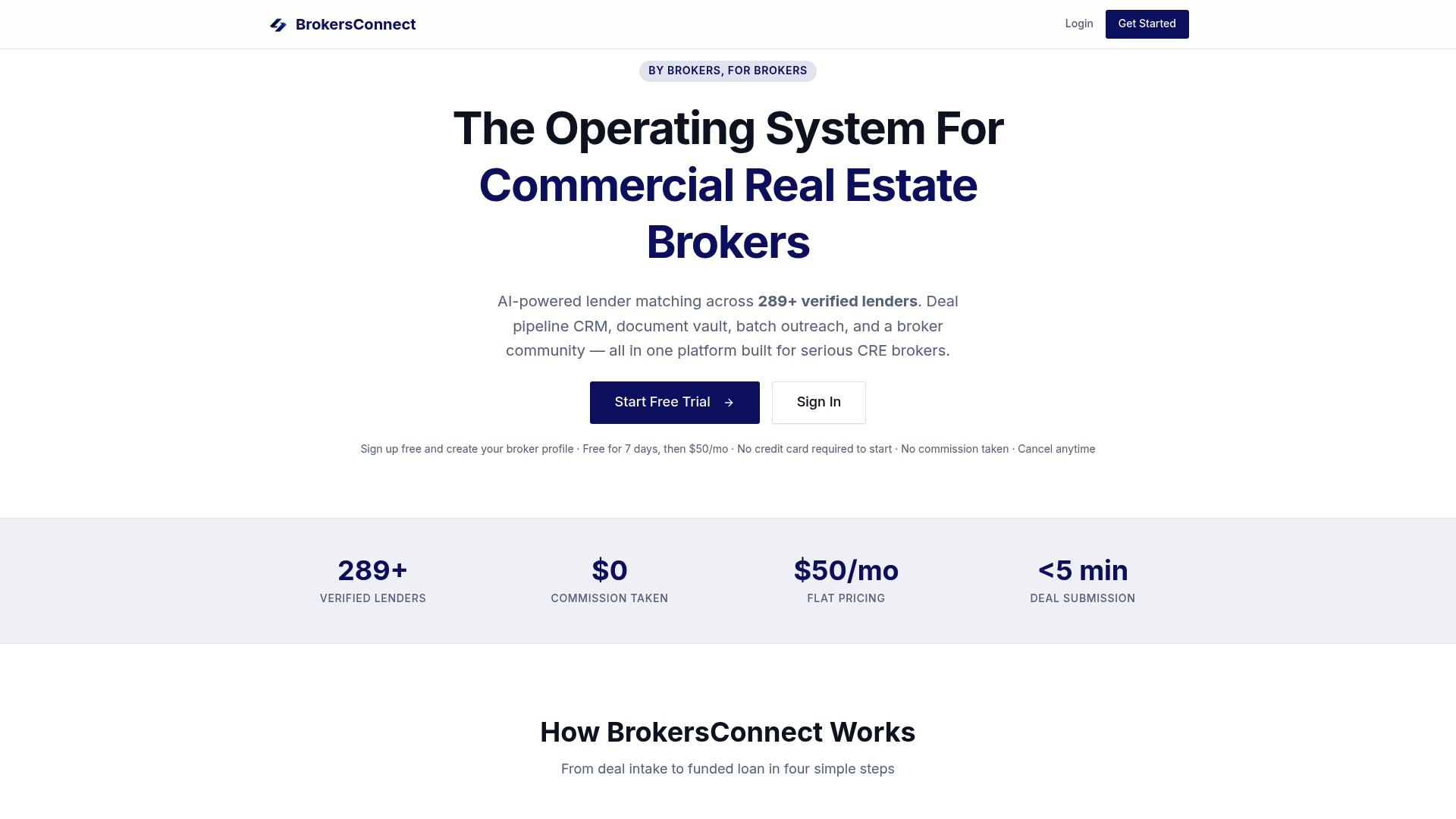
The platform's database covers 289+ verified lenders across all major CRE asset classes. Submit a deal scenario and the AI-powered match engine filters by property type, loan amount, location, leverage, credit profile, and transaction structure. The lender responsiveness leaderboard shows you which lenders are actively engaging with submissions before you spend time on outreach. A built-in deal pipeline CRM keeps every conversation, document, and outstanding item organized in one place.
For brokers who want to move a fix-and-flip, bridge, DSCR, or construction deal forward without rebuilding their process from scratch on every submission, Thecrebrokersconnect is the operating system for that workflow. Flat monthly subscription, no commission, no transaction fees, and a free trial to start.
Start matching deals with verified lenders at Thecrebrokersconnect today.
Useful sources and directories to start your search
Use these resources in combination with the due-diligence checklist above. A directory listing is a starting point, not a guarantee.
- AAPL member directory — the primary industry directory for verifying private lender membership; search by state and specialty. Remember: AAPL does not license lenders; membership is a professional signal, not a credential.
- PrivateLenderLink — browse direct lenders by deal type and geography; useful for bridge and short-term financing across U.S. markets.
- Thecrebrokersconnect — verified lender matching platform for commercial real estate brokers; submit a deal scenario and match against 289+ lenders filtered by your deal criteria.
- County recorder's office (public records) — search recorded mortgages in your target county to identify repeat private lenders by name and address; most county recorders offer free online search tools.
- Local title companies — ask the closing officer which lenders they see regularly on investment transactions; this is the fastest way to surface active, market-specific funders.
- BiggerPockets private lender guide — practical overview of the three-circle outreach model and public-record search tactics for individual investors.
Cross-reference any lender you find across at least two of these sources before submitting a deal package. A lender with a PrivateLenderLink profile, a verifiable AAPL membership, and a reference from a local title officer is a lender worth calling.
This article is general information for educational purposes. Loan terms, rates, and legal requirements vary by state and deal structure. Confirm current rules and terms with a licensed real estate attorney or qualified financial professional before entering any lending agreement.