
Defeasance substitutes a portfolio of U.S. Treasuries for the original property collateral, keeping the loan alive inside the trust. Yield maintenance is a cash make-whole paid directly to the lender, calculated as the present value of the coupon the lender loses by accepting early repayment. Which one applies to your loan is almost never a choice you make at prepayment. The loan structure determines the regime at origination: CMBS conduit loans require defeasance; life insurance company loans and CMBS single-asset single-borrower (SASB) deals typically use yield maintenance; agency multifamily loans follow their own step-down conventions.
The immediate next step for any borrower or broker modeling a refinance or sale: pull the prepayment section of the mortgage note and the pooling and servicing agreement (PSA). Identify the regime, any lockout period, the make-whole spread, and whether the note allows a zero floor on yield maintenance. Everything else flows from those clauses.
- CMBS conduit: defeasance required (REMIC rules protect pooled bondholders)
- Life insurance company / CMBS SASB: yield maintenance standard
- Agency multifamily (Fannie Mae / Freddie Mac): step-down or agency-specific variants
- Bank / bridge loans: often open prepayment or negotiated exit fees
- Chatham Financial is widely used for defeasance consulting and yield maintenance modeling
- Thecrebrokersconnect surfaces lender prepayment preferences at the deal-matching stage, before the term sheet is signed
Table of Contents
- What is defeasance and how does it work?
- What is yield maintenance on a loan?
- How do defeasance and yield maintenance compare?
- How to calculate defeasance and yield maintenance costs
- Which loan types use defeasance or yield maintenance?
- What does the execution process actually look like?
- Practical implications for brokers and borrowers
- Key Takeaways
- The prepayment clause is the most underread line in a loan commitment
- How Thecrebrokersconnect helps brokers get ahead of prepayment decisions
- Authoritative sources and calculators
What is defeasance and how does it work?
Defeasance is a collateral substitution, not a payoff. The borrower purchases a portfolio of U.S. Treasury or agency securities sized to replicate every remaining scheduled payment on the mortgage, including the balloon. The trust keeps the loan on its books; the property is released; the Treasuries generate the cash flows bondholders were promised. From the CMBS conduit investor's perspective, nothing changed.
Pooled CMBS bondholders require this structure because the trust's ratings and payment waterfalls depend on the original cash-flow schedule staying intact. A simple cash payoff would disrupt the trust's yield and potentially trigger rating-agency scrutiny. Defeasance sidesteps that problem entirely by substituting collateral rather than retiring the debt.
Cost components borrowers should budget for:
- Treasury portfolio purchase price (the dominant cost, driven by the yield curve)
- Defeasance consultant fee
- Defeasance counsel (legal fees)
- Trustee and master servicer fees
- Securities broker commissions
- Any difference between the portfolio cost and the outstanding loan balance
The fixed professional fees alone can sum to tens of thousands of dollars, which is why defeasance is often uneconomic for smaller loans. A $3M conduit loan facing $20,000 in advisory costs on top of the Treasury portfolio is a very different calculus than a $50M loan where those same fees are rounding errors.
Typical execution checklist:
- Engage a defeasance consultant (Chatham Financial is one of the most cited)
- Request a payoff and defeasance quote from the master servicer
- Confirm lockout expiration (CMBS conduit loans typically carry 24–36 month lockouts)
- Obtain servicer approval and REMIC compliance confirmation
- Purchase the Treasury portfolio through a securities broker
- Execute the substitution agreement with the trustee
- Close the property sale or refinance with the collateral swap recorded
Defeasance typically takes 30–45 days from consultant engagement to close. Rushing that window is one of the most common execution mistakes on CMBS exits.
Pro Tip: Engage your defeasance consultant at least 60 days before your target close date. Servicer approval queues and Treasury settlement windows can compress your timeline fast, and a missed close date on a sale can cost far more than the consultant's fee.
Pros: Preserves trust cash flows; can be cheaper than yield maintenance when Treasury yields are high (or even net positive in a negative-defeasance environment); releases the property cleanly.
Cons: High operational lift; fixed professional fees that scale poorly on small loans; 30–45 day minimum timeline; requires specialized counsel and consultant.
What is yield maintenance on a loan?
Yield maintenance is math. The lender calculates the present value of the coupon payments it will not receive because the borrower is prepaying, discounts those cash flows at a Treasury reinvestment rate plus a make-whole spread, and collects the result as a lump-sum penalty at closing. The loan is then fully retired.

Standard formula:
More precisely: for each remaining payment period, take the coupon difference between the loan rate and the comparable Treasury yield, discount it back to today at that Treasury rate plus the make-whole spread, and sum across all periods. Many servicers use the Federal Reserve H.15 curve, interpolated to the loan's remaining term.
Contract language variations to check:
| Clause | What it means for cost |
|---|---|
| Make-whole spread (25–50 bps) | Adds to the discount rate, reducing the penalty slightly |
| 1% minimum floor | YM cannot be less than 1% of the outstanding balance |
| Zero floor | Prevents negative YM; borrower pays nothing if Treasury yields exceed loan coupon |
| No floor | Borrower may receive a credit if Treasury yields are above the loan rate |
| Tenor interpolation rule | Determines which Treasury maturity is used for the discount rate |
Pros: Fast (often quoted and closed in days); lower advisory fees; no collateral substitution mechanics; straightforward for lender and borrower alike.
Cons: In a low-rate environment, the penalty can be very large on a big balance; cost is entirely driven by the spread between the loan coupon and current Treasuries; no operational flexibility once the note is signed.
A worked example: on a $50M loan at 5.5% with four years remaining, if the comparable Treasury yield is 3.5%, the rate differential is 200 basis points. The present value of that differential across 48 monthly periods, discounted at 3.75% (Treasury plus a 25 bps spread), produces a penalty in the range of $3.5M–$4M depending on amortization. Use Chatham Financial's calculator or Janover's yield maintenance tool to run your specific scenario before modeling an exit.
How do defeasance and yield maintenance compare?
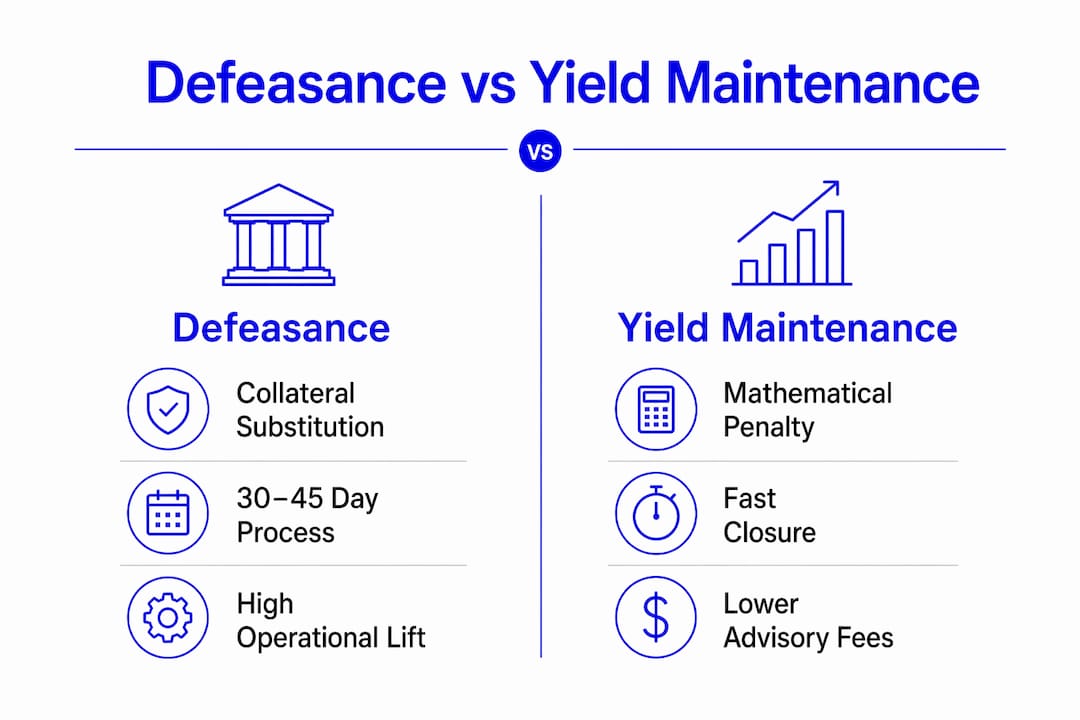
The two regimes feel similar in dollar terms under certain rate conditions, but they differ sharply in mechanics, timeline, and operational complexity.
| Dimension | Yield Maintenance | Defeasance |
|---|---|---|
| Cost driver | PV of coupon differential vs. Treasuries | Treasury portfolio price minus loan balance |
| Treasury yield sensitivity | High: lower rates = higher penalty | High: lower rates = more expensive portfolio |
| Execution time | Days to 1–2 weeks | 30–45 days minimum |
| Third-party fees | Low (lender calculates; minimal advisory) | High ($8,000–$25,000+ in consultant/counsel fees) |
| Loan outcome | Loan retired at closing | Loan stays active; collateral substituted |
| Property release | Immediate at payoff | Released via substitution agreement |
| Typical loan types | Life co, CMBS SASB, bank/bridge | CMBS conduit (required by REMIC rules) |
| Operational burden | Low | High (consultant, counsel, trustee, securities broker) |
| Negative outcome possible? | Only if note has no floor | Yes ("negative defeasance" when Treasury yields exceed loan coupon) |
Rules of thumb:
- Small-balance loans (under $5M): yield maintenance is almost always the practical choice. Fixed defeasance fees eat too large a share of the loan balance.
- Large CMBS conduit loans: defeasance is typically required, not optional. Model it from day one.
- Flat or inverted yield curve: defeasance can be cheaper, or even net positive, because the Treasury portfolio costs less than the loan balance.
- Steeply upward-sloping curve with rates well below the loan coupon: yield maintenance penalties can be punishing on large balances.
A small-ticket bridge loan on a value-add multifamily property will almost certainly carry open prepayment or a simple exit fee. A $75M conduit CMBS deal on a stabilized office building will almost certainly require defeasance. The loan type tells you the regime before you ever read the note.
How to calculate defeasance and yield maintenance costs
Yield maintenance formula
The standard calculation:
YM Cost = PV of [ (Loan Coupon Rate − Treasury Reinvestment Rate) × Remaining Principal ] discounted at (Treasury Rate + Make-Whole Spread)
Each term matters:
- Loan Coupon Rate: the fixed rate on the note
- Treasury Reinvestment Rate: the yield on a Treasury matching the remaining loan term (interpolated from the H.15 curve)
- Make-Whole Spread: typically 25–50 basis points added to the discount rate per the loan docs
- Remaining Principal: the outstanding balance at prepayment
Defeasance cost formula
Defeasance Cost = (Treasury Portfolio Purchase Price − Outstanding Loan Balance) + Professional Fees
The portfolio must generate cash flows that exactly match every remaining scheduled payment. When Treasury yields are low, the portfolio costs more than the loan balance, and the borrower funds the gap. When Treasury yields are high enough to exceed the loan coupon, the portfolio can cost less than the balance, producing negative defeasance.
Worked examples (illustrative, $50M loan at 5.5%, 4 years remaining)
Yield maintenance scenario:
| Treasury Yield | Rate Differential | Approximate YM Penalty |
|---|---|---|
| 2.5% (below coupon) | 3% (300 basis points) | ~$5.5M |
| 3.5% (moderately below) | 200 bps | around $3.5M - $4M |
| 5.5% (at coupon) | zero basis points | zero or 1% floor |
| 6.5% (higher than coupon) | Negative | zero (if zero floor applies) |
Defeasance scenario (same loan):
| Treasury Yield | Portfolio Cost vs. Balance | Net Defeasance Cost (before fees) |
|---|---|---|
| 2.5% | Portfolio > balance | Positive cost (~$4M–$6M range) |
| 5.5% | Portfolio ≈ balance | Near zero |
| 6.5% | Portfolio < balance | Negative (borrower receives cash) |
The negative-defeasance window that reappeared for certain loan vintages in 2024–2026 is a real phenomenon, not a theoretical curiosity. Borrowers with conduit CMBS loans originated at lower coupons who held through the rate-hike cycle found themselves in a position where defeasance actually returned cash. Always model both directions.
Caveat: Real-world execution includes bid-ask spreads on Treasury purchases and dealer financing costs. Model with a band of 10–20 basis points around your Treasury assumption, not a single point estimate.
Which loan types use defeasance or yield maintenance?
The securitization structure usually fixes the regime at origination. Borrowers and brokers who treat this as a choice they can make at exit are setting themselves up for a surprise.
Quick mapping:
- CMBS conduit loans: defeasance required. REMIC rules governing pooled trusts demand the original cash-flow schedule be preserved. There is no negotiating around this at exit.
- CMBS SASB (single-asset single-borrower): yield maintenance is standard. The loan is not pooled with others, so a cash make-whole is acceptable to the single investor or small group holding the debt.
- Life insurance company portfolio loans: yield maintenance, often with a make-whole spread and a 1% minimum. Life companies hold loans on their own balance sheets and prefer the simplicity of a cash settlement.
- Agency multifamily (Fannie Mae / Freddie Mac): step-down prepayment schedules or agency-specific variants. These are distinct from standard YM and defeasance conventions. Treat agency loans as their own category.
- Bank and bridge loans: typically open prepayment after a short lockout, or a simple exit fee (1%–2%). Yield maintenance is occasionally used but rarely defeasance.
Underwriting checklist for brokers:
- Confirm the loan type and securitization structure on the term sheet
- Locate the prepayment section: does it say "defeasance," "yield maintenance," or "make-whole"?
- Note the lockout period expiration date
- Record the make-whole spread and any minimum floor
- Flag whether the note allows negative YM or negative defeasance
- Document the reinvestment-rate tenor interpolation rule
- Capture all of this in the deal package before lender selection, not after
Negotiate clarity on prepayment terms at origination when the loan is not yet securitized. Once a conduit loan closes into a CMBS trust, the PSA controls and there is nothing to negotiate.
For CMBS structures and why conduit pools require defeasance, the mechanics of the pooled trust are worth understanding before you originate a conduit loan for a client.
What does the execution process actually look like?
Yield maintenance execution
- Request a payoff quote from the lender or servicer (include the target prepayment date)
- Confirm the Treasury rate and make-whole spread used in the calculation
- Review the calculation against your own model
- Wire the payoff amount plus the YM penalty at closing
- Receive lien release; loan is retired
Timeline: often 5–10 business days from quote to close. Many lenders still ask for 30 days' notice even though the math can be done overnight.
Defeasance execution
- Engage a defeasance consultant (60+ days before target close)
- Request a defeasance quote and servicer approval letter
- Confirm REMIC compliance and eligible collateral (Treasuries or agency securities)
- Engage defeasance counsel for substitution agreement drafting
- Purchase the Treasury portfolio through a securities broker
- Obtain trustee and master servicer sign-off
- Execute the substitution agreement and record the collateral swap
- Close the property sale or refinance
Timeline: 30–45 days minimum, and that assumes no servicer delays. Build in buffer.
Fee ranges (2026 estimates):
- Defeasance consultant: several thousand dollars
- Defeasance counsel: several thousand dollars
- Trustee/master servicer fees: a few thousand dollars
- Securities broker commissions: varies with portfolio size
- Total professional fees: often tens of thousands of dollars on a mid-size loan
Yield maintenance advisory costs are a fraction of this. The lender or servicer runs the calculation; a borrower's counsel reviews it. Total third-party cost is often under $2,000.
Pro Tip: For short-term bridge loans where open prepayment or a small exit fee is the norm, model the exit cost at origination using a bridge loan calculator so the fee is already in your underwriting. Don't let a 1%–2% exit fee catch a client off guard at a sale closing.
Practical implications for brokers and borrowers
The most common mistake is treating defeasance and yield maintenance as interchangeable options the borrower selects at exit. They are not. The securitization structure fixes the regime at origination, and brokers who fail to capture this at underwriting hand their clients a costly surprise.
Modeling priorities:
- Run both regimes in every sensitivity analysis, even if only one applies. Understanding the counterfactual helps clients appreciate the cost.
- Test Treasury yields at least 150 basis points above and below your base case. The penalty swings are large.
- Include professional fees as a line item, not a footnote. On a $10M defeasance, $20,000 in fees is 20 basis points of loan balance.
- Model the execution window as a constraint on your sale or refi timeline, not just a cost.
Origination actions:
- Capture the prepayment regime in your lender-selection filters before submitting a scenario. A life company lender and a conduit CMBS lender are not interchangeable if the client's exit strategy requires speed.
- Include the regime, lockout expiration, make-whole spread, and any floors in your loan submission template.
- Flag securitization constraints early in lender conversations so clients understand what they are signing.
Platforms that surface lender prepayment preferences at the deal-matching stage, before the term sheet is signed, give brokers a real edge. Knowing that a particular lender's standard terms include a 1% YM minimum or a 36-month lockout changes which lenders you pitch to.
Key Takeaways
The regime is almost never a choice at prepayment. Loan structure determines whether defeasance or yield maintenance applies, and capturing that fact at origination is the single most valuable thing a broker can do for a client's exit planning.
| Point | Details |
|---|---|
| Regime is set at origination | CMBS conduit loans require defeasance; life co and SASB loans use yield maintenance. Verify in the PSA before modeling. |
| Treasury yields drive cost | Lower rates increase both YM penalties and defeasance portfolio costs; rising rates can produce negative defeasance. |
| Defeasance fees add up | Professional fees of $8,000–$25,000+ make defeasance uneconomic on small loans; budget this from day one. |
| Timeline differs sharply | Yield maintenance closes in days; defeasance takes 30–45 days minimum. Build the window into your sale or refi schedule. |
| Thecrebrokersconnect surfaces lender preferences | The platform's lender-matching filters help brokers identify prepayment regimes and constraints before the term sheet is signed. |
The prepayment clause is the most underread line in a loan commitment
Most borrowers spend hours negotiating rate and proceeds. The prepayment clause gets a skim. That imbalance is where exit surprises are born.
The practical lesson here is not complicated: a borrower who originates a $40M conduit CMBS loan in a low-rate environment and plans to sell in three years needs to know, on day one, that defeasance will cost them a Treasury portfolio priced at that future rate environment, plus $15,000–$20,000 in professional fees, plus a 30–45 day execution window that cannot be compressed. If the sale timeline slips, the defeasance quote expires and the process restarts.
Brokers who surface this at origination, model the cost across rate scenarios, and build the execution window into the client's business plan are genuinely more valuable than those who treat prepayment as a closing-day detail. The 2024–2026 negative-defeasance window is a perfect illustration. Borrowers with older conduit loans who had modeled their defeasance cost under rising-rate scenarios knew they had an exit opportunity. Those who had never modeled it missed it entirely.
The advice is simple: capture the regime at underwriting, model it across Treasury scenarios, and treat the execution timeline as a hard constraint on your deal calendar. The borrowers who get surprised at exit are almost always the ones whose brokers skipped this step.
How Thecrebrokersconnect helps brokers get ahead of prepayment decisions
Knowing the prepayment regime before you submit a deal scenario is the difference between a clean exit and a costly surprise. Thecrebrokersconnect gives brokers a direct line to 289+ verified lenders, with filters that surface lender-specific preferences, including prepayment structures, at the deal-matching stage.
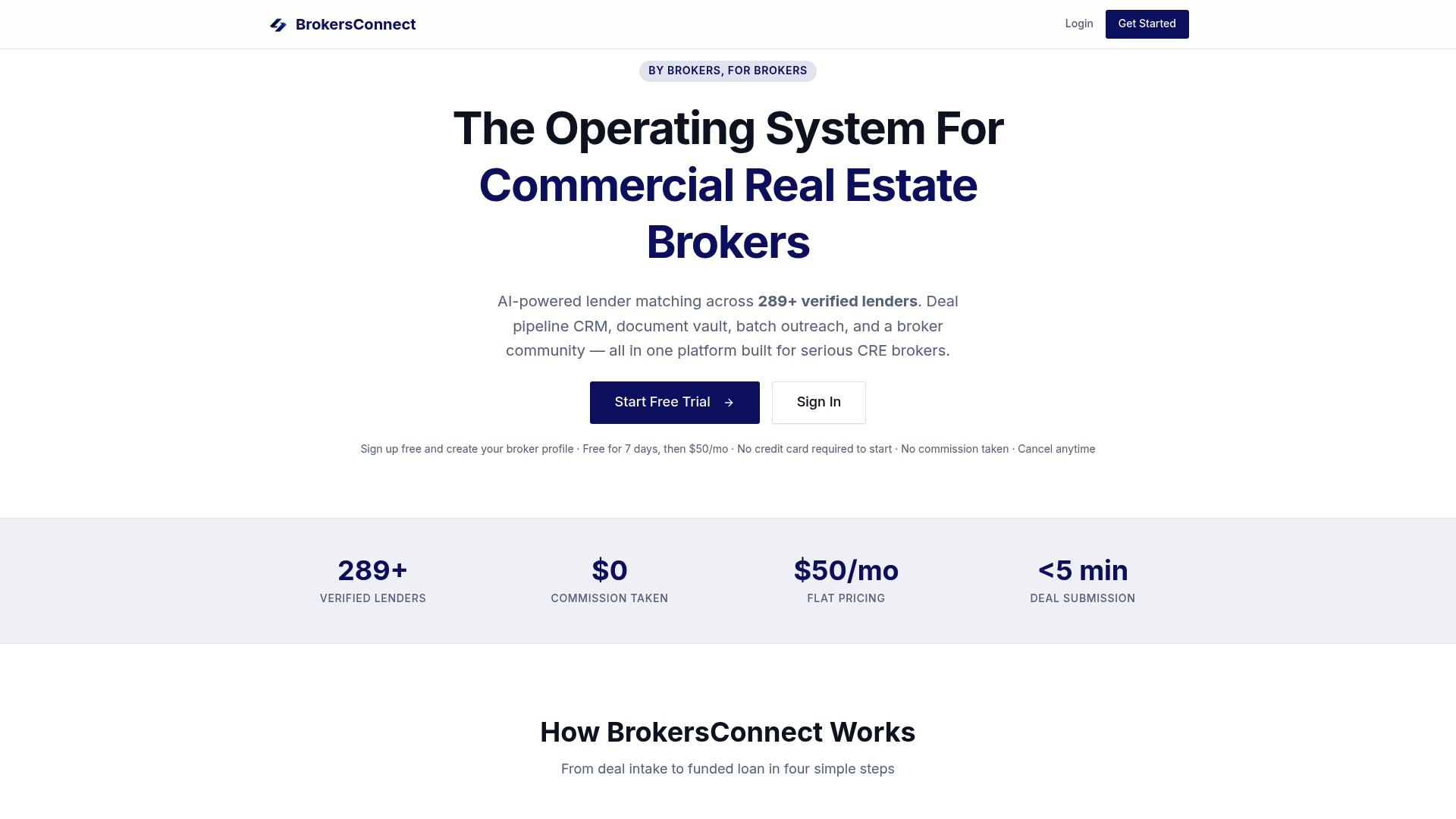
Instead of discovering a 36-month lockout or a mandatory defeasance clause after the term sheet is signed, brokers using Thecrebrokersconnect can filter by loan type, securitization structure, and lender preference before the first conversation. The platform's deal templates capture prepayment regime, make-whole spread, and lockout terms as standard fields, so nothing gets buried in a footnote. Fee calculators and document tools help package the scenario accurately for lender review.
Start a free trial at Thecrebrokersconnect and see how lender prepayment preferences surface in the deal workflow before you commit a client to a structure they cannot exit cleanly.
Note: Thecrebrokersconnect is a deal-sourcing and workflow platform. Final determinations on prepayment obligations, servicer requirements, and REMIC compliance come from the loan documents and servicer counsel.
Authoritative sources and calculators
Use these to model scenarios and verify execution requirements. The loan documents and PSA always control; these sources inform your modeling.
- Counselors of Real Estate (CRE.org): practitioner-level explanation of the regime distinction and common borrower misconceptions; good starting point for client education.
- Apers prepayment guide: detailed methodology on defeasance cost math, Treasury portfolio sizing, and negative-defeasance mechanics; useful for building your own sensitivity model.
- Apers CMBS conduit vs SASB: maps loan structure to prepayment regime and explains why REMIC rules drive the conduit defeasance requirement.
- J.P. Morgan: defeasance clause explained: covers agency lending context and step-down conventions for Fannie Mae and Freddie Mac products.
- Chatham Financial: widely used for defeasance consulting and yield maintenance modeling; their calculator is a standard reference for practitioners running prepayment scenarios.
- Federal Reserve H.15 release: the source for Treasury yields used in YM calculations; servicers interpolate this curve to the loan's remaining term.
- IRS guidance on defeasance of debt: relevant for tax treatment questions; consult a qualified tax advisor for your specific transaction.
This article is general information for educational purposes. It is not legal, tax, or financial advice. Verify prepayment obligations with your servicer, loan counsel, and a qualified advisor before executing any transaction.