
Secure document sharing for commercial real estate brokers means more than sending a file with a password. It means encrypted file sharing with granular access controls, time-stamped audit trails, and the ability to revoke access the moment a deal falls through or a lender relationship changes. CRE brokers handle rent rolls, personal financial statements, tax returns, and loan packages that carry serious legal and financial weight. Sending those over standard email attachments or a generic shared drive is not just careless. It exposes clients, creates liability, and signals to lenders that you run a loose operation.
The professional standard is Information Rights Management (IRM), which keeps the document owner in control even after the file leaves their hands. Mimecast has documented how traditional encryption methods create so much friction for recipients that brokers abandon secure methods entirely and fall back on unprotected email. Virtru frames it differently: secure sharing is a trust signal, not just a compliance checkbox. When a lender receives a protected link instead of an attachment, it tells them something about how you run your business.
Key features every CRE broker needs in a secure sharing platform:
-
End-to-end or zero-knowledge encryption so the platform itself cannot read your files
-
Expiration dates and view limits that cut off access automatically
-
Instant revocation, even after a recipient has already opened the document
-
Email verification or multi-factor authentication to confirm the right person is viewing
-
Audit trails with time-stamped logs showing who opened what, when, and for how long
-
View-only modes that block downloading, printing, or forwarding
-
No-account access for recipients, so lenders open files in one click without installing software
Table of Contents
-
What features should a secure document sharing platform include for CRE?
-
Security best practices and common pitfalls in CRE document sharing
-
How secure sharing supports compliance and builds credibility with lenders
-
How to integrate safe document transfer into your daily CRE workflow
-
How Brokers Connect supports secure document management for CRE brokers
-
How do different secure document sharing solutions compare for CRE brokers?
-
Step-by-step guide to implementing secure sharing in your CRE workflow
-
What real efficiency gains look like when brokers adopt secure sharing
-
Legal and regulatory considerations for CRE loan document handling
-
How to set access controls that match CRE document sensitivity
-
Brokers Connect puts secure document tools where you already work
What features should a secure document sharing platform include for CRE?
The features that matter most for confidential document exchange in CRE go well beyond basic password protection. Granular access controls let you set a document to expire after three opens or after a specific date, which is useful when submitting to multiple lenders on a deadline. Instant revocation means you can pull access the moment a deal dies or a lender relationship sours, without chasing down forwarded copies.

Audit trails with time-stamped logs integrate directly with tools like Outlook and Gmail, letting brokers track exactly when a lender opened a submission package and how long they spent on it. That data turns a follow-up call from a guess into a targeted conversation. Platforms like Capsule and Send Securely also offer email verification and view limits without requiring recipients to create accounts, which keeps lenders from abandoning the secure link for a quick email reply.
Platform features checklist:
-
Zero-knowledge or end-to-end encryption (AES-256-GCM is the current standard)
-
Expiration by date or number of opens
-
Instant one-click revocation
-
Email verification for recipient identity confirmation
-
Real-time audit logs with location and duration data
-
View-only mode with no download or print option
-
Recipient access without account creation
-
Integration with Outlook, Gmail, and CRM systems
Security best practices and common pitfalls in CRE document sharing
Permission leakage is the most underappreciated risk in CRE document sharing. A lender downloads your loan package, forwards it to a partner, and suddenly your borrower’s financial data is circulating beyond anyone you vetted. View-only modes prevent this by keeping the file in a browser window rather than on a hard drive.
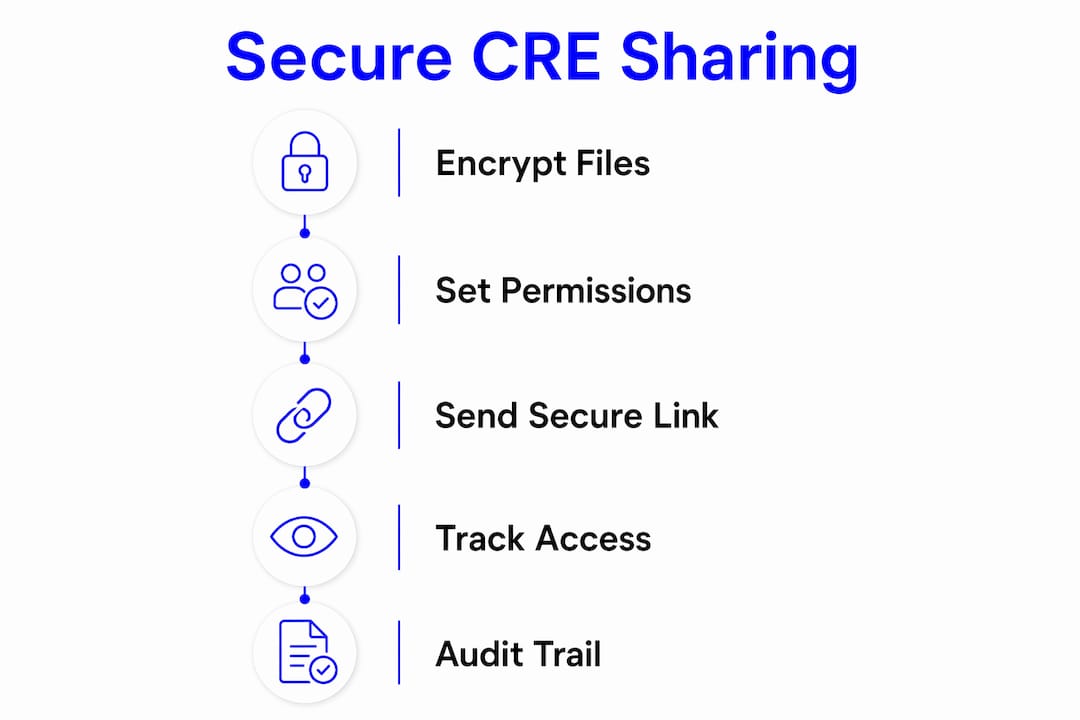
Password-protected links alone are not enough. If the platform can read your files, so can a breach. Zero-knowledge architecture, where the encryption key lives in the shareable link and never touches the provider’s servers, is the only way to guarantee that even the platform cannot access your documents. Send Securely uses AES-256-GCM encryption that runs entirely in the browser before upload.
Best practices for CRE brokers:
-
Use view-only mode for all underwriting documents and financial statements
-
Set expiration dates tied to deal timelines, not open-ended links
-
Require email verification for any document containing borrower PII
-
Never rely on a single password-protected link as your only security layer
-
Revoke access immediately when a deal closes, falls through, or a lender passes
-
Audit your active shared links monthly and close anything stale
Pro Tip: Keep the recipient experience frictionless. One-click access without software installation is the difference between a lender opening your package and abandoning it for something easier. Security that creates friction gets bypassed.
How secure sharing supports compliance and builds credibility with lenders
Audit-ready document environments directly support due diligence. When a lender or investor asks for a record of who accessed a submission package and when, a platform with time-stamped logs answers that question in seconds. That kind of transparency reduces friction in the underwriting process and signals that you manage deals with discipline.
IRM-based sharing lets brokers retain ownership of documents after delivery, including the ability to revoke access remotely. For CRE brokers working with healthcare investors or any counterparty subject to HIPAA, platforms like Virtru Secure Share support HIPAA-compliant encrypted file sharing with full compliance documentation. That level of compliance coverage matters when a deal involves a regulated entity on the other side of the table.
Compliance and credibility benefits:
-
Audit trails satisfy due diligence requests without manual documentation
-
IRM and remote revocation protect sensitive financial data after delivery
-
HIPAA-compliant platforms cover deals involving regulated counterparties
-
Secure sharing signals professionalism and reduces lender hesitation
-
Reduced liability exposure when documents are accessed only by verified recipients
How to integrate safe document transfer into your daily CRE workflow
The brokers who get the most out of secure sharing tools are the ones who wire them directly into existing workflows rather than treating them as a separate step. Platforms that integrate with Outlook and Gmail let you send a protected link from the same compose window you already use. CRM integration means every document send is logged against the deal record automatically.
Real-time engagement alerts tell you when a lender opens your package, how long they spent on each page, and whether they came back for a second look. That data lets you prioritize follow-ups based on actual interest rather than a calendar reminder. Batch sending tools cut the time spent on multi-lender submissions from an hour to minutes.
Integration checklist:
-
Connect your secure sharing platform to Outlook or Gmail for in-workflow sends
-
Link audit trail data to your CRM deal records for automatic logging
-
Use batch send for multi-lender submissions with individual tracking per recipient
-
Set standard permission templates for each deal phase (initial inquiry, full package, closing docs)
-
Maintain a central secure document vault as the single source of truth for all submissions
-
Train any team members or assistants on permission settings before they send on your behalf
How Brokers Connect supports secure document management for CRE brokers
- Brokers Connect builds secure document handling directly into the deal workflow rather than treating it as an add-on. The platform’s secure document vault uses encryption to protect loan packages, financial statements, and deal files, with access controls that let brokers set expiration dates, limit views, and revoke access instantly. Audit trails show exactly when a lender opened a document and for how long, giving brokers the engagement data they need to time follow-ups effectively.
The platform connects document sharing to lender matching and deal submission in one place. Brokers can match a loan scenario to verified lenders from a large database of verified lenders, package the deal, and send a protected submission link without switching tools. That integration removes the gap between finding a lender and getting them the right documents securely.
| Feature | Brokers Connect capability |
|---|---|
| Secure document vault | Encrypted storage with access controls and instant revocation |
| Audit trails | Time-stamped logs showing lender engagement per document |
| Lender matching | AI-powered matching across 289+ verified lenders |
| Deal pipeline CRM | Tracks submissions, conversations, and deal status |
| Batch lender outreach | Send protected packages to multiple lenders simultaneously |
| Loan types supported | Bridge, DSCR, construction, multifamily, commercial mortgage, and more |
| Recipient access | No account required for lenders to open submissions |
How do different secure document sharing solutions compare for CRE brokers?
General-purpose encrypted file sharing tools like Proton Drive, Send Securely, and Capsule each offer strong encryption, expiring links, and no-account recipient access. They work well for one-off confidential document exchange but lack CRE-specific context: no lender database, no deal pipeline, no submission tracking tied to a specific loan scenario.
Enterprise platforms built for financial services add compliance depth and audit infrastructure, but they carry enterprise pricing and implementation timelines that most independent CRE brokers cannot justify. CRE-specific platforms close that gap by combining document security with the deal management tools brokers actually use daily.
Step-by-step guide to implementing secure sharing in your CRE workflow
-
Audit your current process. List every point where you send or receive sensitive documents. Email attachments, shared Google Drive folders, and Dropbox links are the most common gaps.
-
Choose a platform with zero-knowledge encryption and no-account recipient access. Friction kills adoption on the lender side.
-
Set permission templates for each deal stage. Initial inquiry packages get view-only with a 14-day expiration. Full underwriting packages get email verification and a 30-day window.
-
Integrate with your email client. Connect the platform to Outlook or Gmail so protected links replace attachments in your normal compose workflow.
-
Connect audit data to your CRM. Log every document open against the deal record so your pipeline reflects actual lender engagement.
-
Revoke and archive on deal close. When a deal closes or dies, revoke all active links and move documents to your secure vault.
What real efficiency gains look like when brokers adopt secure sharing
A broker submitting to 10 lenders simultaneously without a batch tool spends time formatting and sending individual emails, then manually tracking who responded. With a platform that supports batch protected sends and per-recipient audit trails, that same submission takes a fraction of the time and produces engagement data that shows which lenders actually opened the package.
The credibility shift is equally concrete. Lenders who receive a professionally packaged, access-controlled submission link rather than a ZIP file attached to an email treat the broker differently. It signals that the deal is organized, the borrower data is handled carefully, and the broker runs a professional operation.
Legal and regulatory considerations for CRE loan document handling
CRE brokers in the U.S. handle documents that touch multiple regulatory frameworks. Borrower financial statements and tax returns carry privacy obligations. Deals involving healthcare-related properties or healthcare investors may trigger HIPAA requirements for any shared financial data. The Gramm-Leach-Bliley Act (GLBA) applies to brokers who handle nonpublic personal financial information, requiring reasonable safeguards for that data.
Audit trails are not just operationally useful. They are a defensible record that you handled sensitive information appropriately. In a dispute or regulatory inquiry, a time-stamped log showing exactly who accessed a document and when is far stronger than an email thread.
How to set access controls that match CRE document sensitivity
Not every document in a deal package carries the same risk. A property brochure can go out on an open link. A personal financial statement or tax return needs email verification, view-only mode, and a short expiration window. Structuring permissions by document sensitivity rather than applying one setting to everything is how brokers avoid both over-restricting low-stakes materials and under-protecting high-stakes ones.
For the most sensitive documents, stack multiple controls: email verification plus view-only plus a 7-day expiration. For lender-facing deal summaries, a password-protected link with a 30-day expiration is usually sufficient. Instant revocation should always be available regardless of which tier a document falls into.
Brokers Connect puts secure document tools where you already work
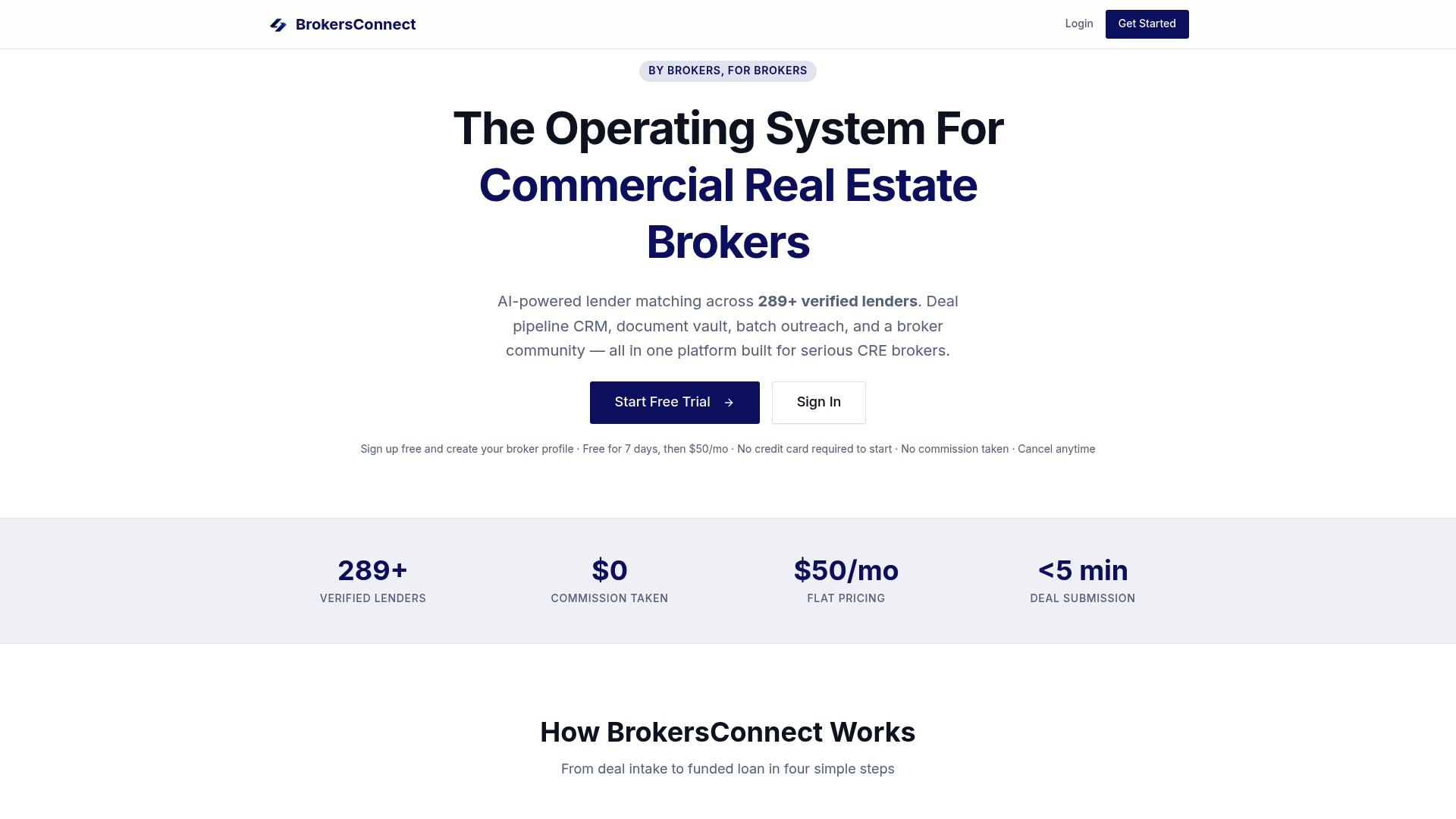
Most brokers don’t need another standalone tool. They need secure document handling built into the platform where they already manage deals, track lenders, and submit packages. Brokers Connect does exactly that. The platform combines an encrypted document vault, audit trails, and batch lender outreach with AI-powered lender matching across 289+ verified lenders, a deal pipeline CRM, and direct messaging, all under one subscription with no commission or transaction fees.
For brokers who want to stop emailing attachments and start sending protected, trackable submissions that reflect how seriously they take their clients’ data, start with BrokersConnect and see how the workflow changes from the first deal.
Key Takeaways
Secure document sharing in CRE requires encryption, granular access controls, and audit trails working together. Platforms that lack any one of those three elements leave brokers exposed.
| Point | Details |
|---|---|
| Zero-knowledge encryption | The platform cannot read your files; the decryption key stays in the shareable link. |
| View-only mode prevents leakage | Blocking downloads stops recipients from forwarding sensitive underwriting data beyond vetted contacts. |
| Audit trails drive follow-ups | Time-stamped engagement logs show which lenders opened your package and for how long. |
| IRM enables remote revocation | Information Rights Management lets brokers cut off document access after delivery, even for downloaded files. |
| Brokers Connect integrates both | The platform combines an encrypted document vault and audit trails with lender matching and deal pipeline tools in one place. |