
A credit memo is an accounting document that reduces a prior invoice, and it is never a cash refund. To be audit-ready for a real estate transaction, it needs a unique memo number, an original invoice reference, itemized credit lines, a tax reversal, a total, and a specific, contract-linked reason for the credit.
TL;DR:
- A credit memo must reference the original invoice, include itemized credit lines, and specify a contract-linked reason to ensure auditability and traceability.
- Proper processing requires verifying supporting documents, applying the credit before the next payment, and correctly reversing sales tax to avoid common errors.
- Using standardized templates like DOCX, PDF, or native ERP formats helps prevent manual entry mistakes and suits different volumes of transaction adjustments.
- Lenders and auditors expect detailed, contract-specific reasons, supporting documents, and sequential numbering for quick review and faster loan approvals.
- Organizing credit memos and supporting files within a document management platform enables quick retrieval, reducing delays during underwriting and loan closings.
Table of Contents
- What Fields Belong on a Real Estate Credit Memo Template?
- How Do You Process and Apply a Credit Memo in Real Estate Accounting?
- A Worked Example: Broker Commission Credit Memo
- Which File Format Should Your Credit Memo Template Use?
- What Do Lenders and Auditors Expect From a Real Estate Credit Memo?
- Clean Paperwork Moves Loans Faster Than Clean Deals
- Keep Your Templates and Submissions Organized With BrokersConnect
- Templates and Guidance Worth Bookmarking
- Sources
- FAQ
What Fields Belong on a Real Estate Credit Memo Template?
A credit memo works only if the person reading it later, whether that's an auditor, a lender's underwriter, or your own bookkeeper, can trace it back to the original charge without asking you a follow-up question. That means every field earns its place for a reason.
The essential elements of a professional credit memo start with issuer and buyer identity: legal entity names, addresses, and tax IDs where applicable. Skip the DBA name if it doesn't match your invoicing records. Layer on these next:
- Credit memo number and issue date. Use a sequential numbering scheme (CM-2026-0142, for example) so gaps get flagged automatically.
- Original invoice number and date. This is the single most important field. Without it, the credit floats unmatched in your books.
- Itemized lines. Description, quantity, unit price, credited amount, and tax rate per line, not a lump sum.
- Tax reversal line. Show the sales tax being credited separately from the principal amount.
- Subtotal, tax, and total credit, with currency and a clear sign convention (most systems show credits as negative amounts).
- Reason for credit, written specifically. "Correcting overbilled leasing commission per contract addendum dated March 3, 2026" beats "billing error" every time.
Optional but genuinely useful: a purchase order number, the contract clause you're citing, an approver's name or signature, and any terms or expiry date on the credit. One data model groups all of this into four logical clusters: issuer details, customer details, order linkage, and credit calculation, which makes templates easier to build and easier for a system to parse.
Pro Tip: Write the reason field the way you'd write a memo line for a lender's underwriter, not a shorthand note to yourself. Six months from now, neither of you will remember what "adjustment per email" meant.
How Do You Process and Apply a Credit Memo in Real Estate Accounting?
Issuing the memo is the easy part. Applying it correctly, so it actually reduces the right receivable or payable, is where most errors happen.
- Receive and log the request. Capture the supporting documentation, whether that's a signed commission addendum, a lease amendment, or a deposit reconciliation, before anything gets entered.
- Verify and get approval. Match the credited quantity and amount against the contract clause being cited, and route it through whatever approval threshold your firm requires.
- Enter it in your accounting system. Code it to the correct GL account and include the tax reversal at this step, not after the fact.
- Match and apply it to the original invoice. Do this before the next payment run, not after. A credit sitting unmatched is a credit that can get missed entirely.
- Reconcile both sides. On the seller side, debit Sales Returns/Allowances and credit Accounts Receivable. On the buyer side, debit Accounts Payable and credit the original expense account.
Failing to reverse the associated sales tax is one of the most frequent errors in credit memo processing, and it creates discrepancies in both parties' tax filings. Duplicate memo numbers and missing invoice references cause the same kind of downstream mess, usually discovered during a quarterly close when nobody has time to untangle it.
A Worked Example: Broker Commission Credit Memo
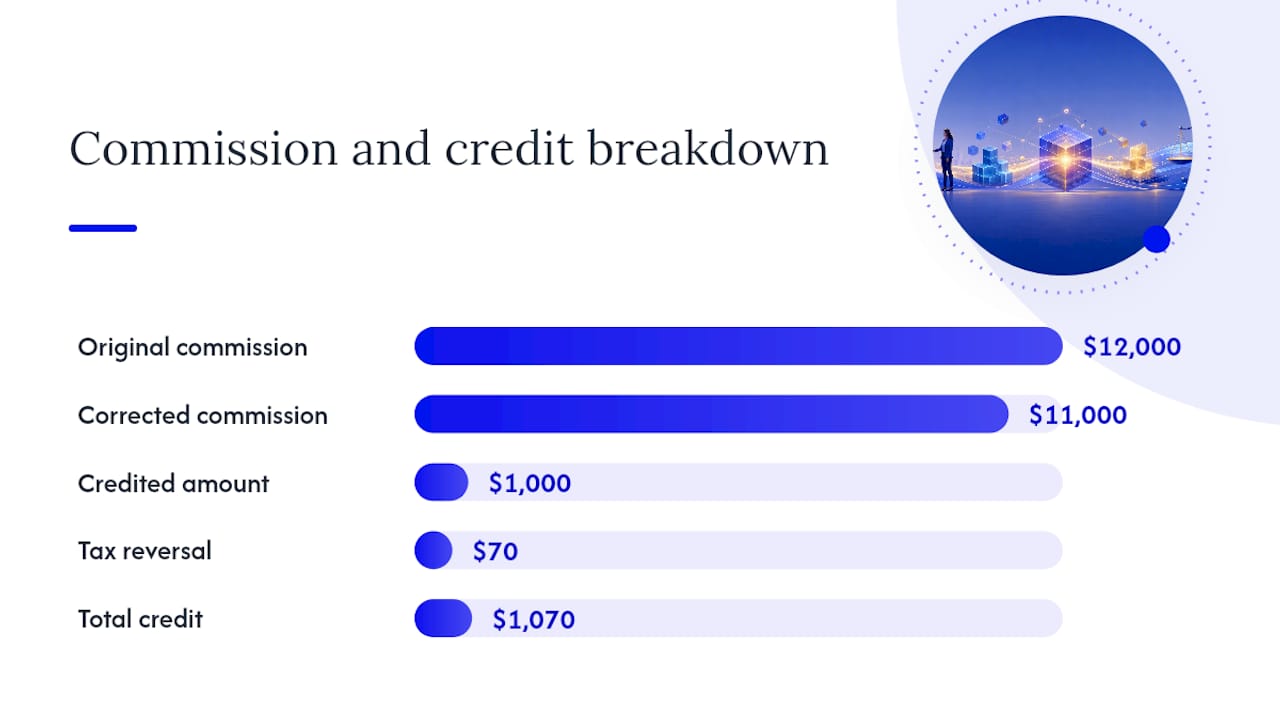
Here's a scenario every commercial broker recognizes: a leasing commission gets calculated on the wrong square footage, and the client needs a credit before the invoice gets paid.
Say the original invoice billed a $12,000 commission based on 24,000 rentable square feet, but the lease amendment corrected the space to 22,000 square feet. The corrected commission is $11,000, so a $1,000 credit is due.
| Field | Value |
|---|---|
| Credit Memo Number | CM-2026-0142 |
| Issue Date | February 2026 |
| Original Invoice Ref | INV-2026-XXXX |
| Line Item | Commission adjustment, square footage correction |
| Credited Amount | $1,000 |
| Tax Reversal | $70 |
| Total Credit | $1,070 |
| Reason | Correcting commission per lease amendment dated February 2026, Section referenced |
On the brokerage's books, that's a debit to Commission Revenue for $1,000, a debit to Sales Tax Payable for $70, and a credit to Accounts Receivable for $1,070. The client's books mirror it in reverse.
When a single property has multiple tenants or recurring management charges tied to one master invoice, allocate the credit line by line against each affected tenant charge rather than issuing one blended adjustment. Lumping it together is exactly what makes reconciliation painful three months later.
Which File Format Should Your Credit Memo Template Use?
The right format depends on volume, not preference. A brokerage issuing three or four credits a year has different needs than a firm managing recurring property management adjustments across dozens of leases.
- Editable DOCX or Excel works well for one-off adjustments where you want full control over layout and can hand-edit line items quickly.
- Fillable PDF is faster for standardized use. US-focused credit memo generators let you reference the original invoice, add line items, and calculate the sales tax reversal, then download a compliant PDF with no signup required.
- Native ERP entry (QuickBooks, NetSuite, Xero) is the right call once volume justifies it, since the credit posts directly against the matched invoice.
If you're mapping fields into a system or API, keep the naming consistent: memo number becomes creditMemoId, the original invoice becomes invoiceRef, and each credit line becomes an entry in a lines array with sku, description, quantity, unit price, and tax rate. A real-estate-specific credit note template built for brokerage commission adjustments and recurring property management invoices already follows this structure, and it supports programmatic PDF generation for firms issuing credits at scale.
Pro Tip: If you're issuing more than a handful of credits a month, stop hand-typing them. Automation and direct ERP integration cut manual data-entry errors far more reliably than a careful eye ever will.
What Do Lenders and Auditors Expect From a Real Estate Credit Memo?
A credit memo that touches a borrower's income or expenses doesn't just need to balance the books, it needs to survive a lender's scrutiny during underwriting. In CRE loan packaging, lenders expect any credit affecting borrower cash flow to come with supporting documents and a precise contract reference, so the underwriter can tell whether it's a routine operational adjustment or a structural change to income.
A few controls make that review faster:
- Cite the exact contract clause or amendment date in the reason field, not a vague summary.
- Present the sales tax reversal with the calculation visible, not just the net figure.
- Retain the receiving documents, approvals, and signed amendments for as long as your firm's audit retention policy requires.
- Apply the credit before the next payment run, never after, so the file reflects the true balance at closing.
- Use sequential, gap-free numbering so a reviewer can spot a missing memo at a glance.
Specific, contract-linked wording for the reason field materially cuts down on the back-and-forth auditors and lenders generate when a credit looks ambiguous.
Clean Paperwork Moves Loans Faster Than Clean Deals
Underwriters don't slow down deals because the numbers are wrong. They slow down because the numbers don't explain themselves. A credit memo with a vague reason field ("adjustment," "billing correction") invites a follow-up email, and that email sits in someone's queue for three days while your deal waits.
The fix isn't complicated. Build one template, use it every time, and cite the contract clause instead of paraphrasing it. Include the supporting documents in your initial submission rather than waiting for the lender to ask, the same way a well-built deal memo front-loads the questions a lender would otherwise ask later. Brokers who treat this as a formatting exercise are missing the point: it's a speed exercise. The checklist in this article exists to make sure your file never becomes the reason a deal stalls at week three of underwriting.
— Theron
Keep Your Templates and Submissions Organized With BrokersConnect
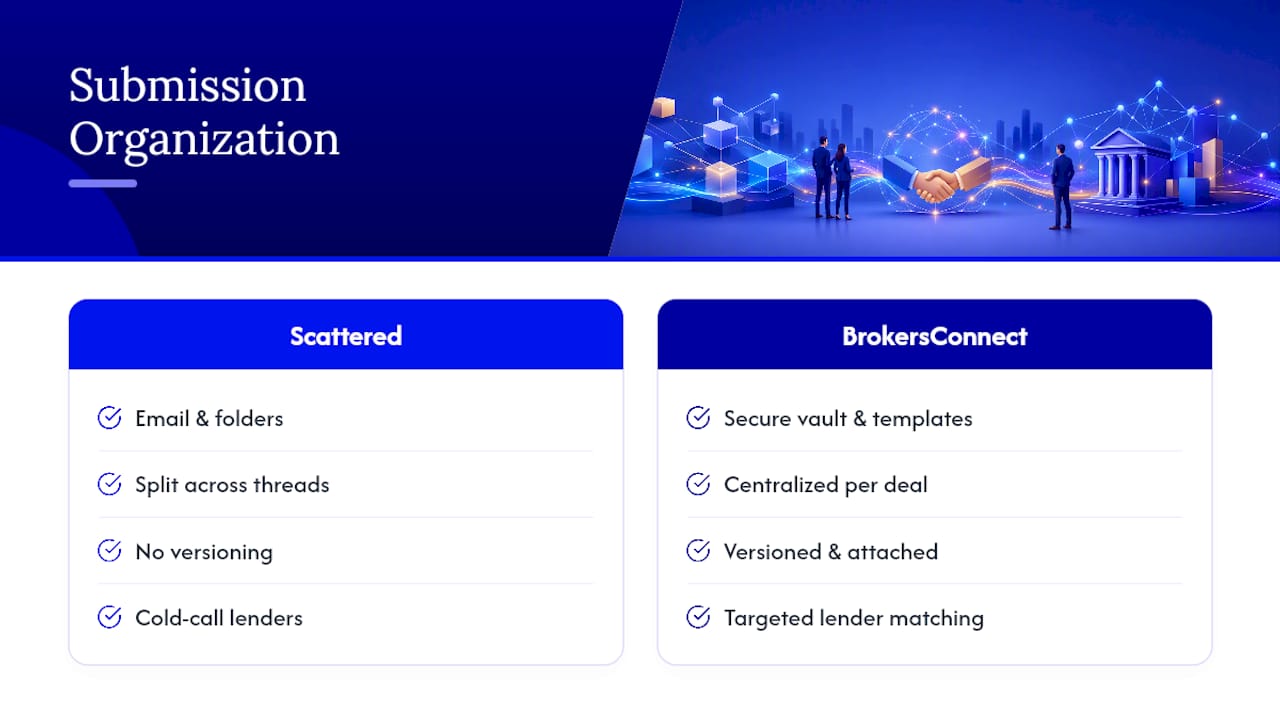
BrokersConnect gives you a real edge over cobbling together spreadsheets and email chains: a secure document vault and template library where your credit memos, supporting amendments, and loan submission files live in one organized place instead of scattered across your inbox.

That matters more than it sounds. When a lender's underwriter asks for the commission adjustment backup on a deal you submitted six weeks ago, you shouldn't be searching three folders and two email threads to find it. BrokersConnect's deal pipeline tools keep every document versioned and attached to the right scenario, and the platform's lender matching means your packaged submission, credit memos included, reaches lenders who are actually positioned to move on your deal type and loan size. Instead of cold-calling lender lists, you're submitting to a shortlist built around your property type, leverage, and structure.
If you're currently managing loan documentation across scattered folders and email threads, start a free trial with BrokersConnect and see how a real-estate credit memo template fits directly into a lender-ready submission package.
Templates and Guidance Worth Bookmarking
For quick reference, the US credit memo generator produces a fillable PDF with tax reversal built in, and the real estate credit note template covers brokerage-specific adjustments. For broader transaction context, ACDNSW's property transaction guide walks through procedural steps worth knowing as an analogy for documentation discipline.
Sources
- Credit Memo — The Complete Guide +3 Templates & Examples
- Credit Memo: What It Is, Meaning, Examples - Blog - InvoiceExtractor
- Credit Memo in Accounts Receivable: Definition, Examples & Best Practices
- US Credit Memo Generator - Free Credit Note PDF Template | invoice24
- Pdf4
FAQ
How Do You Write a Credit Memo?
Start with a unique memo number and issue date, reference the original invoice, itemize each credited line with its tax rate, add a tax reversal, and write a specific, contract-linked reason before totaling the credit.
Can You Give an Example of a Credit Memo?
A commission overbilling correction is a common real estate example: a $12,000 commission invoice gets reduced by $1,000 plus tax because a lease amendment corrected the square footage, producing a $1,070 total credit tied to the original invoice number.
What Are the "C's" of Credit Appraisal?
Definitions vary by lender, but the most common version includes character, capacity, capital, collateral, conditions, and sometimes credit history and cash flow. This framework applies to borrower creditworthiness assessments, not to credit memo formatting.
What Is a Letter of Credit in Real Estate?
A letter of credit is a bank's guarantee of payment to a landlord or lender, often used in place of a cash security deposit. It's a separate financial instrument from a credit memo, which adjusts an existing invoice rather than guaranteeing future payment.
Is a Credit Memo the Same as a Refund?
No. A credit memo is a ledger adjustment that reduces a receivable and stays open until it's applied to an invoice, while a refund is an actual cash payment back to the buyer.