
Broker fee calculation on a commercial real estate loan comes down to one formula: agreed percentage times the funded loan amount. Mid-market deals typically start around 1% of the funded loan, scaling up for smaller, more labor-intensive loans and down for large institutional deals. The main exceptions are retainers credited against the success fee and who actually pays it: borrower, lender, or both.
TL;DR:
- Broker fees typically start around 1% of the funded loan but vary based on deal size, complexity, and effort, with higher fees for smaller or more labor-intensive loans.
- The fee calculation depends on the basis (funded amount versus total facility), with rounding and minimum fee floors significantly affecting small deals.
- Who pays the fee (borrower, lender, or split) influences the total cost, with lender-paid fees often baked into interest rates rather than paid upfront.
- Clear engagement letters must specify the exact fee, basis, payer, timing, and credit terms to prevent disputes and ensure transparency.
- Pricing strategies should incorporate historical close rates, tiered fees, retainers, and accurate cost tracking to maintain profitability across all deal types.
Table of Contents
- How Do You Calculate a Broker Fee Step by Step?
- Who Pays the Broker Fee, and How Does That Change the Numbers?
- What Are Typical Broker Fee Percentages by Loan Size?
- What Does a Broker Fee Look Like in Dollars?
- What Should the Engagement Letter Say About Fees?
- How Should Brokers Price Fees to Cover Real Costs?
- A Habit That Keeps Fee Disputes Off Your Desk
- Calculate and Close Faster With Thecrebrokersconnect
- Sources
How Do You Calculate a Broker Fee Step by Step?
Before touching a formula, pull four numbers: the funded loan amount, the agreed fee percentage, any minimum fee floor, and any retainer paid up front. Skipping the minimum-floor check is how brokers on small deals accidentally invoice themselves out of a living wage.
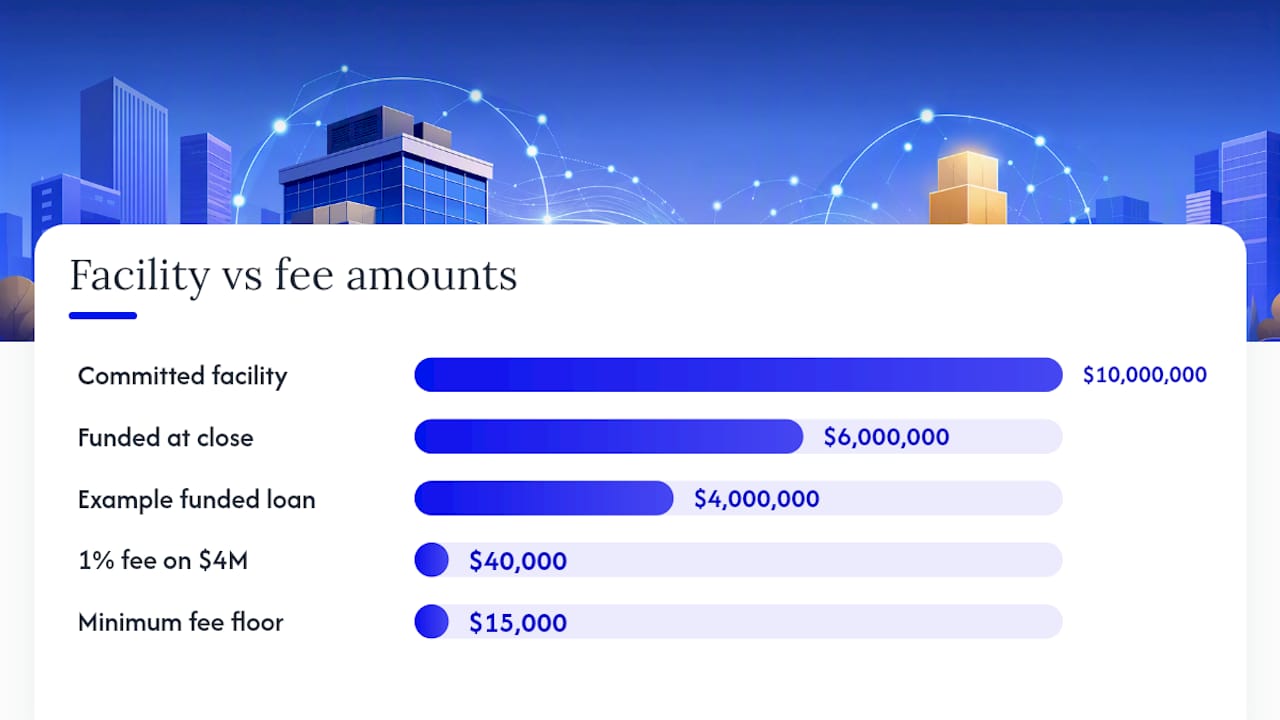
- Confirm the fee basis. Is the percentage applied to the funded loan amount or the full facility (including undrawn/unfunded commitments)? These produce very different numbers on a construction loan with a $10 million facility but only $6 million funded at close.
- Apply the percentage. Fee = agreed % × funded loan amount. A 1% fee on a $4 million funded loan is $40,000.
- Check against the minimum. If the engagement letter sets a $15,000 floor and the calculated fee is $9,000, the floor wins.
- Subtract any retainer already collected. If a $5,000 retainer was paid at engagement and credited against the success fee, the final invoice is the calculated fee minus that amount.
- Split if multiple parties are compensated. On co-brokered deals, apply the agreed split (commonly 50/50 or negotiated) to the net fee after any referral cut.
Rounding matters more than brokers assume. Round to the nearest dollar on the final invoice, never on intermediate steps, or you compound small errors across a split calculation.
Pro Tip: Always confirm in writing whether the fee applies to the amount funded at closing or the total committed facility. On a phased construction draw, that distinction alone can shift your check by tens of thousands of dollars.
Who Pays the Broker Fee, and How Does That Change the Numbers?
The payer model changes both who writes the check and how much the deal actually costs over time.
- Borrower-paid: the sponsor pays a percentage fee at closing, typically deducted from loan proceeds or paid separately. This is the most transparent structure and the easiest to disclose.
- Lender-paid: the lender compensates the broker, often by baking the cost into a rate uplift of roughly 12.5 to 25 basis points rather than an upfront dollar amount.
- Split compensation: borrower and lender each cover a portion, common on institutional bridge and debt fund transactions where both sides negotiate who absorbs what.
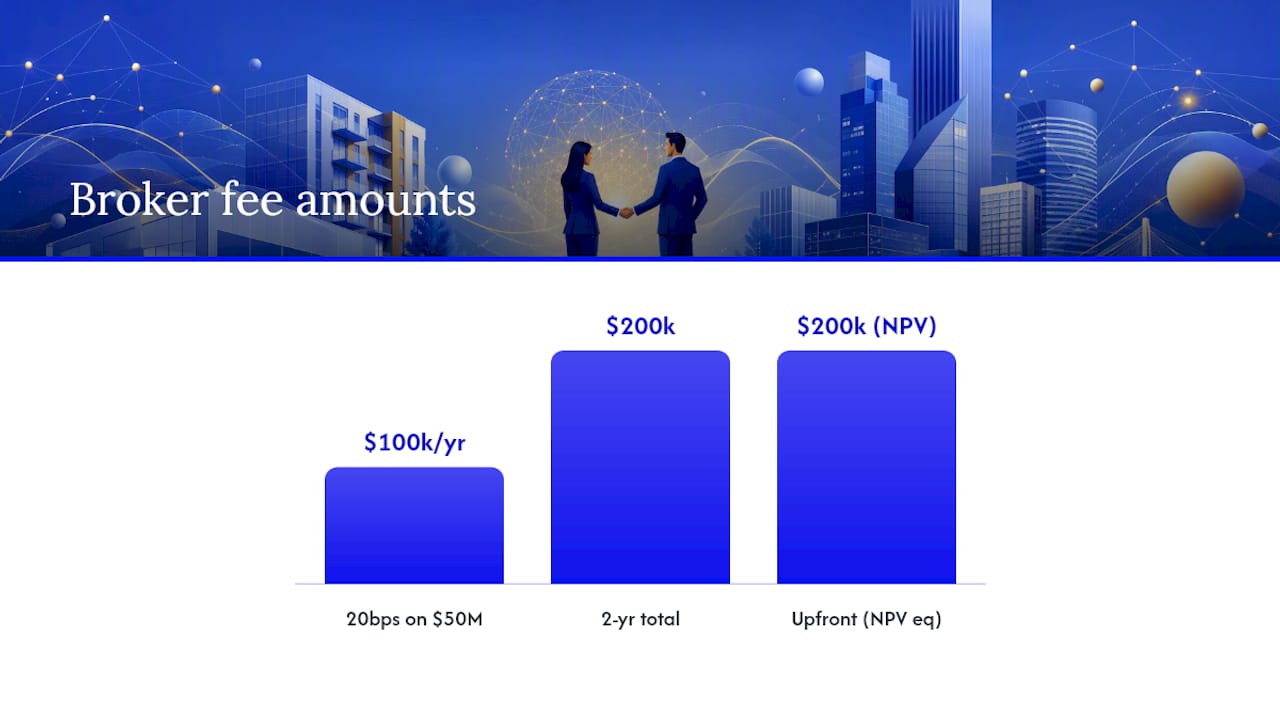
A 20 basis point rate uplift on a $5 million loan adds $10,000 a year in extra interest. Borrowers who want to preserve cash at closing tend to prefer lender-paid structures; borrowers focused on minimizing total cost of capital often do better negotiating a smaller upfront fee instead.
Disclosure obligations shift too. A split structure requires both parties to see the same fee basis in writing, or the broker risks a dispute at the closing table.
What Are Typical Broker Fee Percentages by Loan Size?
Broker fee percentages move inversely with loan size, because underwriting effort does not scale down as fast as the loan amount does. A $750,000 loan and a $50 million loan both require similar amounts of lender vetting, document review, and negotiation, but the smaller deal pays a much thinner dollar fee at the same percentage.
- Under $1 million: fees tend to be higher, reflecting the greater relative workload, often combined with a flat-fee floor since percentage alone may not cover the effort.
- $1 million to $5 million: around 1%, the most common mid-market benchmark.
- $5 million to $15 million: 0.75% to 1%, with room to negotiate based on complexity.
- $15 million and up: 0.25% to 0.75% on institutional-grade deals, where volume and relationship value replace per-deal margin.
- Specialty products like bridge loans, hard money, and SBA financing frequently command premiums above these ranges, since speed and risk tolerance justify a higher price.
Complexity and speed requirements can override loan size entirely. A rushed $20 million bridge refinance with a 30-day close can justify a fee closer to the mid-market range than the institutional range, because the broker is compressing weeks of work into days.
Retainers in the $0 to $10,000 range are common on larger or more speculative deals, and nearly always credited against the final success fee rather than charged on top of it.
What Does a Broker Fee Look Like in Dollars?
Numbers make the percentages concrete. The table below assumes borrower-paid structures unless noted, with a $10,000 retainer credited where applicable.
That last row is worth unpacking: a 20 basis point uplift on $50 million generates $100,000 a year in additional interest. Over a two-year hold, that is $200,000, matching the equivalent upfront fee almost exactly once modeled against the NPV over the loan term rather than compared as raw cash.
What Should the Engagement Letter Say About Fees?
Every dispute over broker compensation traces back to something left vague in the engagement letter. Nail down these items before you start working the deal, not after a term sheet lands.
- The exact percentage or formula, spelled out in numbers, not "market rate" language.
- The fee basis, funded loan amount versus total facility, stated explicitly for any deal with phased funding.
- Who pays, borrower, lender, or a defined split, with the mechanism for each.
- Payment timing, whether the fee is due at closing, partially at term sheet acceptance, or on a milestone schedule.
- Refundable and credit terms, specifying exactly how a retainer applies against the success fee and what happens if the client walks before closing.
A short pre-closing checklist should confirm the funded amount, recheck the fee basis against the actual closing documents, and verify the retainer credit before the final invoice goes out. Templates for this language exist so you are not drafting from scratch on every deal; a solid fee agreement template covers most of the clauses above out of the box.
Pro Tip: Write the retainer-credit clause so it survives a terminated engagement. Something like "the retainer is fully creditable against any success fee earned within 12 months of termination if the borrower closes with a lender introduced during the engagement" protects you from losing credit on a deal that closes late.
How Should Brokers Price Fees to Cover Real Costs?
Brokers who price only for the deals that close end up underpaid across their full pipeline. If you close a minority of the files you actively work, your effective fee on winning deals needs to cover the hours spent on the ones that fell apart.
- Fold your historical close rate into your minimum fee threshold, not just your percentage.
- Use tiered percentages that reward speed and simplicity, and charge more for deals with unusual structures or short timelines.
- Set retainers on speculative or first-time sponsor relationships to offset diligence time that may never convert to a closing.
- Track time-per-file against fees earned so you know which deal types are actually profitable.
A fee calculator that ties percentage, minimums, and retainer credits together in one workflow, paired with lender-matching data on which loan types close fastest, makes it easier to defend your number to a sponsor who is comparing quotes.
A Habit That Keeps Fee Disputes Off Your Desk
I ask for a retainer on any deal where the sponsor is new to me or the structure is unusual, and I write the credit terms into the engagement letter before I do a single hour of underwriting. It has saved more relationships than it has cost me clients. If you want to see how the math works on your next deal, run it through a calculator built for this exact workflow.
— Theron
Calculate and Close Faster With Thecrebrokersconnect
Thecrebrokersconnect turns fee math and lender outreach into one workflow instead of two separate headaches. Its built-in fee calculator applies the formulas above automatically, while AI-powered lender matching pulls from a database of 289+ verified lenders so you spend less time cold-calling and more time closing.
Every deal scenario you submit gets matched against lenders by property type, loan amount, and structure, then tracked through a pipeline CRM built for brokers, not generic sales teams. If you place DSCR loans regularly, the platform's DSCR-specific guidance pairs well with the fee calculator when pricing those deals. For numeric cross-checks on offer modeling, a tool like DealAnalyzerAI's calculators is a solid companion for the underwriting side.
Start a free trial and run your next deal's fee calculation through the platform before you send the engagement letter.