
A CRE loan deal memo is a one-page lender-facing summary that states the loan request, the key underwriting numbers, the collateral, and your recommendation. Its only job is to get a lender to say yes to a phone call. Lenders triage dozens of submissions a week, and a memo that forces them to hunt for the loan amount, the DSCR, or the LTV gets pushed to the bottom of the pile. One page, organized around NOI, LTV, and DSCR, moves faster because it answers the lender's first three questions before they have to ask. Brokers using Thecrebrokersconnect's template library build this structure once and reuse it across every submission.
Start with a three-line BLUF: loan amount, purpose, and your recommendation. Then fill in the essentials:
- Property address, type, and current occupancy
- Loan amount, purpose (acquisition, refinance, or construction), and requested term
- LTV and DSCR
- NOI (trailing twelve months)
- Sponsor experience and net worth/liquidity summary
- Two or three sentences on exit strategy
- Top risk and its mitigant
Key Takeaways
A one-page deal memo built around DSCR, LTV, and NOI, with each figure tied to a named document, gets read and answered faster than a lengthy narrative packet.
| Point | Details |
|---|---|
| Lead with the BLUF | State loan amount, purpose, and recommendation in the first three lines. |
| Show four core numbers | LTV, DSCR, NOI (T-12), and term belong in a scannable table, not buried in prose. |
| Name your top risk first | State the biggest risk and its mitigant before the lender has to ask. |
| Tie numbers to documents | Reference the exact file backing each ratio to avoid follow-up delays. |
| Use Thecrebrokersconnect to scale | Templates, lender matching, and a document vault turn one good memo into a repeatable process. |
Templates and Guides Worth Reading Next
- Pre-submission document checklist: what lenders actually require before underwriting starts.
- Commercial loan credit memo structure: the underwriter's version of your memo.
- IC memo template: useful structure for larger institutional submissions.
- Best DSCR lenders guide: matching DSCR deals to the right capital source.
- Value-add multifamily case study: a real repositioning deal to benchmark your own numbers against.
Table of Contents
- One-Page Deal Memo Template and a Filled Example
- Three Filled Deal Memo Examples for Common CRE Loan Types
- What Lenders Read First (and the Red Flags That Kill a Request)
- How to Package and Send a Deal Memo Lenders Will Open
- Copy-and-Paste Blank Deal Memo Template
- What Brokers Who Submit to Lenders Every Week Get Right
- Package Deals Faster With Thecrebrokersconnect
- Frequently Asked Questions
- Sources
One-Page Deal Memo Template and a Filled Example
Every strong memo follows the same skeleton: a header identifying the deal, a one-line recommendation, a compact numbers table, and a short narrative. A lender-ready financing memo needs financial analysis, borrower qualifications, collateral details, and a clear executive summary stating the loan amount, purpose, structure, and your recommendation. Skip any of those and you invite a round of clarifying emails instead of a term sheet.
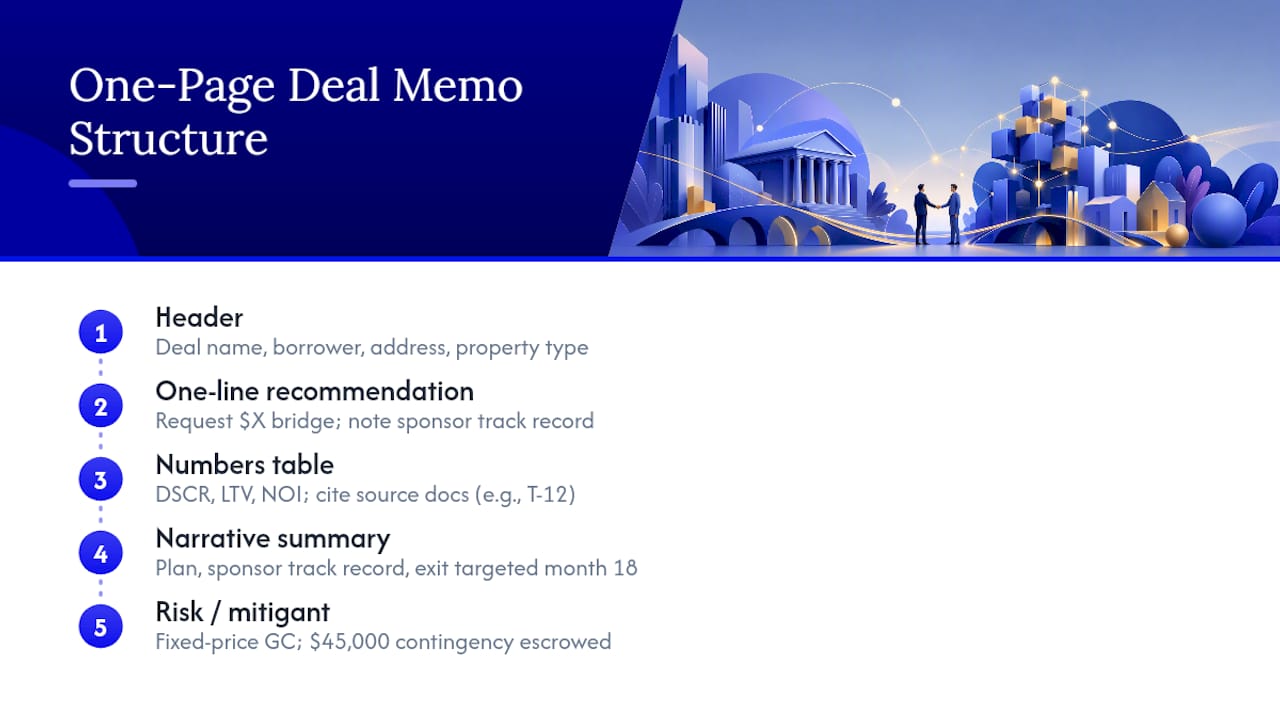
Header: Deal name / Borrower entity / Property address / Property type
One-line recommendation: "Requesting $X bridge loan at Y% LTV to fund acquisition and renovation; sponsor has completed three similar repositions in the submarket."
Numbers table (fill with your deal's figures):
Narrative (3-5 sentences): State the business plan, the sponsor's track record, and the exit. Post-renovation rents are projected at $1,450/unit, up from $1,180 in-place, based on three comparable renovated properties within one mile. Exit is a permanent refinance or sale at stabilization, targeted at month 18. Sponsor has completed four similar value-add projects in the last six years with no defaults.
Risk/mitigant lines (one or two, no more): "Renovation timeline risk mitigated by fixed-price GC contract with $45,000 contingency reserve already escrowed."
A commercial loan credit memo built for internal underwriting will run several pages. Your broker-facing version compresses the same substance into fields a loan officer can scan in under a minute.
Pro Tip: Tie every ratio to one supporting document. If your memo states DSCR of 1.32x, note the source in parentheses: "(1.32x, per T-12 attached: RentRoll_T12.pdf)." That single habit cuts follow-up questions dramatically because the lender never has to ask where a number came from.
Three Filled Deal Memo Examples for Common CRE Loan Types
Adapting a template is faster than writing one from scratch, and these three cover the loan requests brokers submit most often: bridge, multifamily refinance, and construction. Lenders typically want to see a headline DSCR near 1.25x for a clean approval, with LTV in the 75 to 80% range depending on asset type, so use these general benchmarks when deciding whether a deal needs extra risk mitigation language.
-
Bridge loan, value-add retail. Sponsor requests $4.2 million (62% LTV) to acquire and reposition a 28,000-square-foot strip center anchored by a regional grocer, with a 12-month interest-only term. In-place NOI is $290,000 against a $410,000 pro forma NOI once three vacant suites are leased at market rents. Exit assumes refinance into a permanent CMBS or bank loan at stabilization, or sale to a 1031 buyer. Top risks: lease-up timing and interest rate movement on the takeout loan. Mitigants: signed LOIs on two of three vacant suites and a rate-lock option built into the exit lender's term sheet.
- Sponsor bullets: 15 years retail ownership, three prior repositions in the same MSA, $1.1 million liquid.
-
Multifamily refinance, stabilized asset. Borrower seeks $6.5 million (70% LTV) to refinance a 60-unit apartment complex, replacing a maturing bridge loan. Stabilized NOI is $520,000 with 94% occupancy and a 5.9% cap rate. Rent comps from two nearby properties support a modest rent bump over the next 12 months without disrupting occupancy. DSCR at the new rate comes in at 1.28x. Top risks: rate reset exposure and rising insurance costs in the region. Mitigants: five-year fixed-rate request and an insurance reserve escrow.
- Sponsor bullets: owned the asset four years, no late payments, net worth exceeds loan amount 2:1.
-
Construction loan, ground-up industrial. Developer requests $8.9 million in a $12.4 million total capital stack (72% LTC) to build a 65,000-square-foot flex industrial building, with sponsor equity covering the remaining $3.5 million. Sources and uses show land already owned free and clear, contributing $1.8 million in basis. A 10% contingency ($890,000) is built into the draw schedule, with disbursements tied to third-party inspections at four phases. Pro forma stabilized NOI at lease-up is $980,000 against comparable industrial rents of $11.50/square foot triple net. Top risks: construction cost overruns and lease-up timing in a softening industrial submarket. Mitigants: GMP contract with the general contractor and a signed LOI covering 40% of the building.
- Sponsor bullets: completed two prior industrial builds on budget, GC has 20-year track record with this developer.
What Lenders Read First (and the Red Flags That Kill a Request)
Loan officers scan in a predictable order: loan amount and purpose first, then DSCR and LTV, then whether the NOI is actually supported by a T-12, then sponsor strength. If any of those four items is missing or vague, the memo often gets set aside rather than rejected outright, which is worse. It just sits.
The five C's of credit framework, capacity, character, capital, collateral, and conditions, still governs how underwriters evaluate a request, and most red flags trace back to one of those five being unclear. Common ones:
- Missing T-12 or a P&L that doesn't reconcile with tax returns
- Rents shown at market instead of in-place, with no comp support
- Vague exit strategy ("refinance or sell") with no timeline or lender named
- Sources and uses that don't add up, or omit the contingency line
State mitigants upfront instead of waiting for the lender to ask. Reference supporting documents inline, like "NOI $520,000 (T-12 attached: RentRoll_2026.pdf)," so the reviewer never has to chase you for backup.
Pro Tip: Redact Social Security numbers and account numbers from any personal financial statement before it goes into the initial packet. Lenders need verification of liquidity and net worth, not the raw account details, at the submission stage.
How to Package and Send a Deal Memo Lenders Will Open
Bundle your one-page memo (PDF) with the trailing-12 or pro forma, rent roll, guarantor PFS, and a title commitment or survey if you have one. Photos help, especially for value-add or construction deals where the lender can't picture the current condition.

Name files clearly: "SmithApartments_DealMemo.pdf," not "Scan_004.pdf." A single ordered PDF packet beats six separate attachments.
For the subject line, try one of these:
- "Bridge Loan Request - $4.2M - [Property Name] - [Borrower]"
- "Refinance Opportunity - 60-Unit Multifamily - 70% LTV"
- "Construction Financing - Flex Industrial - Ground Up"
A short cover email, three to five sentences, works as the verbal handshake: summarize the deal, list what's attached, and state the action you want. Follow up in 48 to 72 hours if you haven't heard back, and log every reply so you know which lenders respond fastest.
Copy-and-Paste Blank Deal Memo Template
Paste this directly into your CRM or email draft:
- Deal name / Borrower / Property address / Property type: ____
- Loan amount: $____ — Purpose: acquisition / refi / construction
- LTV: ____% — DSCR: x — NOI (T-12): $
- Term / Amortization: ____
- Sponsor summary (1-2 sentences): ____
- Exit strategy (1-2 sentences): ____
- Top risk + mitigant: ____
Cover email: "Attached is a one-page summary for [Property Name], a $[amount] request at [LTV]% LTV. NOI, rent roll, and sponsor financials are included. Let me know if this fits your current appetite." Keep the memo in PDF and the detailed model in Excel so the lender can open either without extra software.
What Brokers Who Submit to Lenders Every Week Get Right
The memos that get answered fastest aren't the most detailed. They're the ones where every number traces to a named document, so the lender never has to ask "where did this come from." Naming your top risk before the lender finds it themselves also changes the tone of the whole conversation. It reads as confidence, not concealment.
One habit worth adopting: send Tuesday through Thursday morning. Lenders often clear a backlog of Monday submissions before giving new ones real attention, and Friday afternoon sends tend to sit until the following week.
Pro Tip: Keep a running log of which lenders respond within 48 hours versus which go quiet. Over a few months, that log tells you more about where to send your next deal than any lender directory.
Package Deals Faster With Thecrebrokersconnect
Thecrebrokersconnect turns the workflow above into a repeatable process instead of a one-off scramble. Build your one-page memo from a template library, pull matched lenders based on property type, loan amount, and leverage instead of cold-calling a static list, and send batch outreach to verified lenders while tracking every reply on a responsiveness leaderboard.
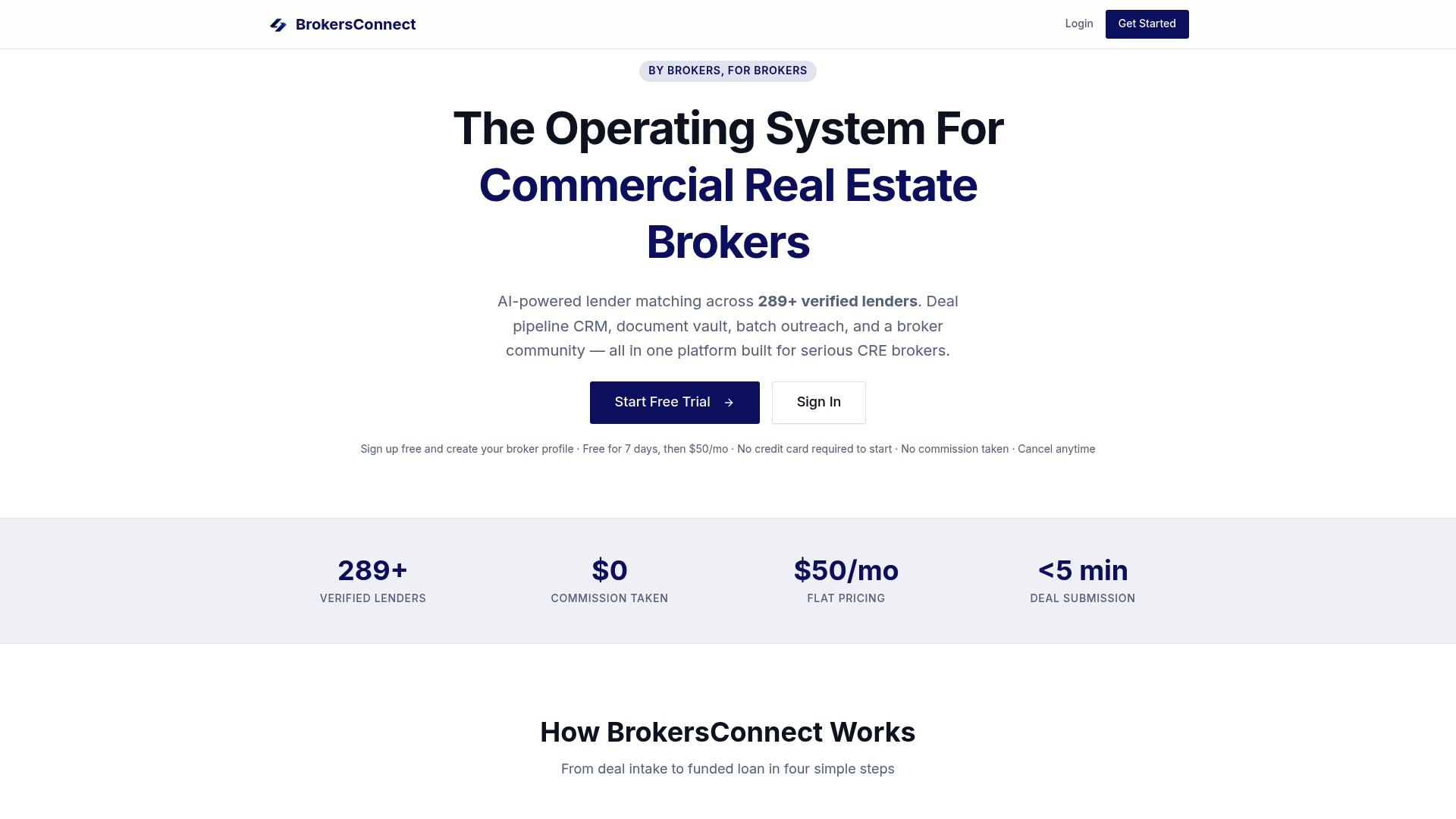
The platform's secure document vault keeps your T-12s, rent rolls, and PFS organized and shareable without a scattered email trail, similar to the secure document sharing practices that protect sensitive borrower data during submission. Thecrebrokersconnect runs on a flat monthly subscription with a free trial and no commission or transaction fees, so you can test the full workflow, template, matching, outreach, tracking, before committing. Start a free trial at Thecrebrokersconnect and package your next submission today.
Frequently Asked Questions
What is a CRE loan deal memo? It's a one-page summary a broker sends a lender stating the loan request, key metrics like LTV and DSCR, the collateral, and a recommendation, built to move a deal from cold submission to phone call quickly.
How long should a deal memo be? One page. Supporting detail belongs in attachments like the T-12, rent roll, or pro forma, not in the memo itself.
What numbers do lenders expect to see first? Loan amount, purpose, LTV, DSCR, and NOI (T-12), in that order, according to how most loan officers triage submissions.
Do deal memo formats change by loan type? The core fields stay the same, but construction deals need sources and uses plus a draw schedule, while refinances lean harder on stabilized NOI and rent comps.
Can I reuse one deal memo template across different lenders? Yes. Keep the structure fixed and adjust the emphasis, banks weigh sponsor liquidity heavily, while debt funds often focus more on the collateral and exit.
Sources
- What Documents Do Lenders Really Need? A Pre-Submission Checklist
- Lender Ready Financing Memo: Essential Components for Successful Deal Approval
- Commercial Loan Credit Memo: What to Include (Template) - LenderAnalyzer
- Credit Memo Best Practices and “The 5 C’s” | Carr, Riggs & Ingram CPAs & Advisors