
Cross-collateralization is a lending arrangement where the collateral securing one loan is simultaneously pledged to cover one or more additional loans with the same lender — and the single most important risk is asset lock-up: a lender can block you from selling or refinancing any pledged asset until every linked debt is satisfied, even if the loan directly tied to that asset is fully paid off.
Pro Tip: Before signing any loan with a lender where you already have an account, search the security agreement and promissory note for the phrases "all obligations," "present and future indebtedness," or "any and all liabilities." Those three phrases are the clearest signal that your collateral is being swept into a cross-collateral pool.
Table of Contents
- What cross-collateralization actually means in U.S. loan documents
- How cross-collateralization is created, perfected, and enforced
- When lenders typically use cross-collateralization
- Three concrete examples of how it plays out
- Benefits and risks: when cross-collateralization is worth it and when it is not
- U.S. legal implications: enforcement, lien priority, and bankruptcy
- How to tell if your loan is cross-collateralized
- How to get out of a cross-collateralized loan
- Questions to ask and red flags to watch before you sign
- How cross-collateralization differs from cross-default and blanket liens
- How CRE brokers should handle cross-collateralized portfolios
- When to accept cross-collateralization and when to walk away
- Key Takeaways
- Why cross-collateralization deserves more attention than it gets
- Thecrebrokersconnect helps brokers navigate cross-collateralized CRE deals
- Authoritative U.S. sources and where to go next
What cross-collateralization actually means in U.S. loan documents
Cross-collateralization is a legal lending practice in the United States where one asset secures multiple debts at the same institution. On default, the lender can seize or liquidate the shared collateral to satisfy any of the secured obligations, not just the one directly tied to that asset.
The phrase "cross-collateralization" rarely appears in the loan documents themselves. Instead, it shows up through several clause types borrowers need to recognize:
- Dragnet clause: Sweeps all current and future debts owed to the lender into the collateral pool. A car loan signed today can end up securing a credit card opened two years from now.
- All-indebtedness provision: Broader than a dragnet clause in some drafting styles; it explicitly states the collateral secures "any and all" obligations, past, present, and future.
- Blanket lien: A security interest that covers all business assets rather than a single named piece of property. Common in commercial lending via a UCC-1 financing statement.
- Cross-default clause: A separate but related concept. A default on one loan triggers a default on others. Cross-default determines the trigger; cross-collateralization determines what can be seized. They often appear together in aggressive loan packages.
Cross-collateralization clauses are frequently buried in standard security agreements under language that sweeps past, present, and future obligations into a single collateral pool — which is exactly why borrowers miss them.
How cross-collateralization is created, perfected, and enforced
The arrangement is built in four steps, and understanding each one tells you where you can push back.
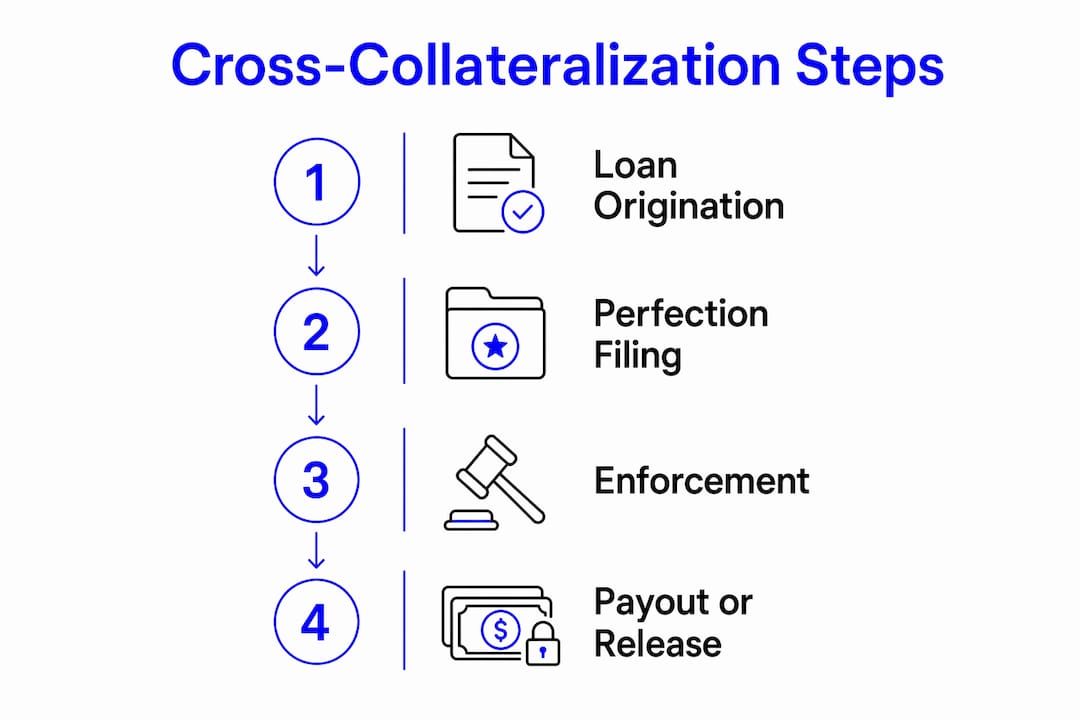
Step 1 — Loan origination: The lender presents a security agreement alongside the promissory note. The security agreement names the collateral and, if a dragnet or all-indebtedness clause is present, extends that collateral to cover other debts.

Step 2 — Perfection: For personal property (vehicles, equipment, business assets), the lender files a UCC-1 financing statement with the appropriate state office. For real property, the lender records a mortgage or deed of trust in the county where the property sits. Perfection establishes the lender's priority against other creditors and makes the security interest enforceable against third parties.
Step 3 — Priority: The first lender to perfect generally holds first-lien position. A blanket UCC-1 filing can cloud title on business assets and signal to any subsequent lender that the collateral is already encumbered, which can limit your ability to secure competing financing.
Step 4 — Enforcement: On default, the lender can pursue foreclosure on real property or repossession and sale of personal property under UCC Article 9. Because the collateral secures all linked debts, the lender is not required to limit its claim to the defaulted loan alone.
A lender holding a perfected blanket lien on your business assets effectively controls your refinancing options. Any new lender will see that UCC-1 filing and know their security interest would be subordinate — which is why many institutional lenders require a payoff and lien release before they will fund a competing loan.
When lenders typically use cross-collateralization
Recognizing the common scenarios helps you anticipate the clause before it appears in paperwork.
- Credit unions (consumer accounts): Credit unions rely heavily on dragnet clauses embedded in membership agreements. A financed vehicle can end up securing a personal loan, a credit card, or a line of credit opened later at the same institution. The rationale: credit unions are member-owned cooperatives and use cross-collateralization to reduce shared risk while offering lower rates.
- Auto loans bundled with other products: A dealer-arranged auto loan at a captive lender or credit union is a common entry point. The car secures the auto loan, and the lender's standard agreement extends that security to any future product.
- HELOCs and second mortgages: A home equity line of credit can be structured so the home secures both the primary mortgage and the HELOC. Lenders use this to reduce exposure on what is technically unsecured revolving credit.
- Blanket mortgages for developers and investors: A developer with multiple properties may accept a blanket mortgage that ties all parcels to a single loan facility. The lender's rationale is portfolio-level risk reduction; the borrower's trade-off is restricted ability to sell individual assets.
- Commercial lending with blanket UCC liens: Commercial lenders routinely file blanket UCC-1 statements covering all business assets. This is standard practice in SBA loans, equipment financing, and working capital lines.
Borrowers with the least negotiating leverage — thin credit histories, limited standalone collateral, or urgent capital needs — are most likely to encounter non-negotiable cross-collateral terms.
Three concrete examples of how it plays out
Consumer example — car and credit union personal loan: A member finances an SUV through their credit union and later takes out a personal loan at the same institution, attracted by the low rate. What they do not realize is that the membership agreement contains a dragnet clause. When they pay off the auto loan and try to sell the SUV, the credit union places a hold: the vehicle still secures the personal loan balance. The member cannot transfer title until the personal loan is paid in full.
Mortgage/HELOC example: A homeowner carries a primary mortgage and opens a HELOC with the same bank, pledging the home as collateral for both. She later starts a business and draws the full HELOC. When the business struggles and she misses a HELOC payment, the bank can initiate foreclosure proceedings on the home — even though the primary mortgage is current. Both obligations are secured by the same asset, so a default on either triggers the lender's enforcement rights against the property.

Commercial real estate example: An investor owns four retail strip centers financed under a blanket mortgage with a regional bank. He finds a buyer for one property and expects to pay down the loan with the sale proceeds. The bank refuses to release that parcel without a paydown exceeding the allocated loan amount for that property, plus a release fee. The investor cannot close the sale on the terms the buyer offered, and the deal falls apart. The blanket structure gave the lender effective veto power over individual asset dispositions.
Benefits and risks: when cross-collateralization is worth it and when it is not
Benefits for borrowers:
- Access to credit that might otherwise be unavailable — weaker credit profiles can qualify when the lender's risk is reduced through shared security.
- Lower interest rates, because the lender holds more collateral relative to the outstanding balance.
- Simplified documentation when multiple facilities are consolidated under one security structure.
- Higher borrowing limits, since multiple assets backing a single facility increase the lender's comfort with a larger exposure.
Risks for borrowers:
- Asset lock-up is the most significant practical risk. Once assets are cross-collateralized, the lender can veto sales or refinances without a negotiated release, which increases lender leverage in every future conversation.
- Cascade default risk: when cross-collateralization is paired with a cross-default clause, a missed payment on a small account can permit the lender to accelerate a much larger secured loan or foreclose on valuable assets.
- Refinancing barriers: moving a single loan to a competing lender is difficult and expensive when a blanket lien encumbers the same collateral.
- Reduced future borrowing power: pledged assets are unavailable as collateral for new lenders.
Benefits for lenders:
- Reduced credit risk through expanded collateral coverage.
- Greater leverage in workout negotiations.
- Simplified enforcement when a borrower holds multiple products at the same institution.
Pro Tip: Cross-collateralization is a reasonable trade-off when you have limited standalone collateral, need the credit, and are confident you will not need to sell or refinance the pledged asset during the loan term. It becomes a serious problem the moment your plans change and the lender holds veto power over your exit.
Community banks and credit unions are generally more willing to negotiate cross-collateral terms than institutional lenders, where the security agreement is often a non-negotiable standard form.
U.S. legal implications: enforcement, lien priority, and bankruptcy
Lenders can typically seize cross-collateralized assets the moment a covered loan defaults. The mechanics depend on asset type and how the security interest was perfected.
For real property, enforcement follows state foreclosure law — either judicial (court-supervised) or non-judicial (power of sale under a deed of trust), depending on the state. For personal property and business assets, UCC Article 9 governs: the secured party can repossess and sell collateral after default, provided it does so in a commercially reasonable manner.
Lien priority follows the "first in time, first in right" principle. A recorded mortgage or perfected UCC-1 filing establishes the lender's position in the priority queue. A subsequent lender who discovers an existing blanket UCC filing will know their interest is subordinate, which is why blanket liens materially complicate third-party refinancing.
Bankruptcy consequences are significant. Under Chapter 7, a borrower with cross-collateralized loans must either reaffirm all linked debts or surrender the collateral. Reaffirmation means agreeing to remain personally liable after discharge — a decision that should never be made without counsel. Under Chapter 13, a borrower may propose a repayment plan that treats secured claims differently, but the lender's secured claim extends to all cross-collateralized obligations, not just the one in default. The automatic stay halts enforcement temporarily, but it does not eliminate the lender's secured claim.
Cross-collateralization in bankruptcy is not just a payment problem — it is a collateral problem. A lender holding a perfected security interest across multiple assets has a stronger claim than most unsecured creditors, and that claim survives the automatic stay once the court grants relief from it.
Consult a licensed attorney for case-specific advice. Blanket liens and cross-collateral structures vary significantly by state law and loan type, and the consequences of getting this wrong are severe.
How to tell if your loan is cross-collateralized
The phrase itself rarely appears. You are looking for clause language, not a label.
Documents to review:
- Promissory note
- Security agreement
- Deed of trust or mortgage
- Membership agreement (especially at credit unions)
- UCC-1 financing statements (searchable at your state's Secretary of State office)
- Payoff statements (a payoff that exceeds the outstanding principal on a single loan is a red flag)
Clause language that signals cross-collateralization:
- "All obligations" — covers every debt you owe the lender, not just this one.
- "Present and future indebtedness" — sweeps in loans you have not taken yet.
- "Any and all liabilities" — the broadest dragnet formulation; assume it covers everything.
- "Securing all amounts now or hereafter owed" — a future-obligations sweep.
Reviewing security agreements and promissory notes for this language is the only reliable method. Verbal assurances from a loan officer carry no legal weight.
Actionable next steps if you suspect cross-collateralization:
- Request a complete payoff statement for each loan and compare it to the outstanding principal.
- Ask the lender in writing whether any collateral secures more than one obligation.
- Run a UCC lien search at your state's Secretary of State office.
- Order a title report on any real property involved.
- Involve a real estate or commercial attorney before signing anything.
How to get out of a cross-collateralized loan
The most reliable exit is to satisfy all linked obligations at the same lender simultaneously, or to negotiate a written partial release before you need one.
Full payoff: Paying off every loan that shares the collateral pool terminates the cross-collateral arrangement. Paying off a single loan does not release the lien if the collateral also secures other debts. Get a written lien release — do not assume payoff equals release.
Simultaneous refinance: Refinancing all linked facilities with a new lender at the same time severs the arrangement. This is the cleanest option but requires qualifying for replacement financing on all accounts.
Partial release: Partial releases are negotiable but typically involve fees, a required paydown, or collateral substitution. Lenders are not obligated to grant them. Negotiate the release mechanism before you sign the original loan, not after you need to sell.
Collateral substitution: Offer the lender a replacement asset of equal or greater value to free the original collateral. This works when you have another unencumbered asset the lender will accept.
Bankruptcy: Chapter 13 can restructure secured claims, but the lender's cross-collateral position complicates the plan. Chapter 7 forces a reaffirm-or-surrender decision. Neither path is clean or cheap.
Negotiation playbook:
- Offer a higher interest rate or a principal paydown in exchange for a partial release clause.
- Request explicit written release language tied to a specific paydown threshold or sale escrow.
- Ask for a release fee schedule upfront — know the cost before you are under contract to sell.
- Expect timelines of 30–90 days for a lender to process and record a partial release.
- Never rely on verbal assurances. A loan officer's promise to "work with you" has no legal effect. Written release language in the original agreement is the only protection that holds.
Pro Tip: The best time to negotiate a partial release clause is before you sign the loan. Once the security agreement is executed, you are negotiating from a position of weakness. Ask for a pre-agreed release trigger tied to a paydown percentage or a sale escrow — something like "lender will release Parcel A upon receipt of EX in escrow" — and get it in the signed agreement.
Questions to ask and red flags to watch before you sign
Walk into every loan signing with this checklist.
Direct questions to ask the lender:
- Does any clause in this security agreement secure obligations beyond this specific loan?
- Is there an all-indebtedness or dragnet provision in the membership agreement or security agreement?
- What triggers a release of this collateral, and what are the fees?
- Will a UCC-1 filing be made, and what assets does it cover?
- If I pay off this loan, will the lien on this asset be released immediately and in writing?
Red flags in the documents:
- Unlimited future obligations language with no cap on the dollar amount or loan type covered.
- No partial release clause, or a partial release clause that gives the lender sole discretion with no defined criteria.
- Blanket UCC filings that cover "all assets" with no carve-outs for specific property you intend to sell or refinance.
- Cross-default provisions paired with cross-collateralization — the combination amplifies risk significantly.
- Membership agreements at credit unions that contain dragnet language separate from the loan documents themselves.
Sample negotiable clause requests:
- Cap the coverage to named facilities only: "This security agreement secures only Loan No. [X] and Loan No. [Y]."
- Insert a carve-out: "The collateral described herein shall not secure any obligation other than those expressly listed in Schedule A."
- Pre-agreed partial release trigger: "Lender shall release [Property/Asset] upon borrower's payment of $[X] into escrow at closing."
How cross-collateralization differs from cross-default and blanket liens
Cross-default determines the trigger; cross-collateralization determines what can be seized. A blanket lien is the security instrument that often implements cross-collateralization across all assets.
| Concept | Purpose | Operational effect | Common remedy |
|---|---|---|---|
| Cross-collateralization | Pledges one asset to secure multiple debts | Lender can seize shared collateral on default of any linked loan | Payoff all linked debts; negotiate partial release |
| Cross-default | Defines what constitutes a default event | Default on Loan A automatically triggers default on Loan B | Cure the triggering default; negotiate cure periods |
| Blanket lien (UCC-1) | Perfects a security interest across all assets | Encumbers all business/personal property; limits competing financing | Payoff and UCC-3 termination filing by lender |
A practical illustration: a small business owner has a term loan and a line of credit with the same bank. The loan documents include both a cross-default clause and a cross-collateral provision backed by a blanket UCC-1 filing. She misses one payment on the line of credit (cross-default triggers a default on the term loan). Because of cross-collateralization, the bank can now pursue all business assets to satisfy both obligations. The blanket UCC-1 is the instrument that makes that seizure enforceable against third parties.
How CRE brokers should handle cross-collateralized portfolios
Cross-collateralization in commercial real estate deals creates direct friction on deal mobility: a single-asset sale or refinance inside a blanket mortgage structure requires lender consent, and that consent comes with conditions.
CRE due diligence checklist:
- Run a UCC lien search on the borrower entity at the state Secretary of State office before submitting any deal.
- Pull a title report on each property and flag any blanket mortgage or deed of trust that covers multiple parcels.
- Review the existing loan agreement for release pricing schedules and partial release conditions.
- Identify whether a cross-default clause accompanies the cross-collateral provision.
- Confirm whether the existing lender has a right of first refusal on refinancing.
Negotiation levers for CRE deals:
- Push for a release fee structure tied to a percentage of the allocated loan amount per parcel, agreed at origination.
- Propose escrow-triggered releases: the lender releases a parcel when sale proceeds hit escrow, eliminating timing risk.
- For blanket mortgages, negotiate individual property valuations at origination so release prices are pre-set and not subject to future lender discretion.
- When presenting a single-asset refinance to a new lender, disclose the blanket lien upfront and include a payoff letter from the existing lender in the submission package.
Pro Tip: When packaging a single-asset refinance for a borrower inside a blanket structure, include the existing lender's release fee schedule and a draft payoff statement in the submission. New lenders need to see that the lien can be cleared at closing — without that documentation, many will decline to underwrite the deal before they even price it.
Commercial lenders routinely file blanket UCC-1 statements that materially impact a borrower's ability to secure competing financing. Brokers who surface this issue early, with documentation in hand, close deals faster than those who discover it at the title commitment stage.
When to accept cross-collateralization and when to walk away
Accept it when:
- You have limited standalone collateral and need the credit to move forward.
- The pledged asset is one you have no near-term plan to sell or refinance.
- The rate or terms improvement is material and the lender is a community bank or credit union willing to negotiate release conditions.
Decline or negotiate harder when:
- The pledged asset is one you may need to sell, refinance, or transfer within the loan term.
- The security agreement contains unlimited future obligations language with no cap.
- The lender is an institutional lender offering no partial release mechanism.
Immediate next steps after signing or discovering cross-collateralization:
- Obtain and file a copy of every security agreement, UCC-1 filing, and mortgage document.
- Note the payoff amount for each linked loan and the conditions for lien release.
- Calendar any balloon payments or maturity dates across all linked facilities.
- Contact a real estate or commercial attorney if you are planning a sale or refinance within the next 12 months.
- Request a written confirmation from the lender of the exact conditions and fees required for a partial release.
This article provides general information, not legal or financial advice. Confirm the specific terms and implications of any cross-collateral arrangement with a licensed attorney or qualified financial professional before acting.
Key Takeaways
Cross-collateralization locks multiple debts to shared collateral, and the only reliable exit is satisfying all linked obligations or securing a written partial release before you need one.
| Point | Details |
|---|---|
| Core definition | One asset secures multiple loans at the same lender; default on any linked loan gives the lender seizure rights. |
| Biggest risk | Asset lock-up: the lender can block a sale or refinance until every linked debt is paid, even if the direct loan is current. |
| How to spot it | Search security agreements and promissory notes for "all obligations," "present and future indebtedness," or "any and all liabilities." |
| Top exit option | Pay off all linked obligations simultaneously, or negotiate a written partial release clause before signing the original loan. |
| Thecrebrokersconnect | Helps CRE brokers package single-asset refinance requests, track lender release policies, and manage payoff statements and UCC searches in a secure deal vault. |
Why cross-collateralization deserves more attention than it gets
Most borrowers treat cross-collateralization as a fine-print technicality until it costs them a deal. That is the wrong frame. The clause is not a technicality — it is a structural transfer of control. The moment you sign a security agreement with an all-indebtedness provision, you have handed the lender a veto over your future asset decisions. That veto does not expire when you pay off the loan it was attached to. It expires when every obligation in the pool is gone.
What surprises me most, having seen this play out in commercial portfolios, is how often the problem surfaces at the worst possible moment: a buyer is under contract, a refinance is priced, and then the title commitment comes back with a blanket lien nobody flagged. At that point, the borrower is negotiating a partial release under time pressure, which is exactly the position the lender prefers.
The conventional advice is to "read the fine print." That is true but incomplete. The more useful discipline is to run a UCC search and a title report on every asset before you accept new financing from a lender where you already have a relationship. The cross-collateral clause is already in the membership agreement. The new loan just activates it.
For CRE brokers, the practical implication is clear: surface the lien structure in due diligence, not at the title commitment. Deals that die at the closing table because of an undisclosed blanket mortgage are avoidable. The brokers who catch this early, document the release conditions, and present a clean path to the new lender are the ones who close.
Thecrebrokersconnect helps brokers navigate cross-collateralized CRE deals
Brokers handling commercial portfolios with cross-collateral structures need more than a lender list. They need a way to match the deal to lenders who understand blanket lien payoffs, package the submission with the right documentation, and track where each refinance stands in the pipeline.
Thecrebrokersconnect is built for exactly that workflow. The platform's AI-powered lender matching surfaces financing sources based on property type, loan amount, leverage, and transaction structure — including single-asset refinances inside blanket mortgage portfolios. The secure document vault keeps payoff statements, UCC search results, title reports, and release fee schedules organized and accessible for every deal. The lender responsiveness leaderboard shows which lenders are actively engaging on similar scenarios, so brokers spend time on conversations that move forward.
For a broker managing a borrower with cross-collateralized properties, Thecrebrokersconnect cuts the time spent searching for lenders willing to underwrite around an existing blanket lien and puts the submission package together in a format that addresses the release question upfront. Start a free trial at thecrebrokersconnect.com and see how much faster a cross-collateral refinance moves when the documentation is organized before the first lender call.
Authoritative U.S. sources and where to go next
For UCC lien searches and state-level filings:
- Your state's Secretary of State office website — most states offer online UCC search portals at no cost or low cost. Search by debtor name and entity type.
- The Uniform Commercial Code Article 9 framework governs perfection and priority of security interests in personal property across all U.S. states.
For mortgage and real property lien searches:
- County recorder or register of deeds office in the property's jurisdiction — recorded mortgages, deeds of trust, and releases are public record.
- A licensed title company can run a full title search and flag blanket mortgages or cross-collateral encumbrances.
For consumer protection and disclosure rules:
- The Consumer Financial Protection Bureau (CFPB) at consumerfinance.gov publishes guidance on secured lending disclosures and borrower rights.
For bankruptcy implications:
- The U.S. Courts website (uscourts.gov) provides plain-language overviews of Chapter 7 and Chapter 13 bankruptcy, including secured creditor treatment.
When to hire counsel and what to bring:
Hire a real estate or commercial attorney before signing any loan with a blanket lien or all-indebtedness provision, and before attempting to sell or refinance a cross-collateralized asset. Bring the complete security agreement, promissory note, membership agreement (if a credit union), any UCC-1 filings, the most recent payoff statement for each linked loan, and a timeline of when each loan was originated. That package gives counsel everything needed to assess your position and draft release language quickly.