
A broker fee agreement is a binding contract that ties a broker's payment to a specific, defined success event — no event, no fee. Before you sign or draft one, do three things right now:
- Download and read a sample template. The annotated fill-in template in Section 6 of this guide gives you a clause-by-clause walkthrough you can copy and customize.
- Confirm who pays in your industry. In residential real estate, the seller traditionally pays; in mortgage brokerage, the borrower typically does. The rules shifted after the 2024 NAR settlement, so verify your state's current practice.
- Lock down the success event language. Vague triggers ("when a deal closes") are the single biggest source of fee disputes. The drafting checklist in Section 4 shows you how to write it precisely.
The annotated sample template in Section 6 is the fastest way to get a working draft. Read Sections 3 and 4 first if you want to understand the fee math and clause logic before you fill anything in.
Key Takeaways
A broker fee agreement is only as strong as its success event clause — define the exact trigger, name the paying party, and attach an introduced-parties exhibit before you sign anything.
| Point | Details |
|---|---|
| Define the success event precisely | Name the counterparty, the milestone, and the date trigger — vague language is the top cause of fee disputes. |
| Name who pays and when | State the paying party, the calculation base, and the due date explicitly; never leave payment mechanics to closing-day negotiation. |
| Include a tail period with an exhibit | A 6–12 month tail clause with a named introduced-parties list protects fees on deals that close after the agreement expires. |
| Keep a timestamped paper trail | Log every introduction with date and contact details; retain signed agreements, invoices, and funding confirmations for at least three years. |
| Get legal and tax review | Attorney review is worth the cost on any deal above $500,000; consult a tax advisor on 1099-NEC reporting and multi-year fee arrangements. |
| Use Thecrebrokersconnect for pipeline management | The platform's secure vault, timestamped introductions, and fee calculator give CRE brokers a built-in audit trail for every active fee agreement. |
Table of Contents
- What does a broker fee agreement actually cover?
- How are broker fees structured, and who pays?
- What clauses must every broker fee agreement include?
- How do broker fee agreements differ across industries?
- Annotated sample broker fee agreement you can use today
- Negotiation tactics, red flags, and common drafting mistakes
- How to enforce earned fees and handle recordkeeping
- How deal-management tools reduce fee agreement disputes
- What I verify before signing any broker fee agreement
- Thecrebrokersconnect gives CRE brokers a built-in fee management workflow
- Sources
What does a broker fee agreement actually cover?
A broker fee agreement, sometimes called a broker fee contract or finder's fee agreement, documents six core things: the parties involved, the scope of services the broker will provide, how the fee is calculated, the success event that triggers payment, the contract term, and standard boilerplate (governing law, dispute resolution, indemnities). That is the skeleton every version of this document shares, whether it covers a residential home sale, a commercial mortgage placement, or an insurance referral.
The difference between a handshake and a binding fee agreement is enforceability. A verbal "I'll take care of you" is worth nothing in court.
When you need a written agreement:
- Introducing a buyer to a seller or a borrower to a lender
- Sourcing financing for a commercial property acquisition
- Referring a client to an insurance carrier or another professional
- Raising capital or placing securities (where regulatory clauses are also required)
- Any co-brokerage arrangement where two agents split a commission
Short use-case examples:
- Buyer's broker: A buyer's agent signs a buyer-broker representation agreement before showing properties. The fee is negotiable, disclosed in writing, and typically due at closing.
- Seller listing intro: A listing broker introduces a qualified buyer. The fee agreement specifies that payment is due when the purchase contract goes to closing, not when an offer is accepted.
- Mortgage broker placement: A mortgage broker sources a lender for a $2M commercial acquisition. The fee agreement states a percentage of the funded loan amount, payable at funding.
- Insurance referral: A broker refers a client to a carrier. A referral partner agreement sets a flat dollar amount payable within 30 days of the policy binding.
Brokerage fees vary widely by industry, but the document structure is consistent enough that a well-drafted template can be adapted across all four contexts with targeted clause edits.
How are broker fees structured, and who pays?
Commission-based pay is the most common fee arrangement across industries, typically calculated as a percentage of the sale price, loan amount, rent, or insurance premium. But percentage-only thinking misses the full picture. The effective fee often combines a base percentage with flat add-ons, a retainer, or a success bonus.
The four main fee structures
Percentage of transaction value is the default in residential real estate, commercial brokerage, and mortgage placement. It aligns the broker's incentive with deal size, which clients generally accept. The downside: on very large deals, the dollar amount can feel disproportionate to the work.
Flat fee works well when deal complexity is predictable. An insurance referral paying a fixed $500 per bound policy is easier to budget than a percentage that swings with premium size. Flat fees are less common in real estate and mortgage lending, where deal size varies too much.
Tiered or success-bonus structure layers an escalating percentage on top of a base rate once a threshold is crossed. A commercial broker might earn 1% on the first $5M of a loan and 0.75% on the balance above that. This rewards larger placements while keeping the base rate competitive.
Retainer plus success fee is common in capital-raising and M&A advisory contexts. The client pays a monthly retainer for ongoing search activity, then a success fee at close. The retainer is often credited against the success fee, which makes it easier to sell to clients.
Fee math examples
Who pays by industry
In residential real estate, the seller has historically paid both the listing and buyer's broker commissions from sale proceeds. Post-2024 NAR settlement, buyer-broker compensation must be negotiated separately and disclosed in writing. The National Association of REALTORS® guidance on broker-to-broker agreements covers seller consent requirements and co-op compensation mechanics in detail.
In mortgage brokerage, the borrower typically pays the origination fee or broker fee, which is disclosed on the Loan Estimate. Federal rules cap total points and fees for qualified mortgages, so mortgage broker fee agreements must reflect those limits.
In commercial real estate, the borrower or the property owner pays depending on the deal type. For commercial mortgage placements, the borrower almost always pays the broker fee at loan funding.
In insurance brokerage, the insurer typically pays the broker a commission built into the premium. A separate referral fee agreement between brokers governs splits.
What clauses must every broker fee agreement include?
Think of this as your pre-signing checklist. Each clause below is a potential dispute waiting to happen if it is missing or vague.
-
Parties. Full legal names and entity types for both the broker and the client. Model language: "This Agreement is between [Broker Legal Name], a [state] [LLC/Corp], and [Client Legal Name], a [state] [LLC/Corp]." A mismatch between the signing entity and the operating entity has voided more than a few fee claims.
-
Scope of services. Describe specifically what the broker will do: source lenders, introduce buyers, negotiate terms, prepare submissions. Vague scope ("provide brokerage services") invites disputes about whether the broker actually performed.
-
Fee definition and calculation. State the percentage or flat amount, the base on which it is calculated (funded loan amount, gross sale price, net proceeds), and how it is computed if the deal structure changes mid-transaction.
-
Success event. This is the highest-risk clause. Define the exact trigger: "the date on which the loan funds and is disbursed to borrower" or "the date the purchase and sale agreement is executed by both parties and the earnest money deposit is received." Avoid "when the deal closes" — it is ambiguous in every industry.
-
Payment terms. State the due date (e.g., at closing, within 5 business days of funding), invoicing requirements, and what happens if payment is late (interest rate, right to suspend services).
-
Exclusivity and non-circumvention. Specify whether the broker has an exclusive right to introduce parties or whether the client can work with other brokers simultaneously. A non-circumvention clause prevents the client from going around the broker to deal directly with an introduced party.
-
Term and tail/protection period. The term sets how long the agreement is active. The tail clause — sometimes called a protection period — extends the broker's right to a fee for deals that close after the agreement expires, provided the counterparty was introduced during the term. Template providers consistently recommend including a tail period to prevent circumvention. A well-drafted tail clause attaches an exhibit listing all introduced parties by name and date.
-
Expense reimbursement. State which expenses (travel, third-party reports, filing fees) are reimbursable, the approval process, and the cap.
-
Reporting and tracking. Require the broker to maintain a log of introductions with dates and contact details. This log becomes the evidence base if a fee dispute arises.
-
Tax treatment. State that the broker is an independent contractor, responsible for their own taxes. Require the client to issue a Form 1099-NEC for payments over $600.
-
Confidentiality. Mutual NDA language covering deal terms, client identity, and introduced parties. Specify the survival period (typically 2–3 years post-termination).
-
Indemnities. Each party indemnifies the other for their own acts, errors, and omissions. Watch for overbroad indemnities that make one party responsible for the other's negligence.
-
Governing law and venue. Name the state whose law governs and the county where disputes will be heard. This matters enormously if the parties are in different states.
-
Dispute resolution. Specify mediation first, then binding arbitration or litigation. Many commercial agreements require AAA or JAMS arbitration to keep disputes out of court.
-
Signature block. Authorized signatories, titles, and dates. For entities, confirm the signatory has authority to bind the company.
Boilerplate to verify before signing: survival clauses (which provisions outlast termination), assignment restrictions (can the broker assign the agreement to a successor firm?), and notice procedures (email vs. certified mail, and to which address).
Pro Tip: Draft the success event as a two-part test: (1) a named counterparty introduced by the broker, AND (2) a specific measurable transaction milestone (funding date, deed recording, policy binding date). Both conditions must be met. This eliminates the "they found them on their own" argument.
How do broker fee agreements differ across industries?
The skeleton is the same; the flesh changes significantly depending on the regulatory environment and transaction norms of each industry.
Residential real estate
Buyer-broker agreements are now required in most states following the 2024 NAR settlement. The Consumer Federation's buyer-broker representation form shows how fee items and success-event language appear in practice. Key drafting points: the fee must be disclosed in writing before the broker shows any property, it is negotiable, and it is typically due at closing. Co-brokerage splits between a listing broker and a buyer's broker are now documented in separate broker-to-broker agreements rather than embedded in the MLS.
Mortgage brokerage
Mortgage broker fee agreements must align with federal disclosure requirements. The fee appears on the Loan Estimate and Closing Disclosure. For qualified mortgages, total points and fees are subject to federal caps, so the agreement's fee definition must be consistent with what is disclosed to the borrower. The success event is almost always loan funding, not application or approval. Mortgage broker fee agreements also typically address whether the fee is paid outside of closing (POC) or added to the loan.
Insurance brokerage
Insurance broker compensation is regulated at the state level. The broker's fee is usually a commission paid by the insurer, but a separate referral fee agreement between brokers governs splits. State rules vary on whether brokers must disclose their compensation to the insured, so check your state's Department of Insurance requirements. California's Department of Insurance publishes a standard broker fee agreement form for surplus lines and non-admitted placements — a useful reference even if you operate in another state.
Commercial real estate and capital markets
Commercial broker fee agreements tend to be more negotiated and less standardized than residential forms. Exclusivity clauses are common and often hotly negotiated. Fee-splitting between co-brokers is documented in a separate co-brokerage agreement or a side letter. For securities-related introductions (capital raises, private placements), the agreement must include compliance language acknowledging Regulation D requirements and broker-dealer registration status. A standard real estate template is not adequate for a securities placement — get specialized counsel.
For DSCR loan placements and other CRE financing scenarios, the fee agreement should specify whether the broker fee is paid by the borrower at closing or netted from the lender's origination fee, since lenders handle this differently.
Annotated sample broker fee agreement you can use today
The template below is a compact, fill-in-the-blanks version covering the essential clauses. Replace every bracketed placeholder with your actual deal terms. Get a licensed attorney to review it before use, particularly for jurisdiction-specific requirements or high-value transactions.
Available in fillable PDF and Word formats from JotForm's broker fee agreement template and Rocket Lawyer's broker agreement template.
BROKER FEE AGREEMENT
Parties This Agreement is entered into as of [Date] between [Broker Full Legal Name], a [State] [LLC/Corporation/Sole Proprietor] ("Broker"), and [Client Full Legal Name], a [State] [LLC/Corporation/Individual] ("Client"). Annotation: Use the exact legal entity name that will sign. A mismatch voids the claim.
Appointment and Scope of Services Client appoints Broker on a [exclusive / non-exclusive] basis to [describe specific services: e.g., "identify and introduce qualified commercial mortgage lenders for the acquisition of the property located at [Address]"]. Broker will [list deliverables: prepare loan submissions, conduct lender outreach, negotiate term sheets]. Annotation: Non-exclusive is common in residential; exclusive is standard in CRE capital markets. Define deliverables specifically.
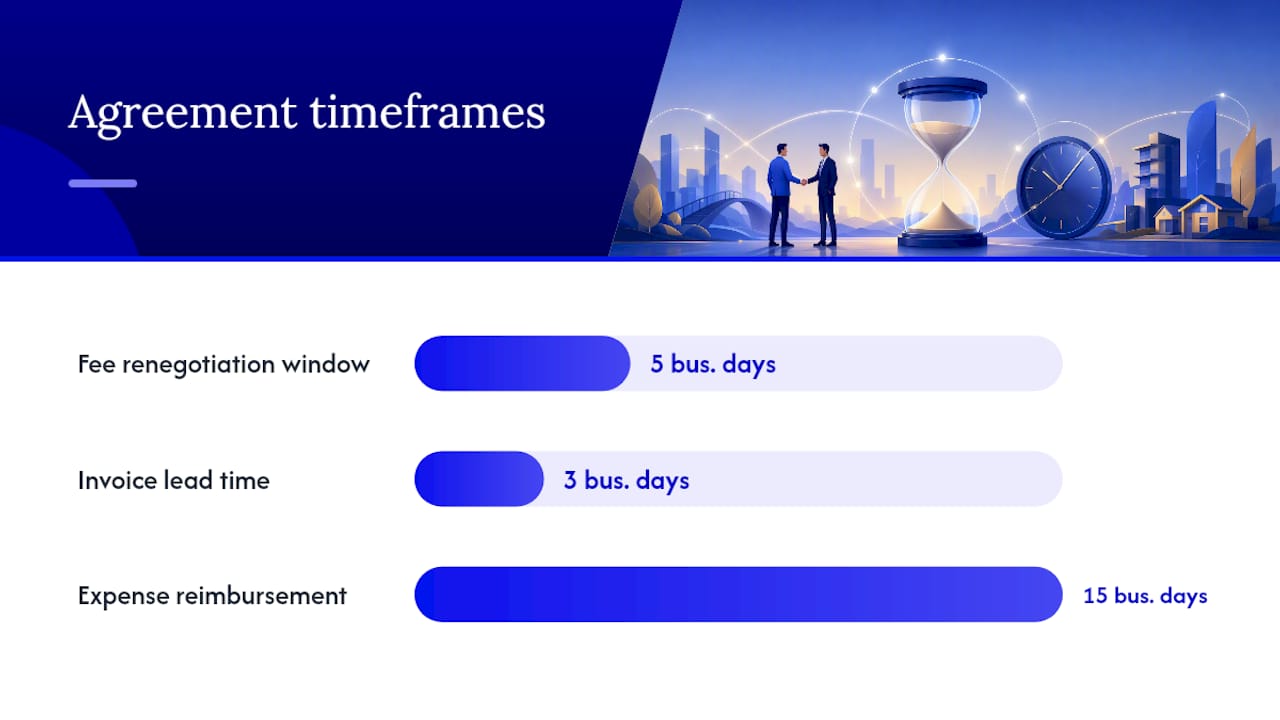
Fee Client agrees to pay Broker a fee equal to [X%] of [funded loan amount / gross sale price / insurance premium / capital raised] ("Fee"). If the transaction structure changes materially, the parties will negotiate the Fee in good faith within [5] business days of the change. Annotation: Name the calculation base explicitly. "Deal value" is not a base.
Success Event The Fee is earned when: (1) a counterparty introduced by Broker to Client executes a binding [purchase agreement / loan agreement / insurance policy / investment agreement], AND (2) [the loan funds and is disbursed / the deed is recorded / the policy binds / the capital is received] ("Success Event"). Annotation: Two-part test. Both conditions must be satisfied. This is the clause most often disputed.
Payment Terms The Fee is due and payable [at closing / within 5 business days of the Success Event]. Broker will submit an invoice to Client at least [3] business days before the due date. Late payments accrue interest at [1.5%] per month. Annotation: Specify the invoicing lead time so there is no excuse for a missed payment.
Reimbursable Expenses Client will reimburse Broker for pre-approved out-of-pocket expenses exceeding $[threshold] per item, within [15] business days of receipt of itemized documentation.
Exclusivity and Non-Circumvention [If exclusive:] During the Term, Client will not engage any other broker for the services described above without Broker's written consent. Client agrees not to circumvent Broker by dealing directly with any party introduced by Broker, whether during the Term or the Tail Period.
Term and Tail Period This Agreement begins on [Start Date] and continues until [End Date or completion of transaction] ("Term"). For [12] months following expiration or termination ("Tail Period"), the Fee remains payable if a Success Event occurs with any party listed on Exhibit A (Introduced Parties). Annotation: Attach Exhibit A with names and introduction dates. Update it each time a new party is introduced.
Tax and Invoicing Broker is an independent contractor. Client will issue a Form 1099-NEC for all payments exceeding $600 in a calendar year. Broker is solely responsible for all applicable taxes on Fee income.
Confidentiality Each party will keep the other's confidential information (deal terms, client identities, introduced parties) strictly confidential for [2] years following termination.
Indemnity Each party indemnifies and holds harmless the other from claims, losses, and expenses arising from that party's own acts, errors, or omissions in connection with this Agreement.
Governing Law and Venue This Agreement is governed by the laws of the State of [State]. Any dispute will be resolved in [County], [State].
Dispute Resolution The parties will first attempt mediation through [AAA / JAMS / agreed mediator]. If mediation fails within [30] days, disputes will be resolved by binding arbitration under [AAA / JAMS] rules.
Signatures
| Broker | Client |
|---|---|
| Signature: _________________ | Signature: _________________ |
| Name: _________________ | Name: _________________ |
| Title: _________________ | Title: _________________ |
| Date: _________________ | Date: _________________ |
Before you use this template:
- Replace every bracketed placeholder with deal-specific language.
- Attach Exhibit A listing all introduced parties with introduction dates.
- Have a licensed attorney review it for your state's specific requirements.
- For mortgage transactions, confirm the fee aligns with your Loan Estimate disclosures.
- For securities placements, add Regulation D compliance representations.
- For California insurance placements, cross-reference the California Department of Insurance standard broker fee agreement form.
Negotiation tactics, red flags, and common drafting mistakes
Most fee disputes trace back to one of four drafting failures: a vague success event, no tail clause, an undefined calculation base, or silence on who pays. Fix those four and you eliminate the majority of disputes before they start.
Negotiation scripts that work
On fee percentage: "I'm proposing X% based on [comparable transactions / market standard]. I'm open to a tiered structure if you prefer to reward larger outcomes." This frames the ask as market-driven and offers a concession path without dropping the number outright.
On tail period: "A 12-month tail is standard for transactions of this complexity. I'm willing to shorten it to 6 months if we attach a named list of introduced parties as an exhibit, so there's no ambiguity." Offering the exhibit as a trade for a shorter tail is a move most clients accept.
On exclusivity: "Exclusive representation for 90 days with a 30-day extension option if we have active term sheets. After that, it converts to non-exclusive." This gives the client an exit if the broker underperforms while protecting the broker's work during the active search.
Red flags that should stop you cold
- Overbroad indemnity language that makes you responsible for the client's own negligence or third-party claims unrelated to your services.
- An ambiguous calculation base — "fee on the transaction value" without defining what counts as transaction value (gross vs. net, including assumed debt or not).
- Retroactive fee triggers — language that makes you responsible for deals the client was already pursuing before you were engaged.
- No invoicing procedure — if the agreement is silent on how and when to invoice, the client can delay payment indefinitely by claiming they never received a proper invoice.
- Missing tail clause — if the agreement expires the day before closing, you get nothing. Always include a tail.
When to walk away
Walk away from any agreement that lacks a defined success event, refuses to include a tail clause, or contains an indemnity that exposes you to unlimited liability. For deals above $1M or any securities-related placement, insist on escrow of the fee at closing or a clear invoicing procedure tied to a specific funding date. If the client won't agree to basic fee protection, that tells you something about how they intend to behave at closing.
How to enforce earned fees and handle recordkeeping
Winning a fee dispute starts long before you file anything. The broker who wins is almost always the one with the better paper trail.
Recordkeeping checklist
- Keep the signed broker fee agreement and all amendments in a secure document vault.
- Log every introduction with the date, method (email, phone, in-person meeting), and the full name of the introduced party.
- Save all email threads and meeting notes confirming the introduction.
- Maintain CRM timestamps showing when each prospect was added and what actions were taken.
- Keep copies of all invoices sent, with delivery confirmation.
- Retain the signed closing statement or funding confirmation showing the Success Event occurred.
Collection and enforcement options
When a client refuses to pay a fee you've clearly earned, start with a formal written demand letter citing the agreement, the Success Event date, and the invoice. Many disputes resolve at this stage. If they don't, your options in order of escalation are:
- Mediation — fast, cheap, and preserves the relationship if there is one worth preserving.
- Arbitration — binding and faster than litigation if the agreement requires it.
- Small claims court — for fees under your state's small claims limit (varies by state, typically $5,000–$25,000).
- Civil litigation — for larger amounts; engage counsel experienced in contract disputes.
For co-op payment workflows and compliant payout tracking, purpose-built commission payment platforms can reduce disputes by creating an independent audit trail of what was paid, when, and to whom.
Tax and reporting basics
Broker fees and referral commissions are taxable income in the year received. The paying party must issue a Form 1099-NEC for payments over $600. Keep records of all fee income and related business expenses for at least three years. Consult a tax advisor for treatment of retainers, advance fees, and multi-year arrangements. This is general information, not tax advice.
How deal-management tools reduce fee agreement disputes
The workflow that prevents most disputes looks like this: intake → signed fee agreement upload → CRM tagging of introduced prospects with timestamps → milestone tracking → invoice generation → payment reconciliation. Each step creates a record that is nearly impossible to dispute.
Features that materially reduce fee disputes include:
- Secure document vault for storing signed agreements and amendments with version control.
- Timestamped introductions logged in a CRM so the date and identity of each introduced party is on record.
- Fee calculator to confirm the math before invoicing, reducing back-and-forth over the calculation base.
- Audit trail showing every action taken on a deal, from first lender contact to funding confirmation.
- Co-broker split tracking for deals involving multiple brokers, so each party's share is documented before closing.
For AI-assisted document extraction, tools that can pull fee terms and success-event language from existing agreements help brokers quickly verify clause consistency across a large portfolio of deals.
Thecrebrokersconnect includes a fee calculator, secure document storage, timestamped deal activity, and pipeline management tools designed for commercial real estate brokers managing multiple active fee agreements. These tools help manage agreements and reduce disputes, but they do not replace legal review. Treat any workflow tool as a complement to a properly drafted contract, not a substitute for one.
What I verify before signing any broker fee agreement
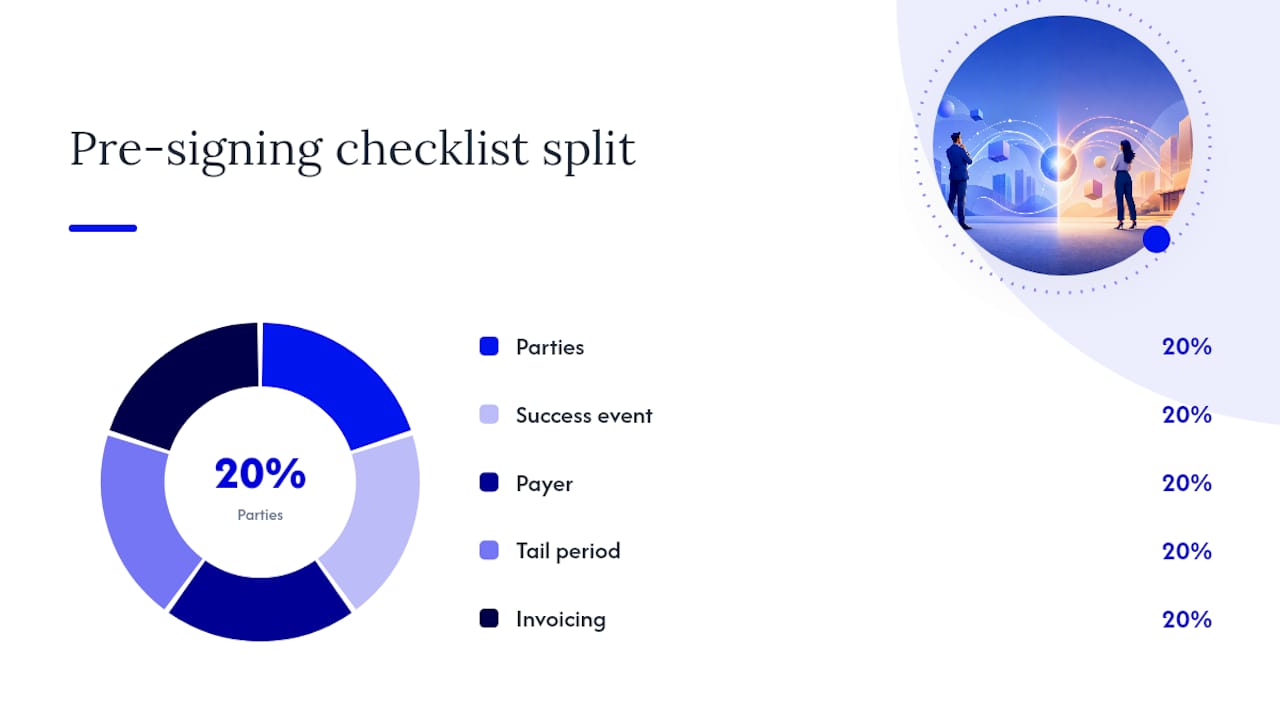
Before I sign anything, I run through five checks. Miss one and you may spend months chasing a fee you technically earned.
My pre-signing checklist:
- Parties confirmed. The signing entity matches the operating entity on both sides. If the client is an LLC, the signatory has authority to bind it.
- Success event defined precisely. I can point to a specific, measurable milestone. If I can't describe it in one sentence with a date and a counterparty name, it needs to be rewritten.
- Who pays is explicit. The agreement names the paying party and the payment mechanism. "We'll work it out at closing" is not acceptable.
- Tail period is in writing. Minimum 6 months, with an attached exhibit of introduced parties. No exhibit, no tail protection worth having.
- Invoicing and recording procedures are clear. I know exactly when to send the invoice, to whom, and what documentation to attach.
Walk-away triggers:
- The success event is defined by a subjective judgment call rather than a measurable event.
- Exclusivity is required but the tail period is missing or shorter than 90 days.
- The indemnity clause makes me responsible for the client's own acts.
- The calculation base is undefined or subject to post-closing adjustment without a cap.
For any deal above $500,000 or any securities-related placement, I get counsel to review the agreement before signing. The cost of a one-hour attorney review is trivial compared to the cost of a disputed fee on a seven-figure transaction.
Thecrebrokersconnect gives CRE brokers a built-in fee management workflow
Commercial real estate brokers managing multiple active fee agreements need more than a folder of PDFs. Thecrebrokersconnect gives you a deal-management platform where signed agreements live in a secure document vault, every lender introduction is timestamped in your pipeline, and a built-in fee calculator confirms your math before you invoice. The platform's audit trail documents the full lifecycle of each deal — from first lender match to funding confirmation — so you have the evidence you need if a fee is ever disputed.
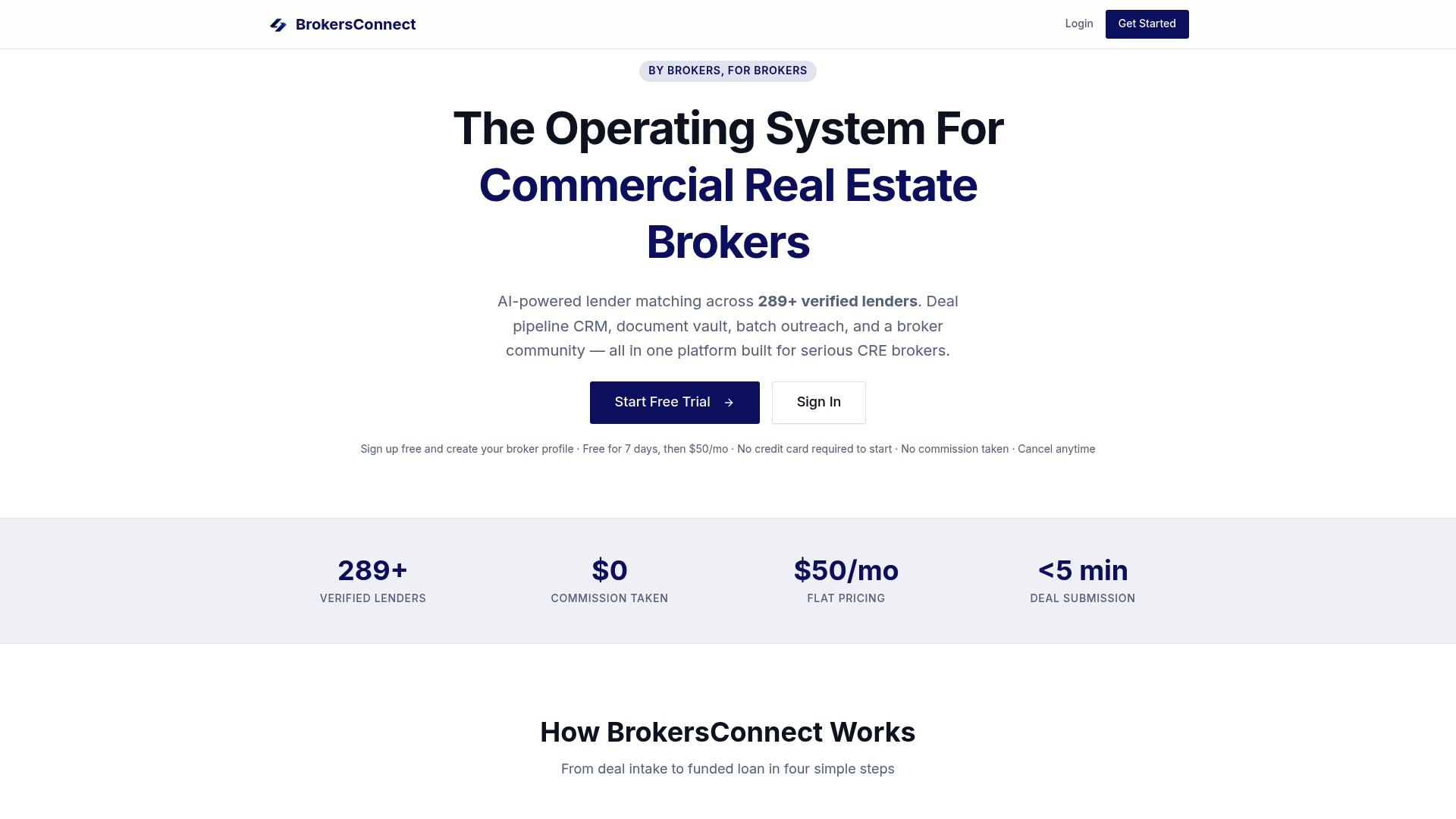
Thecrebrokersconnect also connects you to a database of 289+ verified lenders across all major CRE asset classes, so you spend less time on cold outreach and more time on deals that close. The platform is a workflow tool, not legal counsel. Get a licensed attorney to review your fee agreement language. Then use Thecrebrokersconnect to manage the pipeline, track introductions, and make sure the paper trail is airtight when it counts.
Sources
A short annotated list of the primary sources cited in this guide, organized by use case.
Templates and fillable forms
- Fee protection and commission agreements with brokers: what you need to know | Nolo
- What is a Broker Fee Agreement? (Key Terms + Sample) | ContractsCounsel
- Broker Agreement template | Rocket Lawyer
- Broker Fee Agreement Template (PDF) | JotForm
- Broker-to-Broker Agreements 101 | National Association of REALTORS®
- Premier 10-K, Exhibit — Broker Agreement (SEC filing)
- Buyer-Broker-Representation-Agreement-FORM (Consumer Federation)
- Brokerage fee definition and explanation | Investopedia
Regulatory and industry guidance
Reference and background
Check your state's specific rules before finalizing any broker fee agreement. State licensing laws, disclosure requirements, and fee caps vary significantly. A licensed attorney in your state is the only reliable source for jurisdiction-specific guidance.