
A tenant estoppel certificate is a signed document in which a commercial tenant confirms the key facts of its lease — rent, term, security deposit, defaults, and any offsets — so that a buyer or lender can rely on those statements when closing a transaction. The estoppel effect is the critical legal consequence: once signed, a tenant is generally barred from later contradicting what the certificate states, even if the underlying facts were different.
Two things to do right now:
- Tenants: Before signing, pull every lease amendment, side letter, and rent credit. Compare each field on the form against your actual lease documents. Anything you omit or misstate can permanently waive a claim against the new owner.
- Landlords and brokers: Finalize the estoppel form during due diligence, pre-fill it from the rent roll and lease file, and set a firm delivery deadline. Waiting until the week before closing is how deals stall.
Table of Contents
- What tenant estoppel certificates are and why every deal depends on them
- What facts does a standard estoppel certificate cover?
- Who signs, and does it need to be notarized?
- What are the legal risks of signing an estoppel certificate?
- What happens when a tenant refuses or doesn't return an estoppel?
- A step-by-step checklist for tenants reviewing an estoppel
- How landlords and brokers should collect and track estoppels
- How to read a sample estoppel certificate and spot the red flags
- State law variations and notarization: what you need to know
- Key Takeaways
- The part of estoppel collection that most brokers get wrong
- Thecrebrokersconnect helps brokers manage estoppel collection without the chaos
- Useful sources and templates
What tenant estoppel certificates are and why every deal depends on them
A tenant estoppel certificate is a legally binding statement in which a commercial tenant confirms lease status — rent, term, deposits, and the absence of landlord defaults — for a third-party purchaser or lender. The word "estoppel" comes from the legal doctrine of equitable estoppel: a party who makes a representation that another party reasonably relies on cannot later take a contradictory position to that party's detriment.
In U.S. commercial real estate, estoppels are requested in four main contexts: property sales, refinancings, loan underwriting, and lease assignments. The requesting party is almost always the buyer or lender, though landlords initiate the process. Lenders require estoppels from material tenants before funding because they protect loan collateral by confirming rents and the absence of undisclosed prepayments or offsets.
A practical example: a buyer under contract on a multi-tenant office building needs to verify that the anchor tenant is current on rent, has no outstanding landlord obligations for unpaid tenant improvement allowances, and has not exercised an early termination option. The estoppel certificate is the mechanism that locks in those facts before the buyer wires closing funds.
The House of Representatives publishes a short explainer and sample estoppel form that illustrates the government's own use of the document in its leasing program — a useful reference for understanding standard field language.
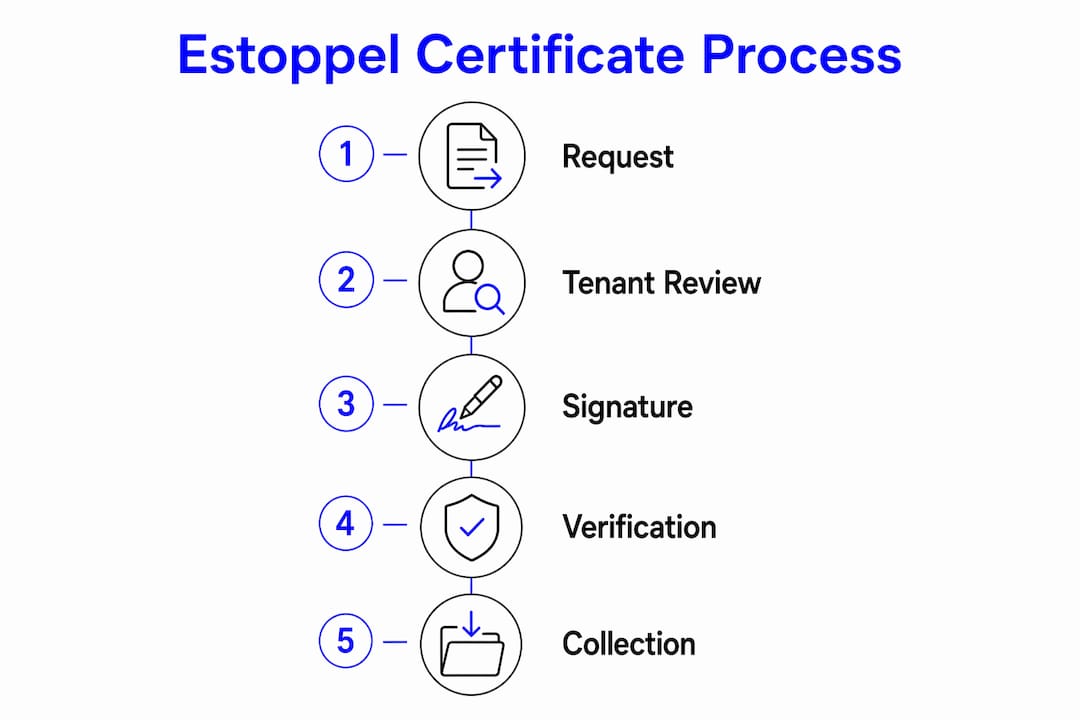
What facts does a standard estoppel certificate cover?
The specific fields on an estoppel form track the lease facts a buyer or lender needs to underwrite the income stream and assess risk. Typical fields include:
- Lease identification: The lease date, all amendments, and a confirmation that no other agreements exist between landlord and tenant. This is the field most likely to catch undisclosed side letters.
- Current base rent and escalations: The exact monthly rent, the escalation schedule (fixed steps or CPI-linked), and the date through which rent has been paid. A buyer relies on this to project net operating income.
- Prepaid rent and concessions: Any free-rent periods, rent credits, or prepayments beyond the current month. Undisclosed prepayments reduce the effective yield a buyer thought they were acquiring.
- Security deposit: The amount held, whether it is cash or a letter of credit, and whether any portion has been applied or returned.
- Lease term, commencement, and expiration: The exact start and end dates, plus any holdover provisions. Inconsistent dates between the estoppel and the lease file are a common red flag.
- Renewal and extension options: Whether options exist, the exercise window, and whether any option has already been exercised or waived.
- Improvement allowances: Whether the landlord has fully performed all required tenant improvement work and paid all allowances. An uncompleted allowance is a live liability that transfers to the buyer.
- Defaults and offsets: A confirmation that neither party is in default and that the tenant has no claims, offsets, or defenses against rent. This is the highest-risk field for tenants to sign unqualified.
- Subleases and assignments: Whether the tenant has sublet any portion of the premises or assigned the lease, and whether any required consents were obtained.
- Signatory authority: A representation that the person signing is authorized to bind the tenant entity.
Pro Tip: When a field asks for an unqualified "no defaults" statement, tenants should add a qualifier: "to the best of Tenant's knowledge, as of the date hereof." An unqualified statement covers facts the tenant may not know, including landlord defaults that haven't surfaced yet.
Who signs, and does it need to be notarized?
The tenant signs the estoppel certificate. For a corporate tenant, that means an authorized officer — typically a VP, CFO, or general counsel — whose authority to bind the entity should be confirmed in the corporate resolution or operating agreement. A property manager signing on behalf of a corporate tenant without documented authority creates an enforceability problem.

Notarization is not universally required. Most estoppel certificates in U.S. commercial transactions close without notarization. That said, some lenders and title companies request it, particularly for large loans or when the estoppel will be recorded. Notarization strengthens the document's evidentiary weight and can matter if the certificate is later challenged in litigation.
Common execution pitfalls include: leaving signature blocks blank, using an incorrect entity name, signing with a title that doesn't match the lease, and dating the certificate inconsistently with the closing timeline. Estoppels are typically dated within 30 days of closing, so a stale certificate can become a closing condition issue even when the tenant cooperated.
What are the legal risks of signing an estoppel certificate?
Signing an estoppel certificate is not a formality. By signing, a tenant risks losing the ability to later claim landlord defaults, unpaid improvement allowances, or side-letter agreements not disclosed in the certificate. Courts have enforced these representations against sophisticated commercial tenants even when the underlying lease told a different story.
Consider a scenario where a tenant signs an estoppel stating "Landlord is not in default" but the landlord has failed to complete $200,000 in promised HVAC upgrades. After closing, the new owner argues the tenant waived that claim. Courts applying equitable estoppel principles will weigh whether the buyer reasonably relied on the certificate, whether the tenant had counsel, and whether the lease itself put the buyer on notice of the obligation. California courts have given estoppel certificates strong evidentiary weight when parties relied on them, treating statements as near-conclusive in some circumstances.
Courts often favor the estoppel certificate's plain statements under equitable estoppel. When an estoppel conflicts with a lease or omits material facts, courts weigh tenant sophistication, the reasonableness of reliance, and whether the third party had access to lease documents.
Where estoppels do not automatically override the lease: if the lease contains an explicit, unambiguous provision that directly contradicts the estoppel, courts may look to the lease. But "may" is doing a lot of work in that sentence. The safer position is to get the estoppel right the first time.
Pro Tip: Ask your attorney to compare the draft estoppel against the lease and every amendment before you sign. The specific question to ask: "Are there any landlord obligations, credits, or defaults that this certificate would waive if I sign it as drafted?"
What happens when a tenant refuses or doesn't return an estoppel?
Refusal or silence has real consequences, and most commercial leases are drafted to address exactly this situation. Lease clauses commonly require tenants to return a completed estoppel within 10–30 days of a landlord's written request. Failure to do so can constitute a lease default, trigger a deemed-delivery clause, or allow the landlord to execute the certificate on the tenant's behalf.
Deemed-delivery clauses are the landlord's sharpest tool here. Under a self-executing clause, if the tenant doesn't respond within the required period, the landlord's version of the estoppel is treated as if the tenant signed it. That means a tenant who ignores the request may end up bound by a certificate it never reviewed.
On the transaction side, a missing estoppel from a material tenant can delay lender funding, give a buyer grounds to seek a price credit or escrow holdback, or in extreme cases allow a buyer to terminate the contract. Sellers facing a nonresponsive tenant typically use one of these workarounds:
- Indemnity or escrow holdback: The seller sets aside funds to cover any claims the tenant later asserts that the estoppel would have revealed.
- Conditional closing: The parties close with a limited reliance letter or a waiver of the estoppel condition, with the buyer accepting defined risk.
- Lease and rent roll reliance: Where the lender permits, the buyer and lender rely directly on the lease file and certified rent roll rather than a tenant-executed certificate.
For CMBS loans and other securitized financing structures, lenders are far less flexible about waiving estoppel conditions because the loan will be sold to investors who need clean documentation.
A step-by-step checklist for tenants reviewing an estoppel
Before a tenant puts pen to paper, this sequence reduces the risk of inadvertently waiving a live claim.
- Locate the full lease file. Pull the original lease, every amendment, any side letters, and any arbitration awards or settlement agreements affecting the lease. The estoppel should reflect all of them.
- Compare rent figures. Verify the base rent, escalation schedule, and the date through which rent has been paid against your actual payment records and the lease schedule.
- Check prepaid rent and concessions. Confirm whether any free-rent periods are outstanding or whether rent credits remain unapplied.
- Verify the security deposit. Confirm the amount, form (cash or letter of credit), and whether any portion has been drawn or returned.
- Confirm improvement allowances. Identify every landlord obligation for tenant improvements. If work is incomplete or an allowance is unpaid, note it explicitly on the certificate.
- Identify pending repair requests and unresolved claims. Review your maintenance log and any written notices to the landlord. Any open item is a potential "default" that should be disclosed.
- Check sublease and assignment status. Confirm whether any portion of the premises has been sublet and whether all required consents are documented.
- Confirm possession. Verify that the tenant (and only the tenant) is in possession of the described premises at the described square footage.
- Confirm signatory authority. Check that the person signing has a current corporate resolution or operating agreement provision authorizing them to bind the entity.
- Propose qualifying language where needed. For any field where you cannot make an unqualified representation, add a narrow qualifier or attach a schedule of exceptions.
Sample qualifying language for the defaults field: "To the best of Tenant's knowledge, as of the date hereof, Landlord is not in default under the Lease, except as set forth on Schedule A attached hereto."
Pro Tip: For informal side agreements — a verbal promise from the original landlord, an email confirming a rent deferral — attach a brief written description as a schedule. The exact phrase that tends to survive buyer/lender review: "except as set forth on Schedule A." Buyers and lenders expect schedules; they are far less comfortable with inline qualifications that muddy the certificate's representations.
How landlords and brokers should collect and track estoppels
Starting estoppel collection early and using systematic tracking is what separates closings that stay on schedule from those that blow up in the final week. The process should begin during due diligence, not after the lender issues a loan commitment.
The practical workflow: identify which tenants are "material" (anchor tenants, largest rent contributors, or any tenant whose estoppel is a closing condition), pre-fill the estoppel forms from the rent roll and lease abstracts, deliver the forms with a written request letter that cites the lease clause requiring response, and set an internal deadline at least 10 days before the lender's required delivery date.
| Milestone | Typical Window | Owner |
|---|---|---|
| Estoppel form finalized | Week 1–2 of due diligence | Seller's counsel / broker |
| Forms delivered to tenants | Week 2–3 of due diligence | Landlord / property manager |
| Tenant response deadline | 10–30 days from delivery | Tenant (per lease clause) |
| Review and cure period | 3–5 business days | Buyer's counsel / lender |
| Closing-ready estoppels | Within 30 days of closing | All parties |
Escalation for nonresponsive tenants should follow a defined sequence: a reminder call at day 7, a formal written notice at day 14 citing the lease default provision, and escalation to the tenant's corporate real estate department (for national tenants) at day 21. Sophisticated brokers manage this process with tracking tools that log delivery dates, response status, and document versions.
Using a deal-management platform like Thecrebrokersconnect to track receipt status, issue automated reminders, and store signed estoppels in a secure document vault keeps the entire collection process visible and auditable — which matters when a lender asks for confirmation that all required certificates are in hand.
How to read a sample estoppel certificate and spot the red flags
A standard one-page estoppel form — like the sample available from eForms — typically includes checkboxes for "unmodified" or "modified" plus fields for dates, rent, defaults, and signatures. Here is how to read the key fields and what to watch for.
| Field | Red Flag | Model Response |
|---|---|---|
| Lease identification | "No amendments" checked when amendments exist | List each amendment by date; attach as Exhibit A |
| Base rent | Amount differs from lease schedule | Correct the figure; note the discrepancy in writing |
| "No defaults" statement | Unqualified, no knowledge qualifier | Add "to the best of Tenant's knowledge, as of [date]" |
| Improvement allowance | Field left blank when allowance is outstanding | State the unpaid amount and expected completion date |
| Expiration date | Inconsistent with lease or amendment | Correct to match the controlling document |
| Options | "None" checked when renewal option exists | Describe the option, exercise window, and status |
| Sublease/assignment | "None" checked when sublease exists | Disclose the sublease and confirm consent was obtained |
Red flags in the drafting itself: watch for fields that ask the tenant to certify facts "to the best of Landlord's knowledge" (a drafting error that shifts the wrong party's knowledge), overly broad "no claims" language that sweeps in future claims, and estoppels that omit the improvement allowance section entirely. That last one is common in landlord-prepared forms and is almost always intentional.
- Cross-reference any arbitration award or confirmed settlement by document title and date in the relevant field.
- If the lease has been assigned, confirm the assignment is disclosed and the correct landlord entity is named.
- Never leave a blank field unchecked. Per standard form language (as seen in the Marshall County, Iowa sample), a blank field is typically deemed to read "None" — which can be a waiver if the actual answer is something else.
State law variations and notarization: what you need to know
Notarization practice varies by transaction type and lender requirement, not by a uniform state mandate. Most U.S. commercial estoppels close without notarization. When a lender or title company requires it — typically for large loans, CMBS transactions, or when the estoppel will be recorded — the notarization adds evidentiary weight and can affect admissibility in later litigation.
State-level differences matter most in how courts treat the evidentiary effect of an estoppel. California is the most-cited jurisdiction on this point.
In California, courts have treated estoppel certificate statements as near-conclusive evidence when a sophisticated party relied on them at closing. The practical implication: a California tenant who signs an unqualified "no defaults" statement faces an extremely high bar to later assert a landlord default in litigation, even with contrary lease evidence.
Other states apply a more flexible balancing test, weighing the sophistication of the parties, whether the third party had independent access to the lease, and whether the reliance was reasonable. That variation is exactly why counsel in the target state matters.
Escalate to counsel when: the lease has a complex amendment history, there is an arbitration award or settlement affecting lease terms, the tenant is being asked to make broad unqualified representations, or the transaction involves a commercial loan broker or lender with specific due diligence requirements that go beyond standard form language.
This article is general information, not legal advice. Confirm the rules applicable to your specific transaction and jurisdiction with qualified real estate counsel.
Key Takeaways
A signed tenant estoppel certificate is a binding transaction document, not a formality — tenants who sign without reviewing their lease file risk permanently waiving live claims against the new owner.
| Point | Details |
|---|---|
| Estoppel effect is binding | Tenants cannot later contradict signed representations, even if the underlying facts differ. |
| Lenders require clean estoppels | Material-tenant estoppels are a common loan funding condition; CMBS lenders rarely waive this requirement. |
| Start collection in due diligence | Estoppels should be finalized and delivered to tenants in weeks 1–3 of due diligence, dated within 30 days of closing. |
| Tenants must qualify carefully | Use "to the best of Tenant's knowledge" and attach schedules for any exceptions rather than signing unqualified representations. |
| Thecrebrokersconnect for brokers | Brokers can track estoppel receipt status, issue reminders, and store signed certificates in one deal-management platform. |
The part of estoppel collection that most brokers get wrong
Most brokers treat estoppel collection as a paperwork task. It isn't. It's a risk-management process, and the brokers who close deals on time treat it that way from day one.
The mistake I see most often on multi-tenant assets: waiting until the purchase agreement is signed to think about the estoppel form. By then, the seller's counsel is negotiating the form language, the lender has its own requirements, and the tenant's corporate real estate team is already juggling three other transactions. You've handed yourself a 30-day problem with a 10-day window.
The brokers who consistently avoid this start by tiering the tenant roster. Anchor tenants and anyone representing more than 10% of gross rent get personal outreach — a call before the written request, a pre-filled form, and a named contact at the tenant's corporate office. Smaller tenants get the standard written notice with a firm deadline. That distinction alone cuts the nonresponse rate significantly.
The other bottleneck nobody talks about: ambiguous lease amendments. A tenant who has three amendments and a side letter confirming a rent deferral will not sign a clean estoppel quickly. The broker's job is to surface those issues before the form goes out, not after. Pull the full lease file, read the amendments, and pre-fill the form accurately. If there's a discrepancy between the rent roll and the lease, resolve it before the tenant sees the form.
Coordinating with title and the lender early also matters more than most brokers acknowledge. Title companies have their own estoppel requirements, and lenders reviewing a CMBS deal will flag a certificate that doesn't match their standard language. Getting alignment on the form before delivery eliminates a full round of revision after the tenant has already signed.
Thecrebrokersconnect helps brokers manage estoppel collection without the chaos
Chasing estoppels across email threads, spreadsheets, and shared drives is how closing timelines slip. Thecrebrokersconnect gives commercial real estate brokers a single platform to centralize the entire collection process — from form delivery to signed document storage.
With Thecrebrokersconnect, brokers can batch-send estoppel forms to multiple tenants, track receipt and response status in real time, and attach signed certificates directly to loan submissions. Automated reminders replace the manual follow-up cycle, and the secure document vault keeps every version of every form organized and auditable. When a lender asks for confirmation that all required estoppels are in hand, the answer is one click away.
The platform also connects brokers with a database of 289+ verified lenders, so the same workflow that manages estoppel collection also supports lender matching and deal packaging. Start a free trial and see how much time the collection process actually takes when it runs on a system instead of a spreadsheet.
Useful sources and templates
- Estoppel Certificate — House.gov: The U.S. House of Representatives' own estoppel explainer and sample form; useful for standard field language and government-context reference.
- Tenant Estoppel Certificates: A Peek Behind the Curtain — California Lawyers Association: Detailed practice note covering deemed-delivery clauses, California judicial treatment, and broker collection strategies.
- Tenant Estoppel Certificates: Understanding Their Role in Real Estate Transactions — Blakes: Law firm brief on tenant risks, closing conditions, and counsel recommendations for cross-referencing before signing.
- The Role of an Estoppel Certificate in a Lease Relationship — Klein & Wilson: Practice note on lender reliance, qualifying language strategy, and negotiating certificate content.
- Tenant Estoppel Certificate: Definition, Contents & Process — Cove Glossary: Concise field-by-field breakdown of standard estoppel contents and the estoppel effect.
- 1-Page Estoppel Certificate Sample PDF — eForms: A downloadable one-page sample form with checkboxes, date fields, and signature blocks; useful as a drafting baseline. Have counsel review any customized language before use.