
Every commercial lender wants the same core file before they'll touch a deal: a loan request or executive summary, a T-12 operating statement, a current rent roll, two to three years of tax returns for the borrower and guarantors, a personal financial statement, entity formation documents, a title commitment, an appraisal or valuation plan, a Phase I environmental report, and lease copies for major tenants. Underwriters build their first read around NOI, DSCR, guarantor liquidity, and clean title, so a submission missing any of those pieces stalls before it reaches a credit committee.
A lender-ready packet has three tells: nothing is missing, nothing is stale (your PFS should be dated within 60 to 120 days), and everything lands as one indexed PDF or a clearly labeled folder instead of a dozen loose attachments. Thecrebrokersconnect built its document vault and templates around exactly this problem, since packaging speed often decides whether a deal gets a first look or gets shelved.
If your rent roll is three months old, your PFS predates your last tax return, or you still don't have a title commitment ordered, the file isn't ready. Fix those three things before it ever reaches a lender's inbox.
- Loan request / executive summary
- T-12 operating statement and current rent roll
- 2 to 3 years of tax returns (borrower and guarantors)
- Personal financial statement and entity documents
- Title commitment, appraisal or valuation plan, Phase I environmental report
- Lease copies for major tenants
Key Takeaways
A lender-ready submission requires a complete, current document set organized by category, packaged as one indexed file, and sequenced to match how lenders actually underwrite.
| Point | Details |
|---|---|
| Lead with the core set | A loan request, T-12, rent roll, tax returns, PFS, entity docs, title commitment, appraisal, Phase I, and major leases cover most lender first-look requests. |
| Keep financials current | PFS should be dated within 60 to 120 days and bank statements within 30 to 90 days to avoid a stale-file bounce. |
| Match the loan type | DSCR, construction, agency, CMBS, and bridge loans each add specific documents on top of the core package. |
| Package as one file | A single indexed PDF or clearly labeled portal folder speeds underwriting more than a dozen loose attachments. |
| Use a platform for packaging | Thecrebrokersconnect's deal templates and document vault help brokers assemble and export a lender-ready packet without rebuilding it from scratch each time. |
Table of Contents
- What Goes Into a Complete Loan Document Checklist?
- Does the Checklist Change by Loan Type?
- How Should You Package and Submit the File?
- What Are the Most Common Submission Mistakes?
- What Do Appraisals and Reports Actually Cost?
- How Thecrebrokersconnect Helps You Assemble a Packet Faster
- Frequently Asked Questions
- Sources
What Goes Into a Complete Loan Document Checklist?
A lender-ready loan package breaks into ten categories, and each one exists because it answers a specific question an underwriter is going to ask anyway. Skip a category and you're not saving time, you're just moving the question to a follow-up email that adds a week to your timeline.
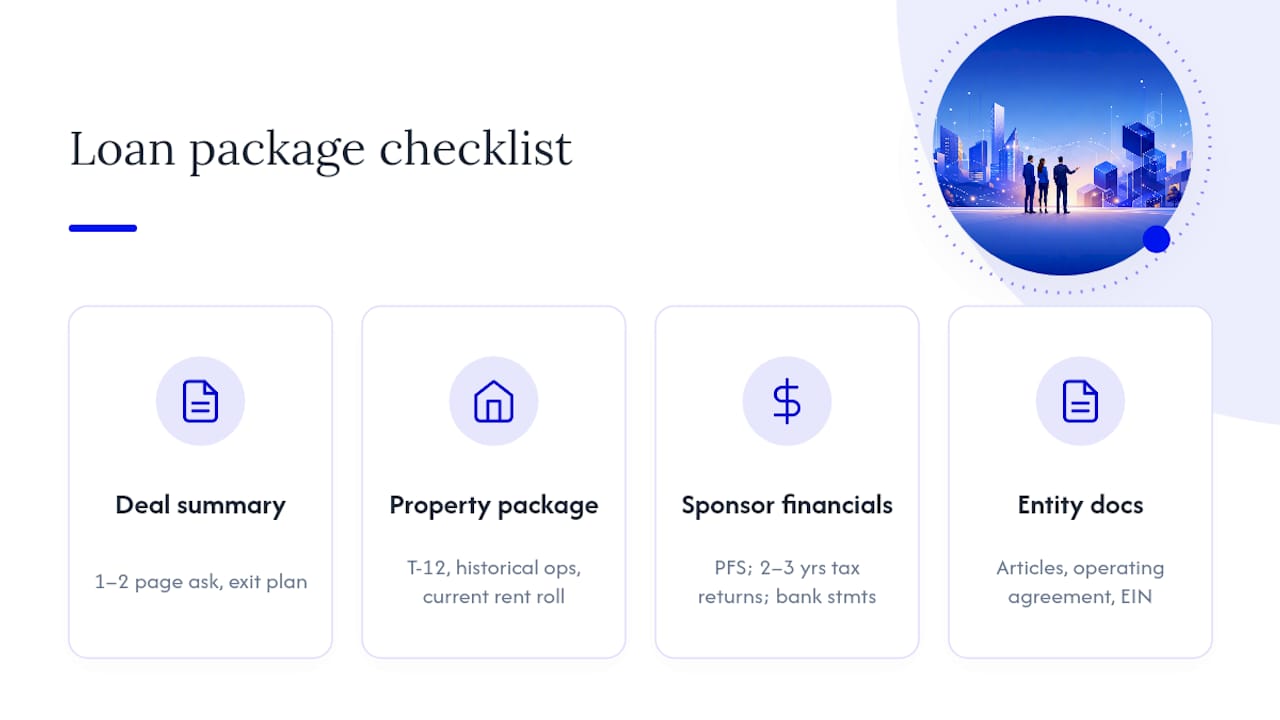
Deal summary and loan request. One or two pages stating the ask, the property, the sponsor, and the exit or repayment plan. This is the cover sheet that turns a teaser into a real pre-screen package.
Property package. Month-by-month T-12 operating statement, two to three years of historical operating statements, a current rent roll (as-of the submission date, with lease start/end dates, monthly base rent, and any concessions spelled out), and a pro forma. Lenders also expect property photos and capital improvement history here.

Sponsor and guarantor financials. A personal financial statement dated within 60 to 120 days, a schedule of real estate owned, two to three years of tax returns, and 30 to 90 days of bank statements proving liquidity. Disorganized or outdated financials are one of the most common reasons files get bounced back.
Entity and legal documents. Articles of organization, operating agreements, EIN documentation, and an organizational chart if there's more than one layer of ownership.
Third-party reports. Appraisal, Phase I environmental site assessment, ALTA/NSPS survey, and property condition report.
Leases and tenant support. Lease abstracts, estoppels where required, and financials for anchor or major tenants.
Transaction documents. Purchase and sale agreement, or existing loan documents if this is a refinance.
Title and insurance. Title commitment and current insurance declarations page.
Construction documents (when applicable). Plans, permits, GC contract, sources and uses, draw schedule.
Lender forms and authorizations. Lender questionnaire, credit authorization, broker fee agreement.
A downloadable single-PDF template with a one-page index at the front solves most of this in one move. Use consistent file naming, something like PropertyName_DocumentType_Date.pdf, so nothing gets lost in a shared folder with forty files in it.
Pro Tip: Build your executive summary to answer four questions in the first paragraph: what's the request, what's the property, who's standing behind it, and what proof backs it up. That single page often determines whether a lender opens the rest of the file at all.
Does the Checklist Change by Loan Type?
The core package holds steady across product types, but each loan type adds its own emphasis.
- DSCR and investor loans: rent support documentation, lease abstracts, two months of bank statements, LLC formation docs if title vests in an entity, and a simple debt schedule.
- Construction and heavy rehab: full sources and uses, an approved budget, a construction schedule, the GC contract, lien waivers, and an interest reserve plan.
- Multifamily and agency (Fannie Mae/Freddie Mac): sponsor liquidity and net worth thresholds, stabilized occupancy metrics, and agency-specific certification forms.
- Bridge loans: a documented exit strategy, rehab budget, and sponsor liquidity and reserves.
How Should You Package and Submit the File?
Most institutional lenders now want either one merged PDF or a clearly organized folder inside a secure portal. Keep spreadsheets like the T-12 and pro forma in native Excel format when a lender requests it. Formulas intact matter more than a polished export, since underwriters often want to test your assumptions themselves.
- Searchable PDF for operating statements and rent rolls, never a flat scan.
- Original Excel files for T-12s and pro formas with formulas preserved.
- File naming like RentRoll_123MainSt_20260315.pdf, applied consistently across every document.
- A one-page cover and index at the front of the merged file.
Sequence matters as much as format. Lead with your executive summary and cover sheet, then sponsor documents, then property financials, then leases, then third-party reports, with title and closing documents last. That order mirrors how lenders move through pre-screening, underwriting, and closing, so a file organized the same way gets read faster.
Pro Tip: Never email a personal financial statement or bank statement as a standalone attachment. Route sensitive PII through a secure document sharing portal instead of a plain email thread.
What Are the Most Common Submission Mistakes?
Most delays trace back to a handful of repeat offenders: a stale PFS, tax returns that don't reconcile with the personal financial statement, an incomplete rent roll, missing lease copies for the biggest tenants, no recent bank statements to prove where the equity is coming from, and no title commitment ordered yet.
- Too many loose attachments instead of one indexed file.
- Scans that are blurry or cropped, forcing a lender to ask for a re-send.
- No cover index, so the underwriter has to guess what's in the package.
- Missing broker authorization or credit authorization forms.
The fix is usually mechanical, not complicated: reconcile your numbers in a single worksheet before you submit, refresh the PFS and bank statements, consolidate everything into one indexed PDF, and order your Phase I and survey early instead of waiting for a lender to ask.
What Do Appraisals and Reports Actually Cost?
Timelines run in two speeds. Private and bridge lenders often move from screening to term sheet in one to four weeks. Institutional and agency channels typically take three to twelve or more weeks before a term sheet, and underwriting and due diligence commonly run 30 to 90 days once that term sheet is signed and reports are ordered.
Third-party report costs vary by asset class and loan size: appraisals run roughly $4,000 to $25,000, a Phase I environmental site assessment typically costs $1,200 to $5,000, an ALTA/NSPS survey runs $3,000 to $12,000 or more, and a property condition report costs $2,000 to $10,000. On larger CMBS and non-recourse deals, combined third-party costs can reach $30,000 to $75,000.
Non-recourse lenders in 2026 are generally underwriting in the 65% to 75% loan-to-value range, with post-closing reserves often expected to cover 6 to 18 months of debt service depending on the product.
How Thecrebrokersconnect Helps You Assemble a Packet Faster
Thecrebrokersconnect matches your scenario against 289+ verified lenders using property type, loan amount, leverage, credit profile, and loan purpose, then lets you build the actual submission inside the same workflow.
- AI lender matching narrows your outreach list before you send a single email.
- Deal templates auto-populate your executive summary and checklist categories.
- The secure document vault holds sponsor financials, T-12s, and third-party reports in one place.
- Batch lender outreach and a pipeline CRM track who's seen the file and who hasn't responded.
- The lender responsiveness leaderboard shows which lenders actually reply, not just which ones are listed.
The upside isn't abstract. A cleaner, more complete packet means fewer follow-up requests and a faster path to a term sheet, because you're handing the lender exactly what their checklist expects on the first try.
Pro Tip: Use the deal templates before you contact a single lender. Filling out the checklist inside the platform forces you to spot a missing rent roll or stale PFS before it costs you a week in follow-up emails.
A brief note from BrokersConnect
I've watched enough files get bounced back for a missing T-12 or a three-month-old PFS to know: brokers who assemble a complete packet before the first call close faster, full stop.
How to Try Thecrebrokersconnect on Your Next Deal
If you're used to assembling packets in a shared drive and emailing PDFs one at a time, there's a faster loop worth testing on your next live deal. Sign up, pick a loan-package template that matches your product type, run the AI lender match against your scenario, and export a single indexed PDF ready for submission.
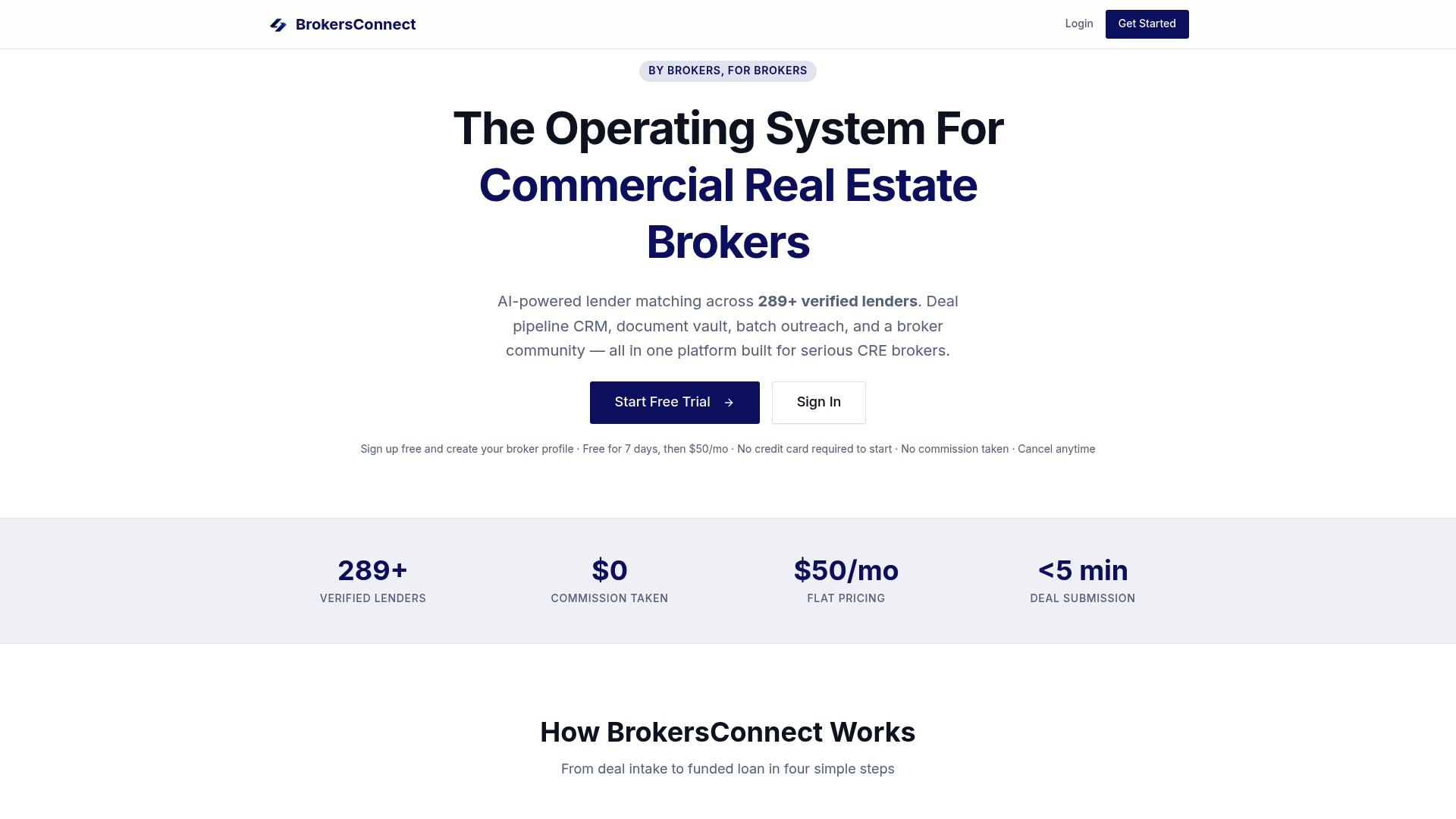
Thecrebrokersconnect runs on a flat monthly subscription with a free trial, no commission or transaction fees tied to the deals you close. That matters if you're tired of lender databases that charge per lead or platforms that take a cut of your fee. Start a free trial with BrokersConnect and build your next lender-ready packet before your next cold call.
Frequently Asked Questions
What is the most important document in a loan document checklist? The executive summary or loan request letter carries the most weight upfront. It's what a lender reads first, and it either earns a full review or gets the file set aside.
How old can a personal financial statement be for a CRE loan submission? Most lenders want a PFS dated within 60 to 120 days of submission. Anything older typically triggers a request for an update before underwriting proceeds.
Do all CRE loans require a Phase I environmental report? Most institutional and bank lenders require one regardless of property type, though some private and bridge lenders waive it for lower-leverage deals or properties with a clean environmental history.
How long does it take to assemble a complete lender submission? Brokers with organized sponsor files can typically assemble a complete packet in a few days. Ordering third-party reports like an appraisal or survey adds the longest lead time, often two to six weeks.
What format do lenders prefer for loan document submissions? A single merged, searchable PDF with a cover index is the most common preference, though spreadsheets like the T-12 and pro forma should stay in native Excel format when a lender's underwriting team requests it.
Sources
These sources shaped the checklist above and are worth a closer read if you're building your own submission process.
Brookmont Capital's guide on what lenders want breaks down the financial documentation lenders expect before they'll even schedule a call.
Axiant Partners covers underwriting priorities in plain terms, and Lendersa's phase-by-phase guide is the clearest breakdown available on non-recourse and institutional packaging requirements.
- How to Get Your CRE Deal Funded: What Lenders Want
- What Do Lenders Look for in a Commercial Real Estate Loan? | Axiant
- First-Time Commercial Borrower's Checklist | The Lender Directory
- What Do Lenders Really Need? A Pre-Submission Checklist