
Effective deal pipeline management means enforcing borrower-aligned pipeline stages with measurable exit criteria so commercial real estate loan deals move predictably from first contact to closing table. Three things to do right now: define strict exit criteria for your first two stages (lead to qualified) and apply them to every open deal; run a 15-minute pipeline hygiene sweep to flag any deal with no borrower-driven next step on the calendar; and enable at least one automation that updates days-in-stage in real time. Organizations with a formally defined sales process achieve higher revenue growth than those without one, according to CSO Insights. Salesforce guidance on pipeline management is direct: every stage must map to a buyer action, not an internal admin milestone. BrokersConnect is built to enforce exactly that framework for CRE loan brokers.
Three immediate actions:
- Define 2–4 observable, borrower-driven exit criteria for your Lead and Qualified stages and apply them retroactively to every open deal today.
- Flag every deal with no confirmed next step and a borrower contact as stalled. Reclassify or re-engage within 48 hours.
- Turn on a days-in-stage counter in your CRM so you stop estimating and start measuring.
Table of Contents
- Why your CRE loan pipeline needs a formal process now
- What every CRE deal pipeline must include
- How to set up a CRE loan pipeline in your SaaS
- Which automations actually help your CRE deal flow
- Common CRE pipeline bottlenecks and how to fix them
- How BrokersConnect implements this pipeline framework
- How to measure ROI from better pipeline management
- Key Takeaways
- The case for flow over volume
- BrokersConnect gives you the pipeline infrastructure to close faster
- Useful sources
Why your CRE loan pipeline needs a formal process now
The CRE lending market in 2026 is slower to close, not faster. Longer underwriting timelines, larger lender decision committees, and heavier documentation requirements mean a broker who tracks deals by gut feel is flying blind. The CSO Insights data showing 18% higher revenue growth from formal processes was measured across B2B sales broadly. For CRE loan brokers, where a single deal can represent $5M–$50M in loan proceeds, the dollar impact of even one fewer stalled deal per quarter is significant.
The real problem is not generating pipeline. It is making pipeline predictable. Raw volume of deals in your tracker tells you almost nothing about whether you will close this quarter. What matters is flow: how fast deals move, where they stall, and whether the signals driving advancement are real borrower behaviors or wishful internal updates.
Three business outcomes from a formal pipeline:
- Forecast accuracy: When every stage has exit criteria, your close-date estimates reflect actual borrower progress, not optimism.
- Lender responsiveness: Brokers who submit cleaner, better-documented packages get faster lender responses. A pipeline process enforces that packaging discipline before submission.
- Win rate: Nooks research on sales pipeline optimization targets typical stage-to-stage conversion rates of 40–60% and recommends multi-threaded engagement in 70% of deals by mid-stage. Both require a process, not a spreadsheet.
What every CRE deal pipeline must include
A CRE loan pipeline is not a to-do list. It is a flow system with defined entry conditions, measurable progression signals, and hard exit criteria at every gate.
Minimum required data fields per deal:
- Loan amount and property type
- Estimated close date and last-updated date
- Next step and next-step date (borrower-driven, not internal)
- Primary borrower contact plus at least one secondary contact (multi-threading)
- Lender stage (not yet submitted / submitted / under review / term sheet issued / approved)
- Loss reason (populated immediately on any deal marked dead)
KPIs to track on your dashboard:
- Stage conversion rate (deals advancing ÷ deals entering each stage)
- Average days in stage per stage
- Pipeline velocity (formula below in Section 8)
- Pipeline coverage ratio (total pipeline value ÷ quarterly revenue target)
- Stalled-deal count and total value
- Win rate (closed-won ÷ total deals exited)
Pro Tip: AI underwriting tools can surface qualification signals at pipeline entry, cutting the number of deals that reach mid-stage before failing basic lender criteria.
| Pipeline Component | What It Must Include |
|---|---|
| Stage design | 5–7 stages mapped to borrower actions |
| Exit criteria | 2–4 observable, buyer-driven signals per stage |
| Data fields | Amount, property type, close date, next step, contacts, loss reason |
| Scoring | Intent signals: budget confirmed, timeline set, champion identified |
| KPIs | Conversion rate, days-in-stage, velocity, coverage ratio, win rate |
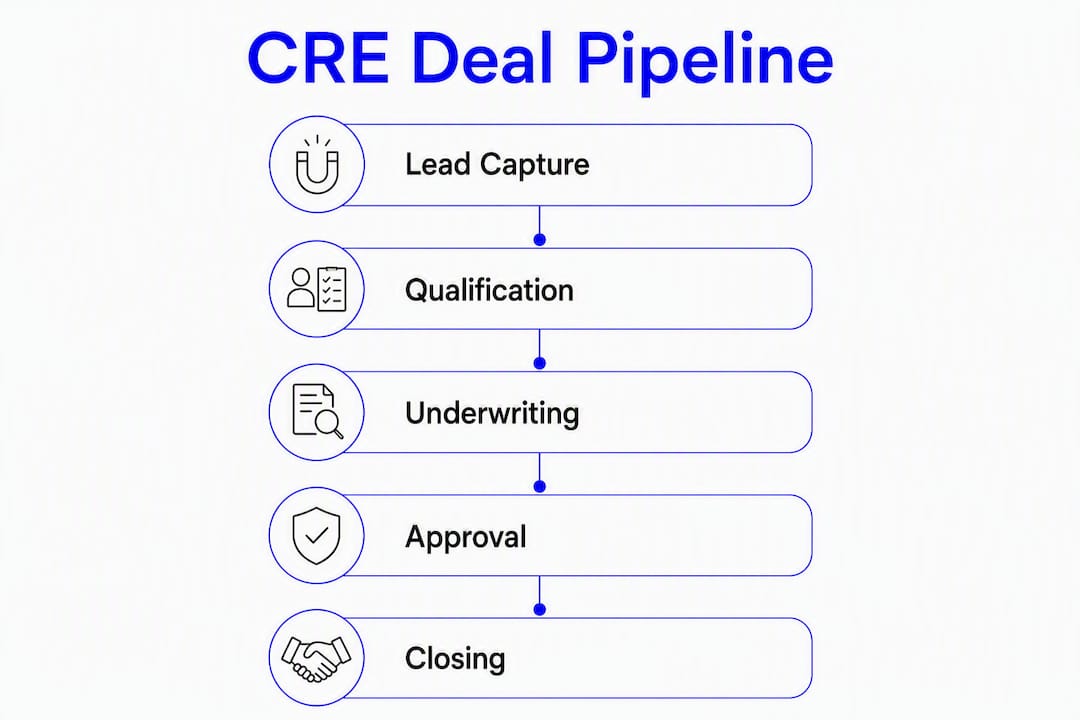
How to set up a CRE loan pipeline in your SaaS
ECOSIRE's pipeline optimization guidance recommends several stages for B2B pipelines and a healthy coverage ratio benchmark. For CRE loan deals, six stages map cleanly to borrower behavior:
| Stage | Borrower Action | Broker Action | Exit Criteria | Typical Duration |
|---|---|---|---|---|
| 1. Lead | Inquires or is identified | Capture deal metadata, source, loan type | Loan amount, property type, and borrower contact confirmed | 1–3 days |
| 2. Qualified | Confirms budget, timeline, and intent | Run qualification checklist; confirm 2+ contacts | Budget, timeline, and champion verified; no fatal lender objections | 3–7 days |
| 3. Package Ready | Provides required docs | Build loan package; upload to document vault | Rent roll, operating statements, entity docs, and property details complete | 5–14 days |
| 4. Lender Outreach | Reviews term sheets | Submit to matched lenders; track responses | At least one lender in active review or term sheet issued | 7 days |
| 5. Under Negotiation | Negotiates terms | Manage lender Q&A; track borrower responses | Executed LOI or term sheet signed by borrower | 7–30 days |
| 5. Closing | Executes closing docs | Coordinate title, escrow, and final conditions | Loan funded | 14 days |
Quick setup checklist:
- Create the six stages above in your CRM with the exact exit criteria as required fields, not optional notes.
- Add a days-in-stage counter and a "stalled" flag with a reasonable threshold for inactivity.
- Build a document checklist for Stage 3 that gates advancement: tenant estoppel certificates, rent rolls, operating statements, and entity documents must all be uploaded before the deal moves to Stage 4.
- Assign stage ownership: one named broker or team member owns each deal's current stage.
- Capture at least two borrower contacts at Stage 2. Single-threaded deals stall at a disproportionate rate when the primary contact goes dark.
Which automations actually help your CRE deal flow
Simple, buyer-signal-driven automation preserves momentum. Complex automation tied to internal admin events creates false pipeline and bad forecasts.
Automations to enable:
- Days-in-stage counter: Updates automatically every 24 hours. No manual entry, no guessing.
- Stalled-deal alert: Fires when a deal has no next-step date after a defined threshold (7 days is a reasonable default for most CRE stages).
- Stage advancement trigger: Fires only when a borrower-driven document or action is recorded, such as an executed LOI uploaded to the vault or a term sheet confirmed.
- Document-required gate: Blocks Stage 3 to Stage 4 advancement until all required documents are present in the vault.
Automations to avoid:
- Advancing a stage when you send a proposal (that is your action, not the borrower's).
- Marking a deal "active" because you left a voicemail.
- Auto-closing deals as won before loan funding is confirmed.
Agile CRM's deal-tracking guidance makes the same point: automate to reduce manual work, but tie every trigger to a buyer behavior, not an internal task completion.
Pro Tip: Start with 1–3 automations only. Measure their impact on average days-in-stage over 30 days before adding more. Automation debt compounds fast.

Common CRE pipeline bottlenecks and how to fix them
Most stalled CRE loan deals trace back to one of five causes:
- Single-threaded contact: One borrower contact goes quiet and the deal dies. Fix: require two verified contacts at Stage 2 qualification. If you cannot get a second contact, that is a qualification failure, not a pipeline problem.
- Loose qualification: Deals enter Stage 3 without confirmed budget or timeline. Fix: enforce the Stage 2 exit criteria retroactively. Reclassify anything that does not meet them.
- Missing critical docs: Packages stall at lender submission because rent rolls or entity documents are incomplete. Fix: use a secure document vault with a required-document checklist that gates stage advancement.
- Lender responsiveness delays: Some lenders take weeks to respond. Fix: track lender response time by lender name and prioritize lenders with faster response records on time-sensitive deals.
- Unrealistic close dates: Brokers set close dates based on borrower wishes, not actual stage duration data. Fix: use your average days-in-stage history to set close dates, then update them when stage data changes.
Weekly pipeline review checklist (15–30 minutes):
- Pull all deals with no next-step date. Reclassify or re-engage each one.
- Review the top five deals by value. Confirm each has a borrower-driven next step within seven days.
- Check any deal in Stage 4 or 5 with no lender response in 14 days. Escalate or re-submit to additional lenders.
- Flag deals that have been in the same stage longer than the stage's typical duration benchmark.
A bridge loan deal stalled at Stage 4 for 19 days with no lender response. The fix took three steps: re-qualify the borrower's timeline (it had shifted), re-submit to two additional lenders using the platform's lender match tool, and set a 5-day response SLA with each new lender. The deal moved to Stage 5 within eight days of re-submission.
How BrokersConnect implements this pipeline framework
BrokersConnect maps directly to the six-stage framework above. The platform's deal pipeline CRM lets brokers create custom stages with required fields, so exit criteria are enforced at the data level, not just in a team meeting.
Feature-to-need mapping:
- Deal pipeline CRM: Tracks stage, next step, days-in-stage, and deal metadata in one view.
- AI lender matching: At Stage 3, the platform matches your loan scenario against 289+ verified lenders by property type, loan amount, leverage, and structure, cutting manual lender research.
- Batch lender outreach: Submit to multiple lenders simultaneously at Stage 4, with response tracking built in.
- Lender responsiveness leaderboard: Shows which lenders respond fastest, so you can prioritize on time-sensitive deals.
- Secure document vault: Houses all deal documents with access controls, satisfying Stage 3 exit criteria and reducing back-and-forth with lenders.
Three-step usage example:
- Submit your deal scenario in BrokersConnect, attach all Stage 3 documents to the vault, and confirm exit criteria are met.
- Run the AI lender match, review the ranked lender list, and launch batch outreach to your selected lenders in one action.
- Monitor stage movement and lender responses on the dashboard. When a term sheet arrives, mark the borrower-driven trigger and advance the deal to Stage 5.
Pro Tip: Use BrokersConnect's private lender database to multi-thread lender outreach on bridge and construction deals where speed matters most.
How to measure ROI from better pipeline management
Pipeline velocity tells you how much revenue your pipeline generates per day. The formula:
Velocity = (Number of deals × Average deal value × Win rate) ÷ Average sales cycle in days
Example: Using the velocity formula, improving win rate on the same pipeline increases daily pipeline revenue generation.
ECOSIRE's benchmark for a healthy coverage ratio suggests your pipeline value should be multiple times your quarterly revenue target.
| KPI | What to Measure | Healthy Benchmark |
|---|---|---|
| Coverage ratio | Total pipeline value ÷ quarterly target | 3–4x |
| Stage conversion rate | Deals advancing ÷ deals entering each stage | 40–60% |
| Average days in stage | Days per stage across all active deals | Varies by stage (see setup table) |
| Win rate | Closed-won ÷ total deals exited | Track trend; improve quarter over quarter |
| Stalled-deal value | Total $ value of deals with no next step | Target: — |
The 18% revenue growth lift from CSO Insights translates directly: a broker closing $800,000 in annual fees with a formal pipeline process could reasonably target $944,000, holding all other variables constant.
Key Takeaways
A formal, borrower-aligned pipeline with enforced exit criteria is the single highest-leverage change a CRE loan broker can make to improve forecast accuracy and close rate.
| Point | Details |
|---|---|
| Enforce exit criteria | Every stage needs 2–4 observable, borrower-driven signals before a deal advances. |
| Prioritize momentum over volume | Aim for multi-threaded engagement in 70% of deals by mid-stage and track response cadence, not deal count. |
| Keep automation simple | Start with 1–3 automations tied to buyer behavior; measure impact before adding more. |
| Run weekly hygiene reviews | A 15–30 minute weekly sweep of stalled deals and missing next steps prevents pipeline rot. |
| BrokersConnect centralizes the process | The platform's CRM, AI lender matching, document vault, and batch outreach implement this framework in one place. |
The case for flow over volume
Most brokers I see struggling with pipeline are not short on deals. They are short on discipline about what counts as a real deal. A pipeline full of optimistic entries and no exit criteria is not a pipeline. It is a wish list with a dollar amount attached.
The shift that changes everything is treating "stalled" as a diagnostic signal rather than a stage. When a deal stops moving, that is data. It tells you something about qualification, documentation, lender fit, or borrower readiness. A broker who acts on that signal within 48 hours, either re-engaging or reclassifying, will consistently outperform one who lets stalled deals age in the tracker.
The other thing most guides miss: pipeline management is a team behavior, not a software feature. The best CRM in the world does nothing if the team updates it only before a pipeline review. The fix is short SOPs, clear stage ownership, and a weekly review cadence that is non-negotiable. Software enforces the rules. People have to agree to play by them first.
BrokersConnect gives you the pipeline infrastructure to close faster
Brokers who implement the framework in this guide without the right tools spend more time on data entry than deal advancement. BrokersConnect removes that friction directly.
The platform gives you a deal pipeline CRM with enforced exit criteria fields, AI-powered matching against 289+ verified lenders, batch outreach with built-in response tracking, and a secure document vault that gates stage advancement until packages are complete. No transaction fees. One flat monthly subscription. You can start a free trial on BrokersConnect today and have your first six-stage pipeline running before your next weekly review.
Useful sources
- CSO Insights via HBR: Formal sales process and revenue growth
- Salesforce: Sales pipeline management best practices
- AdPropix: Conversion tracking for real estate campaigns
- AdPropix: Platform-driven campaign setup for real estate
- BrokersConnect platform blog: Templates, SOPs, and CRE broker resources