
A broker-focused commercial real estate financing platform will cut time-to-lender for most workflows, mainly because it replaces cold-call lender searches with automated matching, batch outreach, and a pipeline that tracks every conversation. The evidence points one way: platforms that pair verified lender databases with submission templates and CRM tools reduce administrative drag and put more quotes in front of a sponsor faster.
The rationale is simple. Sourcing capital manually means scrolling old lender lists, guessing at appetite, and re-typing the same deal summary into five different emails. A matching engine does that filtering in minutes, not days.
If you want proof rather than a promise, don't read another comparison article. Do this instead:
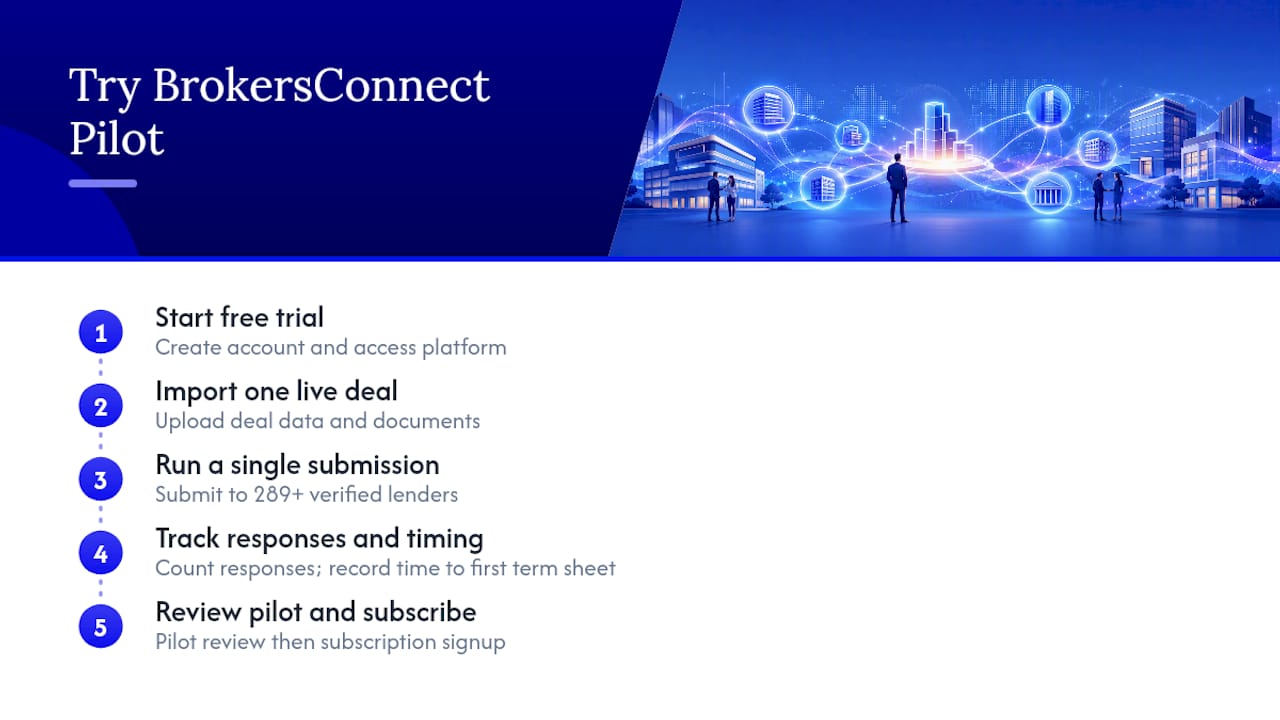
- Start a free trial and import one active or recently closed deal.
- Run a real submission and count how many qualified lenders respond within 48 hours.
- Compare that response count against your last five manual outreach efforts.
Key Takeaways
A broker-focused commercial real estate financing platform speeds deal placement by automating lender matching, batch outreach, and pipeline tracking, which increases quote counts and shortens time-to-lender.
| Point | Details |
|---|---|
| Verdict on speed | Automated lender matching and batch outreach reduce time-to-lender compared to manual sourcing. |
| Core capabilities to expect | Lender matching, verified database, submission templates, pipeline CRM, document vault, and analytics. |
| Evaluation priority | Check matching methodology, lender verification frequency, and data export rights before subscribing. |
| Pilot metrics that matter | Track time-to-first-quote, quotes per submission, and response rate during any trial. |
| BrokersConnect fit | Matches deals against 289+ verified lenders with submission templates, pipeline CRM, and a free trial to test first. |
Useful Sources for Deeper Research
- Best Commercial Mortgage Lenders: A Broker's Matching Guide
- Best DSCR Lenders for Real Estate Investors in 2026
- Best DSCR Lenders and Calculators
- Preserve data ownership: confirm export rights and run a real pilot before purchasing any subscription.
Table of Contents
- What Is a Commercial Real Estate Financing Platform?
- Who Actually Needs This Kind of Platform?
- How Do You Evaluate a CRE Financing Platform Before Buying?
- How Does Lender Matching Actually Work?
- What Should You Expect to Pay, and What's the ROI?
- How Do You Run a Short Pilot to Validate a Platform?
- What Actually Matters in Practice for Brokers
- Why BrokersConnect Fits This Checklist
- Frequently Asked Questions
What Is a Commercial Real Estate Financing Platform?
A commercial real estate financing platform, in the broker sense, is software that matches a loan scenario to verified lenders and manages the deal from submission to closing table. It's distinct from lender-side origination software; this is built for the broker doing the placing, not the bank doing the funding.
The core capability set looks consistent across the category:
- Lender matching based on property type, loan size, geography, and leverage
- Verified lender database with updated appetite and contact information
- Batch outreach to shortlisted lenders instead of one-by-one emails
- Submission templates that standardize how a deal package looks
- Pipeline CRM to track every deal stage and lender conversation
- Secure document vault for financials, rent rolls, and offering memos
- Analytics on response rates and quote counts per submission
Most platforms in this category support bridge loans, DSCR loans, construction financing, multifamily, fix-and-flip, private money, and traditional commercial mortgages, with some also covering equity placements.
Who Actually Needs This Kind of Platform?
Producing brokers, capital advisors, mortgage brokers, and brokerage operations teams get the most out of a matching-and-pipeline platform, mainly because their bottleneck is volume, not knowledge.
The jobs it solves are specific:
- Source lenders without cold-calling a stale contact list
- Package submissions once and route them to a shortlist
- Track every lender response in one place instead of a scattered inbox
- Keep full deal context available to anyone on the team
A solo broker validating a single sponsor deal benefits differently than a ten-person shop running forty submissions a week, but both are solving the same core problem: too much manual coordination.
How Do You Evaluate a CRE Financing Platform Before Buying?
Run through these evaluation dimensions before committing to any subscription:
- Matching methodology. How does the system score a lender match? Is it filtering on real criteria (asset class, loan amount, leverage, credit profile, loan purpose, transaction structure) or just tagging by loose category?
- Lender coverage and verification. How many lenders are in the network, and how often is that list refreshed? A lender matrix that tracks loan size range, geographic focus, and last-touch date is the highest-leverage asset a debt brokerage owns, so the platform's version of it needs to be current.
- Submission and template quality. Can you customize a package, or are you stuck with a generic form that doesn't reflect your deal?
- Pipeline CRM depth. Does it track deal stage, lender, contact history, and documents natively, or does it just bolt a spreadsheet view onto a lender directory?
- Integrations and data control. Can you export your data? Is your deal information ever used to train external models or resold?
- Support and pricing. Flat subscription or hidden fees per submission?
Ask a vendor directly during a demo: how many quotes does a typical submission generate, and what's the average time to first quote? If they can't answer with a number, that's itself an answer.
Watch for these red flags before signing anything:
- Broker data resold to third parties without disclosure
- A "verified" lender network that's actually just a scraped list
- No export or API access to your own deal data
- No audit trail showing who touched a deal and when
Pro Tip: Ask specifically whether lender preferences (loan size range, advance rate guidance, spread guidance) are updated by the platform's team or left stale after onboarding. A matching engine is only as good as the data behind it.
How Does Lender Matching Actually Work?
Under the hood, a matching engine filters the active lender pool against the deal's real parameters, not just a broad category label.
The typical logic runs through several layers: asset class, loan amount, geography, leverage requested, sponsor credit profile, loan purpose, and preferred transaction structure. Cross collateralization and other structural factors also affect which lenders will even consider a file, so the better platforms weigh those too.
The workflow from submission to quotes generally follows this sequence:
- Prepare the deal package (financials, rent roll, sponsor bio)
- Let the system auto-extract data from those documents, which reduces manual entry considerably compared to retyping numbers into five different lender forms
- Run the lender shortlist against your deal parameters
- Trigger batch outreach to that shortlist instead of individual emails
- Collect term sheets as they come in
- Rank offers side-by-side on rate, leverage, and terms
- Update the pipeline stage and move to negotiation
Pro Tip: Before trusting match quality on a live deal, seed the lender matrix with your known relationships first, then run a sample submission on a deal you've already placed. If the system surfaces lenders you'd have called anyway, plus a few you hadn't considered, that's a good signal.
What Should You Expect to Pay, and What's the ROI?
Most platforms in this category run on a flat monthly subscription with a free trial period rather than charging per-transaction fees, which matters because a broker closing a $2 million deal shouldn't pay more for the software than one closing $200,000.
A basic plan typically includes:
- Access to the verified lender database
- A capped or unlimited number of monthly submissions
- Pipeline CRM and document storage
- Standard submission templates
Onboarding runs two to eight weeks depending on how clean your existing contact and deal data is. Expect these milestones: initial data import, template setup, a handful of pilot submissions, then team training.
During a trial, track four numbers: time-to-first-quote, number of quotes generated per submission, how much follow-up time drops compared to your manual process, and overall pipeline velocity. Platforms that automate underwriting-adjacent tasks tend to show up clearly in the time-to-quote metric, since less manual analysis means faster packaging.
How Do You Run a Short Pilot to Validate a Platform?
A short, structured pilot beats a long evaluation period. Follow this sequence over two to three weeks:
- Pick one or two live deals, ideally ones you're actively trying to place
- Prepare a sponsor financial package with real numbers, not a test file
- Import your existing lender contacts and preferences
- Seed the lender matrix with known relationships and appetite notes
- Run the sample submission through the matching engine
- Track every quote, response time, and lender touch that comes back
- Review results against your last several manual placements
Success looks like more qualified quotes per submission and a shorter gap between submission and first response, compared to your baseline. Capture time stamps, quote counts, and how quickly your team actually adopts the new workflow instead of reverting to old habits.
What Actually Matters in Practice for Brokers
The honest take: these platforms earn their subscription fee on volume and speed, not on replacing judgment. A broker running two or three deals a month might not notice much difference. A broker running fifteen submissions a month notices immediately, because the administrative overhead compounds.
The most common implementation mistake is skipping the data cleanup step. Importing a messy, inconsistent lender contact list into a new taxonomy just recreates the old chaos in a new interface.
Relationships still close deals. A platform surfaces the shortlist and cuts the busywork. It doesn't replace the phone call where a lender tells you what they won't say in writing.
Why BrokersConnect Fits This Checklist
Everything covered above, matching methodology, lender coverage, submission quality, pipeline depth, security, maps directly onto how BrokersConnect is built.
The platform runs AI-powered lender matching against a database of 289+ verified lenders, covering bridge, DSCR, construction, multifamily, fix-and-flip, private money, and traditional commercial mortgages. Submission templates, a pipeline CRM, a secure document vault, and batch lender outreach come standard, along with a lender responsiveness leaderboard that tells you which lenders actually answer versus which ones just sit in a database.
If you want to know whether this changes anything for your deal flow, the fastest way to find out is to test it on something real. Start a free trial, import one live deal, and run a single submission. Track how many verified lenders respond and how fast the first term sheet lands. From there, a pilot review and subscription signup are the next steps.
Frequently Asked Questions
Does a commercial real estate financing platform replace my existing lender relationships? No. It surfaces additional qualified lenders faster and organizes outreach, but the phone calls and negotiation still depend on you.
How many lenders should a verified network include to be useful? Coverage matters less than verification quality. A network of 289+ actively verified lenders across major asset classes, refreshed regularly, outperforms a larger but stale list.
Can I import my own lender contacts and deal data? Most broker-focused platforms support data import during onboarding, and you should confirm export rights before signing, so you never lose access to your own contact history.
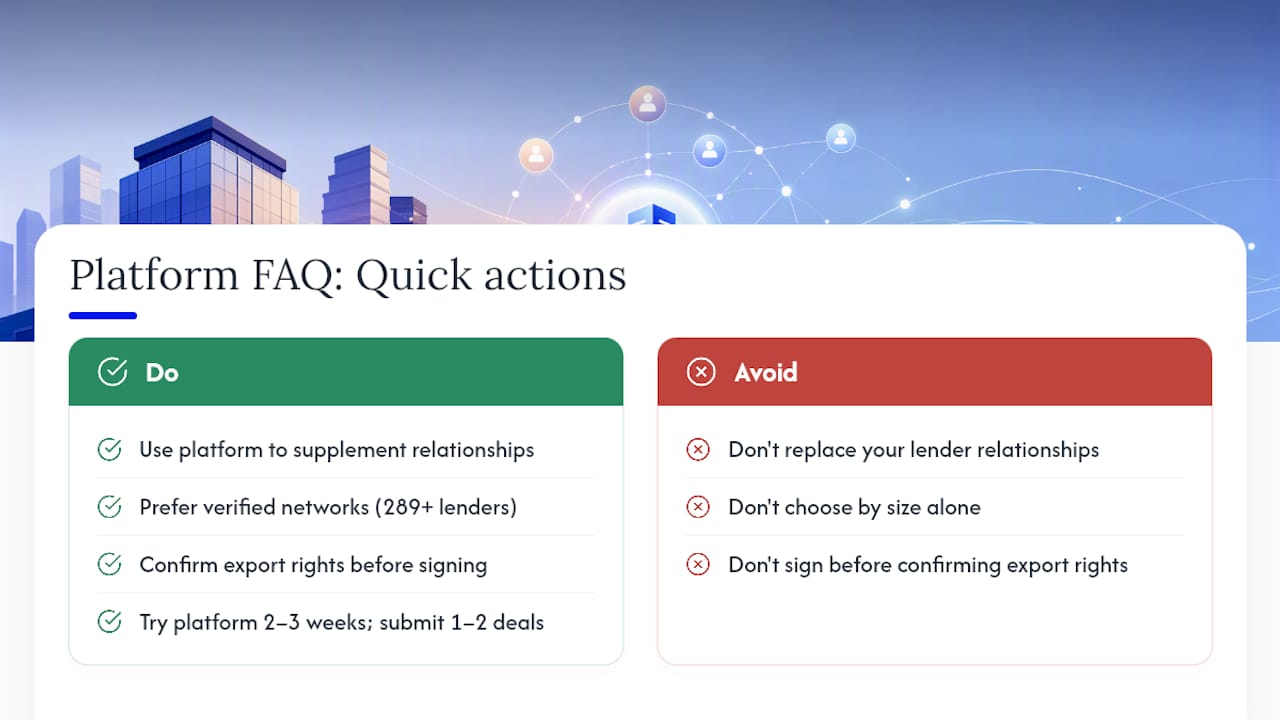
What's a realistic trial period to judge match quality? Two to three weeks running one or two live submissions gives enough signal on response rates and quote counts without dragging out the evaluation.