
Intelligent Document Processing (IDP) converts unstructured CRE loan packages — rent rolls, leases, operating statements, loan applications — into schema-driven, auditable JSON that feeds directly into underwriting templates and lender-matching workflows. Before you run a pilot, validate three signals: per-field confidence scores that route low-confidence values to human review, bounding-box traceability linking every extracted number back to its source PDF location, and SOC 2-equivalent security controls. Platforms like Thecrebrokersconnect are built to test this with real deal packages.
Key signals to confirm before committing to any IDP tool:
- Per-field confidence scores with automatic routing of exceptions to human review
- Bounding-box citations so every dollar amount traces to a page and coordinate
- Schema-driven output (not free-text LLM dumps) for downstream automation
- SOC 2 or equivalent security attestation for sensitive borrower data
- API or webhook support for CRM and underwriting template integration
Pro Tip: Before evaluating any vendor, pull your last five deals and note where manual data entry caused the most delays. Those document types are your pilot scope.
Table of Contents
- What AI document extraction actually does for CRE workflows
- Why IDP changes the economics of deal packaging
- How IDP fits into a loan packaging pipeline
- What to look for when evaluating IDP vendors
- A 30–60 day pilot plan you can actually run
- Deployment risks and how to control them
- How Thecrebrokersconnect applies this to real broker workflows
- Key Takeaways
- The gap between what IDP demos show and what production actually requires
- Thecrebrokersconnect: built for brokers who want to pilot IDP now
- Useful sources and documents to request from vendors
What AI document extraction actually does for CRE workflows
Automated document processing uses computer vision, machine learning, and NLP to convert unstructured documents into structured, database-ready formats like JSON or CSV. That is the technical definition. What it means for a broker: a lengthy loan package stops being a reading exercise and becomes a populated underwriting template.
The components that matter most in a CRE context:
| Component | What it does | Why it matters for brokers |
|---|---|---|
| Layout-aware OCR/vision | Reads scanned PDFs, mixed formats, handwritten notes | Handles real-world deal docs, not just clean digital files |
| Schema-driven field mapping | Extracts only the fields you define (loan_amount, dscr_ratio, rent_roll_gross_income, lease_expiry_date) | Output plugs directly into underwriting models |
| Per-field confidence scores | Assigns a confidence value to each extracted field | High-confidence fields auto-process; low-confidence ones route to review |
| Bounding-box citations | Links each value to its exact page and coordinate in the source PDF | Every number is auditable back to the original document |
| Multi-page table reconstruction | Reassembles rent roll rows that span pages | Prevents silent failures on long documents |
| REST API / webhooks | Pushes structured output to CRM, underwriting tools, lender portals | Closes the loop without manual copy-paste |
Schema-driven output matters more than free-text LLM responses for one practical reason: auditability. A lender asking "where did that DSCR come from?" needs a traceable answer, not a language model's best guess.
Why IDP changes the economics of deal packaging
The core ROI lever is not speed for its own sake. IDP delivers data directly into underwriting models and lender submission templates, which shortens time-to-decision. For a broker running multiple active deals, that compression compounds fast.
Primary CRE use cases where IDP removes friction:
- Rent roll extraction: gross income, vacancy rate, unit count, lease expiry dates pulled automatically
- Lease abstracts: tenant name, term, rent escalations, renewal options structured and searchable
- Operating statements and tax returns: NOI, expense ratios, and depreciation mapped to underwriting fields
- Lender forms: borrower financials and property data pre-populated from source documents
- DSCR calculations: extracted income and debt figures feed directly into a DSCR calculator or underwriting model
IDP also classifies document types automatically — distinguishing a rent roll from a lease before extraction begins — which prevents field mis-mapping and reduces re-requests from lenders.
Pro Tip: Target the document types that gate your lender submissions first. For most brokers, that is rent rolls and DSCR-supporting financials. Measure time saved there before expanding scope.
How IDP fits into a loan packaging pipeline
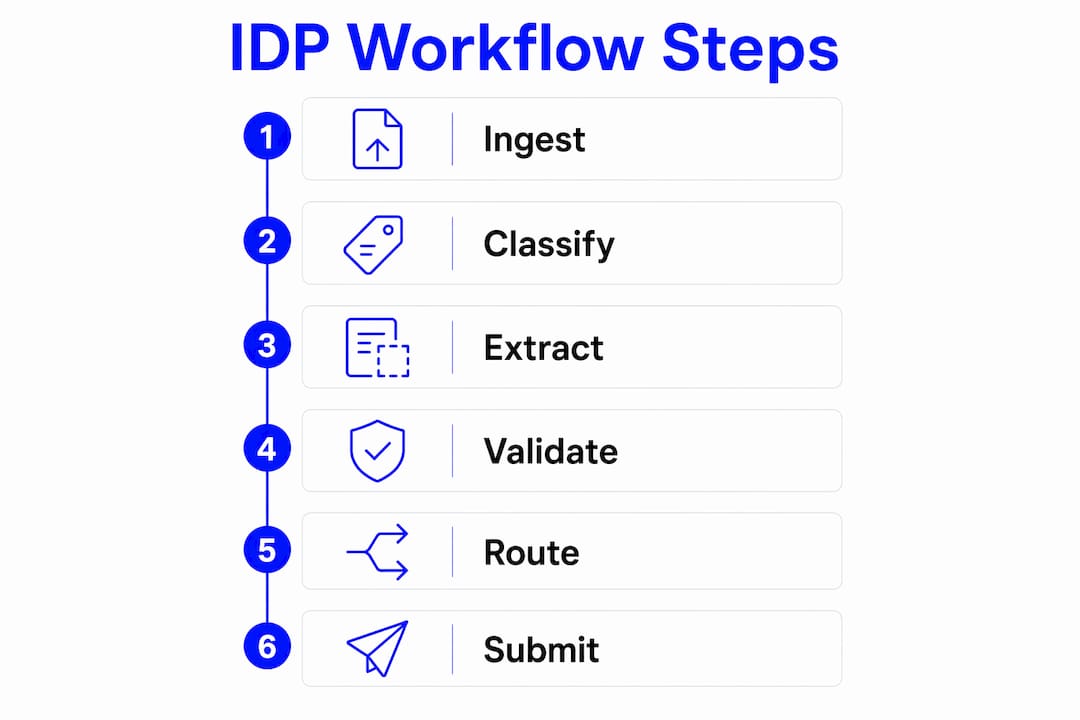
The data flow has six distinct steps, and each one has a specific integration point.

| Step | Action | Integration point |
|---|---|---|
| 1. Ingest | Upload scanned PDFs, emails, or digital docs | Document vault |
| 2. Classify and split | Auto-identify document type; split multi-doc PDFs | Pre-extraction routing |
| 3. Extract with confidence | Schema extraction returns fields + confidence scores + bounding-box links | Extraction API output |
| 4. Human-in-the-loop review | Low-confidence fields flagged for broker verification | Review queue in platform UI |
| 5. Populate templates | Structured data pushes to underwriting spreadsheet and CRM record | CRM field mapping, template export |
| 6. Batch lender submission | Lender-ready packets distributed via lender-matching API | Lender submission pipeline |
Per-field confidence flags drive the routing decision at step 4. Fields above your acceptance threshold auto-process; anything below routes to a review queue. That keeps manual effort focused on genuine exceptions rather than full document re-reads.
Pro Tip: Map one sample deal end-to-end through all six steps before broader rollout. You will find the two or three handoffs where data format mismatches create the most friction.
What to look for when evaluating IDP vendors
Vendor demos tend to show clean, well-formatted documents. Your deals will not always look like that. These are the questions and signals that separate a polished demo from a production-capable tool.
Must-have feature signals:
- Schema-first extraction that handles lender form variations through semantic matching, not brittle per-source templates
- Per-field confidence scores with configurable thresholds for auto-accept vs. human review
- Bounding-box citations for every extracted value — page number and coordinate, not just the value itself
- Agentic multi-page table reconstruction that plans and validates extraction for complex, long documents
- REST API or webhooks with documented CRM integration examples
- SOC 2 Type II or equivalent attestation, plus encryption at rest and in transit
Demo questions worth asking:
- Can you reconstruct a 20-page rent roll with line items that span multiple pages?
- Can you return page and coordinate citations for each extracted value?
- How does the system handle a lender form that changes layout between versions?
- What does your error-rate reporting look like, and how do model improvements get fed back?
Onboarding time and sample-processing SLA matter too. A vendor who needs six weeks to configure your schema is not a pilot-friendly option.
A 30–60 day pilot plan you can actually run
Steps in order:
- Select 5–15 representative deals covering your most common document types (rent rolls, leases, P&Ls, loan applications)
- Define your extraction schema: at minimum, loan_amount, dscr_ratio, rent_roll_rows, lease_terms, and gross_income
- Run batch extraction and review the confidence score distribution across fields
- Manually verify all low-confidence fields and log correction time
- Measure precision (correct extractions / total extractions) and table reconstruction success rate
- Push outputs into your underwriting template and one lender submission packet
- Decide go/no-go based on your acceptance thresholds
| Timeline | Activity | Output |
|---|---|---|
| Weeks 1–2 | Sample selection, schema definition, vendor setup | Defined schema, sample deal set |
| Weeks 2–4 | Batch extraction, confidence review, field corrections | Precision/recall baseline, time-per-deal measurement |
| Weeks 4–6 | Template integration, lender packet generation, ROI measurement | Go/no-go decision, cost-per-deal comparison |
Acceptance thresholds to set before you start: target 90%+ of fields auto-accepted at your confidence threshold, and a table reconstruction success rate above 95% for rent rolls. If either metric falls short after week four, the schema or the vendor needs adjustment before scaling.
Deployment risks and how to control them
Human-in-the-loop validation is not optional for high-stakes CRE financing. Even high-accuracy models produce edge cases, and a mis-mapped DSCR ratio in a lender submission creates real downstream damage.
Risks to test for explicitly:
- Silent failures on long or complex documents — raw LLM approaches frequently miss mid-document values; agentic extractors with semantic chunking handle this better
- Field mis-mapping when a lender changes their form layout — schema-first semantic matching reduces this; brittle regex templates do not
- Missing traceability — if you cannot link an extracted value back to a page and coordinate, you cannot audit it
Security and compliance controls to require:
- Encryption at rest and in transit for all uploaded documents
- Role-based access controls limiting document visibility by deal or team
- Audit trail tying every extracted value to its source document location
- SOC 2 Type II attestation or equivalent
Pro Tip: Include your worst-case documents in the pilot — handwritten notes, scanned multi-document PDFs, and 30+ page rent rolls. Silent failures show up there first, not on clean test files.
How Thecrebrokersconnect applies this to real broker workflows
Thecrebrokersconnect is built around the same pipeline described above. The platform's secure document vault stores deal packages, and its AI tools apply pre-built CRE schemas to extract rent roll metrics, lease terms, and financial data using per-field confidence flags and audit traceability.
| Platform feature | Broker workflow application |
|---|---|
| Secure document vault | Centralized storage for all deal docs with access controls |
| Pre-built CRE schemas | Rent rolls, leases, P&Ls ready to extract without custom configuration |
| Per-field confidence flags | Low-confidence fields surface in review queue before submission |
| Audit traceability | Every extracted value linked back to source document location |
| CRM and underwriting exports | Structured data pushes to deal pipeline and lender packet templates |
| Lender-matching pipeline | Extracted deal metrics feed directly into lender-matching for a large network of verified lenders |
A broker running a pilot on Thecrebrokersconnect uploads sample deals, selects a pre-built schema, reviews flagged fields in the platform UI, and uses built-in lender-matching to distribute lender-ready packets. The free trial gives you enough runway to process real deals and measure time saved before committing to a subscription. To check commercial loan qualification criteria alongside your extracted financials, that context helps frame what lenders will actually want to see in the packet.
Key Takeaways
Schema-driven AI document extraction with per-field confidence scores and bounding-box traceability is the fastest path from raw CRE loan packages to lender-ready submissions.
| Point | Details |
|---|---|
| Schema-first design wins | Define fields like loan_amount and dscr_ratio upfront; semantic matching handles lender form variations without brittle templates. |
| Confidence scores drive efficiency | High-confidence fields auto-process; only exceptions reach human review, cutting manual effort to genuine edge cases. |
| Traceability is non-negotiable | Bounding-box citations link every extracted value to its source PDF page and coordinate for audit-ready underwriting. |
| Pilot with worst-case docs | Include handwritten notes and multi-page rent rolls in your 30–60 day pilot to surface silent failures before scaling. |
| Thecrebrokersconnect for pilots | The platform's pre-built CRE schemas, secure vault, and 289+ lender network let brokers run a full extraction-to-submission pilot during the free trial. |
The gap between what IDP demos show and what production actually requires
Most IDP vendor demos run on clean, single-page PDFs with consistent formatting. That is not what a 12-deal pipeline looks like. Rent rolls come in as scanned faxes. Lender forms vary by institution. Borrower financials arrive as multi-tab spreadsheets converted to PDF with merged cells and footnotes.
The vendors worth trusting are the ones who lead with traceability and confidence scores in the demo, not dashboards and throughput numbers. A dashboard that shows "98% accuracy" on vendor-selected test documents tells you almost nothing. A bounding-box overlay that shows you exactly where each DSCR figure was pulled from — that tells you whether the tool will hold up on a live deal.
The human-in-the-loop layer is where most brokers underinvest. Routing low-confidence fields to a review queue is not a sign of a weak tool; it is a sign of an honest one. The risk is not the fields that get flagged. It is the fields that do not get flagged but are still wrong. That is why a constrained pilot on your own documents, with your own acceptance thresholds, is the only real test that matters.
Thecrebrokersconnect: built for brokers who want to pilot IDP now
Faster deal packaging is not about processing more documents. It is about getting the right numbers into lender hands without the manual re-entry that slows every submission. Thecrebrokersconnect gives brokers pre-built CRE extraction schemas, a secure document vault, per-field confidence scoring, audit traceability, and direct integration with a network of 289+ verified lenders — all in one platform, with no commission or transaction fees on top of the subscription.
The free trial is designed for a real pilot: upload your sample deals, apply a pre-built schema, review flagged fields, and push a lender-ready packet through the matching pipeline. Onboarding support is included. Most brokers process their first deal within the first session.
Start your free trial at Thecrebrokersconnect and run your first extraction-to-submission pilot with real deal packages.
Useful sources and documents to request from vendors
Before committing to any IDP vendor, request these specific artifacts during the demo process.
| Document to request | What it validates |
|---|---|
| Sample JSON output with per-field confidence scores | Confirms schema-driven output and confidence scoring are production-ready, not demo-only |
| Bounding-box overlay mapped to original PDF | Proves every extracted value is traceable to a page and coordinate |
| Multi-page rent roll reconstruction example | Tests whether the tool handles long, complex CRE documents without silent failures |
| SOC 2 Type II attestation report | Confirms security controls meet the standard for sensitive borrower and financial data |
| SLA and error-rate summary | Sets expectations for processing time, accuracy benchmarks, and support response |
Authoritative references for deeper technical context:
- LandingAI Agentic Document Extraction — technical overview of agentic extraction, bounding-box citations, and multi-page table reconstruction
- Newgen Intelligent Content Extraction — enterprise IDP architecture including confidence scoring and audit trail design
- Nanonets Document Intelligence — practical overview of schema-driven extraction and classification for complex document types