
A loan pipeline dashboard for commercial real estate brokers has one job: keep every deal moving with a clear next action and an accountable owner, so nothing dies quietly in someone's inbox. The single metric that proves it works is simple, zero deals going stale without anyone noticing. Platforms built for this, like BrokersConnect, pair a deal workspace with next-action enforcement so brokers always know what to do next and who owns it.
TL;DR:
- Limiting pipeline stages to five plus a Not Now stage reduces ambiguities and keeps deals from silently stalling or being forgotten.
- Enforcing a required next-action field with clear due dates and owner assignment ensures accountability and prevents deals from going stale.
- Tagging lenders by appetite and creating templated outreach improve response times and strengthen negotiation leverage.
- Automated alerts for inactive deals and upcoming deadlines help prevent revenue leaks by prompting timely actions.
- Using deal workspaces instead of generic CRMs aligns with brokers’ workflows, increasing adoption and the likelihood of deal completion.
Table of Contents
- What Should a Loan Pipeline Dashboard Actually Include?
- How Do You Design Pipeline Stages for CRE Loan Origination?
- How Should Brokers Track Lender Outreach and Submissions?
- Which Metrics and Alerts Actually Stop Revenue Leakage?
- What Do Brokers Get Wrong When Adopting a Pipeline Tool?
- Where BrokersConnect Fits Into Your Pipeline
- Sources
What Should a Loan Pipeline Dashboard Actually Include?
Every deal needs one home, not five. A deal workspace is the single source of truth for a loan opportunity, holding property details, loan terms, borrower financials, lender conversations, documents, and the current stage in one place. When brokers scatter this across email threads and spreadsheets, deals stall because nobody can see what happened last, and stale deals are exactly what a workflow-first pipeline is built to prevent, according to Why most CRMs fail commercial real estate brokers.
A dashboard built for CRE origination, rather than a repurposed sales CRM, needs a specific set of capabilities:
- Stage enforcement that blocks a deal from advancing without meeting the requirements of its current stage.
- A required next-action field on every active deal, with a specific task and a due date, not a vague status note.
- Owner assignment so one person, not a team inbox, is accountable for the next move.
- Document ingestion that pulls rent rolls, financials, and offering memos straight into the deal workspace instead of a separate folder system.
- Lender-tracking fields, including appetite tags by property type and loan size, recorded terms from past conversations, and a running log of how fast each lender actually responds.
Automation is what keeps this from becoming another abandoned system. Stale-deal alerts flag anything sitting untouched past a set number of days. Callback tasks fire automatically when a deal moves into a holding stage. Templated submission packages pull the right fields for a given loan type instead of forcing a broker to rebuild a package from scratch every time. This kind of automation, especially around document handling and outreach, is where proptech tools deliver real measurable value instead of just digitizing a filing cabinet.
Pro Tip: Set the next-action field as a hard requirement, not a suggestion. If a broker can save a deal record without naming a specific next step and date, the field will get ignored within two weeks.
How Do You Design Pipeline Stages for CRE Loan Origination?
Most brokers overcomplicate this. A pipeline with twelve stages sounds thorough but actually hides where deals are stuck, because everyone interprets the middle stages differently. The stage model that holds up under real volume is short and specific:
- Lead/Prospect — initial contact or referral, not yet qualified.
- Application Received — borrower has submitted financials and deal basics.
- Submitted to Lender — package sent to one or more matched lenders.
- Offer/Negotiation — term sheet or letter of intent is on the table.
- Funded — loan closed and commission booked.
- Not Now — a holding stage for deals that are real but not currently actionable.
That last stage matters more than it looks. A five-stage pipeline plus a dedicated holding stage cuts down on blind spots and keeps deals from silently dying instead of getting formally closed out or forgotten.
Each stage should carry its own required action, encoded as a task template rather than a memory exercise:
- Lead/Prospect requires a scheduled qualification call within 48 hours.
- Application Received requires document checklist completion before advancing.
- Submitted to Lender requires a logged submission date and lender contact.
- Offer/Negotiation requires a response deadline entered the day the term sheet arrives.
"Not Now" is not the same as "Lost." Lost means the deal is dead, financing fell through, the borrower went elsewhere, or the project collapsed. Not Now means the deal is real but the timing is off: rate environment, borrower needs six more months of seasoning, or the property isn't stabilized yet. Schedule a callback date on every Not Now deal so it resurfaces automatically instead of cluttering the active pipeline.
For rollout, pilot the stage rules on 5 to 10 live deals for 30 days before forcing them on the whole team. Track how often each deal gets updated and how long it sits in each stage, then adjust the rules before a full rollout. Skipping this step is how brokers end up rejecting a system after one bad week of forced data entry.
How Should Brokers Track Lender Outreach and Submissions?
Outreach without prioritization is just noise. Tagging lenders by appetite, property type, loan size range, leverage tolerance, and geography lets a broker see instantly which five lenders actually fit a given deal instead of blasting forty and hoping. Brokerages that build lender networks with both breadth across deal types and depth within each category protect their pipelines when a preferred lender goes quiet, and that depth gives brokers real negotiating leverage instead of a single point of failure.
Context-rich submissions outperform generic mass blasts because lenders respond faster to a package that already speaks their language, referencing their stated appetite and recent activity in a similar deal type. Build two or three submission templates by loan category (bridge, construction, DSCR) so a broker isn't rewriting a cover memo from scratch every time.
Every outreach touch belongs in the deal workspace, logged with:
- Channel (call, email, portal submission)
- Contact name and lender
- Date of contact
- Outcome (soft quote, pass, request for more info)
- The next scheduled follow-up
Pro Tip: Build a simple responsiveness leaderboard that ranks lenders by soft-quote speed, closing reliability, and how well they protect broker fees. Feed new deals to the top of that list first, and let underperformers slide down automatically.
Which Metrics and Alerts Actually Stop Revenue Leakage?
A dashboard that only reports numbers after the fact is a scoreboard, not a tool. The metrics worth tracking weekly are stage conversion rate (what percentage of deals move from Submitted to Offer), average time-in-stage, and total commission projected across active deals. A functional pipeline also captures the deal's key dates and source, then surfaces stale deals and upcoming deadlines automatically rather than waiting for a broker to notice.
Deals with no logged activity for more than 10 to 14 days, term sheets sitting unanswered past 48 hours, and LOIs approaching expiration are the three alert triggers that catch the most preventable losses before they become dead deals.
Each alert should force an action, not just a notification: a stale-deal alert should auto-create a callback task, and an aging-offer alert should ping the deal owner directly. The weekly pipeline report worth building includes stale deals by owner, deadlines in the next seven days, any unassigned deals, and a running commission tally by stage. Watching how conversion rates shift week over week tells you exactly where to fix the workflow, whether that's tightening intake or reworking a submission template.
What Do Brokers Get Wrong When Adopting a Pipeline Tool?
The biggest mistake brokers make is treating a pipeline dashboard like optional record-keeping instead of the system that runs the desk. Enforce the next-action field from day one, start with a small pilot group instead of forcing full-team adoption overnight, and use "Not Now" liberally rather than deleting deals that are simply early. Track commission projections weekly. It changes how brokers prioritize which lender calls happen first.
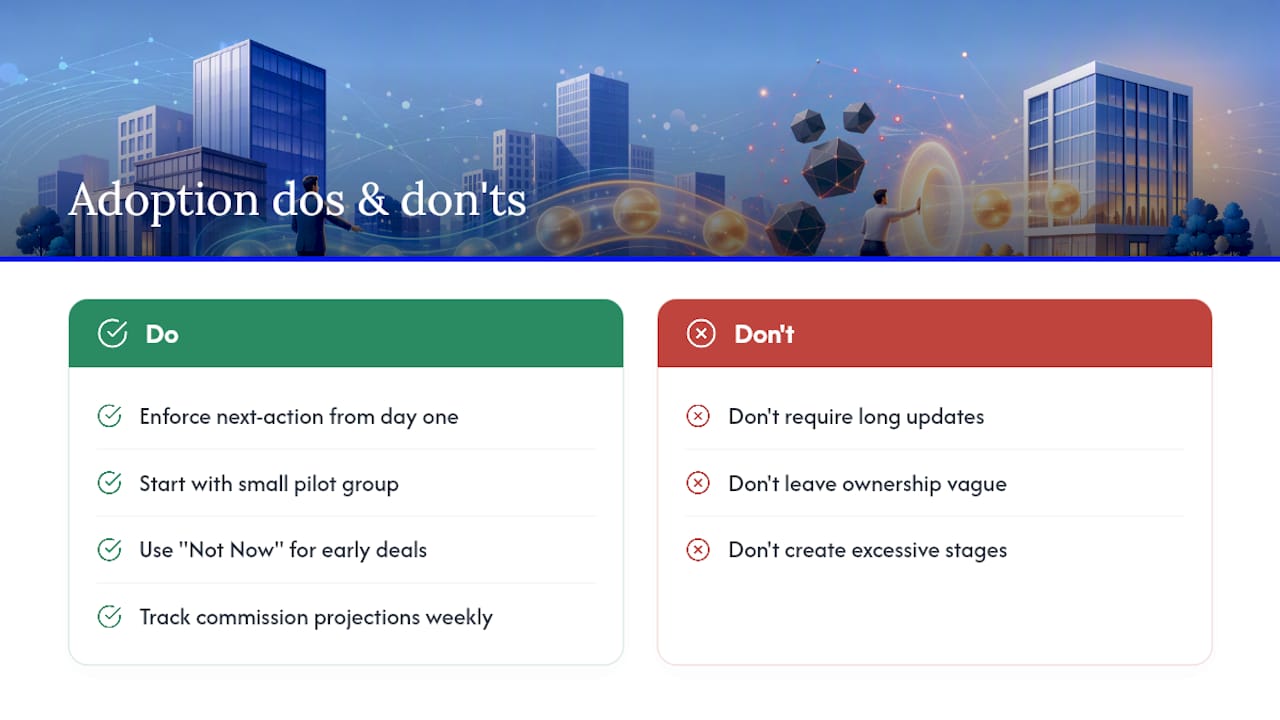
Three pitfalls show up constantly. Data-entry friction kills adoption fast. If updating a deal takes ten fields and three clicks, brokers will skip it. Unclear ownership is just as damaging: a deal with two people vaguely responsible for it gets touched by nobody. And too many stages create false precision. Six clean stages beat fourteen ambiguous ones every time.
This platform was built around this exact logic, deal workspaces, stage-based triggers, and lender appetite mapping working together instead of bolted onto a generic CRM. For deeper implementation help, the deal pipeline management guide walks through stage configuration in more detail.
— Theron
Where BrokersConnect Fits Into Your Pipeline
This platform is built specifically for how CRE brokers actually work: deal workspaces instead of generic contact records, stage-based triggers instead of manual status updates, and lender appetite mapping instead of a static spreadsheet of names and phone numbers. It handles a full range of CRE financing types and pairs that with a database of verified lenders so outreach starts from a matched list rather than a cold search.
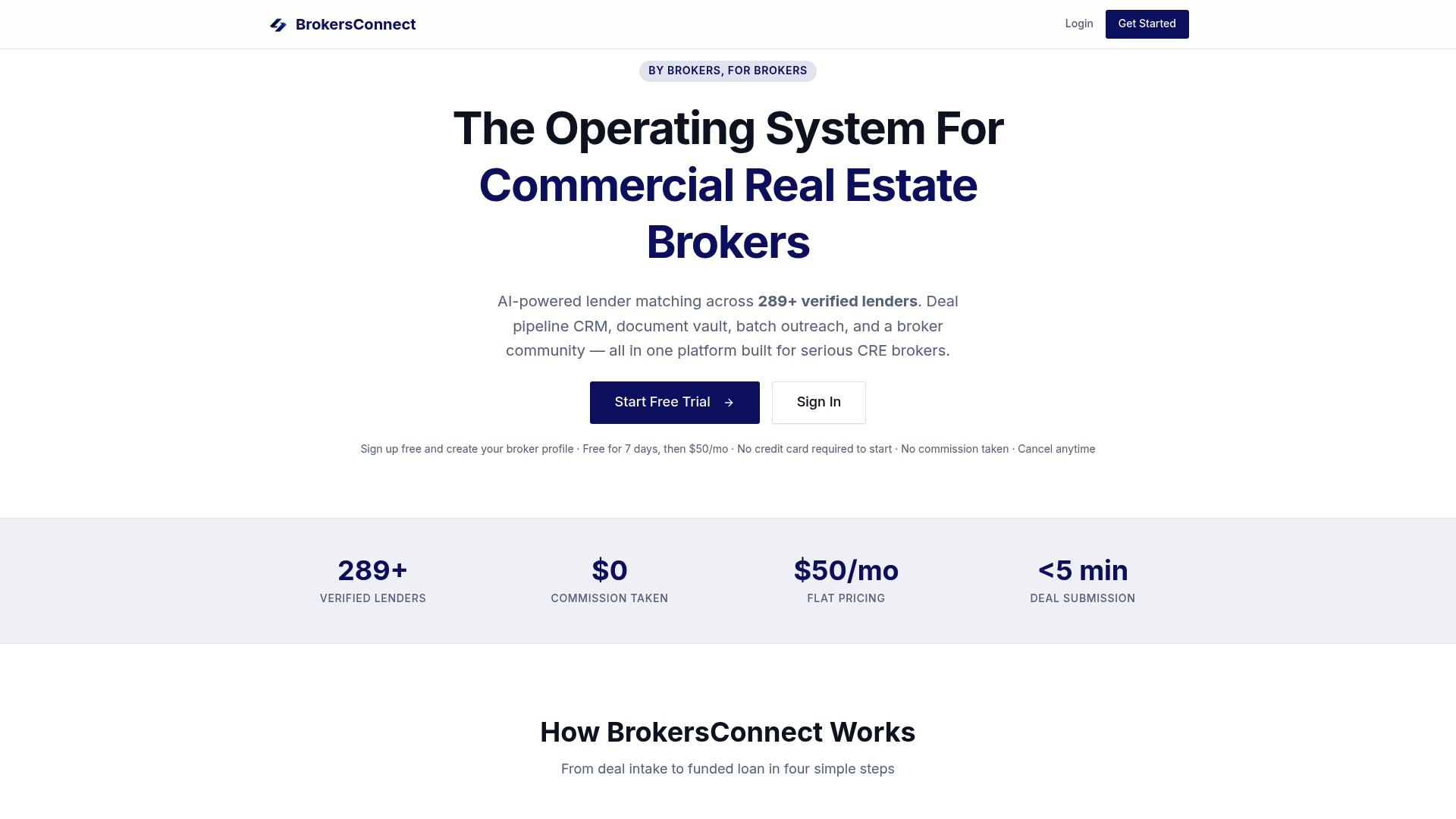
The document vault keeps every rent roll, offering memo, and term sheet tied to its deal instead of buried in an inbox, and the lender matching platform cuts the time brokers spend guessing which lenders will actually look at a given scenario. If the stage structure and next-action rules covered above sound like what your desk is missing, start a free trial at BrokersConnect and get your active deals into a workspace before your next lender call.
Sources
- Why the workflow layer matters in proptech
- Why most CRMs fail commercial real estate brokers (and what works in 2026)
- How to track a commercial real estate deal pipeline