
Commercial construction lenders approve deals on six core axes: loan-to-cost (LTC) ratio, sponsor equity contribution (a significant portion of total project cost), sponsor track record, a signed general contractor contract, permit and entitlement status, and a credible takeout plan. Get those six right before you submit, and the rest of underwriting becomes a documentation exercise.
- LTC and DSCR are the two primary sizing tests. LTC governs the construction period loan sizing; stabilized debt service coverage ratio (DSCR) governs the permanent takeout sizing.
- SOFR is the floating-rate benchmark most lenders use to price construction debt. Banks typically land at SOFR + 275–400 basis points; debt funds run higher.
- Thecrebrokersconnect gives brokers a matched list of verified lenders filtered by asset class, loan size, leverage, and deal structure, so you spend time on submissions, not cold calls.
The sections below cover the full submission checklist, draw mechanics, red-flag mitigation, and a recommended file order you can hand directly to a sponsor.
Pro Tip: Before you touch a lender's portal, confirm the sponsor's equity is liquid and the GC contract is signed. Those two items kill more term sheets than any underwriting metric.
Key Takeaways
Commercial construction lenders approve deals on LTC, sponsor equity, track record, a signed GC contract, permit status, and a credible takeout plan — get all six right before submitting.
| Point | Details |
|---|---|
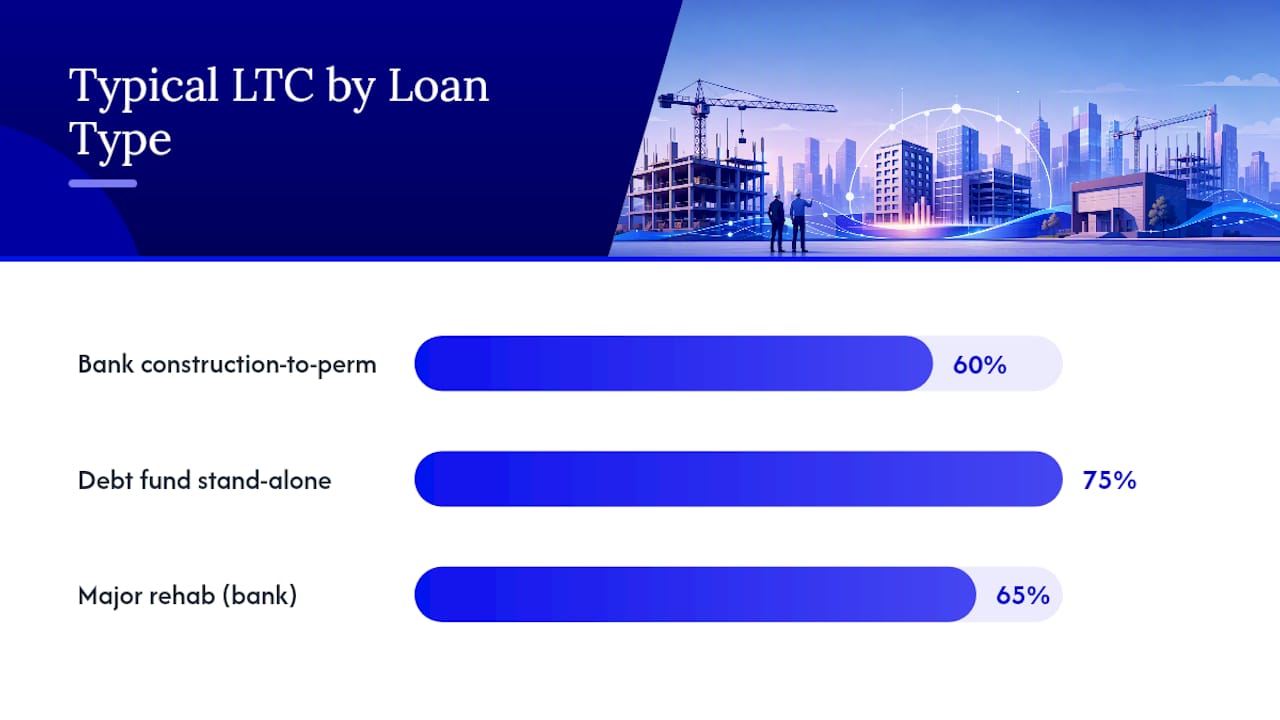
| LTC governs loan sizing | Banks cap LTC at 60%; debt funds go to 75% for strong sponsors. |
| Equity requirement is approximately 25% | First-time developers typically must contribute at the higher end of that range. |
| Sponsor experience is decisive | Inexperienced sponsors must bring an experienced co-sponsor or accept a debt fund at higher pricing. |
| Debt funds close fastest | Debt funds close in 30–60 days; banks need 60–120 days; SBA 504 runs 90–150 days. |
| Thecrebrokersconnect matches lenders | The platform filters 289+ verified lenders by LTC, asset class, and deal structure for faster term sheets. |
Table of Contents
- What do construction lenders require? The submission checklist
- Which loan type fits your deal, and why it changes qualification?
- How lenders size the loan: LTC, LTV, DSCR, and contingency
- What sponsors need to bring: experience, financials, and guarantees
- Plans, permits, GC qualifications, and insurance lenders insist on
- Recommended submission order: the full documentation template
- How draw disbursements work: inspections, retainage, and timing
- Pricing, reserves, and fees: what to budget
- What does the underwriting timeline look like from LOI to first draw?
- Common red flags and how to pre-solve them before submission
- How Thecrebrokersconnect matches construction deals to verified lenders
- Before you hit send: a broker's last-minute checklist
- Thecrebrokersconnect cuts the time from deal to term sheet
- Sources
What do construction lenders require? The submission checklist
A clean submission package answers every lender question before it gets asked. Organize files in this order:
- Executive summary (1–2 pages: deal snapshot, loan request, use of proceeds, exit strategy)
- Sources and uses statement (line-item breakdown of all project costs and funding sources)
- Sponsor package (bio, track record, completed project list with cost/timeline/lease-up data)
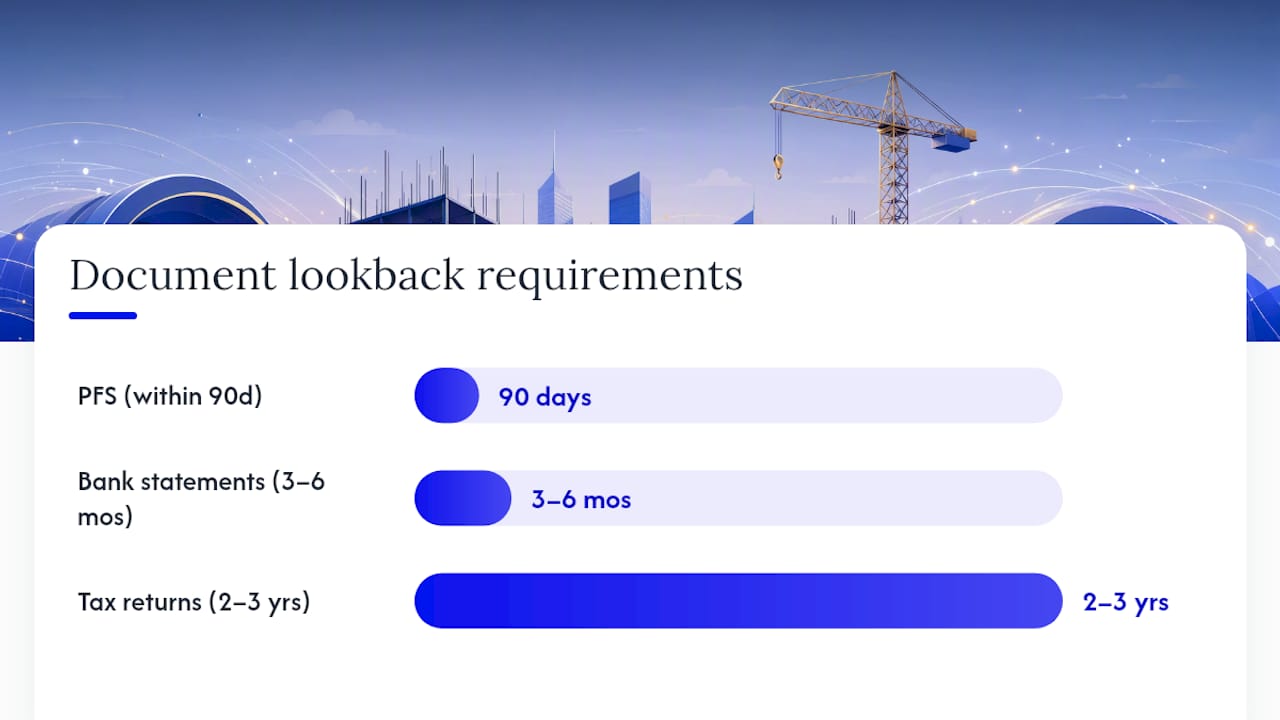
- Personal financial statement (PFS, dated within 90 days) and guarantor financials
- Tax returns (2–3 years personal and business, per lender documentation standards)
- Schedule of real estate owned (SREO) and bank statements (3–6 months)
- Entity formation documents (operating agreement, articles, EIN confirmation)
- Pro forma (stabilized income, expenses, NOI, and DSCR at permanent takeout)
- Construction budget (hard costs, soft costs, contingency, interest reserve)
- Signed GC contract (AIA A101/A102 or equivalent, with schedule of values)
- Plans and permits (stamped construction documents, permit status letter or issued permits)
- Appraisal (as-completed and as-stabilized, from a lender-approved MAI appraiser)
- Market study (rent comps, absorption, competitive supply)
- Environmental report (Phase I, Phase II if flagged)
- Title commitment and survey
Pro Tip: Name every file with a number prefix and a short descriptor: "07_Entity_Docs_LLC_Agreement.pdf." Lenders who receive 200 submissions a month open the organized ones first.
Which loan type fits your deal, and why it changes qualification?
Choosing the wrong loan structure costs you weeks. Here is how the four main structures differ:
Construction-to-permanent combines the construction facility and the long-term mortgage into one closing. Banks and credit unions favor this structure for stabilized asset classes such as multifamily, industrial, and anchored retail. One closing means lower total fees, but the lender controls both phases; underwriting tends to be thorough and slower.
Stand-alone construction is a short-term facility that gets refinanced or sold at completion. Debt funds dominate this space. They close faster and tolerate higher leverage, but pricing reflects that: SOFR + 400–550 bps is common, and recourse is typically full personal guarantee.
Major rehab and renovation loans follow construction-loan mechanics (draws, inspections, retainage) but underwrite to the as-stabilized value of an existing asset. Lenders want a detailed scope of work and a licensed GC, same as ground-up.
SBA 504 (owner-user) blends a bank first mortgage with an SBA debenture. The blended rate typically runs in the mid single digits for owner-occupied projects. The tradeoff is time: SBA 504 closings commonly take several months from term sheet.
| Loan type | Typical LTC | Pricing (approx.) | Close speed | Recourse |
|---|---|---|---|---|
| Bank construction-to-perm | 60% | SOFR + 275–400 bps | 60–120 days | Full or partial |
| Debt fund stand-alone | 75% | SOFR + 400–550 bps | 30–60 days | Full |
| SBA 504 owner-user | up to high leverage range | mid single digit blended rate | closing time measured in months | Full |
| Major rehab (bank) | 65% | SOFR + 275–400 basis points | 60–90 days | Full or partial |
A first-time developer rarely clears a bank's experience threshold. Pair them with an experienced co-sponsor or steer the deal to a debt fund that prices experience risk into the spread rather than declining outright.
How lenders size the loan: LTC, LTV, DSCR, and contingency
LTC (loan divided by total project cost) is the primary sizing constraint during construction. LTV (loan divided by as-completed appraised value) acts as a secondary ceiling and often bites on high-cost markets where construction costs outpace appraised values.
DSCR enters the picture at the permanent takeout stage. Run the permanent DSCR before you size the construction loan. If the stabilized NOI cannot support the takeout debt at those minimums, the construction loan is already oversized.
Debt yield (NOI divided by loan amount) is increasingly used by debt funds as a sizing check independent of cap rate assumptions. It is harder to game than DSCR because it does not depend on an interest rate assumption.
Contingency is non-negotiable. Lenders typically require hard cost contingency of 5–10% and soft cost contingency of approximately 5%, plus an interest reserve sized to cover construction-period debt service with a 3–6 month buffer. Underfunded contingency is one of the fastest ways to trigger a lender default mid-project.
Pro Tip: *Model the DSCR at permanent takeout using the lender's stress assumptions, not your pro forma's best case.
What sponsors need to bring: experience, financials, and guarantees
Sponsor experience is often the single most important qualification factor. Lenders want to see completed projects of comparable type, scale, and complexity, delivered on time and on budget. An inexperienced sponsor must either bring in an experienced co-sponsor or accept that most banks will decline regardless of the deal's economics.
Financial documentation lenders require:
- Several years of personal and business tax returns
- Current personal financial statement (PFS)
- Schedule of real estate owned (SREO) with current debt balances and equity positions
- A few months of personal and business bank statements
- Proof of liquidity sufficient to cover the equity injection plus a reserve
Entity and guarantee requirements:
- Most lenders require a single-purpose entity (SPE) as the borrowing vehicle, with a separate operating account
- Full personal guarantees are standard for construction loans; some lenders may accept alternative guarantees for well-capitalized sponsors.
- Minimum credit score guidance varies by lender; banks typically prefer mid to high 600s and above for guarantors; debt funds may be more flexible with compensating factors.
| Requirement | Bank standard | Debt fund standard |
|---|---|---|
| Tax returns | 3 years personal + business | 2–3 years personal + business |
| Minimum credit score | mid to high 600s and above | 640+ (with compensating factors) |
| Liquidity post-close | 10–15% of loan amount | 5–10% of loan amount |
| SPE required | Usually yes | Usually yes |
| Personal guarantee | Full | Full |
Plans, permits, GC qualifications, and insurance lenders insist on
Lenders underwrite execution risk as much as financial risk. A deal with a weak GC or incomplete permits is a deal that will stall mid-construction, and lenders know it.
Plans and permits:
- Stamped, construction-document-level drawings (CDs) from a licensed architect
- Permit status letter at term sheet; issued building permit required at or before closing
- Zoning confirmation, entitlement approvals, and utility hookup letters
GC qualification checklist:
- Licensed and bonded in the project's state and municipality
- Demonstrated experience on comparable project types and sizes
- Performance and payment bond (typically required for loans above $5M)
- Current certificate of insurance naming the lender as additional insured
- Signed AIA A101/A102 contract (or guaranteed maximum price contract) with a detailed schedule of values
Insurance and lien waivers:
- Builder's risk insurance, with lender named as loss payee
- General liability at lender-specified minimums
- Conditional lien waivers from the GC and all major subcontractors at each draw; unconditional waivers for prior draws before the next release
Pro Tip: Ask the GC for a preliminary schedule of values before the term sheet. Get ahead of it.
Recommended submission order: the full documentation template
A bank-ready construction package follows a predictable structure. Deliver files in this order to match how underwriters actually read submissions:
| # | Document | Common gap |
|---|---|---|
| 1 | Executive summary (1–2 pp.) | Missing exit strategy |
| 2 | Sources and uses | Soft costs understated |
| 3 | Sponsor bio and track record | No on-budget/on-time data |
| 4 | PFS, tax returns, bank statements | PFS older than 90 days |
| 5 | SREO and entity docs | Missing operating agreement |
| 6 | Pro forma and rent comps | DSCR not stress-tested |
| 7 | Construction budget (hard/soft/contingency) | Contingency below 5% |
| 8 | Signed GC contract + schedule of values | Unsigned or letter of intent only |
| 9 | Stamped plans and permit status | Schematic drawings only |
| 10 | As-completed appraisal | Ordered but not yet delivered |
| 11 | Market study | Stale comps (over 6 months) |
| 12 | Phase I environmental | Missing or expired |
| 13 | Title commitment and survey | Survey not yet ordered |
| 14 | Draw schedule | Missing inspection protocol |
Items 12 and 13 are the most commonly delivered late. Order the Phase I and title commitment the same week you send the LOI.
How draw disbursements work: inspections, retainage, and timing
Each draw follows the same cycle: the borrower submits a draw request, a third-party inspector verifies work in place, and the lender releases funds net of retainage.
Draw request package elements:
- AIA G702 (application for payment) and G703 (continuation sheet) signed by the GC
- Invoices from subcontractors and suppliers
- Conditional lien waivers for the current draw; unconditional waivers for the prior draw
- Updated construction schedule showing percentage complete by trade
Timing and retainage norms:
Retainage is released at substantial completion, subject to a final inspection and a certificate of occupancy. Some lenders hold a portion of retainage for 30–90 days post-CO to cover punch-list items.
Pricing, reserves, and fees: what to budget
Construction loans are floating-rate instruments. Banks price at SOFR + 275–400 bps; debt funds run SOFR + 400–550 bps.
Fee budget checklist:
- Origination fee: 0.5–2.0% of loan amount (banks lower, debt funds higher)
- Underwriting/processing fee: $5,000–$25,000
- Third-party inspection fee: $1,500–$3,500 per draw
- Extension fee: 0.25–0.50% per extension period
- Legal (lender's counsel): $15,000–$50,000+ depending on complexity
- Interest reserve: sized to cover full construction period debt service plus a 3–6 month buffer
Build every one of these into the sources and uses before you submit. A sponsor who discovers $80,000 in fees at closing is a sponsor who may not close.
What does the underwriting timeline look like from LOI to first draw?
Debt funds close fastest at 30–60 days; banks typically need 60–120 days; SBA 504 transactions run 90–150 days. Document completeness is the single biggest variable. A package missing the appraisal or Phase I adds 3–6 weeks regardless of lender type.
Milestone checklist:
- LOI/term sheet executed — confirm conditions precedent list
- Third-party reports ordered (appraisal, Phase I, market study)
- Lender legal review and loan document drafting
- Conditions precedent satisfied: permits in hand, GC contract finalized, equity evidence provided, title and survey cleared
- Closing and initial equity funding
- First draw: GC mobilization invoice, conditional lien waiver, inspection scheduled
Pro Tip: Chase the appraisal and Phase I the day the term sheet is signed. Both take 3–6 weeks and neither can be rushed. Everything else in underwriting waits for them.
Common red flags and how to pre-solve them before submission
Most construction loan declines trace back to a handful of problems. Fix them before the package goes out.
- Incomplete permits: Lenders will not close on a building permit that is "pending." Confirm the permit timeline with the municipality and, if closing is imminent, negotiate a pre-closing permit condition with the lender.
- Weak GC contract: A letter of intent or unsigned AIA form signals execution risk. Get the contract signed, with a schedule of values, before submission.
- Undercapitalized sponsor: If the sponsor's liquidity barely covers the equity injection, add a completion guaranty from a stronger guarantor or bring in a preferred equity partner to shore up the capital stack.
- Unrealistic budget: A hard cost budget with less than 5% contingency will be flagged immediately. Recut it to 7–10% and document the basis for each line item.
- Weak market comps: Stale or geographically stretched rent comps undermine the pro forma. Commission a fresh market study or pull CoStar data dated within 60 days.
- Environmental issues: A Phase I with a recognized environmental condition (REC) triggers a Phase II requirement. Order the Phase II early; do not wait for the lender to ask.
Pro Tip: Run a mock underwriting review on every deal before submission. Ask: would a skeptical credit officer approve this? If you hesitate on any line item, fix it first.
How Thecrebrokersconnect matches construction deals to verified lenders
Platform capabilities for construction financing:
- AI-powered lender matching filtered by LTC, asset class, loan amount, and recourse profile
- Secure document vault for organizing and sharing submission packages
- Submission templates pre-formatted for construction loan packages
- Batch outreach to multiple verified lenders from a single deal record
- Lender responsiveness leaderboard so you know which lenders are actively quoting
- Deal pipeline CRM to track term sheets, conditions, and closing milestones
Three-step workflow:
- Enter the deal scenario (asset class, loan amount, LTC, location, sponsor profile)
- Review matched lenders and select targets based on appetite and responsiveness score
- Assemble the ordered submission package using built-in templates and send via batch outreach
The AI document extraction tools inside the platform flag missing items before the package leaves your desk, which is where most submission errors get caught.
Before you hit send: a broker's last-minute checklist
Run through these before distributing any construction loan submission:
- Equity is confirmed liquid and the source of funds is documented
- GC contract is signed, not a letter of intent
- AIA G702/G703 forms are attached for any draw packages
- Third-party inspector contact is confirmed and lead time is noted
- Permit status is current and matches what the executive summary states
- Phase I is dated within 180 days (most lenders require this)
- PFS is dated within 90 days
- Pro forma DSCR is stress-tested at the lender's assumed permanent rate
On subject lines: use a consistent format — "Construction Loan Submission | [Asset Class] | [City, State] | $[Loan Amount]M" — so lenders can sort and retrieve your package without opening it. Lenders who receive high submission volume route organized packages to underwriting faster.
Thecrebrokersconnect cuts the time from deal to term sheet
Matching the right lender to a construction deal manually means hours of research, cold calls, and follow-up with lenders who may not even be active in your market. Thecrebrokersconnect removes that friction.
The platform gives you instant access to 289+ verified lenders, pre-built construction loan submission templates, and AI-powered matching that filters by the exact criteria underwriters use: LTC, asset class, loan size, geography, and sponsor profile. No transaction fees, no commission splits. A flat monthly subscription covers unlimited deal submissions and lender outreach.
Brokers who use the lender matching tools report spending less time sourcing and more time closing. Start a free trial at Thecrebrokersconnect and run your first construction deal scenario through the matching engine today.
Sources
- Commercial Construction Loan Requirements 2026: Checklist
- Commercial Construction Loans: Requirements, Rates & Process | The Lender Directory
- Commercial Construction Loan Requirements Explained - LegalClarity
- Commercial Construction Loan Calculator + Qualifier 2026 | TCG