
Commercial prepayment penalties come in five working forms: yield maintenance, defeasance, step-down, lockout and open periods. Each prices an early exit differently, and the type the lender uses tells you which lender category you are dealing with. Brokers who know the type before the term sheet goes out can match the deal to a lender whose exit terms fit the client's business plan. That is the work BrokersConnect is built to speed up: matching a loan scenario with verified lenders and keeping the conversations and documents in one place.
TL;DR
- Yield maintenance pays the lender the present value of the interest it loses. It gets expensive when Treasury yields fall below the note rate and drops to a floor when they rise.
- Defeasance replaces the collateral with Treasury securities instead of paying a fee. It is typical of conduit (CMBS) loans and carries heavy third-party costs.
- Step-down charges a published percentage of the balance that falls each year. The cost does not move with rates.
- Lockout bars prepayment entirely for an initial period, and an open period near maturity lets the borrower repay with no penalty.
- The note and its prepayment rider set the price, not the sale price. Read them before you quote a client.
Table of Contents
- What a commercial prepayment penalty protects
- The five prepayment structures
- Comparing the structures
- What triggers the penalty
- How to estimate the penalty before you quote it
- Negotiating better exit terms
- Match the exit to the lender up front
- Perspective
- FAQ
- Sources
What a commercial prepayment penalty protects
When a borrower repays early, the lender loses interest it priced into the loan and has to reinvest the money, perhaps at a lower rate. Commentary on enforcing these clauses lists lost bargained-for interest, added tax liability and reinvestment costs as the economic harm the lender is guarding against. The penalty is the contractual price of that exit.
You will see "hard" and "soft" used in some markets. In the residential world, a hard penalty applies on any payoff, including a sale, while a soft one applies only on a refinance. Commercial documents are better described by the five structures below, so quote the structure by name rather than by those labels.
The five prepayment structures
Yield maintenance
Yield maintenance is common on life company and agency loans. Price Capital Group notes that lenders such as Fannie Mae and Freddie Mac use it because they package loan yield into bonds. The premium compares the loan's contract rate with the yield on a Treasury of matching maturity, then discounts the difference to present value.
JPMorgan Chase describes the premium as the present value of the remaining payments multiplied by the spread between the interest rate and the Treasury yield, typically the greater of 1% of the principal being repaid or the formula result.
The steps in practice:
- Identify the Treasury that matches the remaining term.
- Subtract its yield from the note rate.
- Multiply the spread by the outstanding principal and the months remaining.
- Discount the result to present value.
- Apply the minimum floor if the formula comes out lower.
A worked example from LoanBoss: a $10,000,000 loan at a 6.00% note rate with a 4.00% reference yield produces a premium of about $890,000. If the reference yield were 6.50%, the formula yields zero and only the 1% floor, $100,000, is owed.
The lesson for your client is direction. A fall in Treasury yields after closing raises the bill. A rise shrinks it toward the floor. And the floor is not always 1%: Price Capital Group says to confirm it in the documents rather than assume it.
Defeasance
With defeasance, the borrower does not pay the lender a fee. Instead the borrower buys government securities whose cash flows match every remaining loan payment and transfers them, with the loan, to a successor borrower entity. The loan stays outstanding until maturity and the property is released. JPMorgan Chase explains the mechanics, including that the cost of the securities can land below or above the loan balance depending on Treasury yields.
The securities are only part of the bill. A defeasance consultancy's cost breakdown puts non-Treasury costs at typically $75,000 to $250,000 or more on $5 million to $50 million loans, covering consultant, legal, servicer review, rating agency and successor borrower setup. Defeasance is a conduit feature, so a broker placing CMBS paper should read our overview of how conduit loans work before discussing exits with a client.
For a side-by-side view of the two most common exit mechanisms, see our guide to yield maintenance versus defeasance.
Step-down
A step-down charges a fixed percentage of the outstanding balance that declines each loan year. LoanBoss lists the Fannie Mae declining-premium schedules as 5-4-3-2-1 for 5-year terms and 5-5-4-4-3-3-2-2-1-1 for 10-year terms. Step-downs are also common on bridge and bank loans, according to a glossary of prepayment structures.
The appeal for a borrower is certainty: you can calculate the cost on day one. On a $10,000,000 balance in a year where the schedule says 4%, the cost is $400,000, whatever Treasuries are doing. That makes it the cheaper exit when Treasury yields have fallen far below the coupon and the dearer one when yield maintenance would have dropped to its floor.
One trap: the step-down date falls at the end of each loan year as the note defines it. LoanBoss warns that paying off one payment date too early can cost a full extra point. On $10,000,000, that is $100,000.

Lockout
A lockout prohibits prepayment in any form for an initial stretch, often one to two years according to the same glossary. No amount of money buys an exit during it. Price Capital Group notes that many institutional loans carry one, so the property generally cannot be sold or refinanced free and clear during that time, whatever the borrower will pay.
For a client with a short business plan, such as a value-add investor planning a sale in 24 months, a lockout can break the deal. Flag it at the intake stage, not at the term sheet.
Open period
Many structures include an open window near maturity when repayment carries no premium. The same glossary puts it typically at the last three to six months of long-term loans. Institutional allocators often time their exits to close inside that window, per Price Capital Group.
Comparing the structures
| Structure | What the borrower pays | Moves with rates? | Typical home |
|---|---|---|---|
| Yield maintenance | Present value of lost interest, with a floor | Yes | Agency, life company, some CMBS |
| Defeasance | Cost of replacement Treasuries plus fees | Yes | CMBS |
| Step-down | Declining percentage of balance | No | Agency, bridge, bank |
| Lockout | Nothing is accepted | n/a | Institutional loans, early years |
| Open period | No premium | n/a | Last months of the term |
A rule of thumb for your client conversations: if the borrower expects to refinance when rates drop, yield maintenance and defeasance are the structures that punish that move hardest. If rates have risen, they cost the least. JPMorgan frames it as a trade-off: rising rates make both cheaper but force any replacement loan at a higher rate, while falling rates make both more expensive but may bring a better new-loan rate.
What triggers the penalty
The usual triggers, per a multifamily brokerage's breakdown of selling with a loan in place, are:
- A sale where the loan is paid off at closing.
- A refinance, including cash-out, that retires the loan.
- A voluntary early payoff from cash or other proceeds.
- Some partial paydowns, depending on the note.
The penalty may not apply if the buyer assumes the loan with lender approval, if the loan is in its open period, or if the note has no prepayment clause. Assumption is worth raising with sellers early, since it can change what they owe at closing. This overview of rental property refinancing helps clients see which refinancing events retire the existing loan.
Default does not switch the clause off. Lenders typically draft prepayment provisions to require a fee on acceleration, whether prepayment occurs before, after or during foreclosure.
How to estimate the penalty before you quote it
The sale price does not set the fee. The promissory note and its prepayment rider do, which is why two owners selling similar buildings the same month can face very different payoff costs. Pull these documents:
- Promissory note: the prepayment structure, minimum floor and open-window dates.
- Prepayment rider or schedule: the step-down percentages or the yield maintenance formula.
- Loan agreement: assumption rights, assumption fee and buyer requirements.
- Servicer contact details: who issues payoff quotes and how much notice they need.
- Default and remedies sections: acceleration can still trigger charges.
Our loan document checklist for CRE brokers covers the wider package, and the commercial loan closing checklist shows where payoff figures fit at closing.
Read the definitions, not just the formula
There are no industry-wide standards for yield maintenance. AST Defeasance points out that each loan document sets the methodology, index and discount rate, and small drafting changes can have an outsized effect. Two loans both labeled "yield maintenance" can produce very different numbers. Confirm in the document:
- Which Treasury index is used and how it is matched to the remaining term.
- Whether the discount rate is Treasury flat or Treasury plus a spread.
- Whether the premium runs to maturity or to an earlier open period.
- The minimum floor and the lockout term.
Casualty and condemnation
After a casualty or condemnation, lenders can usually require insurance proceeds or awards to prepay the loan. Cleary Gottlieb's article on silent issues in loan documents advises borrowers to make sure that mandatory prepayment carries no penalty, and to secure the right to prepay the remainder without penalty. It also suggests asking for penalty-free partial prepayment or defeasance when a maturity extension or release is conditioned on DSCR or debt-yield tests.
Negotiating better exit terms
Terms are not always fixed. According to a consultancy's guide to prepayment terms, institutional lenders will typically accept a 10 to 25 basis point rate increase in exchange for materially better prepayment terms. Open windows in the back third of the loan are widely available, though yield maintenance and defeasance are largely standard on agency multifamily and CMBS. Put prepayment on your list of priorities when you work the term sheet; our term sheet negotiation playbook shows how to rank them, and the closing timeline checklist helps you time a payoff against a step-down date or open window.
Match the exit to the lender up front
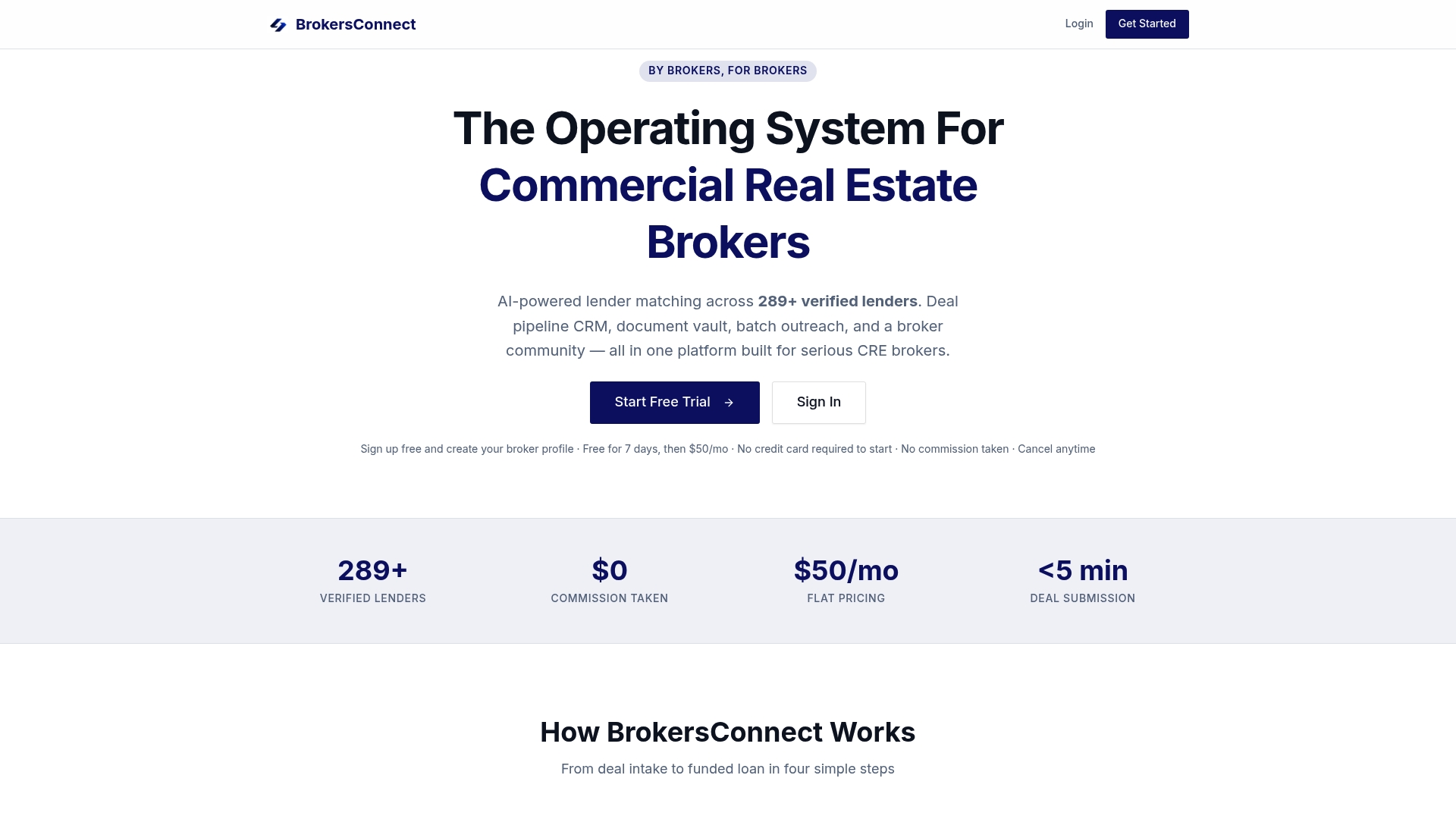
Prepayment terms vary by lender type, so the cheapest fix for a client who wants flexibility is to place the loan with a lender whose structure fits the plan. BrokersConnect matches loan scenarios with verified lenders by factors such as property type, loan amount, location, leverage, credit profile, loan purpose and transaction structure, and its database covers 289+ verified lenders. You can send the deal to several of them with batch lender outreach, track each conversation in the deal pipeline CRM and keep the notes and rider in the secure document vault. The platform is $50 per month with a free trial and no commissions or transaction fees. See it at BrokersConnect.
Perspective
Prepayment terms are decided in the first lender conversation, long before anyone reads the rider. A broker who learns on closing day that the loan is locked out has no move left.
We built BrokersConnect around that problem. Matching a scenario to lenders by loan purpose and transaction structure means the question "who is likely to consider this deal" gets answered before hours go into calls. Keeping lender conversations, deal templates and documents in one pipeline means the exit terms the lender quoted are still on the record when your client asks about them a year later.
Our view: brokers win repeat clients by raising the exit early, with the structure named and the numbers on the page.
Theron
FAQ
What is the most common prepayment penalty on commercial loans?
It depends on the lender. Yield maintenance is widely used by agency and life company lenders, defeasance is specific to CMBS, and step-downs are common on bridge and bank loans, according to a glossary of prepayment structures. Identify the lender category first and the structure usually follows.
How is yield maintenance different from a step-down?
Yield maintenance floats with Treasury yields, so the cost can be large or fall to the floor. A step-down is a fixed percentage that declines each year, so the cost is known from the schedule. Which is cheaper depends on where rates sit relative to the note rate when the borrower exits.
Can a borrower avoid a prepayment penalty?
Sometimes. The penalty may not apply if a buyer assumes the loan with lender approval, if the loan is in its open period, or if the note has no prepayment clause, per Stepp Commercial. Casualty and condemnation prepayments are commonly excepted too. Check the note for each.
Is the yield maintenance floor always 1%?
No. One percent is typical, and JPMorgan Chase describes the premium as the greater of 1% of the principal or the formula result. Price Capital Group says to confirm the floor in your documents rather than assume a standard figure.
Sources
- Enforcing Prepayment Premium Clauses, Law.com
- Defeasance Clause: How it Works, JPMorgan Chase
- The Complete Guide to Commercial Real Estate Prepayment, Price Capital Group
- Yield Maintenance, LoanBoss
- Prepayment Penalty Types on Commercial Real Estate Loans, LoanBoss
- Defeasance, Linton Global
- Prepayment Penalty in Commercial Real Estate Loans, Linton Global
- Prepayment Penalty When Selling an Apartment Building, Stepp Commercial
- Yield Maintenance Prepayment Guide, AST Defeasance
- Borrower Beware! Selected Silent Issues in Loan Documents, Cleary Gottlieb