
A single master checklist, tracked to approval state, is what prevents retrades and gets a commercial loan to the funding table. Not a delivery log. Not a folder of PDFs marked "received." A live document that separates what has been sent from what counsel and underwriting have actually signed off on.
Eight items typically stand between a term sheet and a wire transfer: clear title with no unresolved exceptions, an appraisal that supports the loan basis, insurance policies with the correct lender endorsements, organizational and authority documents proving who can sign, fully executed loan documents, UCC filings ready to record, wire instructions verified through a callback protocol, and a settlement statement that reconciles to the penny. Miss one, and the closing date moves.
Ownership matters as much as content. Someone, usually the lead broker or a dedicated closing coordinator, needs to own the checklist end to end. That person tracks every item through three states: Draft, Submitted, Approved. A document that has been submitted but not approved is not done. That distinction is where most last-minute renegotiations start.
Pro Tip: Set up your checklist so "Approved" requires a named approver and a date, not just a checkbox. If you can't say who approved an item and when, you don't actually know it's closed.
Key Takeaways
A status-tracked master checklist, organized by document family and owned by one accountable person, is the single control that prevents retrades and keeps a commercial loan closing on schedule.
| Point | Details |
|---|---|
| Track status, not just delivery | Use Draft, Submitted, and Approved fields so a received document is never mistaken for a cleared one. |
| Order reports at commitment | Appraisals, Phase I reports, and surveys can each take two to four weeks and usually set the real closing date. |
| Assign one checklist owner | A lead broker or closing coordinator should manage the master list and the vendor schedule end to end. |
| Verify wires by callback | Confirm bank details through a known phone number before any funds move, never through email alone. |
| Treat the checklist as the file index | Point every entry to the final executed exhibit, not a draft, so audits and refinances go faster later. |
Table of Contents
- The Complete Commercial Loan Documentation Checklist
- What Is the Closing Timeline and Who Owns Each Step?
- How Do You Manage Third-Party Report Vendors?
- Clearing Title, Survey, and Insurance Requirements
- Execution, Notarization, and Recording Without Priority Gaps
- How Funds Actually Move at Closing
- What Happens After the Loan Closes?
- How Broker Platforms Reduce Retrades in Practice
- Financial Ratios and Lender Requirements That Shape Closing
- Checklist Differences Across Loan Types
- Get Your Deal to the Table Faster
- The Checklist Is Infrastructure, Not Paperwork
- Sources
The Complete Commercial Loan Documentation Checklist
A commercial loan closing checklist works best when it is organized by document family, not by whoever happens to send something first. Break it into six groups and assign an owner to each.
1. Loan agreement suite
This is the core paper: the commitment letter, credit agreement (for syndicated or larger facilities), promissory note, mortgage or deed of trust, guaranty agreements from sponsors, and any intercreditor or subordination agreements where mezzanine debt or a ground lease is involved. Commercial loan documentation has to name borrowers, guarantors, and collateral with total precision, because small discrepancies in legal names or property descriptions are a common cause of perfection defects down the line.
2. Collateral perfection documents
UCC-1 financing statements, fixture filings for equipment and improvements, landlord waivers where personal property sits on leased ground, and releases of any prior liens on the collateral. This is where lender priority actually gets established, and it is the family most often shortchanged when teams focus on the note and mortgage and treat the filings as an afterthought.
3. Third-party reports
Appraisal, Phase I environmental assessment, ALTA/NSPS survey, and a property condition report where the asset warrants one. These typically follow ALTA's published survey standards and ASTM's environmental protocols, so lenders know what scope to expect before the report lands.

4. Organizational and authority documents
Formation documents, operating agreements or bylaws, borrowing resolutions, certificates of good standing, KYC documentation, and two to three years of tax returns for the borrowing entity and guarantors. Loan committees frequently stall not on the deal terms but on a resolution that does not match the signature block on the note.
5. Insurance package
Property and liability policies, builder's risk if construction is involved, and the endorsements lenders require: additional insured status, lender's loss payee, and a mortgagee clause with an effective date that lines up with closing, not the day after.
6. Exhibits and operational schedules
Rent roll, copies of leases, tenant estoppel certificates, subordination and non-disturbance agreements, and any capital improvements schedule tied to future advances.
Loan-type checklist libraries, like the ones ValueXpress publishes by product category, organize items this same way because CMBS, bridge, and construction deals each layer additional requirements onto this base structure. Our own loan document checklist for CRE brokers walks through the base list in more detail if you're building a binder from scratch.
What Is the Closing Timeline and Who Owns Each Step?
A commercial mortgage closing moves through underwriting, third-party report delivery, loan committee, document drafting, execution, recording, and funding, roughly in that order, though drafting often overlaps with the tail end of underwriting. The stage that determines your actual closing date is almost never document drafting. It is the third-party reports.
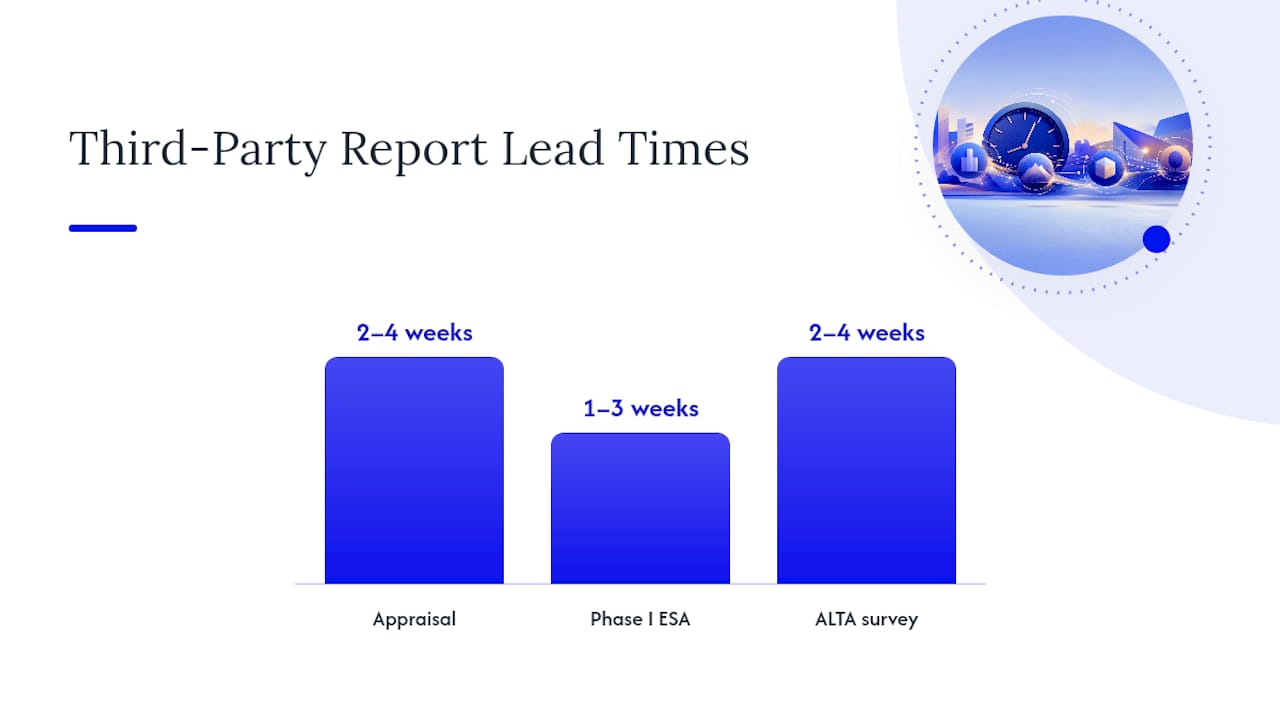
Appraisals commonly take two to four weeks, Phase I environmental assessments run one to three weeks, ALTA surveys take another two to four weeks, and these lead times are the most common bottleneck in the entire process. Order them the day the commitment is signed, not after documents are drafted.
A basic responsibility matrix keeps ownership unambiguous:
- Lender: commitment terms, loan documents, loan committee approval
- Borrower: organizational documents, financial statements, insurance procurement
- Counsel (both sides): document review, title and survey clearance, closing coordination
- Title company: commitment, endorsements, recording
- Broker or closing coordinator: vendor scheduling, checklist maintenance, status updates
Set an internal cutoff for final document comments, usually five business days before signing, and move to daily status updates in the two weeks leading into closing. Practitioners generally recommend naming one closing coordinator to own the vendor schedule so nobody assumes someone else ordered the survey.
Pro Tip: Build your timeline backward from the target closing date, not forward from commitment. Working backward exposes which vendor deadline is actually the constraint before it becomes a crisis.
How Do You Manage Third-Party Report Vendors?
Order appraisals, Phase I reports, and surveys the same week the commitment letter is signed. Choose from the lender's approved panel when one exists; independent vendors work for private or bridge lenders without a panel requirement, but confirm scope matches what underwriting expects before you commit a deposit.
Track each report through five status fields: ordered, in progress, draft received, final accepted, and exceptions outstanding. A draft is not a final report, and treating it as one is how appraisal adjustments or environmental flags get missed until the week of closing.
When a report comes back with an issue, a wetland flag on the Phase I, a survey line that conflicts with a recorded easement, escalate to counsel and underwriting immediately rather than waiting for the final version. Waiting rarely resolves anything and just compresses the time left to fix it.
Where reports do not depend on each other, run them in parallel. Order the appraisal and survey simultaneously. But sequence any report that genuinely feeds another. A property condition report can change the scope that affects an appraisal adjustment, so those two sometimes need to run in order rather than side by side. Conditional approvals, closing subject to a specific outstanding item with a defined cure period, are a reasonable mitigation tactic when the alternative is delaying the entire transaction.
Clearing Title, Survey, and Insurance Requirements
The title commitment needs to show clean, insurable title with a defined list of exceptions, and every exception either gets cured or gets an affirmative endorsement around it before signing. Mechanic's liens, unresolved judgments, and open mortgages are the ones that most often require real cure work rather than a simple explanation letter.
The ALTA survey has to match the legal description in the title commitment exactly, and lenders lean on it to confirm setbacks, easements, and encroachments. A fence three feet over the property line has killed closings that were otherwise ready to sign.
Insurance endorsements, additional insured, lender's loss payee, and the mortgagee clause, all need effective dates matching the closing date, not the date the policy was originally issued. Clear title and survey issues before the signing package goes out; fixing them after documents are drafted means redrafting the legal description, which cascades through the note, mortgage, and every exhibit that references it.
Execution, Notarization, and Recording Without Priority Gaps
- Confirm signing authority first. Match every signer against the borrowing resolution and entity operating agreement before the signing session, not during it.
- Verify notarization requirements for the recording jurisdiction. Real property documents, mortgage, deed of trust, generally require in-person or state-approved remote notarization; confirm which your county accepts.
- Check every legal description and entity name against the title commitment and organizational documents. This is the single most common source of perfection defects, according to documentation practice reviews.
- Record in sequence: mortgage or deed of trust first, then assignments, then UCC-1 filings, tracking the exact time stamp on each.
- Confirm the notary block is complete on every real property instrument before it leaves the signing table, missing acknowledgment language is a common reason for a rejected recording.
Recording timing sets lien priority. A gap of even a few hours between signing and recording can matter if a competing lien gets filed in between, which is why title companies typically record the same day funds disburse.
How Funds Actually Move at Closing
Wire fraud targeting real estate closings is common enough that every wire instruction needs a callback verification to a phone number you already had on file, never one included in the same email as the instructions. Confirm bank details verbally before funds move, no exceptions, regardless of how much time pressure the closing is under.
The settlement statement is where every fee gets reconciled: origination fee, third-party report costs, title insurance premium, recording fees, tax and insurance reserves, and net proceeds to the borrower. Origination fees on commercial loans commonly run in the range lenders and brokers negotiate case by case, and who pays which line item, borrower or lender, should be locked in the term sheet well before the closing statement is drafted, not negotiated at the table.
After funding, get written confirmation of wire receipt and a final, signed settlement statement for the file. Both belong in the permanent record before anyone considers the deal closed.
What Happens After the Loan Closes?
Closing is not the finish line. Borrowers typically owe periodic financial statements, annual covenant certificates, and proof of insurance renewal on a schedule set in the loan agreement, often quarterly for financials and annually for insurance and covenant compliance.
Use the closing checklist as your permanent file index going forward. Point every entry to the final executed version of each document, not the draft filename, so a future audit or refinance does not send someone hunting through five versions of the same exhibit.
- Financial statement delivery dates and covenant certificate deadlines
- Insurance renewal dates, tracked separately from the policy effective date
- DSCR and leverage covenant triggers that require lender notification if breached
- Document retention schedule, matched to the loan term plus any post-payoff requirement
Pro Tip: Treat the checklist as a single source of truth that outlives the closing. If your file index still points to draft PDFs six months later, you will lose time finding the right version exactly when you need it fastest, at renewal or refinance.
How Broker Platforms Reduce Retrades in Practice
Brokers who manage several closings at once need more than a spreadsheet. A platform built for this workflow tracks each checklist item through Draft, Submitted, and Approved status, ties documents to a secure vault instead of scattered email threads, and flags stale items automatically instead of waiting for someone to notice a report has been "in progress" for three weeks.
Consider a bridge loan closing where the survey comes back with an easement discrepancy. On a status-tracked system, that item stays flagged "Submitted, not Approved" until counsel signs off, which keeps the closing date visible and prevents the item from quietly slipping through as if it were resolved. That visibility, not any single feature, is what actually reduces retrades: a checklist tracking approval state distinguishes delivery from acceptance, and that distinction is where most last-minute surprises get caught early instead of at the signing table.
Delivery is not approval. A document marked "received" tells you nothing about whether counsel has actually cleared it, and treating the two as the same thing is how closings slip by a week with no warning.
Platforms built specifically for commercial real estate brokers extend this further with lender matching and deal pipeline tools, so the checklist connects directly to the submission that generated it rather than living in a separate system nobody checks.
Financial Ratios and Lender Requirements That Shape Closing
Every closing checklist item exists to satisfy an underwriting threshold set earlier in the process, and those thresholds resurface at closing when lenders confirm nothing has changed since approval. Debt service coverage ratio targets for stabilized commercial assets typically vary depending on property type and lender appetite, and these ratios get recalculated before signing against final figures. If a tenant vacates between commitment and closing, the DSCR can shift enough to trigger a re-underwrite.
Loan-to-value ratio gets a final check against the completed appraisal, not the initial pro forma value. A conservative appraisal that comes in below the assumed basis is one of the most common reasons a closing gets delayed for a term sheet renegotiation rather than proceeding as planned.
Lenders also confirm debt yield, net operating income divided by loan amount, particularly for larger balance loans where DSCR alone does not capture refinance risk. Global cash flow analysis for sponsors with multiple properties, and updated liquidity and net worth covenants for the guarantor, round out the final financial review.
None of these ratios are new information at closing. They were set during underwriting. What changes is verification: the closing checklist exists partly to confirm the numbers underwriting approved still hold true on the day funds actually move, and any material shift needs to be flagged well before the signing table, not discovered there.
Checklist Differences Across Loan Types
An SBA 7(a) or 504 closing checklist adds SBA-specific forms, personal guaranty requirements for owners with 20% or more equity, and use-of-proceeds certifications that conventional commercial mortgages never require. Timelines also run longer because SBA approval sits on top of lender underwriting, not alongside it.
Bridge loan checklists trim organizational and financial documentation compared to permanent financing but add exit-strategy documentation and often a shorter, more aggressive third-party report timeline since bridge lenders frequently close in three to four weeks total. Insurance and title requirements stay largely the same as any commercial closing.
Construction loan checklists are the most document-heavy of the group. They add a disbursement schedule tied to construction milestones, a general contractor's agreement, payment and performance bonds, builder's risk insurance, permits and approvals, and a construction budget reviewed against the appraisal's as-completed value. Draws typically require inspection reports before each disbursement, which means the checklist becomes a recurring process rather than a one-time event. Our construction lender requirements guide breaks down the milestone and draw documentation in more detail.
Conventional commercial mortgages and CMBS loans sit closer to the base document list, though CMBS adds servicer-specific requirements and rating agency criteria that rarely apply outside securitized lending.
Get Your Deal to the Table Faster
Most closing delays trace back to a checklist that lived in someone's inbox instead of a shared system everyone could see. Brokers running several deals at once need status tracking, document storage, and lender visibility in one place, not scattered across email threads and spreadsheet versions. Brokers Connect gives brokers exactly that: a document vault tied to lender matching, deal pipeline tracking, and status fields that make Draft, Submitted, and Approved visible to everyone on the deal, not just the person managing the file.
The Checklist Is Infrastructure, Not Paperwork
Most advice on commercial loan closings treats the checklist as an administrative afterthought, something a paralegal assembles the week before signing. That's backwards. The checklist should exist the day the commitment letter gets signed, and it should drive the timeline rather than document it after the fact.
The conventional wisdom that closings slip because of "unexpected issues" mostly does not hold up. Survey discrepancies, appraisal gaps, and resolution mismatches are not unexpected. They are common, predictable failure points that a status-tracked checklist catches early instead of at the signing table. What's actually underrated is the discipline of separating "submitted" from "approved." That single distinction, tracked consistently, does more to prevent a retrade than any amount of extra due diligence layered on top of a sloppy tracking system.
If you take one thing from this, prioritize ownership before content. A perfect document list with no accountable owner still falls apart. A modest list with one person driving it to Approved status on every item closes on time.
— Theron
Sources
- Commercial Loan Documentation: What Lenders Expect - LegalClarity
- How Mortgage Brokers Close Commercial Loans: Process, Fees, and Timeline | Avana Capital