
For commercial construction deals, the best construction lenders are multi-product national and regional banks, credit funds, life companies, private/hard-money lenders, and SBA 504 lenders for owner-occupied projects. The single most effective broker strategy: prioritize lenders that can cover the full lifecycle — construction through takeout — because lifecycle capability is what keeps deals on schedule and prevents costly refinance risk at stabilization.
Match your deal profile to the right lender type first:
- Ground-up multifamily or mixed-use (under $20M): Regional banks or credit funds with construction loan options and takeout appetite
- Build-to-suit industrial or large multifamily ($20M+): National banks or life companies with permanent takeout capability
- Speculative or time-sensitive deals: Credit funds or bridge lenders (2–4 week close possible)
- Owner-occupied facilities: SBA 504 via bank/CDC partnership
- Gap financing or distressed capital stacks: Private/hard-money lenders as a bridge, not a first call
Multi-product lenders that handle SBA 504, bridge, construction, and conventional term loans let brokers submit once and match the deal to the right product, cutting friction and increasing placement velocity.
Table of Contents
- Which construction lender type fits your deal?
- How to prepare a construction loan submission lenders will actually read
- How to structure deals so takeout doesn't become a crisis
- Key Takeaways
- Why multi-product lender relationships are worth building deliberately
- BrokersConnect gives brokers a faster path to verified construction lenders
- Useful sources for broker-level construction finance reference
Which construction lender type fits your deal?
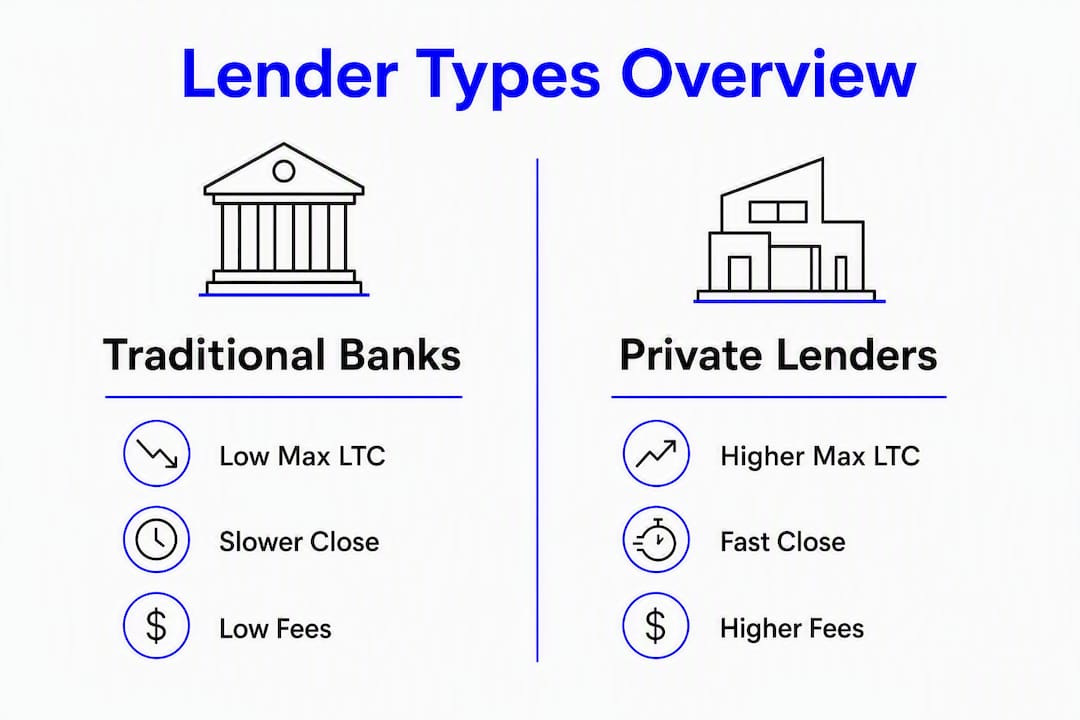
Commercial construction lenders span banks, credit funds, life companies, and private lenders — each with distinct leverage tolerances, pricing, and documentation demands. Here is how they compare across the dimensions that matter most for a broker placing a deal.
| Lender Type | Best For | Max LTC | Speed to Close | Rate / Pricing | Fees & Structure | Doc Intensity | Takeout Capability |
|---|---|---|---|---|---|---|---|
| BrokersConnect | Brokers matching any deal to 289+ verified lenders across all types | Varies by matched lender | Accelerates placement; lender timelines apply | Varies by matched lender | Subscription SaaS; no transaction fees | Platform-assisted packaging | Full lifecycle: construction, bridge, perm, SBA 504 |
| National & regional banks | Stabilized sponsors, multifamily, industrial, owner-occupied | 65–75% LTC | 45–75 days | 6%–8% floating | 1%–2% origination; 5–10% retainage | High — full underwriting, covenants, guarantees | Strong; many offer C2P or permanent takeout |
| Life companies | Large stabilized projects ($20M+), low-risk asset classes | 55–65% LTC | 60–90 days | Competitive fixed; tighter spreads | Lower origination; structured retainage | Very high — institutional grade | Yes; preferred for permanent conversion |
| Credit funds / bridge lenders | Speculative deals, speed-sensitive, value-add | 70–75% LTC | 2–4 weeks | Higher spreads; floating | 2%–3% origination; interest reserve required | Moderate — asset and sponsor focused | Limited; typically require separate takeout |
| Private / hard-money lenders | Gap financing, distressed stacks, non-bankable sponsors | Up to 70% LTC | Days to 2 weeks | Highest; 9%–12% | 2–4 points; short terms | Low — asset-value driven | Minimal; exit strategy required upfront |
| SBA 504 (owner-occupied) | Owner-occupied facilities, small business construction | Up to 90% combined | 45–90 days | Below-market fixed (CDC tranche) | CDC fees + bank fees; structured draws | High — SBA eligibility, personal guarantees | Built-in: CDC debenture is the permanent piece |
On the deal profiles brokers actually see:
A 50-unit garden multifamily works well with a regional bank at 70–75% LTC, assuming the sponsor has at least two comparable completions. The bank will want a committed GC contract, a pre-leasing covenant, and a clear interest reserve. A 150,000 SF speculative industrial deal is where build-to-suit LTC norms of 70–75% give credit funds a real edge — they move faster and tolerate more speculation than banks. A branded 120-room hotel is the hardest placement: hospitality typically lands at 55–65% LTC with higher stabilization DSCR requirements, so life companies and institutional credit funds are the realistic universe, and private lenders fill gaps only.
Avana Capital offers multi-product broker resources covering SBA 504, bridge, construction, and term loans — useful when a deal could pivot between product types. Anchor Commercial Capital provides detailed draw-administration guidance and GC qualification standards, practical for brokers packaging ground-up or heavy-rehab files.

TCG brings capital-stack modeling and owner-rep services for complex developments where yield-on-cost modeling is non-negotiable. TerryDale Capital publishes rate benchmarks useful for pricing conversations. The Lender Directory offers a lender-selection checklist covering leverage, contingency treatment, draw speed, and takeout capability beyond rate alone.
How to prepare a construction loan submission lenders will actually read
Underwriting friction almost always traces back to incomplete packages. Here is the ordered checklist that covers what lenders expect and what speeds draw administration once the loan closes.
- Executive summary and use of proceeds — one page: project description, total cost, loan request, sponsor overview, and exit strategy
- Detailed budget and schedule of values (SOV) — line-item breakdown by trade; this is the draw administration backbone
- Committed GMP or fixed-price GC contract — lenders want a signed contract, not a bid; open-ended cost-plus arrangements raise red flags
- GC qualifications and insurance — license, bonding capacity, completed project list, and certificate of insurance naming the lender
- Pro forma and stabilized DSCR — permanent lenders typically require 1.20x–1.30x DSCR at stabilization; model it now so there are no surprises at takeout
- Environmental reports — Phase I at minimum; Phase II if site history warrants
- Permits and entitlements — building permit or evidence of permit-ready status; zoning confirmation
- AIA pay applications and lien waivers — unconditional lien waivers from major subs for prior work are required before each draw release
- Construction draw administration plan — who submits draws, inspection cadence, and how retainage is tracked
- Contingency and interest reserve sizing — lenders expect 5–10% hard-cost contingency and a fully funded interest reserve; retainage runs 5–10% per draw and is released at substantial completion
Timeline by stage: Soft quote in 3–5 business days for most lenders. LOI or term sheet in 1–2 weeks. Underwriting and third-party reports: 3–5 weeks. Closing: 45–75 days from application for construction financing. First draw: typically 30 days after closing, once the inspector verifies the first milestone.
Pro Tip: The fastest way to speed draw cycles is a clean SOV paired with unconditional lien waivers from all major subs for the prior period. Lenders that require third-party inspections often take 30 days or more from completed work to released funds — a proactive draw manager or owner rep who pre-coordinates the inspector cuts that window significantly. Use secure document sharing to keep draw packages organized and accessible.
Sponsor equity is a practical floor; clients should be advised to prepare meaningful equity contributions before the first lender call.
How to structure deals so takeout doesn't become a crisis
The capital stack you build at origination determines how hard the takeout conversation is 18 months later. Get it wrong and you are scrambling for a bridge extension at the worst possible time.
The standard senior construction debt position sits at 60–75% of total cost, with mezzanine or preferred equity filling the gap between senior debt and sponsor equity. For brokers, the critical underwriting check is yield-on-cost: lenders expect it to exceed the exit cap rate by roughly 150–250 basis points. If the sponsor's pro forma doesn't clear that threshold, the deal will struggle regardless of lender type.
Routing choices that reduce refinance risk:
- Construction-to-permanent (C2P): One lender, one closing, automatic conversion at stabilization. Best for multifamily and owner-occupied deals with predictable lease-up. Eliminates takeout execution risk entirely.
- Stand-alone construction + separate takeout: More flexibility on pricing and lender selection, but requires a second closing. Works when the permanent market is expected to improve or when the construction lender's permanent product is uncompetitive.
- Asset-class LTC norms to model upfront: Industrial/build-to-suit at 70–75% LTC; multifamily typically higher with pre-leasing covenants; hospitality at 55–65% LTC with stricter stabilization DSCR tests.
For retail and multifamily, pre-leasing covenants are standard — lenders want a minimum occupancy threshold before releasing the final draw or converting to permanent. Align that threshold with what your permanent lender requires for DSCR qualification.
Pro Tip: Ask every construction lender upfront whether they issue a conditional takeout commitment or have an in-house permanent product. A lender who can hand you a term sheet for the permanent loan at construction closing removes the single biggest execution risk in the deal. For private money lenders used as a bridge layer, get the exit strategy in writing before the first draw.
Key Takeaways
The most effective approach to commercial construction financing is matching the lender type to the deal's asset class, leverage need, and takeout path before the first call.
| Point | Details |
|---|---|
| Prioritize multi-product lenders | A lender covering construction, bridge, and permanent reduces closing risk and speeds conversion at stabilization. |
| Prepare a lender-ready SOV and GC packet | A complete schedule of values and signed GC contract are the two documents that most often delay underwriting. |
| Anticipate 5–10% retainage and 20–35% equity | Set sponsor expectations on cash requirements before the term sheet, not after. |
| Ask about draw inspection turnaround | Draw cycles of 30+ days are common; lenders with faster inspection protocols protect project cash flow. |
| Use BrokersConnect for lender matching | BrokersConnect matches construction scenarios to 289+ verified lenders and supports draw packaging and pipeline tracking. |
Why multi-product lender relationships are worth building deliberately
The conventional broker playbook treats construction lenders as a separate category from bridge and permanent lenders. That separation costs time and deals.
When a single lender — or a tightly coordinated pair — covers construction, bridge, and permanent takeout, the broker controls the full lifecycle. One relationship, one set of underwriting standards, one draw process. The sponsor avoids a second closing, a second title search, and the market risk of refinancing into an unknown rate environment 18 months out.
The realistic tradeoff: sometimes a credit fund or private lender is the only source that will move fast enough or take the leverage the deal needs. That is a legitimate call. But when you go that route, the takeout question becomes your problem to solve at origination, not at stabilization. A bridge lender who has no permanent product and no investor appetite for the stabilized asset is a one-way door. Going in without a credible takeout plan is where deals stall.
The practical difference shows up in timelines. A deal placed with a multi-product bank that issues a conditional takeout commitment at construction closing can convert in 30–45 days at stabilization. The same deal placed with a credit fund, then re-brokered to a CMBS lender at stabilization, adds 60–90 days and a second round of third-party reports. For a sponsor carrying floating-rate construction debt, that gap is expensive.
BrokersConnect gives brokers a faster path to verified construction lenders
Sourcing the right construction lender for a specific deal — the right asset class, leverage tolerance, draw process, and takeout capability — used to mean hours of cold calls and stale lender lists. BrokersConnect cuts that to minutes.
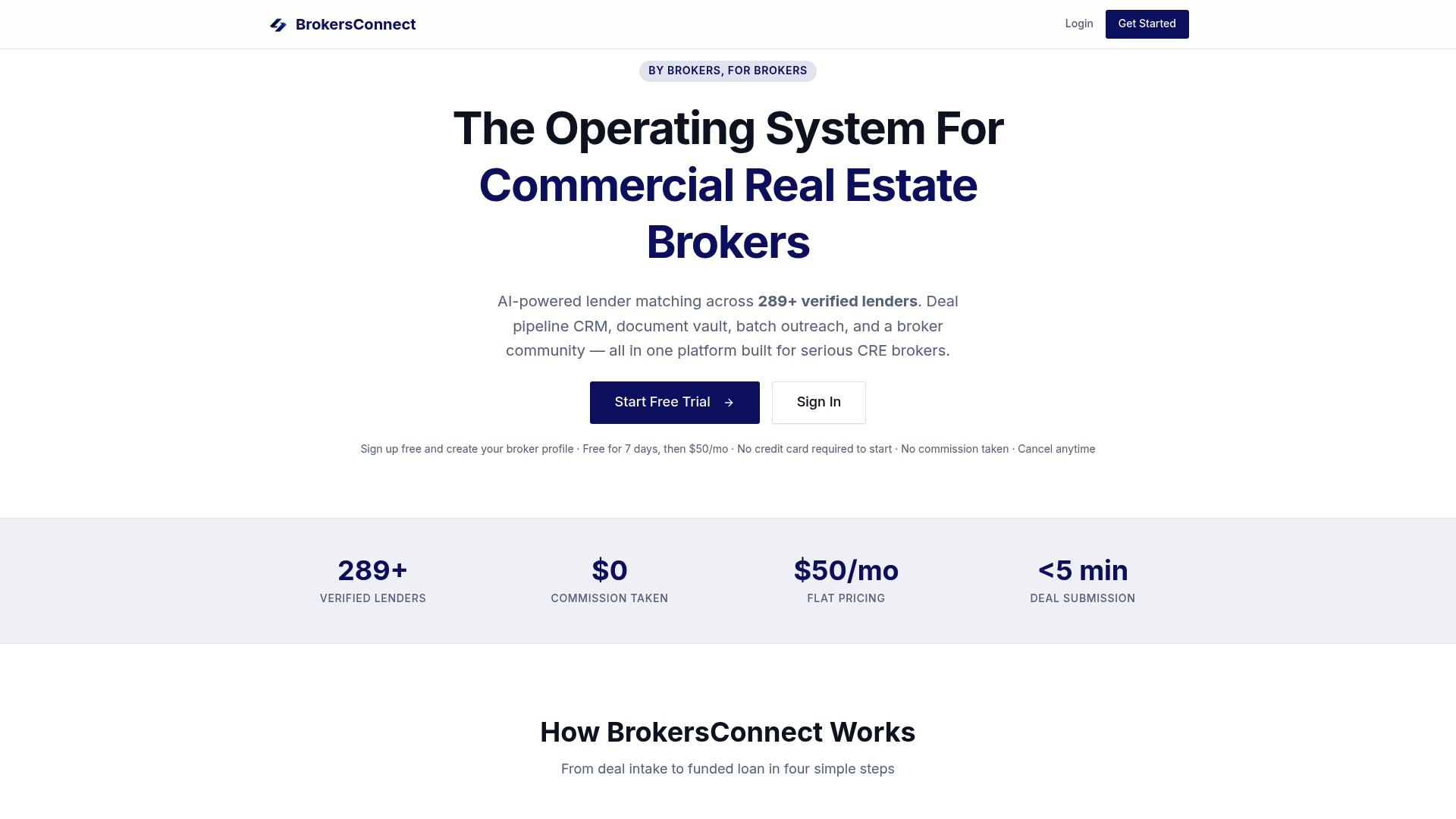
The platform matches your construction scenario to 289+ verified lenders filtered by property type, loan amount, location, leverage, and loan purpose. The lender responsiveness leaderboard shows which lenders are actively quoting, so you skip the ones who won't respond. Secure document vault keeps your draw packages, SOV templates, and GC qualification docs organized and shareable. Batch outreach lets you contact multiple construction lenders simultaneously without rebuilding the submission each time.
For construction files specifically: BrokersConnect includes templates for draw packaging, GC qualification checklists, and deal pipeline tracking from soft quote through closing. Whether you are placing a ground-up multifamily, a build-to-suit industrial, or an owner-occupied SBA 504 deal, the platform surfaces lenders who actually work in that product.
Start matching your construction deals with a free trial — no transaction fees, no commissions, flat monthly subscription.
Useful sources for broker-level construction finance reference
- Commercial loan rate averages (TerryDale Capital) — Published rate and term snapshots for construction and commercial loans; use to benchmark pricing in lender conversations and term sheet negotiations.
- Commercial construction loans guide (Anchor Commercial Capital) — Detailed draw mechanics, retainage norms, and GC qualification standards; use when packaging a construction submission or advising sponsors on draw administration.
- Best commercial lenders for brokers (Avana Capital) — Multi-product lender network guidance and broker program overview; use when building your lender panel or explaining product routing to a client.
- Commercial construction finance and owner advisory (TCG) — Capital-stack modeling, yield-on-cost norms, and asset-class LTC benchmarks; use when underwriting complex developments or advising on mezz/preferred equity sizing.
- Construction loans guide (The Lender Directory) — Lender-selection criteria checklist covering leverage, contingency treatment, draw speed, and takeout capability; use as a side-by-side comparison framework when evaluating competing term sheets.
- Builder loan calculator (Platinum Capital Advisors) — Interactive tool for modeling monthly draws, retainage, and construction financing costs; useful for sponsor conversations and submission preparation.
- AGC Guide to Construction Financing — Industry-standard reference covering lender types, capital sources, and project finance structures for commercial construction; authoritative background for any broker building a lender network.
This article is general information for commercial real estate professionals, not legal or financial advice. Confirm current loan terms, eligibility requirements, and program availability directly with lenders or a qualified advisor before proceeding.