
To place your first commercial real estate loan, do three things: assemble a complete package, submit to three right-fit lenders simultaneously, and stay on top of underwriting until the deal funds. That sequence, done well, is what separates brokers who close from brokers who chase.
Immediate checklist:
- Attach T-12 operating statement, current rent roll, personal financial statement (PFS within 90 days), two years of tax returns, and a one-page executive summary
- Identify three lenders whose product type, LTV tolerance, geography, and loan size match this specific deal
- Add two credibility items to your package: borrower's deal resume and a clear exit strategy
Thecrebrokersconnect is the recommended platform to map lender appetite, match your scenario to verified lenders, and submit the package without cold-calling from scratch.
Key Takeaways
Placing your first commercial loan comes down to a clean package, the right three to five lenders, and active management from submission to close.
| Point | Details |
|---|---|
| Package completeness first | Missing documents are the top reason submissions stall; complete the checklist before sending anything. |
| Batch to 3–5 lenders | Submit simultaneously to create timeline pressure and negotiating leverage on terms. |
| Know your underwriting thresholds | Target DSCR and LTV within the lender's stated range before you submit. |
| Protect your fee in writing | Get a signed fee agreement before submission and confirm the lender acknowledges it in the term sheet. |
| Use Thecrebrokersconnect | Match your deal to 289+ verified lenders, submit via templates, and track responses in one platform. |
Table of Contents
- What does the step-by-step roadmap look like for a first CRE loan?
- What goes in a complete loan package?
- Which lender should you target for each deal type?
- What underwriting metrics do lenders actually care about?
- How do you package and submit a deal so lenders actually respond?
- What does a first CRE loan actually cost and how long does it take?
- How do you clear lender conditions and close the deal?
- What mistakes do first-time brokers make that kill deals?
- How Thecrebrokersconnect speeds up your first commercial loan placement
- Sources
What does the step-by-step roadmap look like for a first CRE loan?
The commercial mortgage broker's process follows a predictable sequence. Knowing the timing at each stage keeps you from losing a deal to a missed deadline.
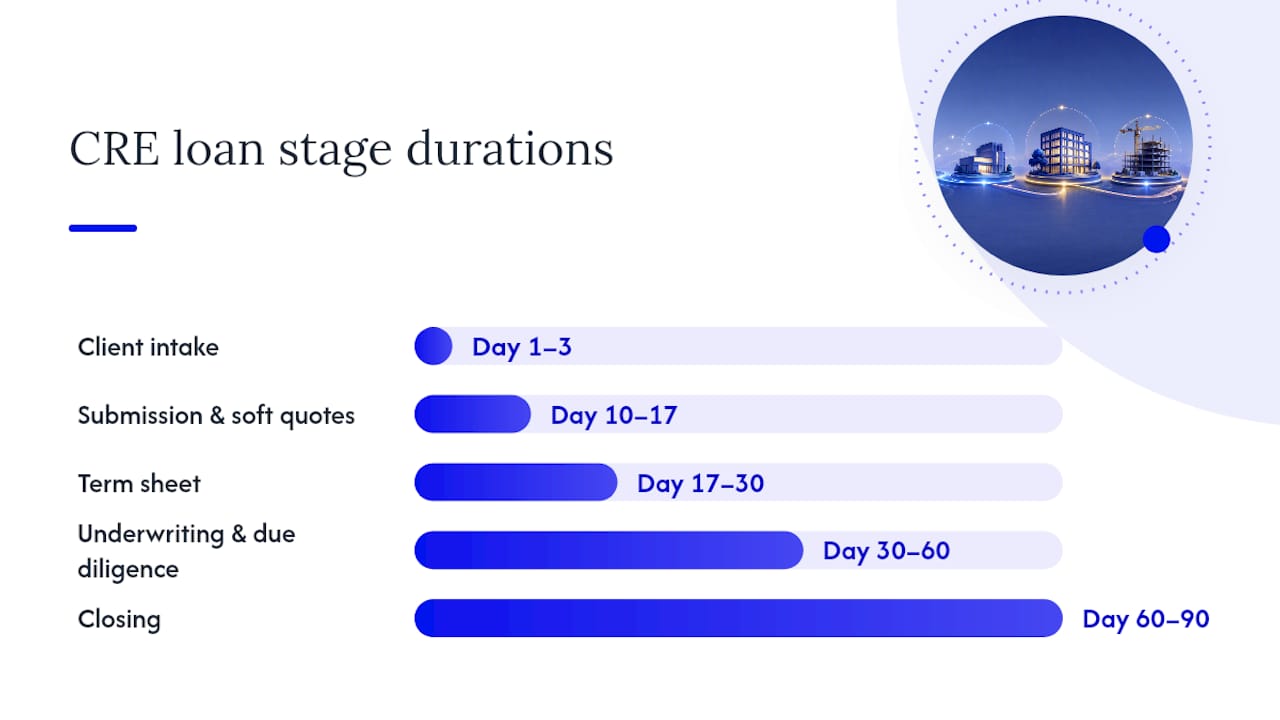
- Client intake (Day 1–3): Collect property details, borrower financials, and deal objectives. Identify loan type, target LTV, and rough loan size.
- Package assembly (Day 3–7): Compile all documents, draft the executive summary, and build the sources and uses statement.
- Lender matching (Day 7–10): Map the deal to 3–5 lenders by product type, geography, and leverage appetite. Register as an approved broker where required.
- Submission and soft quotes (Day 10–17): Send the package. Expect soft quotes or initial interest within 5–10 business days.
- Term sheet (Day 17–30): Negotiate terms, confirm broker fee language, and get the borrower to execute.
- Underwriting and due diligence (Day 30–60): Lender orders appraisal, Phase I environmental, and title. You clear conditions as they arrive.
- Closing (Day 60–90): Final funding mechanics, wire, and fee collection.
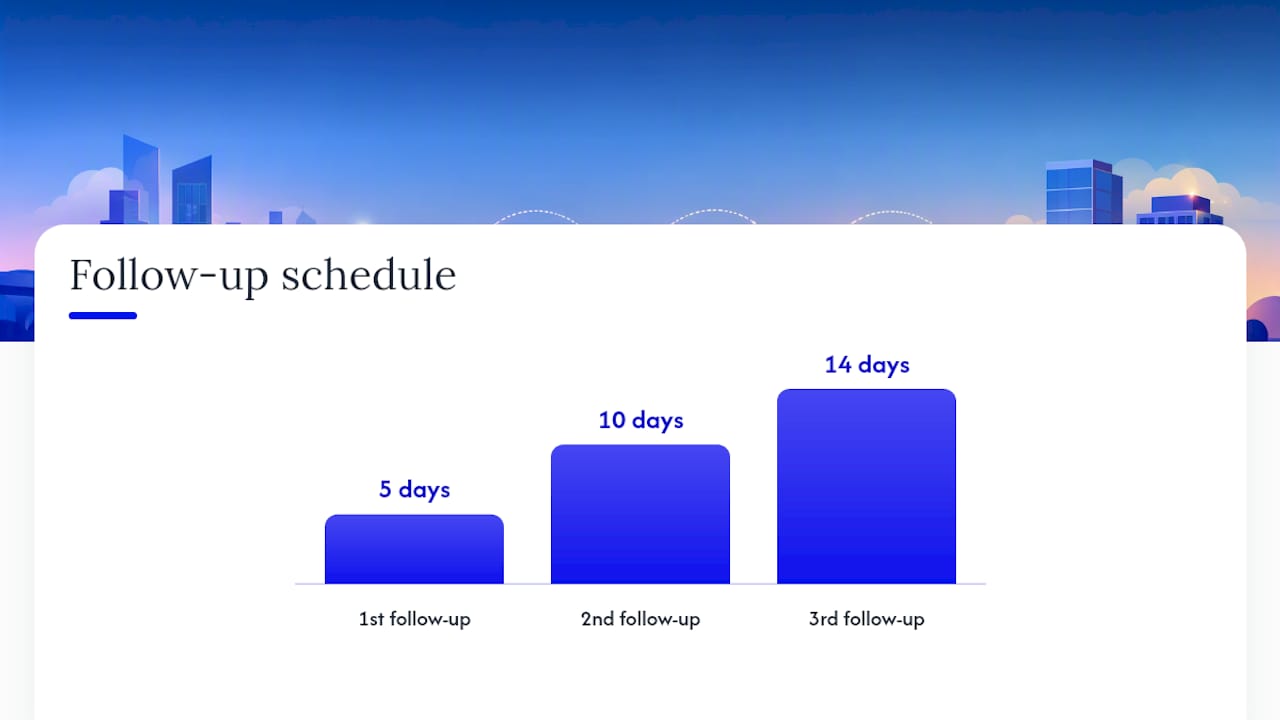
Batch your submission to 3–5 lenders on the same day. Shopping one lender at a time adds weeks to the timeline and gives you no negotiating leverage on terms. Follow up every 5–7 business days after submission — a brief, specific email referencing the deal address and loan amount gets faster responses than a generic check-in.
Building a deep lender network is what separates brokers who fund deals consistently from those who struggle to place anything.
What goes in a complete loan package?
Lenders expect a standard pre-submission package, and incomplete submissions are the top reason deals stall at the initial review stage.
Property documents:
- Trailing 12-month (T-12) operating statement and 2–3 years of historical financials
- YTD income and expense statement
- Current rent roll with tenant names, lease dates, and monthly rents
- Lease abstracts for major tenants
- Property photos (exterior, interior, common areas)
- Survey and title commitment if available
- Tenant estoppel certificates for stabilized assets
Sponsor documents:
- Personal financial statement dated within 90 days
- Real estate owned (REO) schedule
- Two to three years of personal and business tax returns
- Entity documents (operating agreement, articles of organization)
- Borrower resume or deal sheet showing prior transactions
Deal documents:
- One-page executive summary (property, loan request, capital stack, exit strategy)
- Sources and uses statement
- Pro forma with clearly labeled assumptions
- Capital improvements budget if value-add
- Rent comps and sale comps
Pro Tip: Name every file with a consistent convention: "DealAddress_DocumentType_Date." Lenders who receive a folder of files named "scan001.pdf" and "final_v3.pdf" deprioritize the package. Clean file names signal a professional broker.
| Document | Why Lenders Need It |
|---|---|
| T-12 operating statement | Establishes actual NOI for underwriting |
| Current rent roll | Confirms occupancy and lease term stability |
| PFS (within 90 days) | Verifies sponsor liquidity and net worth |
| Executive summary | Frames the deal before the lender reads anything else |
| Pro forma with assumptions | Shows projected performance and exit viability |
Which lender should you target for each deal type?
Most commercial mortgage brokers rely on only two or three lending relationships. Diversifying across at least four lender categories — bridge, SBA, conventional/bank, and CMBS or life company — materially improves placement rates.
Common loan types for first-time placements:
- Bridge loans: Short-term (12–36 months), higher LTV, used for transitional or value-add assets
- DSCR loans: Income-based underwriting, minimal borrower income verification, popular for stabilized rental properties
- Construction loans: Draw-based, requires detailed budget and contractor docs, longer timeline
- Multifamily: Agency (Fannie/Freddie) or bank, strong DSCR requirements, lower rates
- Fix-and-flip: Short-term, asset-based, fast close, lender focus on ARV and experience
- Private money: Flexible terms, fastest close, higher cost, used when conventional lenders pass
Onboarding as an approved broker with each lender category — registration, license verification, first deal submission — accelerates future quotes and gets you prioritized in their pipeline.
What underwriting metrics do lenders actually care about?
Loan approval turns on five factors: creditworthiness, collateral and property metrics, cash flow coverage, documentation completeness, and lender-specific appetite. Present each one cleanly.
Format trailing 12-month NOI as a clean one-page summary: gross potential rent, less vacancy, less operating expenses, equals NOI. Label every line. Lenders discount unsupported assumptions fast.
Bridge lenders tolerate higher LTV and lower occupancy but price that risk into the rate and fee. DSCR lenders care almost entirely about the property's income relative to debt service. Knowing which metric a lender weights most heavily lets you frame the package around their underwriting logic, not a generic template.
How do you package and submit a deal so lenders actually respond?
The one-page executive summary is the most important document in the package. It should answer three questions immediately: what is the property, what is the loan request, and why will this deal work? Include property address and type, loan amount and purpose, LTV and DSCR at request, capital stack, borrower track record, and exit strategy. Everything else goes in the attachments.
Cover email structure:
- One sentence on the deal (property type, location, loan amount, purpose)
- Two bullet points on the strongest metrics (LTV, DSCR, occupancy, or sponsor track record)
- One sentence on the ask (term sheet by a specific date)
- Attachment list
Targeted outreach to a lender's business development officer or broker relationship manager yields far higher response rates than submitting through a generic contact form. Find the right name on LinkedIn or the lender's broker portal before you send anything.
Pro Tip: Send to 3–5 lenders simultaneously, not sequentially. Follow up on day 5, day 10, and day 14 with a brief email referencing the deal address and asking for a status update. After day 14 with no response, move to the next lender on your list.
What does a first CRE loan actually cost and how long does it take?
Timeline from submission to close runs 45–90 days for conventional and agency loans, and 21–45 days for bridge and private money. The most common delay causes: appraisal scheduling, missing borrower documents, and title exceptions that require resolution.
Pro Tip: Present the full cost estimate to the borrower at intake, not at closing. Surprises at the closing table kill deals and damage your reputation. A simple one-page fee and timeline summary sets expectations and positions you as the professional in the room.
How do you clear lender conditions and close the deal?
Once a term sheet is executed, the lender issues a commitment letter with conditions. Work through them in this order:
- Appraisal: Order immediately. Delays here cascade through the entire timeline.
- Phase I environmental: Order in parallel with the appraisal, not after.
- Insurance binder: Request from the borrower's insurance agent on day one of underwriting.
- Title commitment: Engage the title company early; flag any exceptions for resolution.
- Sponsor guarantees: Confirm guarantee structure with the borrower before the term sheet is signed, not after.
- Remaining financial docs: Any missing tax returns or updated PFS should be collected before submission, not during underwriting.
Protecting your broker fee:
- Get your fee agreement signed by the borrower before submitting to any lender
- Confirm the lender acknowledges your fee in writing (most term sheets include a broker fee line)
- Never rely on a verbal agreement
Closing checklist:
- All lender conditions cleared and confirmed in writing
- Title cleared, insurance bound, entity docs verified
- Closing disclosure reviewed with borrower
- Wire instructions confirmed directly with the title company (never by email alone)
- Fee collected at closing via the HUD/settlement statement
What mistakes do first-time brokers make that kill deals?
- Submitting an incomplete package and expecting the lender to ask for what's missing — they won't; they'll just move to the next deal
- Shopping one lender at a time instead of batching to 3–5 simultaneously
- Overstating the pro forma without supporting assumptions — lenders underwrite to actuals, not optimism
- Sending to the wrong lender type (e.g., a 70% LTV bridge request to a life company)
- Missing or outdated PFS — a PFS older than 90 days is often rejected outright
- No borrower deal resume — sponsors with no track record need a clear explanation of their team or equity partner
- Ignoring cross-collateralization risks when the borrower has multiple encumbered properties
- Failing to disclose known title issues or environmental concerns upfront — lenders find them anyway, and surprises damage trust
- No signed fee agreement before submission
- Weak or missing exit strategy — every lender wants to know how they get repaid
Quick mitigation before submission: Run through the package checklist in Section 3, confirm the lender's product criteria match the deal profile, and verify the borrower's PFS date.
How Thecrebrokersconnect speeds up your first commercial loan placement
A broker using Thecrebrokersconnect starts by entering the deal scenario: property type, loan amount, location, LTV, DSCR, and loan purpose. The platform matches that scenario against a database of 289+ verified lenders, filtering by the criteria that actually matter to each lender.
From there, the workflow looks like this:
- Lender matching: The platform surfaces lenders whose product type, geography, and leverage appetite fit the deal, replacing hours of manual research
- Submission templates: Pre-built executive summary and package templates so the first submission goes out clean
- Document vault: Secure document sharing keeps borrower files organized and accessible without email chains
- Batch outreach: Submit to multiple lenders simultaneously from one interface, with tracking on who has opened and responded
- Lender responsiveness leaderboard: Shows which lenders are actively quoting, so you prioritize the ones most likely to respond
- Fee calculator: Confirms your fee at the deal level before you submit
Brokers who treat their first submission as an audition — packaging a high-quality deal and closing it cleanly — typically convert that lender into a repeat partner. The platform's lender responsiveness data helps you pick the right lender for that first impression.
What actually matters most when you're placing your first deal
The brokers who close their first commercial loan quickly are not the ones with the longest lender lists. They are the ones who package clean deals, submit to the right lenders, and stay on top of underwriting. That's the whole game.
New brokers tend to overinvest in finding more lenders and underinvest in the quality of the package. A mediocre package sent to 20 lenders performs worse than a tight, complete package sent to five well-matched ones. Get the package right first.
For week one: collect all documents, draft the executive summary, and identify three to five lenders whose criteria match the deal. For week two: submit simultaneously, follow up on day five, and start clearing any conditions the lender flags early.
Thecrebrokersconnect: your operating system for placing CRE loans
Placing your first commercial loan is faster when you're not rebuilding the process from scratch on every deal. Thecrebrokersconnect gives you a verified lender database of 289+ lenders, AI-powered matching by deal scenario, submission templates, batch outreach, and a deal pipeline CRM, all in one platform. No cold calls, no scattered spreadsheets, no guessing which lender is actually quoting right now.
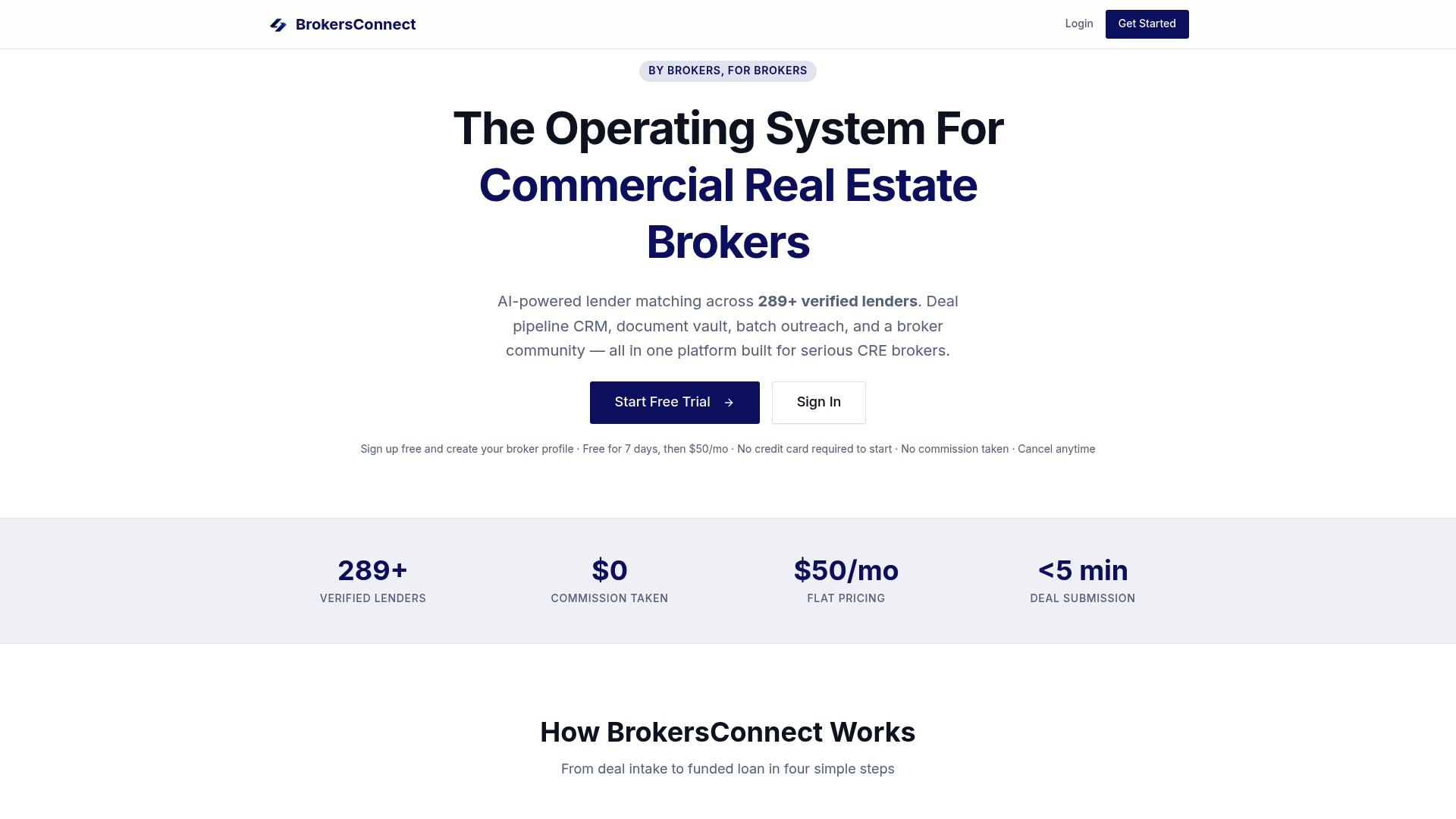
The subscription is flat monthly with a free trial. Start your free trial at Thecrebrokersconnect and submit your first deal scenario today.
Sources
- How Brokers Find Lenders | Commercial Loan Broker | Loans
- Mortgage Broker for Commercial Real Estate: Role, Process, and Fees | Avana Capital
- What Documents Do Lenders Really Need? A Pre-Submission Checklist
- What Affects Business Loan Approval: 5 Key Factors
This article is general information, not a substitute for advice from a qualified financial advisor. Consult a qualified financial professional about your own circumstances before acting on anything here.