
A broker conflict of interest arises whenever a commercial real estate broker's compensation, relationships, or dual representation could bias their advice. The fix is not complicated but is non-negotiable: disclose the conflict in writing, get informed written consent, and put fee arrangements in a signed agreement before you touch the deal. Skip that step and you risk your license and your client's trust.
TL;DR:
- Transparent, signed disclosure and written consent are legally required before discussing material terms in dual agency situations.
- Fee structures that clearly specify commissions and referral payments reduce incentives for steering clients toward higher-paying parties.
- Implementing a conflict register, role-based data access, and signed document vaults helps enforce disclosure protocols consistently across transactions.
- Early, written disclosures and proper operational safeguards largely determine whether conflicts lead to liability or damage trust.
- Regulatory actions focus on whether disclosures occurred before negotiations and were conspicuous, not just on having a disclosure form.
Table of Contents
- What Broker Conflicts of Interest Look Like in CRE Deals
- Legal Disclosure and Informed Consent: The Baseline You Can't Skip
- Contract Clauses and Safeguards That Actually Reduce Risk
- How a Deal-Management Platform Helps You Operationalize Disclosure
- Why Conflicts Quietly Wreck Client Outcomes
- Regulatory Enforcement: What Actually Happens When Conflicts Surface
- Real Conflict Scenarios and How They Get Resolved
- Best Practices the Best Brokerages Already Follow
- How Clients Can Check a Broker's Disclosures Themselves
- Treat Conflicts as Operational Risk, Not Paperwork
- Put Safeguards Into Practice With BrokersConnect
- Where to Read More on Disclosure and Fee Structures
- Sources
What Broker Conflicts of Interest Look Like in CRE Deals
Most conflicts fall into a handful of recurring patterns, and once you can name them, you start spotting them before they cost you a client or a license.
Dual agency is the biggest one. It happens when a single brokerage, or occasionally the same broker, represents both the landlord and the tenant, or both borrower and lender, in the same transaction. Dual agency requires full disclosure and written informed consent in most jurisdictions that allow it at all, because the broker stops being an advocate and becomes a neutral party. That shift sounds harmless until you realize your client thinks they still have someone fighting for them.
Referral fees create a quieter version of the same problem. A broker sends a borrower to a lender, or a tenant to a specific landlord, and collects a fee the client never sees on paper. Lender steering works the same way: a loan originator keeps pushing deals toward one capital source because of a personal relationship, a volume bonus, or an easier underwriting relationship, not because it's the best fit for the borrower.
Multiple-introduction conflicts show up inside brokerages with internal incentive structures that reward whoever "touches" a deal first, regardless of who actually served the client's interests.
- Dual agency: one brokerage represents both sides of a lease, sale, or loan
- Undisclosed referral fees: compensation for a recommendation the client never learns about
- Lender steering: relationship or bonus incentives override borrower fit
- Multiple-introduction conflicts: internal commission splits pressure brokers to funnel deals a certain way
Legal Disclosure and Informed Consent: The Baseline You Can't Skip
Written disclosure plus written informed consent is the standard most U.S. states apply to dual representation, and it is not optional paperwork. It's the legal floor.
Virginia's code offers one of the clearest examples of how a state spells this out. Under Virginia's dual representation statute, disclosure must be conspicuous, meaning bold or boxed language a client can't miss, paired with a signature block acknowledging consent. That structure isn't unique to Virginia. Most states that permit dual agency in commercial deals build in similar mechanics because a buried disclosure in paragraph 40 of a 60-page agreement doesn't count as informed consent.
What this typically requires:
- Conspicuous, separately signed disclosure language (not folded into general boilerplate)
- A clear statement of what dual representation means for advocacy and confidentiality
- Written consent obtained before, not after, material negotiations begin
- A documented right for either party to refuse consent without penalty
The disclosure gap that trips up brokers: Consent is not permanent. If a client refuses to sign, or later withdraws consent once they understand the practical effect, the broker has to withdraw from dual representation, not talk the client back into it. Academic analysis of CRE conflicts argues disclosure alone often falls short because firm-level economics still tilt toward whichever side pays more, even after full disclosure.
Because disclosure rules vary by state and by transaction type, confirm the specific language and signature requirements with your state's real estate statutes or with counsel before you finalize a dual representation form. What satisfies Virginia's requirements won't automatically satisfy Texas or California's.
Contract Clauses and Safeguards That Actually Reduce Risk
Disclosure gets you compliant. Contract structure and operational habits are what actually reduce the conflict itself, and the two are not the same thing.
Start with fee structure. Flat fees, or hourly rates credited against a success fee, remove the incentive to steer a client toward whichever lender or landlord pays the biggest commission. A broker fee agreement template with transparent accounting language does more to protect you legally than any verbal promise of fairness.
- Fee transparency clause — spell out exactly how commissions, referral fees, and success fees get calculated and split, with no discretionary language.
- Consent and disclosure statement — a standalone signature block, not a clause buried inside general terms.
- Confidentiality boundary language — define what information stays walled off between deal teams when dual representation is involved.
- Withdrawal clause — spell out what happens, and who gets notified, if either party revokes consent mid-deal.
- Referral fee disclosure — required under most state RESPA-adjacent rules for mortgage-adjacent transactions, and a smart habit even where it isn't strictly required.
Operationally, separate deal teams inside a brokerage go a long way. So does a conflict register: a simple running log of every dual-representation or referral-fee situation, dated and signed. Audit trails matter more than most brokers assume, because a regulator or a plaintiff's attorney will ask for one eventually.
Tell clients about a conflict the moment you know about it, not once negotiations are underway. Offer them the accounting behind any referral payment, and be upfront that they can request independent representation if dual agency makes them uneasy.
Pro Tip: Keep a dated, signed disclosure form in every deal file where dual agency or a referral fee applies, and log who accessed confidential client information and when. That log is your best defense if a client or regulator later questions how the deal was handled.
How a Deal-Management Platform Helps You Operationalize Disclosure
Good intentions don't survive a busy pipeline. What survives is a system that forces documentation before a deal moves forward.
A platform built for CRE brokers can standardize the parts of conflict management that are easiest to skip under deadline pressure: disclosure templates that get attached to every relevant file, a signed-document vault so consent forms don't live in someone's email, role-based access that walls off confidential borrower or tenant data between team members on opposite sides of a dual-representation deal, and an audit trail showing exactly when disclosure happened and who signed off.
Picture a mid-size brokerage running a dual-representation deal on a multifamily refinance. One originator represents the borrower, another represents the incumbent lender relationship. A platform with role-based permissions keeps loan terms and borrower financials from crossing between the two threads until both sides have signed a documented consent form, and the system logs the exact timestamp.
- Disclosure templates attached automatically to flagged deal types
- Signed-document vault replacing scattered email consent forms
- Role-based access limiting who sees confidential borrower or lender data
- Audit logs showing when disclosure and consent actually happened
Objective lender matching also reduces the informal steering that happens when a broker defaults to whichever lender they know best rather than the lender actually suited to the deal. None of this replaces your fiduciary duty or a signed fee agreement. A platform documents and enforces process; it does not substitute for the legal work of disclosure and consent.
Why Conflicts Quietly Wreck Client Outcomes
An undisclosed conflict rarely blows up loudly. It shows up as a borrower placed with a lender that charges a higher rate because the originator had an easier relationship there, or a tenant steered into a lease that favors the landlord's brokerage economics over the tenant's actual space needs.
Seattle University Law Review's analysis of CRE conflicts makes a pointed argument here: dual representation replaces an advocate with a neutral party, and neutrality isn't the same as fairness when one side of the deal has more leverage or more revenue potential for the brokerage. Firm-level incentives tend to tilt toward whichever party generates more future business, and that's usually the landlord or the larger institutional lender, not the one-time tenant or first-time borrower.
The transaction-integrity cost compounds over time. A borrower who later discovers an undisclosed referral fee doesn't just distrust that broker. They tell other borrowers, they leave negative reviews, and in some cases they file complaints that trigger a state licensing inquiry. Deals also close slower when conflicts surface mid-negotiation, because renegotiating trust takes longer than renegotiating terms.
The quieter damage is to pricing accuracy. When steering replaces genuine lender matching, borrowers routinely end up with worse leverage, higher rate spreads, or unnecessary fees baked into the loan structure, and they often never find out a better option existed.
Regulatory Enforcement: What Actually Happens When Conflicts Surface
State real estate commissions have license-suspension authority when a broker fails to disclose dual representation or an undisclosed fee arrangement, and that authority gets used. Complaints typically originate from a client who discovers a referral fee after closing or realizes their "representative" was quietly representing the other side too.
Industry reporting on dual representation shows growing scrutiny of the practice, including litigation and legislative attention in multiple states. That pressure is pushing some jurisdictions toward tighter disclosure mechanics or outright restrictions on certain dual-agency scenarios in commercial transactions.
Penalties vary by state but generally include license suspension or revocation, fines, and in more serious fraud-adjacent cases, referral to state attorneys general. Civil exposure runs alongside regulatory exposure. A client who can show a broker concealed a material conflict has grounds for a breach of fiduciary duty claim, which can result in disgorgement of commissions or damages tied to the worse deal terms the client received.
The pattern regulators and courts look for is consistent: was the conflict disclosed before material terms were negotiated, and did the client have a real opportunity to object or seek independent representation? A signed form obtained after the fact, or one buried in unrelated paperwork, rarely satisfies either standard. This is why timing and conspicuousness of disclosure carry more legal weight than the mere existence of a disclosure document.
Real Conflict Scenarios and How They Get Resolved
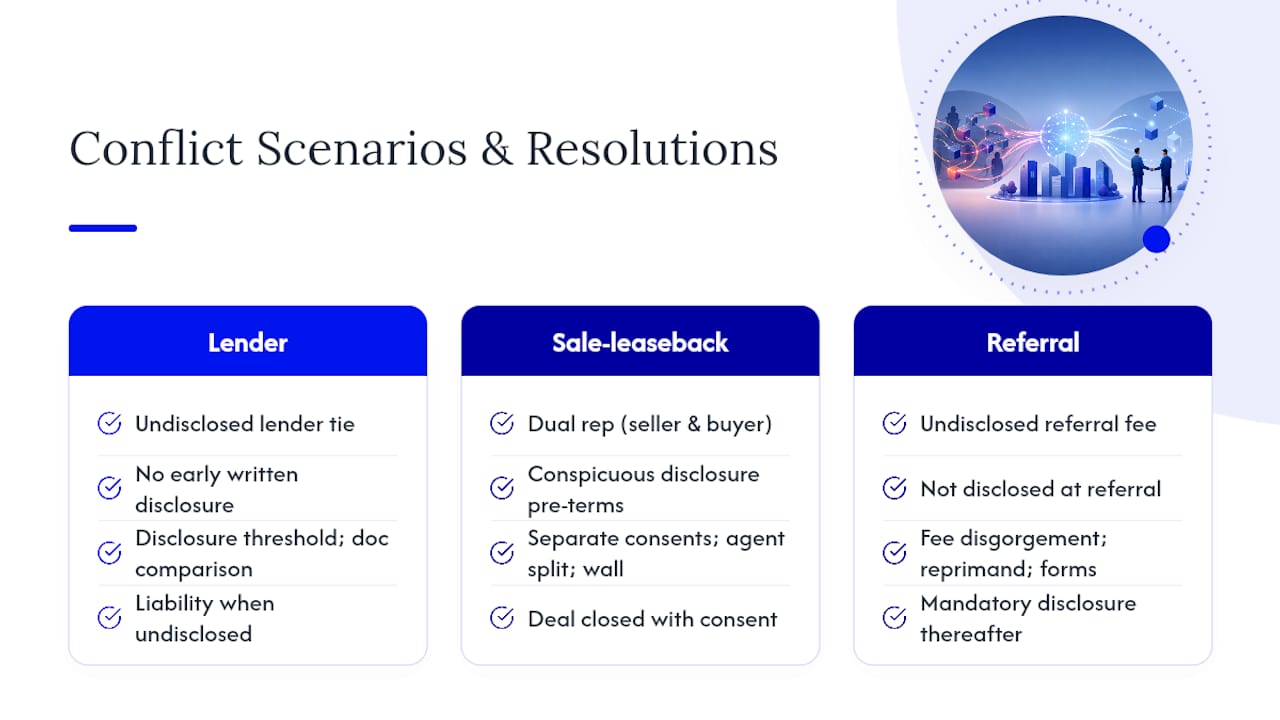
Scenario one: the undisclosed lender relationship. A loan originator repeatedly places deals with one regional bank because of a long personal relationship with the bank's head of commercial lending, without disclosing that relationship to borrowers. When a borrower later discovers a competing lender offered better terms, the resolution typically involves the brokerage adding a disclosure requirement for any lender relationship exceeding a certain deal volume, plus a documented comparison showing why a lender was recommended.
Scenario two: dual representation on a sale-leaseback. A brokerage represents both the seller and the buyer on a sale-leaseback structure. Following conspicuous disclosure requirements similar to Virginia's model, both parties sign separate consent acknowledgments, and the brokerage assigns different individual agents to each side with an internal confidentiality wall. The deal closes without incident because consent was documented before terms were finalized, not after.
Scenario three: the referral fee that wasn't disclosed. A tenant broker refers a client to a specific property manager and receives an undisclosed fee. The tenant discovers the arrangement during a dispute over lease terms, files a complaint, and the resolution includes fee disgorgement and a formal reprimand. The brokerage's response afterward: mandatory referral fee disclosure forms for every third-party recommendation, logged and signed at the time of referral.
The common thread across all three: resolution success tracks almost perfectly with whether disclosure happened early and in writing, not with whether a conflict existed at all. Conflicts are common. Undisclosed conflicts are what create liability.
Best Practices the Best Brokerages Already Follow
The brokerages that avoid conflict-related complaints tend to share a few habits that go beyond minimum legal compliance.
Some firms adopt an occupier-only or tenant-only advisory model specifically to eliminate landlord revenue dependence from their economics. Tenant-focused advisory research points out that this structural choice removes a major source of bias entirely, rather than managing it through disclosure. It's not realistic for every brokerage, but it illustrates the principle: the strongest safeguard is structural, not procedural.
Where dual representation is unavoidable, professional standards bodies like RICS recommend information barriers between the teams handling each side, alongside written informed consent. That principle translates well to U.S. commercial practice even though the specific regulatory framework differs.
Best-practice brokerages also build a documented, ongoing conflict register rather than treating disclosure as a one-time signature. Every referral relationship, every dual-representation deal, and every fee-sharing arrangement gets logged with a date, not just disclosed once and forgotten. Firms that survived regulatory scrutiny with minimal damage were almost always the ones that could produce a paper trail on demand.
Training matters too. Brokers who understand why disclosure timing matters, not just that a form needs a signature, catch conflicts earlier and handle client pushback better than those following a checklist without understanding the reasoning behind it.
How Clients Can Check a Broker's Disclosures Themselves
Clients don't have to take a broker's word for it, and the better-informed ones don't.
A client can ask directly whether the brokerage has any existing relationship with the other party, the lender, or a referral source tied to the deal, and request that answer in writing. Due diligence guidance for tenants recommends asking this question before signing a representation agreement, not after touring properties or reviewing loan terms.
Requesting a fee accounting is a second, underused check. A client can ask for an itemized breakdown of every commission, referral fee, or third-party payment tied to the transaction. A broker with nothing to hide should produce this without hesitation. Hesitation itself is worth noting.
Checking state licensing records is a third option many clients skip. Most state real estate commission websites let anyone search for prior disciplinary actions against a specific broker or brokerage, and a pattern of complaints tied to disclosure failures is a visible red flag.
Finally, clients can simply ask whether independent representation is available, especially in a dual-agency scenario. A broker who resists that question or downplays its importance is giving the client useful information about how seriously that brokerage treats the conflict in the first place.
Treat Conflicts as Operational Risk, Not Paperwork
The brokers who get burned by conflicts of interest almost never lack a disclosure form. They lack a system for using it consistently, before the deal gets hot, not after a client starts asking pointed questions.
A short checklist worth running on every deal that touches dual representation, a referral, or a lender relationship you have history with:
- Draft a standing disclosure template before you need it, not during a live negotiation
- Require signed written consent before material terms are discussed, not after
- Log every conflict in a dated register, even the ones that feel minor
- Separate deal teams when representing both sides of any transaction
- Track every referral fee with a paper trail a client could request tomorrow
Templates for broker fee agreements and referral disclosure language are worth building into your standard deal packet rather than drafting fresh each time.
— Theron
Put Safeguards Into Practice With BrokersConnect
Thecrebrokersconnect gives you the workflow layer that turns disclosure policy into something you actually do on every deal, not just the ones where you remember to. The platform's document vault and audit trails let you store signed consent forms and fee agreements alongside the deal file itself, so nothing lives in a scattered inbox waiting to be requested by a regulator or a client's attorney.
Because the platform matches loan scenarios against a database of verified lenders using objective criteria like property type, leverage, and credit profile, you get a documented, defensible reason for every lender recommendation instead of relying on the relationship that happens to be top of mind. That matters both for reducing steering risk and for showing your work if a client ever asks why you picked one lender over another.
None of this replaces a lawyer or a signed fee agreement. It replaces the guesswork of trying to remember which deals needed disclosure and which forms went where. If you want to see how the pipeline, document vault, and lender matching work together, start a free trial on the BrokersConnect platform and run your next deal through it.
Where to Read More on Disclosure and Fee Structures
- Virginia's dual representation statute for a real example of conspicuous disclosure and consent mechanics
- Referral fee agreement guidance for clauses that keep referral payments compliant
- Tenant estoppel certificate basics for confidentiality procedures relevant to dual-representation deals
- Brokerage commission safeguards for background on firm-level incentive structures
Sources
- Dual Agency: What Is It & How Does It Work? | Rocket Mortgage
- § 54.1-2139.01. Disclosed dual agency and dual representation in commercial real estate transactions authorized. - Virginia Code
- Understanding commercial real estate brokers | Nolo
- Conflicts of Interest in Commercial Real Estate (Seattle University Law Review)