
Referral fee agreements are legal in the United States when they comply with RESPA and state licensing rules. For federally related mortgage loans, payment must reflect fair market value for bona fide services or fit a permitted broker-to-broker split. An enforceable agreement needs to be written, signed by the brokers of record, and spell out the fee formula, the payment trigger, and an expiration date.
TL;DR:
- Payment amounts must reflect fair market value and be supported by clear documentation of the services performed to avoid violations of RESPA Section 8.
- State licensing laws require referral payments to go through licensed brokerages, with specific verification needed for out-of-state or commercial transactions.
- An enforceable agreement must include a defined fee formula, clear payment trigger, expiration date, and signatures from brokers of record.
- Most disputes and unpaid fees result from administrative failures, such as poor filing or lack of early communication with settlement agents, rather than contract wording.
- Proper storage of signed agreements and proactive notification to settlement agents are key to securing referral fee payments at closing.
Table of Contents
- What Federal Law Says About Referral Fee Agreements
- State Licensing Rules That Govern Who Gets Paid
- Contract Essentials: The Clauses That Make an Agreement Enforceable
- How Referral Fees Actually Get Paid at Closing
- Preventing Unpaid Fees and Resolving Disputes
- How BrokersConnect Keeps Referral Agreements From Falling Through the Cracks
- Documentation and Filing Practices That Hold Up Later
- What Happens When You Get Referral Fees Wrong
- Referral Fee Agreements Beyond Mortgage and CRE Deals
- Negotiating Terms That Actually Protect Both Sides
- Referral Fees vs. Finder's Fees: Why the Label Matters
- The Real Compliance Gap Nobody Talks About
- Store Your Referral Agreements Where They Won't Get Lost
- Sources
What Federal Law Says About Referral Fee Agreements
RESPA Section 8 is the rule that trips up more brokers than any other single statute in this business. It prohibits giving or accepting a "thing of value" in exchange for referring settlement service business on a federally related mortgage loan. That covers purchase loans, most refinances, and home equity lines tied to residential property. It does not cover pure commercial real estate deals with no federally related mortgage loan attached, which is why CRE-only referral splits carry less federal exposure than mortgage-linked ones.
The exception that keeps referral arrangements alive is the fair market value carve-out for bona fide services. If a broker actually performs work, screening a borrower, packaging a file, coordinating with a lender, and the payment matches what that work is worth in the open market, the arrangement holds up. If the payment is just a bounty for handing over a name, it's a kickback regardless of what the contract calls it.
The Consumer Financial Protection Bureau treats marketing services agreements as a persistent gray zone. Watch for these red flags in any arrangement you're structuring or reviewing:
- Payment amounts that exceed what comparable services would cost from an independent vendor
- Services described in vague, generic terms rather than specific deliverables
- Fees that scale with loan volume rather than the actual work performed
- No contemporaneous documentation showing what was done and when
Pro Tip: Keep a simple time log or deliverables list for any referral relationship tied to a mortgage-covered transaction. If regulators ever ask "what did this fee actually pay for," you want an answer that isn't just the contract itself.
State Licensing Rules That Govern Who Gets Paid
Federal law sets the ceiling on referral risk, but state licensing law decides who can legally receive a check in the first place. Most states require that referral and commission payments be paid through licensed brokerages, not directly to individual agents or to anyone unlicensed. An agent who refers a deal gets paid through their broker's split, not as a side payment from another company.
This matters more in commercial deals than people expect, because commercial referrals often cross state lines. A broker in Texas sending a multifamily refinance lead to a lender contact in Arizona needs to check whether either state requires a cooperating broker relationship or a specific licensing tie-in before money changes hands. Some states, Kansas among them, have statutes permitting commission sharing with out-of-state licensees as long as the arrangement runs through an in-state supervising broker and meets that state's documentation requirements.
Before you sign anything, verify:
- The receiving party's brokerage license is active and covers the transaction type
- The exact legal entity name matches what's on the license, not a DBA or a personal name
- Whether the deal requires a formal broker cooperation agreement in addition to the referral fee agreement itself
A mismatch between the name on your agreement and the name on the license is one of the most common reasons payments stall for weeks after closing. Settlement agents won't cut a check to an entity they can't verify.
Contract Essentials: The Clauses That Make an Agreement Enforceable
An enforceable referral fee agreement needs a handful of specific fields, not a page of boilerplate. Skip any one of these and you're relying on goodwill instead of a contract.
- Fee formula. State whether the fee is a percentage of gross commission or net commission after expenses, and specify the number. Referral splits commonly run 20 to 35 percent of the receiving broker's commission, though flat fees are common in commercial deals to avoid arguments over what counts as a deduction.
- Payment trigger. Define the exact event that creates the payment obligation, close of escrow, a funded loan, or lease execution, and note how many days after that event payment is due.
- Expiration date. Set a window, typically six to twenty-four months, after which the referral no longer entitles the referring party to a fee if the client resurfaces independently.
- Definition of the referred client. Name the specific person or entity, and address what happens if that client brings a related deal through a different channel later.
- Signatures. Both brokers of record, not just the agents involved, need to sign. Agent-level signatures alone don't bind the brokerage in most states.
- Filing location. Note where the executed copy lives, transaction management system, document vault, or compliance file, so it can be produced at closing.
Pro Tip: Spell out the calculation order explicitly. If the deal includes deductions for marketing costs or co-broke splits, state whether those come out before or after the referral percentage is applied. This one detail causes more post-closing arguments than any other clause.
How Referral Fees Actually Get Paid at Closing
In most residential and many commercial deals, the settlement agent or title company handles disbursement directly. The referral fee shows up as its own line item on the closing settlement statement, deducted from the receiving brokerage's commission and wired or checked to the referring brokerage the same day funds disburse.
Some deals work differently. The receiving brokerage collects its full commission, then pays the referring broker directly within an agreed window, often 10 to 30 days. This is more common when the settlement agent isn't equipped to split fees between brokerages, or when the referral fee was negotiated after the transaction was already underway.
Either way, keep three things on file:
- The signed referral fee agreement itself
- A copy of the settlement statement showing the fee line item
- Internal accounting records documenting receipt, since referral income is reportable and needs a clean paper trail for tax purposes
Payment platforms built for commission splits, like BrokerPay, exist specifically because Venmo and personal checks create a documentation gap that regulators and disputes both exploit.
Preventing Unpaid Fees and Resolving Disputes
The single biggest cause of unpaid referral fees isn't a bad-faith broker. It's a weak process: agreements buried in an email thread, an unsigned broker-of-record line, or nobody telling the settlement agent the fee needs to appear on the closing statement.
- File the signed agreement in your transaction system the day the referral happens, not the week before closing.
- Notify the settlement agent or title company early so the fee gets built into the closing statement rather than negotiated after the fact.
- Flag your accounting team to expect the payout so it doesn't slip through as unreconciled income.
If a fee still goes unpaid, most agreements should include a late fee or interest clause, language on who covers collection costs, and either an arbitration clause or a named jurisdiction for disputes. When payment doesn't arrive, reconcile against the settlement statement first, escalate internally second, and treat arbitration or small claims as the last resort rather than the first move.
How BrokersConnect Keeps Referral Agreements From Falling Through the Cracks
The gap between a signed referral agreement and an actual payout is almost always administrative, not legal. BrokersConnect's document vault gives brokers one place to store the executed agreement instead of an email thread nobody can find at closing. The fee calculator settles gross-versus-net disagreements before they start, and pipeline flags remind you to notify the settlement agent before the closing statement gets finalized.
That combination, a stored record plus an early notification trigger, is what actually prevents the nonpayment problems described above. Broker templates and workflow guides on the BrokersConnect blog are a practical starting point if you're drafting your first referral agreement from scratch.
Documentation and Filing Practices That Hold Up Later
An unenforceable referral agreement is usually a filing problem, not a drafting problem. The clauses can be perfect and the fee still won't get paid if nobody can produce the signed document when it matters.
Treat the executed agreement the way you'd treat a listing agreement: filed the same day it's signed, in a system your whole team can access, not just the inbox of the agent who negotiated it. A secure document sharing setup that timestamps uploads and logs who accessed a file gives you something to point to if a dispute ever goes to arbitration.
Beyond the agreement itself, keep supporting records that prove the referral actually happened as described: the original introduction email or message, the date the referred client's file opened with the receiving broker, and any communications confirming the client's identity matches what's named in the contract. For mortgage-linked deals, also retain documentation showing what services were performed if you're relying on the bona fide services exception, since that's the first thing a compliance review will ask for.

A loan document checklist built for the underlying transaction doubles as a good template for what to retain on the referral side too. File once, retrieve fast, argue less.
What Happens When You Get Referral Fees Wrong
Violating referral fee rules carries real consequences, and they land on both the payer and the recipient. Under RESPA, penalties for illegal kickbacks on federally related mortgage loans can include fines and potential criminal exposure for willful violations, and the CFPB has pursued enforcement actions against firms running disguised referral schemes through marketing agreements.
State-level violations tend to hit differently but just as hard. Paying an unlicensed person for what amounts to real estate or mortgage brokerage activity can trigger license suspension or revocation for the paying broker, civil penalties from the state regulator, and in some states, the referral agreement itself becomes unenforceable, meaning the broker who structured it illegally can't even sue to collect.
There's also a quieter risk: reputational damage with lenders and title companies who notice a pattern of irregular payment requests. Settlement agents talk to each other, and a broker known for pushing payment structures that don't match the paperwork finds fewer partners willing to work fee splits with them going forward.
The safest posture is treating every referral fee as if it might get audited, because in a RESPA-covered transaction, it effectively might. Document the service, match the payment to it, and keep the paper trail intact from day one.
Referral Fee Agreements Beyond Mortgage and CRE Deals
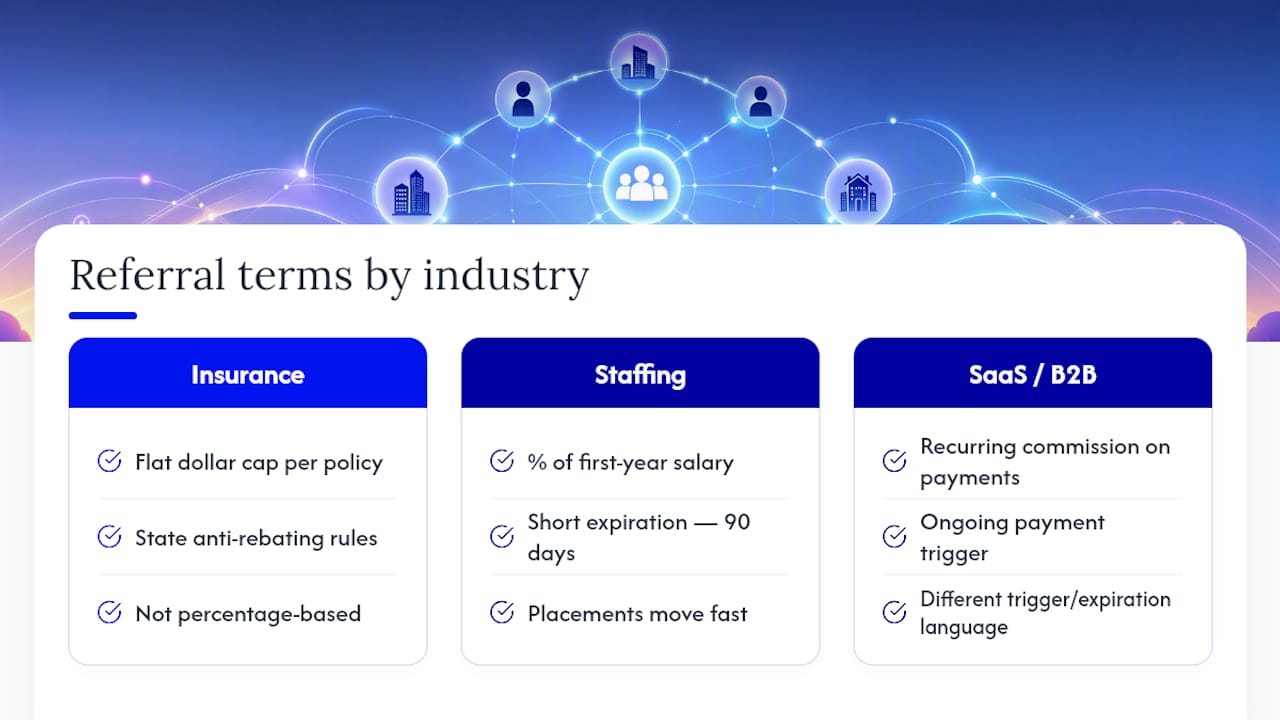
Referral arrangements aren't unique to real estate finance. Law firms, insurance agencies, staffing firms, and B2B service providers all run versions of the same structure, and looking at how they handle it clarifies what's actually standard versus what's specific to mortgage compliance.
Insurance referral agreements often cap fees at a flat dollar amount per policy rather than a percentage, partly because state insurance regulators impose their own anti-rebating rules separate from RESPA. Staffing and recruiting firms typically use a percentage-of-first-year-salary model with a shorter expiration window, often 90 days, because candidate placements move fast and stale referral claims are a common dispute trigger. SaaS and B2B service referrals frequently use a recurring commission tied to the referred client's ongoing payments rather than a one-time fee, which requires very different trigger and expiration language than a real estate closing does.
What stays constant across industries is the core structure this article has walked through: a written agreement, a clear fee formula, a defined trigger, and signatures from parties with authority to bind their organization. The specifics change; the skeleton doesn't. If you're ever unsure whether a real estate referral clause is standard or unusual, comparing it against these adjacent industries is a useful sanity check, mortgage and CRE referral terms tend to be stricter, not looser, because of the federal licensing overlay.
Negotiating Terms That Actually Protect Both Sides
Most referral fee disputes trace back to a term nobody pushed back on during negotiation. Treat the fee percentage as the last thing you negotiate, not the first, because the trigger and expiration language usually matter more to your actual payout.
Negotiate exclusivity carefully. A referring broker who wants exclusive rights to a client relationship for the full agreement term needs to accept a correspondingly clear definition of who counts as "the referred client" if that person later needs a different type of financing. Vague exclusivity language creates more fights than percentage disagreements do.
Push for a shorter expiration window than the other side proposes, not a longer one. A referring broker's instinct is to want maximum coverage time, but a long window on a stale deal invites disputes months later when nobody remembers the original conversation clearly. Six months is often enough for a typical purchase or refinance; commercial deals with longer underwriting timelines justify something closer to twelve.
Finally, customize the payment timing to match how the receiving brokerage actually gets paid. If commissions on a commercial deal disburse in stages, tie the referral payment to the same stages rather than demanding full payment at signing. An agreement that ignores how money actually flows through the deal is an agreement that generates collection headaches later, regardless of how carefully the percentage was negotiated.
Referral Fees vs. Finder's Fees: Why the Label Matters
The terms get used interchangeably in casual conversation, but they carry different weight in a contract and, in mortgage-linked deals, different regulatory exposure. A referral fee typically compensates a licensed professional for connecting a client to another licensed professional who then handles the transaction. A finder's fee compensates someone, licensed or not, simply for making an introduction, with no ongoing role in the deal.
That distinction is exactly where RESPA and state licensing law get strict. Paying a finder's fee to an unlicensed party for introducing a borrower to a mortgage broker can constitute an illegal kickback under Section 8, because the "service" being paid for is nothing more than the referral itself, with no bona fide work behind it. A referral fee paid to a licensed broker for actual screening or packaging work has a defensible fair-market-value basis. A finder's fee paid to your neighbor for mentioning your name to a buyer does not.
In commercial real estate outside the mortgage context, finder's fees are more common and generally lower risk, since there's no federally related loan triggering RESPA. Even there, though, the agreement should specify which term applies and structure the payment accordingly, since calling a kickback a "referral fee" doesn't change what a regulator sees when they read the file.
The Real Compliance Gap Nobody Talks About
Most guidance on referral fee agreements treats compliance as a drafting exercise, get the clauses right and you're covered. That's backwards. The clauses matter, but the research on this topic consistently points to operational failure, not contract language, as the actual cause of disputes and unpaid fees. A perfectly worded agreement sitting unsigned in an email draft protects nobody.
The conventional advice to "just use a template" undersells the harder problem: templates don't notify settlement agents, don't flag accounting teams, and don't catch a broker-of-record signature that never got collected. That's a workflow gap, not a legal one, and it's the gap most brokers actually fall into.
If you take one thing from this, prioritize the boring part first. Get the agreement signed by the right person, file it somewhere your whole team can find it, and tell the settlement agent before closing week arrives. The fee formula and expiration date matter, but they only matter if the paperwork survives long enough to get enforced.
— Theron
Store Your Referral Agreements Where They Won't Get Lost
Most brokers lose referral fees to bad process, not bad contracts, an unsigned line, a buried email, a settlement agent who found out too late. BrokersConnect fixes the process side: a document vault for every executed agreement, a fee calculator that settles gross-versus-net questions before closing, and pipeline flags that remind you to notify the settlement agent while there's still time to get the fee on the statement.
The trial includes a sample referral agreement template you can adapt immediately, plus onboarding help getting your existing deals into the pipeline CRM. If you're currently tracking referral splits in a spreadsheet or an inbox, that's the exact gap this article walked through, and it's the one BrokersConnect was built to close. Visit the BrokersConnect platform to start a free trial and get your first agreement filed somewhere it can actually be found at closing.
Sources
- Demonstrating Value: How to Avoid Running Afield of RESPA Section 8 (Floyd Advisory)
- How do referral fees work? (OpenReferral)
- Referral Agreement Between Brokers: Terms, Fees, and Rules (LegalClarity)