
Verified broker networks, industry associations like CREW Network and BOMA, national brokerage alliances such as SVN, TCN Worldwide, and NAI Global, and targeted LinkedIn outreach deliver the best CRE connections. General social media doesn't come close. The reason is simple: platforms and groups that verify membership and show deal history filter out noise before a conversation even starts, and that trust shortcut is what turns a cold message into a signed engagement letter.
Here's where that leaves you if you're trying to grow a book of business this year:
- Verified broker networks cut through anonymous inbound by confirming who someone actually is and what they've closed.
- Associations (CREW, BOMA) build long-term referral relationships through local chapters and leadership tracks.
- National alliances (SVN, TCN Worldwide, NAI Global) extend your reach into markets you don't cover alone.
- LinkedIn, used with discipline, still sources more first conversations than any other public channel.
None of these fully solve the operational problem, though: once you've made the connection, you still need somewhere to track lender conversations, submit deal scenarios, and see who's actually responsive. That's the gap a platform like Thecrebrokersconnect was built to close.
Key Takeaways
Verified broker networks and deal history transparency consistently produce higher-quality CRE connections than unverified public social platforms.
| Point | Details |
|---|---|
| Match platform to goal | Use verified networks for fast lender access, associations for long-term referrals. |
| Prioritize CREW and BOMA | CREW Network offers nearly 15,000 members and leadership pathways; BOMA connects to owners. |
| Use alliances for reach | SVN, TCN Worldwide, and NAI Global extend deal flow across markets you don't cover alone. |
| Optimize LinkedIn deliberately | Specific profiles and short outreach templates outperform generic pitches and vague headlines. |
| Track every introduction | Tag contacts by asset class and review stalled leads weekly to keep pipeline moving. |
| Close the operational gap | Thecrebrokersconnect matches deals to 289+ verified lenders and tracks conversations in one pipeline. |
Table of Contents
- What Are the Best CRE Networking Platforms for Brokers?
- Which Industry Associations and Alliances Are Worth Joining?
- How Should You Use LinkedIn for CRE Deal-Making?
- How Do You Choose the Right CRE Networking Platform?
- How Do You Turn Platform Connections Into Closed Deals?
- Where Does BrokersConnect Fit Into Your Networking Strategy?
- What Do Successful CRE Networking Playbooks Actually Look Like?
- How Do You Blend Offline and Online CRE Networking?
- What Mobile Apps and Tools Support CRE Networking?
- What's the Real Difference Between Networking and Pipeline Management?
- Ready to Turn Connections Into Closed Deals?
- Sources
What Are the Best CRE Networking Platforms for Brokers?
Not every platform earns your time the same way, and the mistake most brokers make is treating all of them as interchangeable. They're not. Each type solves a different problem, and picking the wrong one for your goal wastes months.
Verified broker networks and invite-only platforms exist to reduce noise. Membership requires proof of licensing or transaction history, so every contact you make starts from a baseline of credibility instead of a cold guess. These networks work best when you need deal-specific introductions fast, like finding a lender who actually closes bridge loans in your asset class, rather than broad brand exposure.
Industry associations operate differently. Groups like CREW Network run on chapter meetings, mentorship, and committee work, and the payoff compounds over years, not weeks. You're building relationships that produce referrals long after the first handshake, but the timeline is slower than a transactional platform.
Brokerage alliances such as SVN, TCN Worldwide, and NAI Global function more like franchise networks. They share listings and leads across member offices, giving independent brokers access to national deal flow they'd never generate solo. If you're trying to place a buyer in a market three states away, an alliance connection often beats a cold call by weeks.
Public networks like LinkedIn scale introductions in a way none of the above can match, but the signal-to-noise ratio is lower. You'll get volume. You won't get verification.
- If you need immediate lender or capital introductions, prioritize verified broker networks first.
- If you're building a referral pipeline for the next three to five years, invest in association membership.
- If your deals cross state lines, a brokerage alliance often opens doors faster than solo outreach.
- If you want top-of-funnel volume, LinkedIn fills that role, but pair it with a verified network for quality control.
Pro Tip: Match the platform to the deal size before you match it to your calendar. A $2 million multifamily refinance rarely needs a national alliance introduction; a $40 million portfolio sale almost always does.
Which Industry Associations and Alliances Are Worth Joining?
Membership dues only pay off if the group actually produces access. Here's what each one realistically delivers.
- CREW Network counts nearly 15,000 professionals across active local chapters, and its real value sits in leadership pathways. Serve on a chapter committee for a year and your name starts circulating in rooms you couldn't buy your way into.
- BOMA connects members directly to building owners and facility managers through local events, which makes it especially strong for leasing brokers and anyone managing landlord relationships.
- SVN, TCN Worldwide, and NAI Global operate as brokerage alliances rather than associations. SVN provides franchise-style support and lead sharing across offices; TCN Worldwide leans on local market expertise paired with national connectivity for cross-market introductions.
The functional split matters when you're deciding where to spend: associations tend to deliver leadership and education, while alliances more often deliver referrals and listings. Weigh cost against chapter activity level and how often referrals actually convert before renewing anything.
How Should You Use LinkedIn for CRE Deal-Making?
LinkedIn remains the dominant public network for B2B introductions, and a sharp profile does more work than most brokers give it credit for.
Your profile needs three things: a headline naming your specialty (not just "Commercial Real Estate Broker"), a summary with actual transaction bullets, and a current employer listing that matches your license record. Vague profiles get scrolled past.
For outreach, keep it to three moves: a short opener referencing something specific about their business, one sentence stating the value you bring, and a direct next step ("Worth a 15 minute call next week?"). Skip the paragraph pitch.
- Post deal teardowns and market notes, not motivational quotes.
- Track profile views and reply rates weekly, then prioritize responses from people who engaged with your last three posts.
- Move promising threads to email or a call within two exchanges. LinkedIn starts the conversation; it shouldn't finish the deal.
Stronger profiles and consistent posting make it measurably easier for prospective partners to verify your track record before they ever respond, which is exactly why engagement data supports investing in both.
How Do You Choose the Right CRE Networking Platform?
Vetting a platform before you join saves you months of wasted membership dues. Run through this checklist first.
- Check member verification. Does the platform confirm licensing or transaction history, or does anyone with an email address get in?
- Look for deal history transparency. Can you see what members have actually closed, or just what they claim?
- Assess the role mix. A network full of brokers with no lenders or capital sources will not produce financing introductions.
- Confirm geographic coverage matches where you actually do business.
- Review the pricing model against what you expect to get back in referrals within the first year.
- Test the admin tools. Can you message directly, track conversations, or does everything route through a slow moderator?
Red flags: no verification step, a heavy skew toward one role type, an opaque referral process nobody can explain, or a feed so noisy you can't find a real lead in it.
Pro Tip: Don't join five platforms at once. Concentrate effort on two, one for depth (an association or verified network) and one for volume (LinkedIn), then expand only once both are producing measurable results.
How Do You Turn Platform Connections Into Closed Deals?
A connection means nothing until it's tracked and followed up on a schedule. Here's the workflow that keeps introductions from dying in your inbox.
- Send the initial message within 24 hours of connecting, referencing the specific reason you reached out.
- Follow up with value, not a check-in. Share a relevant deal comp, a lender that fits their profile, or a market note. Never just "circling back."
- Ask for the meeting directly on the third touch if you haven't heard back. A calendar link removes friction.
- Capture the basics on every contact: asset class focus, deal size range, geography, and how you met them. Tag by deal type so you can filter fast later.
- Structure warm introductions with context. Tell the introducer exactly what you need ("a bridge lender for a 60-unit value-add deal in Phoenix") so they can make a referral-ready connection instead of a vague one.
- Review your pipeline weekly. Fifteen minutes to check what's stalled and what needs a nudge keeps platform-sourced leads from going cold.
Sound recordkeeping is what separates brokers who convert networking into closed volume from those still chasing the same conversation six months later. A structured deal pipeline system makes this routine instead of a weekly scramble.
Where Does BrokersConnect Fit Into Your Networking Strategy?
Every platform covered so far solves part of the problem. None of them close the operational gap between "I met a lender" and "I have a funded deal." That's the specific space Thecrebrokersconnect was built to fill.
- Matches loan scenarios against a database of 289+ verified lenders by property type, loan amount, and structure.
- Tracks lender conversations and deal status inside one pipeline instead of scattered emails.
- Surfaces lender responsiveness so you stop chasing sources that never answer.
- Includes broker community and messaging features on top of the deal tools.
Use an association or LinkedIn to meet people. Use Thecrebrokersconnect to move the resulting deal forward without losing track of who said what.
What Do Successful CRE Networking Playbooks Actually Look Like?
Brokers who convert networking into revenue usually share one habit: they treat every introduction as the start of a tracked process, not a one-off win.

Consider the pattern common among mid-career brokers expanding into a new asset class. A broker with a strong multifamily book decides to break into industrial. Rather than cold-calling industrial owners, the move that actually works is joining a CREW Network chapter committee focused on industrial and logistics, then pairing that with targeted LinkedIn outreach to industrial developers in the same metro. Within a chapter cycle, that combination typically produces two or three warm introductions that a cold approach never would have.
The pattern that shows up again and again in brokerage alliances is even more direct. A broker at an SVN or TCN Worldwide member office gets a listing referral from an office in another state because the buyer specifically wanted local market knowledge the referring office didn't have. The alliance structure exists precisely to route that referral instead of losing it.
What separates the brokers who repeat these wins from the ones who get one lucky break is recordkeeping. The broker who logs where every introduction came from, tags it by asset class, and revisits stalled contacts monthly turns a single success into a repeatable channel. The broker who doesn't ends up rebuilding the same relationship from scratch a year later, having forgotten how it started in the first place.
How Do You Blend Offline and Online CRE Networking?
The brokers with the strongest pipelines don't pick one lane. They use online platforms to find and qualify people, then move the relationship offline as soon as it's worth the time.
Start every offline event, a CREW luncheon, a BOMA chapter meeting, an industry conference, with a LinkedIn scan of the attendee list if it's available. Knowing three things about someone before you shake their hand changes the conversation entirely.
After the event, connect within 48 hours while the context is fresh. A message that references the actual conversation ("good talking about the Phoenix industrial market at the CREW event") converts far better than a generic connection request sent a week later.
Reverse the flow too. When a LinkedIn thread gets warm, suggest coffee or a call instead of letting it drag on as text exchanges. Digital channels are excellent at starting relationships and terrible at deepening them past a certain point.
A simple rule works here: online for volume and first contact, offline for anything you expect to turn into an actual deal. Track both in the same system so a relationship that started at a conference and continued on LinkedIn doesn't get logged as two separate contacts.

What Mobile Apps and Tools Support CRE Networking?
Networking doesn't stop when you leave your desk, and the brokers who stay responsive from a phone tend to win more of the fast-moving deals.
A pipeline CRM you can check from a phone matters more than any single networking app, because most warm leads go cold waiting for a reply. Document tools that let you send and receive deal materials securely from anywhere matter almost as much, since a broker who can't pull a rent roll during a hallway conversation loses momentum.
LinkedIn's mobile app covers the outreach and content side. Calendar tools with direct booking links remove the back-and-forth of scheduling calls with lenders or partners you meet through associations or alliances. And a mobile-accessible lender matching tool means you can check whether a scenario fits a lender's box while you're still standing in the conference hallway, not three days later at your desk.
The common thread across every useful tool here is the same: speed of response. CRE deals move on whoever answers first with something useful, not whoever eventually gets around to it.
What's the Real Difference Between Networking and Pipeline Management?
Most networking advice stops at "meet more people," and that's the part that always struck me as incomplete. Meeting people is the easy half. The brokers who actually grow their business treat every introduction as an entry in a system, not a memory they hope to recall later. Measure what's converting, drop what isn't, and let the data tell you which channel deserves more of your calendar next quarter.
— Theron
Ready to Turn Connections Into Closed Deals?
Every platform covered here gets you a conversation. None of them tell you whether that lender actually funds deals like yours, or where that conversation stands three weeks later. Thecrebrokersconnect is built specifically for the gap between meeting someone and closing with them: it matches your loan scenario against 289+ verified lenders by property type, loan amount, and structure, then tracks every lender conversation inside one pipeline instead of scattered inboxes.
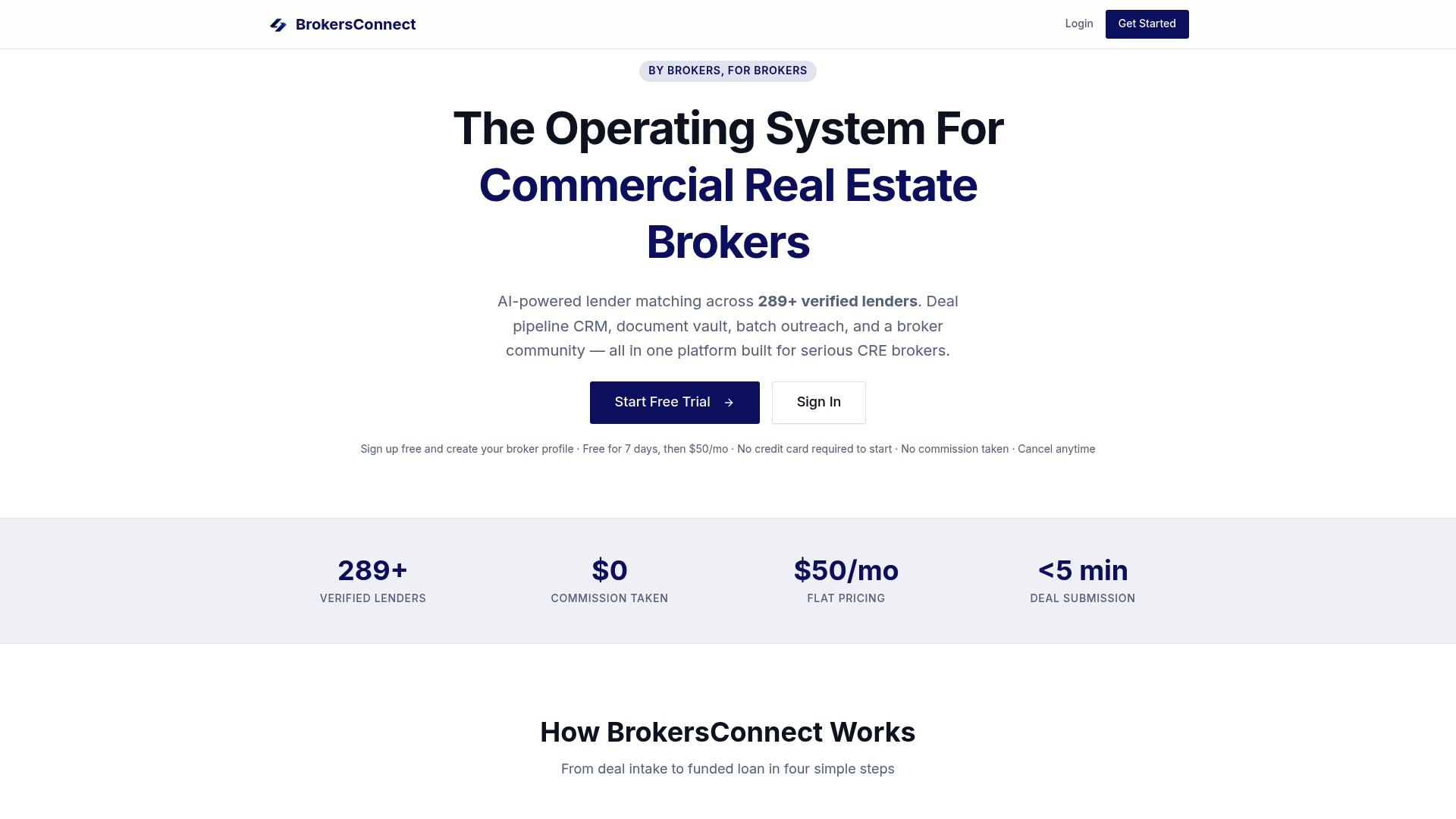
If you've been relying on association meetings or LinkedIn threads to find capital sources, pairing that network with a system that shows lender responsiveness changes how fast deals actually move. You can start a free trial at Thecrebrokersconnect and run your next scenario against the verified lender database before your next chapter meeting.
Sources
- Home | CREW Network
- How to network like a pro in CRE | BOMA
- Commercial Real Estate, Services & Advisors - SVN
- Home | TCN Worldwide Real Estate
- LinkedIn statistics and trends | Sprout Social