
Real estate equity platforms help commercial brokers source equity capital partners and joint-venture investors for client deals. Their main value is faster, more targeted access to partners and cleaner deal packaging, which shortens outreach. With nearly 70% of investors planning to buy more assets, per CBRE, and tools like BrokersConnect built for broker workflows, you can act on this today.
TL;DR:
- Use joint venture equity for large acquisitions or complex development, preferred equity when sponsors want less dilution, and staged or rescue capital for active deals.
- Before sending a full package, confirm sector and ticket size, governance expectations, approval timing, and capital behavior, then check closed deals with two sponsor references.
- Include an executive summary, sponsor biography, sources and uses, a model or rent roll, third party reports, and governance terms; allow 30 to 120+ days.
- Settle contribution schedules, pursuit cost sharing, valuation methods, funding failure remedies, and the senior lender’s reserve and intercreditor terms before pricing hardens.
Table of Contents
- What do real estate equity platforms do for brokers?
- Which equity types can you source, and when does each fit?
- How do you qualify an equity partner quickly?
- How do you prepare and submit a deal, and how long does it take?
- What execution risks slow or reprice equity deals?
- Where does a platform fit in a broker's day-to-day work?
- Why do brokers use BrokersConnect to find equity partners?
- FAQ
- Sources
What do real estate equity platforms do for brokers?
A good platform helps brokers match deals to partners, package opportunities, manage document exchange and vet potential partners. It matches a deal to partners whose appetite fits the asset, packages the opportunity in a format investors expect, runs the document exchange, and helps you vet who is on the other side. Ad-hoc outreach does none of that systematically, and it usually means rewriting the same pitch for each contact.

The use cases are practical. You might need a joint venture for an acquisition or redevelopment, recapitalization or rescue equity for a stalled project, or staged capital for a construction deal with milestones. Platform sourcing tends to beat cold outreach when the deal has a specific profile, because institutional investors are becoming more selective and focusing on particular sectors and strategies, according to PERE's investor study.
That selectivity is the reason matching matters. A retail redevelopment sent to a capital partner that only funds multifamily wastes time for both sides. Targeting first, then packaging, gets you a real answer faster.
Which equity types can you source, and when does each fit?
Joint venture or common equity fits complex development projects and large acquisitions where scale and specialized expertise are needed. SIG notes that joint ventures are critical in those situations because they share risks and rewards. Expect the partner to want governance rights and a share of the upside.
Preferred equity and other structured tranches suit sponsors who want to limit dilution. The partner gets a defined return and priority over common equity, while the sponsor keeps more control. A joint-venture capital guide explains that structures vary across common, preferred and layered forms, and that the right one depends on the problem the capital is solving.
Staged, rescue and recapitalization equity serve deals in motion. Rescue capital fills a gap when a project is short of funds. Recap equity resets the capital stack. For staged funding, present clear milestones so the partner sees what each tranche unlocks.
Whatever you choose, tell the senior lender early. Equity sitting behind or beside a loan changes reserve controls, completion guarantees and exit rights, so the equity choice shapes the lender conversation as much as the reverse.

How do you qualify an equity partner quickly?
Screen for fit, execution alignment, track record and capital behavior before you invest time in a full submission:
- Fit: confirm sector specialization, ticket size and concentration tolerance. Knight Frank's survey shows mid-market deals of roughly $25–250 million remain central to deployment plans, so size your ask accordingly.
- Execution alignment: ask about governance expectations, internal approval timelines and reporting cadence.
- Track record: verify closed deals and call at least two references from past sponsors.
- Capital behavior: find out how fast they close, whether they accept staged funding, and what remedies they document when a party fails to fund.
Also be clear on what the partner is really underwriting beyond the asset. Quantum Growth Consultancy advises focusing early discussions on factors like construction complexity, sponsor concentration or refinancing uncertainty.
Pro Tip: Ask for the dates of their last three closings, from term sheet to funding, and what slowed each one. Real execution speed shows up in specifics, not in a stated target.
How do you prepare and submit a deal, and how long does it take?
A complete package gets a faster read. Platforms and capital partners generally expect:
- A one-page executive summary with the ask, structure and use of funds
- A sponsor biography with relevant track record
- Sources and uses
- An underwriting model or rent roll
- Third-party reports, such as a Phase I environmental assessment and inspections
- Governance term points you can accept
Our loan submission guide maps the same files to what capital sources look for, so one package can serve both lender and equity conversations.
The workflow runs from intake to an initial read, then Q&A, a term sheet, coordinated diligence and documentation. Allow time for the first read, even when the package is complete. The full process typically takes 30 to 120+ days, and diligence, which commonly includes Phase I assessments, physical inspections and lease and tenant reviews, usually consumes the most time. Our due diligence timeline breaks that period down for brokers.
If you need staged funding, put the milestones in the submission itself: what triggers each draw, who verifies it, and what happens if a milestone slips.
| Phase | What you deliver | Where time goes |
|---|---|---|
| Intake and first read | Complete package | Short if the package is complete |
| Q&A and term sheet | Answers, model updates | Depends on partner approvals |
| Diligence | Reports, leases, tenant files | Typically the longest phase |
| Documentation | Agreed term points | Coordination with the senior lender |
For closing tasks that overlap with equity diligence, our commercial loan closing checklist is a useful companion. Workflow tools that coordinate closings can also cut handoff delays, as this explainer on closing coordination systems describes.
What execution risks slow or reprice equity deals?
Execution risk often intensifies after pricing is agreed. Practitioner commentary warns that misalignment among the JV partner, senior lender and sponsor on intercreditor issues, completion guarantees, reserve controls and exit timing can slow or reprice a deal.
Conference materials from a U.S. law program add that successful JV structures settle early the sequencing of initial contributions, whether pre-closing pursuit costs are shared pro rata, how contributed land or entities are valued, and remedies if a party fails to fund.
Flag these in your deal summary:
- A written contribution schedule showing who funds what, and when
- Escrow or reserve mechanics for committed capital
- Milestone-based draws tied to verifiable events
- Explicit remedies for failure to fund
- The senior lender's position on intercreditor terms and reserve controls
Where does a platform fit in a broker's day-to-day work?
My view is that platform sourcing belongs in the normal toolkit, not in the "last resort" pile. It shortens cycle time most when the deal has a clear profile and a clean package, because matching reduces the time you would spend hunting for the right partner. Bespoke outreach still wins when a relationship already exists or the structure is unusual enough to need a conversation first.
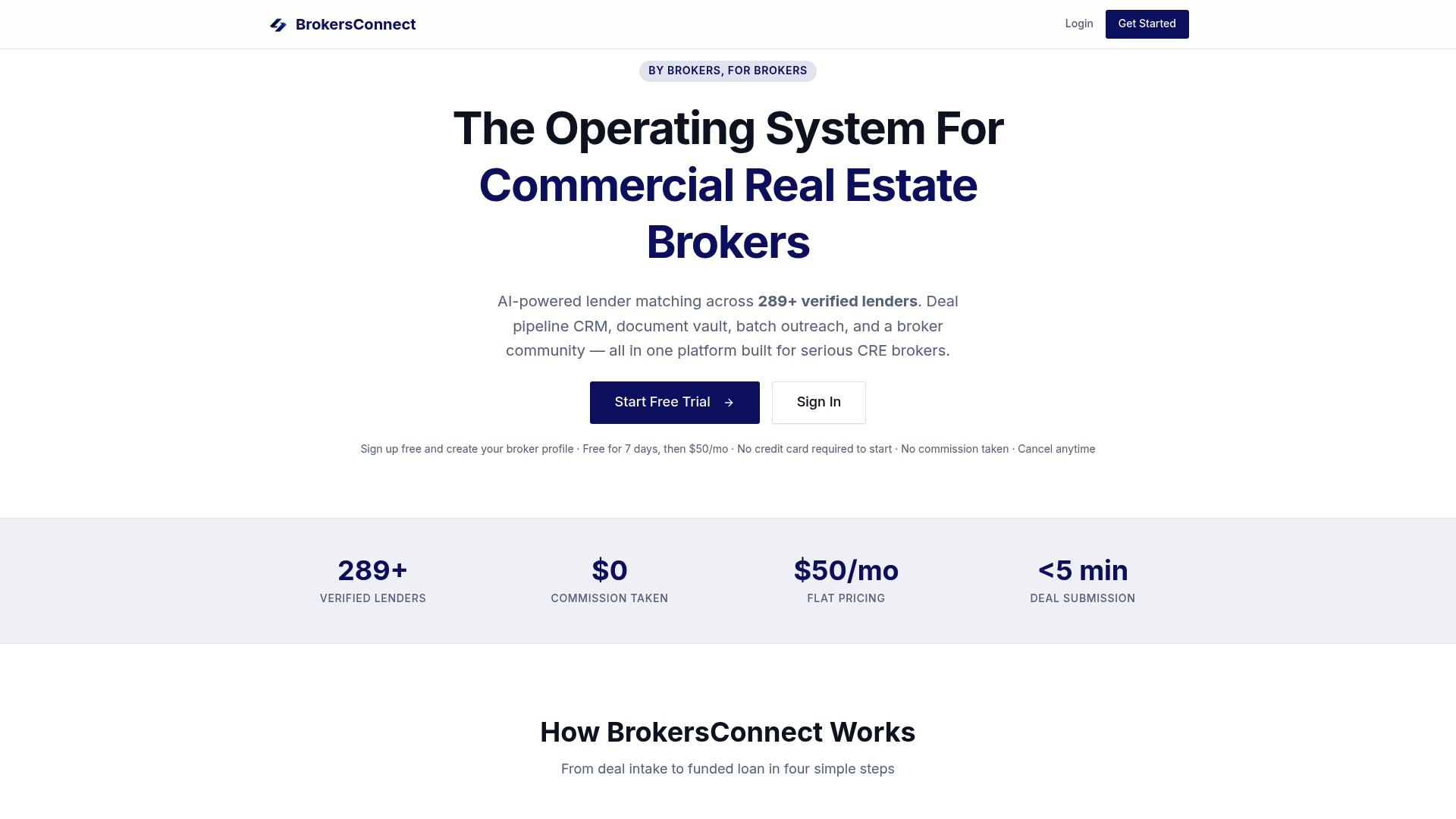
Day to day, useful platforms combine matching, standardized submissions and pipeline tracking. That is how we built BrokersConnect to work, so the same package, the same contact history and the same follow-ups live in one place rather than across inboxes and spreadsheets.
— Theron
Why do brokers use BrokersConnect to find equity partners?
If you want to manage a live deal and connect with lenders, we built BrokersConnect around broker workflows, with no commissions and one flat subscription of $50 per month:
- AI matching that points your deal at lenders more likely to engage
- Standardized deal submissions that cut rewriting
- A verified lender database to coordinate the senior side
- Pipeline and document tools to track every conversation
Together, these cut outreach time and improve fit. Start your free trial and run your next deal through it.
FAQ
What are real estate equity platforms for brokers?
They are platforms that help brokers find equity capital partners and joint-venture investors for client deals. They combine matching, deal packaging and document workflow so you can reach suitable partners faster than with cold outreach.
How long does an equity transaction take?
Commercial real estate transactions typically take 30 to 120+ days. Due diligence is usually the longest phase, so a complete package up front helps.
What documents do I need to submit a deal?
Prepare an executive summary, sponsor bio, sources and uses, an underwriting model or rent roll, and third-party reports such as a Phase I and inspections. Add governance term points to speed the term sheet.
Do investors actually want equity deals right now?
Interest is solid. CBRE reports nearly 70% of investors planned to buy more assets and showed increased interest in direct equity investments.
Sources
- 2025 U.S. Investor Intentions Survey: Investment Activity Poised for Growth | CBRE
- Understanding the Commercial Real Estate Transaction Process | SIG