
For most commercial loan workflows, a secure lender portal beats email as the faster, safer single source of truth. Portals cut fraud exposure and keep every document, message, and approval in one auditable place, while email scatters the deal across inboxes. Email still has a role for quick scheduling and informal check-ins, but anything involving financial data or wiring instructions belongs in a portal.
TL;DR:
- Portals are essential for handling financial documents, wiring instructions, and multi-party approvals to reduce fraud risk and improve auditability.
- Email remains suitable only for scheduling, informal check-ins, and non-sensitive updates, but it exposes financial data to scams and version confusion.
- Protect wiring instructions by verifying through known phone numbers, avoiding email transmission, and enforcing two-factor authentication on portals.
- Implementing a portal involves transition costs, user training, and phased rollout, but it significantly shortens closing times and reduces errors.
- A comprehensive audit trail with user activity logs and version control is vital for resolving disputes and safeguarding against fraud during loan closings.
Table of Contents
- Portals vs email: a side-by-side look at the trade-offs
- Security risks and what regulators say about protecting loan documents
- How portals change the day-to-day work of moving a deal forward
- Document versioning, audit trails, and protecting the closing
- What it actually costs to move a brokerage off email
- When email is still fine, and how to lower the risk
- How BrokersConnect thinks about portals replacing email
- Replace your email threads with a single broker workspace
- Where to verify these security and compliance recommendations
- Sources
- FAQ
Portals vs email: a side-by-side look at the trade-offs
The two methods solve different problems, and knowing which one fits a given deal stage saves brokers from rebuilding the same conversation three times.
Portals tend to win once a deal has real documents and multiple parties attached to it:
- Centralized documents: every file lives in one place instead of scattered attachments across six email threads.
- Role-based access: lenders, borrowers, and brokers see only what they need, which limits accidental exposure.
- Audit logs: every upload, view, and approval is timestamped and attributable.
- Integrations: connections to CRM, e-sign, and loan origination systems remove manual rekeying.
- Status dashboards: everyone can check where a deal stands without asking.
Email keeps a place at the table for a few reasons:
- Ubiquitous and familiar: no login, no new tool, works everywhere.
- Low initial friction: fine for scheduling a call or confirming a meeting time.
- Good for informal follow-ups: a quick "any update?" doesn't need a portal.
The downsides of email are what push most brokerages toward portals once volume grows. Attachments create version confusion, there's no reliable audit trail for who saw what and when, and email is the primary vector scammers use to intercept wiring instructions during closings, according to the Consumer Financial Protection Bureau. Portals require setup time, licensing costs, and a period of user friction while lenders and borrowers adjust.
A simple heuristic: use a portal for anything touching financial documents and loan submissions, wiring instructions, or multi-party approvals. Email is acceptable for scheduling and non-sensitive logistics.
Security risks and what regulators say about protecting loan documents
Email compromise is the mechanism behind most mortgage closing scams. The CFPB describes scammers who monitor broker and lender email threads, then spoof a sender to insert fraudulent wiring instructions right before closing, and its guidance is direct: do not email financial information under any circumstance.

Statistic Callout: Wire transfers are often irreversible, and the FTC warns that once money moves, recovery is rare. That single fact is why wiring instructions should never travel by email, regardless of how the request looks.
The FTC also flags that legitimate banks and credit unions never request account verification by email or text. The CFPB advises contacting the institution through a verified phone number rather than clicking any link in the message. The FFIEC IT Handbook recommends encrypting sensitive data in transit and using controls like secure email protocols or sFTP instead of plain attachments.
Practical safeguards worth adopting immediately:
- Require two-person verification before releasing any wire.
- Never trust a phone number or link embedded in an email requesting funds.
- Confirm wiring instructions by calling a number you already had on file.
- Enforce two-factor authentication and encryption on any portal handling loan documents.
How portals change the day-to-day work of moving a deal forward
A portal's real value shows up in the small frictions it removes. Instead of chasing five people across separate email chains, brokers work from one thread with a visible status for every document and task.
Portals typically support:
- Templates for recurring requests: submission packages and lender questionnaires don't get rebuilt from scratch each time.
- Automated reminders: overdue documents surface without a broker manually following up.
- Assigned tasks: it's clear who owes the next document or signature.
- Integrations with CRM, e-sign, and loan origination systems: information entered once doesn't need rekeying downstream.
Adoption is the real obstacle, not the technology. Lenders accustomed to email are slower to change habits, and borrowers unfamiliar with a new interface sometimes need hand-holding through their first upload. The fix is usually a short, guided pilot rather than a company-wide mandate on day one.
Pro Tip: Run a small pilot with your most active lenders before rolling a portal out to your full book of business. Early wins make the case for everyone else.
Document versioning, audit trails, and protecting the closing

An audit trail answers three questions for every document: who touched it, what changed, and when it happened. That level of detail is what separates a portal from an inbox full of attachments with no history.
What a solid audit system should give brokers:
- User-level activity logs that record every view, edit, and approval with a timestamp.
- Version control that flags outdated drafts so nobody signs the wrong one at closing.
- Immutable timestamps on uploads that can't be altered after the fact.
- Exportable audit reports lenders and title companies can review during underwriting.
Version control alone prevents a common closing headache: two parties working from different drafts of the same loan agreement. When a dispute or fraud claim surfaces, an audit trail gives brokers concrete evidence of who sent what and when, which speeds up underwriting and protects everyone involved. Our closing checklist guide covers what documentation lenders typically expect at this stage.
What it actually costs to move a brokerage off email
Switching from email to a portal is less about the software price and more about the transition period. A phased rollout keeps that transition manageable:
- Pilot phase (4 to 6 weeks): test with a small group of active lenders on one property type before expanding further.
- Expansion phase: bring in the rest of your lender relationships once the pilot proves out.
- Enforcement phase: make the portal the default channel for financial documents across the brokerage.
Train loan operations staff and lead brokers first, since they set the tone for how lenders and borrowers experience the switch. Hidden costs tend to show up in integration work, per-user licensing, and the admin time needed to onboard lenders who are used to email.
Track a few metrics to prove the case: fewer missing-document follow-ups, shorter time-to-close, and fewer wire-confirmation mistakes. Our lender-sourcing guide has more on structuring lender relationships during this kind of transition.
When email is still fine, and how to lower the risk
Email is reasonable for scheduling a call, confirming a meeting time, or sending a non-sensitive update. It becomes a liability the moment financial data or wiring instructions enter the thread.
Statistic Callout: The FTC notes that wire transfers are frequently exploited by scammers and are often impossible to reverse once sent.
If email is unavoidable for something sensitive:
- Never include account numbers or wiring instructions in the body or an attachment.
- Confirm any financial request by phone using a number you already have on file, not one in the email.
- Use encrypted attachments when a document must travel by email at all.
- Agree on a verbal code phrase with lenders to confirm legitimacy before a closing.
How BrokersConnect thinks about portals replacing email
Brokers evaluating a portal should ask vendors a short list of direct questions: how is data encrypted, what does the audit log actually capture, which systems does it integrate with, how are user seats priced, and what's the response time on support requests.
BrokersConnect approaches this from the broker side of the transaction: a secure document vault, lender matching, batch outreach, and a pipeline CRM built to replace the scattered inbox most brokers still work from. The goal isn't just moving files off email, it's giving brokers one place to track a deal from first lender contact to closing, with the audit trail intact the whole way.
Security and speed aren't competing priorities in commercial lending. The brokers who close faster are usually the ones who never had to reconstruct a document trail from memory.
— Theron
Replace your email threads with a single broker workspace
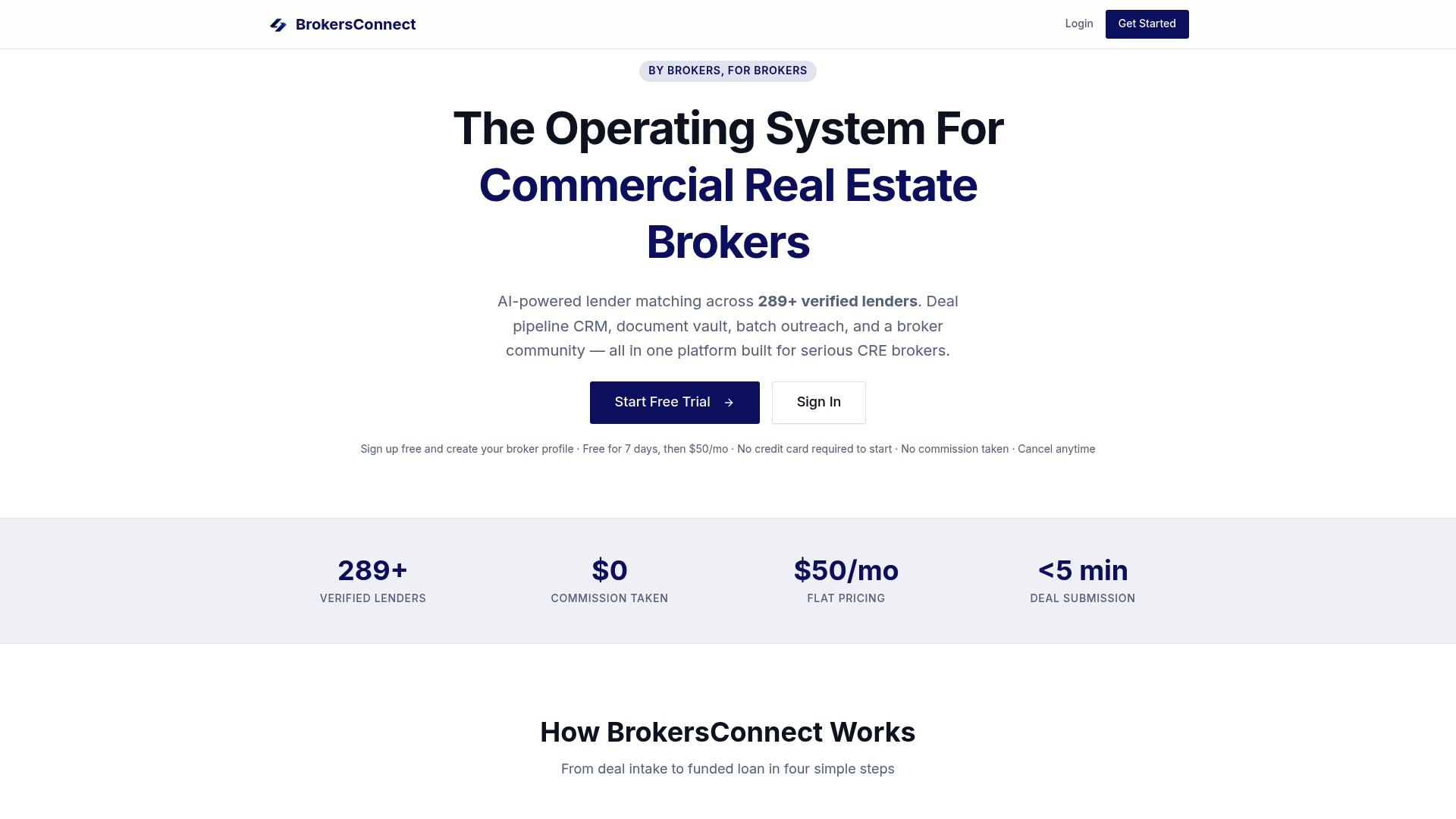
Chasing lenders through inboxes costs brokers hours that a centralized workspace gives back. A secure document vault, batch lender outreach, and a pipeline CRM to track every deal without rebuilding the thread from scratch each time can bring the pieces most brokers juggle separately into one subscription.
What to expect if you start a trial:
- AI lender matching against a database of 289+ verified lenders across major CRE asset classes.
- A secure document vault in place of email attachments.
- Batch outreach tools to contact multiple lenders without manual follow-up.
- A pipeline CRM that tracks deal stage, lender responses, and outstanding documents.
Plans start at $50 per month with a free trial to test the workflow on a live deal before committing.
Where to verify these security and compliance recommendations
The CFPB's guidance on mortgage closing scams, the FTC's wire transfer advice, and the FFIEC's electronic transmission controls all back the practices covered above. For document handling specifics, see our secure document sharing guide and loan document checklist.
Sources
- Mortgage closing scams: How to protect yourself and your closing funds | Consumer Financial Protection Bureau
- What to know before you wire money | Consumer Advice (FTC)
- FFIEC IT Examination Handbook - Electronic transmission of information
FAQ
What are red flags for loan lenders?
Watch for lenders who pressure you to wire funds quickly, refuse to verify instructions by phone, or send financial requests exclusively through email. The CFPB warns that scammers often spoof legitimate-looking emails during the closing process specifically to exploit this urgency.
What not to tell a mortgage lender?
Never send account numbers, wiring instructions, or other sensitive financial details over email, since the CFPB explicitly advises against emailing financial information at all. Confirm any request for sensitive data through a verified phone number instead.
Is it better to apply for a mortgage online or in person?
Either approach can work, but the more important factor is how the lender handles document transmission after the application. A lender using a secure portal with encryption and audit logs reduces fraud exposure compared with one relying on email attachments.
How do I know if a loan company is scamming me?
Legitimate banks and credit unions never ask you to verify account information by email or text, according to the CFPB. If you receive such a request, contact the institution directly using a number you already have on file rather than any number or link in the message.