
Implement parallel lender submissions, keep a living lender matrix, standardize a submission checklist, run pipeline dashboards with aging rules, and track adoption against deal-flow metrics: those five habits are what separate brokers who close in weeks from brokers whose deals go stale. Firms that follow this playbook see faster term-sheet turnaround and fewer deals falling through the cracks. BrokersConnect is built around this exact workflow.
TL;DR:
- Prioritize updating the lender matrix and submission checklist, as their accuracy directly affects deal speed and prevents missed opportunities.
- Submit deals to multiple lenders simultaneously with structured follow-ups to avoid weeks of manual resubmission delays.
- Use dashboards that focus on next actions and lender response times to identify stalled deals before they go stale.
- Ensure sensitive data in the CRM is securely stored, with role-based access, regular inventory, and encrypted authentication to protect sponsor information.
- Track lender responses and response times within the lender matrix to re-engage quiet lenders proactively and maintain deal momentum.
Table of Contents
- Core CRM best practices for lender-focused workflows
- Deal package checklist and CRM templates
- Lender outreach workflows: parallel submissions and follow-up sequences
- Pipeline dashboards and rules that keep deals from going stale
- Data security and retention for broker CRM systems
- Drive adoption with pilots tied to deal-flow metrics
- What to fix first if your CRM feels behind
- How BrokersConnect operationalizes this playbook
- Sources
- FAQ
Core CRM best practices for lender-focused workflows
A CRM built for sales teams tracks one linear pipeline. A CRM built for CRE debt brokers needs to track deal objects by loan product, underwriting stage, and lender response status at the same time, because a single deal might be sitting in "quoting" with three lenders and "declined" with two others simultaneously.
Structure your CRM around these rules:
- Model deals by loan product and stage, not a generic opportunity funnel: bridge, DSCR, construction, and agency deals move through different underwriting checkpoints.
- Treat the lender matrix as a primary object, not a static spreadsheet: capture appetite by asset class, loan size range, geographic focus, recourse posture, internal contact, last-touch date, and a free-text policy note.
- Distribute in parallel and capture responses in structured fields so you can compare rate, leverage, and terms side by side instead of digging through email threads.
- Monitor three KPIs weekly: submission-to-term-sheet time, lender response rate, and pipeline aging by stage.
The parallel-distribution habit matters more than it looks. According to the Federal Reserve's 2025 Small Business Credit Survey, fewer than half of applicant firms received the full financing they requested. That single figure is the strongest argument for shopping every deal to multiple lenders at once rather than waiting on one response before moving to the next name on your list.
Deal package checklist and CRM templates
Lenders decide fast whether a deal is worth a real look, so the package has to do the convincing in the first page. A pre-submission checklist built around a lender-ready structure reduces avoidable rejections and cuts review time.
- Lead with a one-page executive summary or cover memo that states the ask, the property, the sponsor, and the exit in language a credit officer can absorb in about 90 seconds.
- Attach the core financial set: a trailing twelve-month operating statement (T-12), a current rent roll, a personal financial statement no older than 90 days, entity formation documents, recent bank statements, and current property photos.
- Organize the document vault with consistent naming (deal name, document type, date) so nothing gets mismatched across parallel submissions.
- Run a pre-submission validation pass to confirm every required field is filled and every attachment is current before the package leaves your CRM.
Pro Tip: Build one master template per loan product inside your CRM so the cover memo, checklist, and document folder structure populate automatically every time you open a new deal.
Lender outreach workflows: parallel submissions and follow-up sequences
Manual resubmission is where deals lose weeks. Set up routing rules so a decline from one lender automatically triggers the next name on your shortlist without you rebuilding the package from scratch.
- Submit in parallel batches, not one lender at a time, and let a decline waterfall move the deal to the next best-fit name automatically.
- Standardize the outreach cadence: an initial cover email, two structured follow-ups, then a shift to phone or text for lenders who have gone quiet.
- Capture term-sheet fields as structured data, not attachments, so rate, leverage, recourse, and fees line up in one view for comparison and negotiation.
- Log every touch against the lender record, so the next broker on your team can see exactly where a conversation left off.
A five-touch cold email sequence built around this cadence keeps outreach consistent even when you are running dozens of lender conversations at once.
Pipeline dashboards and rules that keep deals from going stale
A dashboard only earns its place in your CRM if it answers one question fast: what needs my attention today? Build widgets around next action rather than deal age alone.
- Deals by next-action, so every open deal shows exactly what needs to happen and who owns it.
- Non-responsive lender flags, surfaced automatically when a lender has gone quiet past a set threshold.
- Term-sheet pipeline view, showing every deal currently holding one or more live offers.
- Aging buckets, separating deals by days since last lender contact so stalled files stand out.
- Renewal and follow-up alerts, timed to fire before a deal goes cold rather than after.
Run a short weekly pipeline meeting: update lender notes, reassign next actions, and flag anything that has stalled past your threshold. A structured loan pipeline dashboard built for this cadence catches stale deals before a sponsor starts asking questions you can't answer.
Pro Tip: Set an automatic flag at seven days of lender silence, not thirty. By the time a deal looks stale on a monthly report, you have already lost the window to re-engage the sponsor with a fresh angle.

Data security and retention for broker CRM systems
Sponsor financials, personal financial statements, and entity documents sitting in your CRM are exactly the kind of data that needs deliberate handling, not default settings.
- Run an information inventory first: know what sensitive data lives in your CRM and delete what you no longer need under a written retention policy.
- Apply role-based, least-privilege access so team members see only the deals and documents relevant to their role.
- Require secure authentication and encryption for data both in transit and at rest.
- Put vendor security obligations in writing, including incident notification timelines, for any third-party tool touching sponsor data.
The NAR data privacy and security toolkit lays out this exact sequence: inventory, least-privilege access, and a written program scaled to the size of the brokerage, without the bureaucracy that would slow a small team down.
Drive adoption with pilots tied to deal-flow metrics
CRM adoption fails when it is measured by login counts instead of deal outcomes. Tie your rollout to numbers that matter.
- Run a small pilot with two or three brokers and measure submission-to-term-sheet time and data-quality scores before expanding.
- Incentivize template use and clean data entry, not raw activity, and name one team member as the data steward responsible for lender matrix accuracy.
- Migrate in stages, moving active deals first and archived files later, so live pipeline never gets disrupted mid-transition.
CRM tools already rank among the top technology sources brokers cite for lead quality and transaction efficiency, according to NAR's 2024 technology survey, which makes a metrics-driven rollout worth the setup time rather than an afterthought.
What to fix first if your CRM feels behind
If you only fix two things this quarter, fix the lender matrix and the submission checklist. Everything else in this playbook, from dashboards to adoption metrics, depends on those two being accurate and current. The matrix pays off within a few submission cycles; governance work like access controls and retention policy takes longer to show up in your numbers but protects the deals you have already won.
— Theron
How BrokersConnect operationalizes this playbook
Running this playbook by hand across spreadsheets and email threads works until your pipeline hits a dozen active deals. BrokersConnect was built around the same structure this article describes: AI-driven lender matching against a large verified lender database, a secure document vault for your submission package, batch outreach to multiple lenders at once, a pipeline dashboard, and reusable deal templates, all inside a flat-fee subscription with no commissions.
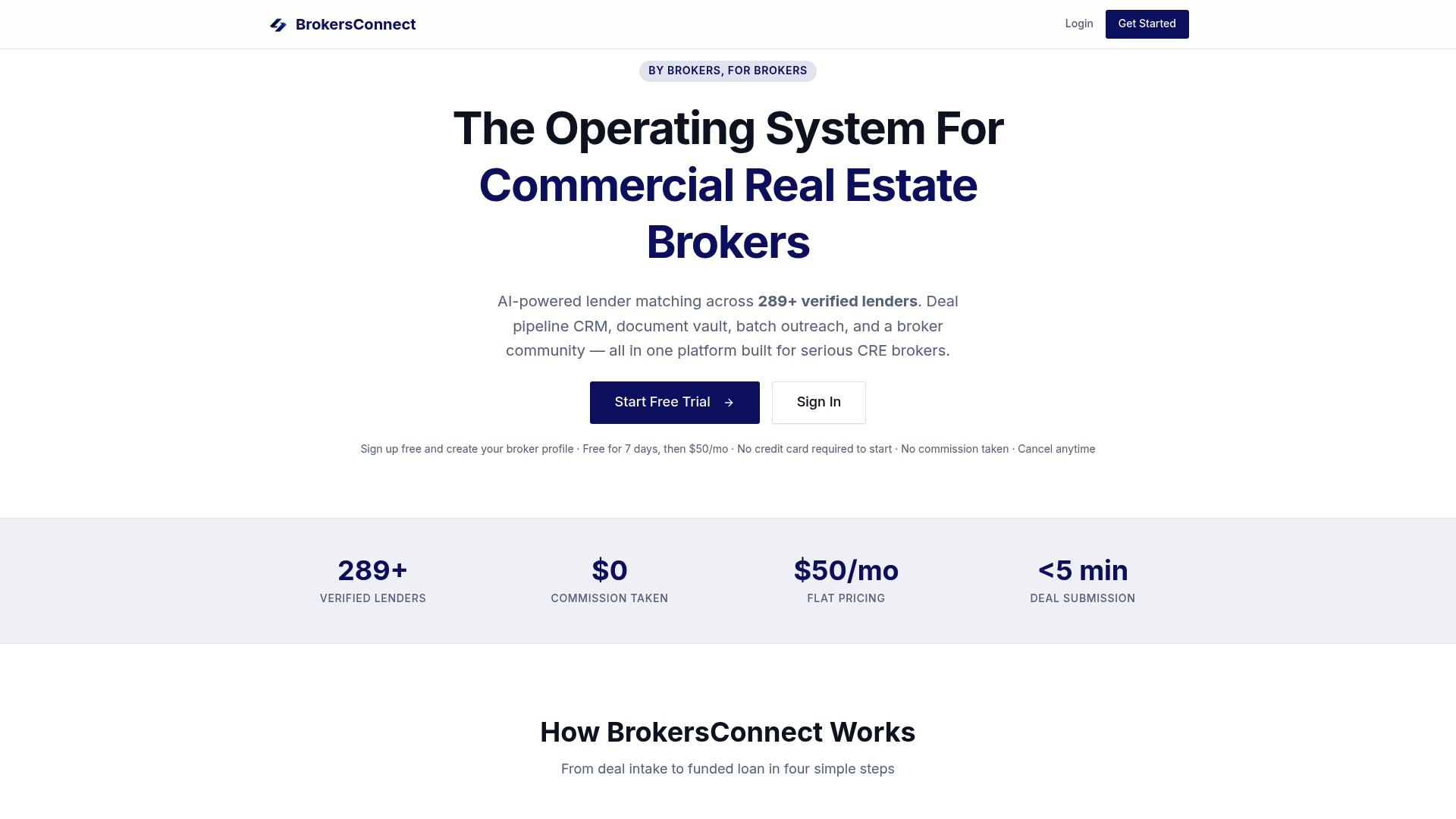
If you want to see how these practices run inside an actual broker CRM rather than a checklist, start a trial at BrokersConnect and load your current pipeline into it this week.
Sources
For deeper detail, see the pre-submission checklist, NAR's data security toolkit, and BrokersConnect's guides on deal pipeline management and lender matching.
FAQ
Why should brokers submit to multiple lenders in parallel?
Parallel submissions protect against the reality that fewer than half of applicant firms received the full financing they requested, according to the 2025 Small Business Credit Survey. Waiting on one lender's response before approaching another wastes the time you need to find a competitive offer.
What documents does a lender need before reviewing a deal?
A complete package typically includes an executive summary, a trailing twelve-month operating statement, a current rent roll, a personal financial statement, entity documents, and recent bank statements, based on the pre-submission checklist. Missing or outdated documents are among the most common reasons a submission gets delayed.
How current does a personal financial statement need to be?
Lenders generally expect a personal financial statement dated within the last 90 days, per standard pre-submission guidance. An outdated PFS is a common reason submissions get sent back for revision.
How should brokers track lender responsiveness over time?
Track responsiveness in the lender matrix itself, recording last-touch dates, average response time, and current appetite notes for each lender. A weekly review of that matrix surfaces lenders who are quietly pulling back before you waste a submission on them.
What basic data security steps should a broker's CRM follow?
Start with an information inventory, apply least-privilege access so team members only see relevant deals, and require encrypted, authenticated access to the CRM. NAR's data privacy and security toolkit outlines this sequence along with vendor oversight practices scaled for smaller brokerages.