
Send a short, personalized first-touch email to a validated list of 50 lender or referral contacts, then run a 5-touch sequence over three weeks mixing email, LinkedIn, and one phone call. Reply rates on cold lender outreach typically run 1 to 3 percent without optimization, so volume and targeting both matter from day one. Skip generic blasts. Pick a template below, send it to a specific segment, and measure before you scale.
TL;DR:
- Targeted segmentation and verified contact lists significantly improve reply rates, with a focus on decision-makers like origination heads and underwriters.
- Building and maintaining proper deliverability infrastructure, including SPF, DKIM, and warm-up processes, can boost inbox placement from below 50 percent to over 90 percent.
- A five-touch sequence over three weeks, with varied angles and a single call-to-action, increases the likelihood of engagement and eventual follow-up calls.
- Running small A/B tests on subject lines, opening sentences, and CTAs helps identify the most effective messaging before scaling outreach efforts.
- Using platforms like BrokersConnect drastically reduces setup time and offers targeted, scalable outreach for portfolios exceeding a few dozen contacts.
Table of Contents
- How Do You Cold Email Lenders Effectively?
- Who Should You Target and How Do You Build the List?
- What Deliverability Setup Do You Need First?
- What's the Right Cadence for Lender Outreach?
- What Metrics Should You Track and Optimize?
- What Are the Compliance Basics for Cold Emailing Lenders?
- What Do Experienced Brokers Actually Do on Day One?
- DIY Outreach, Referral Networking, or a Platform: Which Fits You?
- How BrokersConnect Speeds Up Lender Targeting and Outreach
- Where to Learn More
- Sources
- FAQ
How Do You Cold Email Lenders Effectively?
Effective lender outreach starts with a message that reads like it was written for one person, not a list. The best-performing cold emails to lenders run 3 to 4 sentences, name a specific deal type or asset class, and ask for a small commitment, a five minute call or a quick intro, rather than pushing a full submission on the first touch, according to GMass.
That structure works because lenders and capital markets contacts get dozens of pitches a week. A vague "we have deals for you" opener gets deleted in two seconds. A specific one, mentioning a property type, loan size, and geography they actually fund, gets read.
First-touch template
Subject: DSCR deal in [market], closing timeline [X weeks]
Hi [First Name],
I'm a commercial mortgage broker working a [loan type] deal on a [property type] in [city/state], [loan amount] at roughly [LTV]% leverage. Given [Lender Name]'s activity in this space, I wanted to see if it is a fit before I package it.
Do you have five minutes this week, or should I loop in someone else on your team?
[Your Name] [Company] | [Phone]
Short follow-up (touch 2)
Subject: Re: DSCR deal in [market]
Hi [First Name],
Following up in case this landed at a busy time. The deal I mentioned closes in [X weeks], and I'd rather confirm fit early than waste your team's time later.
Worth a quick call, or is there a better contact for [asset class] deals on your side?
[Your Name]
Value-add template
Subject: A quick underwriting snapshot for [property type] deals
Hi [First Name],
I put together a one-page summary of a [loan type] scenario I'm sourcing, rate, term, sponsor strength, exit. Happy to send it over so you can flag interest or pass in under two minutes.
Want me to forward it?
[Your Name]
Referral-partner opener
Subject: Partnering on [asset class] deal flow
Hi [First Name],
I broker [loan types] across [region] and I'm looking to build a short list of lenders and referral partners I can send qualified deals to consistently. I saw [Lender Name] has been active in [asset class] lately.
Open to a short call to see if there's a fit for future deal flow?
[Your Name]
Breakup email (final touch)
Subject: Should I stop reaching out?
Hi [First Name],
I don't want to keep filling your inbox if this isn't a fit right now. If [loan type] deals in [market] aren't a priority for [Lender Name], no worries. If timing shifts, I'm easy to find.
[Your Name]
Subject lines that outperform generic ones tend to combine a specific trigger with a hint of curiosity: a loan size, a property type, a closing deadline, or a named market. "Quick question" beats nothing, but "$4.2M bridge loan, Phoenix industrial" beats both.
Personalization tokens worth automating, beyond first name, include:
- Lender's stated asset-class focus (from their website or recent deal announcements)
- Loan type and approximate size of the deal you're sourcing
- Geographic market overlap
- A mutual connection or recent transaction you can reference
- Recent news about the lender's fund raise, new program, or leadership hire
Keep every message to one call to action. Asking for a call and a document review and a warm intro in the same email kills response rates. Lending-focused outreach playbooks consistently point to single-ask emails as the biggest lever for reply rate, ahead of subject line tweaks or send time.
Who Should You Target and How Do You Build the List?
The list matters more than the copy. A perfectly written email to the wrong contact still gets ignored, so start with roles, not company names.
At lending institutions, the contacts worth prioritizing are:
- Origination heads or VPs of production, who own new deal flow decisions
- Underwriting leads, especially at smaller balance-sheet lenders where they influence early screening
- Broker relations or correspondent lending managers, whose entire job is fielding broker submissions
- Economic buyers at private lenders and debt funds, often a managing partner or principal at smaller shops
Referral partners, title reps, appraisers, CPAs, and other brokers who see deals before you do, deserve a different segment entirely. Their trigger isn't loan appetite. It's trust and reciprocity, so templates for that group should lean on mutual benefit rather than deal specifics.
Segment your list before you write a single email. Group contacts by loan product (bridge, DSCR, construction, multifamily), by asset class, and by recent deal activity. A lender who just closed three industrial deals in your metro is a warmer target than one whose last public transaction was two years old.
A minimal data schema per contact should include name, title, company, email, LinkedIn URL, asset-class focus, loan products offered, geographic footprint, and a note on the most recent deal or announcement tied to them. That last field is what makes personalization possible at scale instead of one email at a time.
Quick enrichment sources worth checking before every send:
- LinkedIn, for title changes, recent posts, and shared connections
- Public deal announcements and press releases, for recent closings and stated appetite
- Lender websites and program sheets, for stated minimum and maximum loan sizes
- Commercial real estate news outlets, for fund raises or new program launches
Before sending anything, run a vetting pass to strip out generic inboxes, contacts who've changed roles, and anyone whose title doesn't match a real decision point. A list of 50 verified, segmented contacts will consistently outperform 500 scraped ones. If building that list manually feels slow, a broker-focused lender research process can cut a lot of that legwork down.
What Deliverability Setup Do You Need First?
Deliverability determines whether your templates even get read. Practitioner case studies on lending outreach found that fixing infrastructure moved inbox placement from roughly 40 to 50 percent up to around 90 percent, multiplying reply volume even with the exact same email copy, according to IMISOFTS. That's the single highest-leverage fix most brokers skip.
Work through this in order before you send your first batch:
- Warm up every sending domain for at least two weeks before real outreach, starting at low volume (5 to 10 emails per day) and increasing gradually.
- Set up SPF, DKIM, and DMARC on every sending domain. These three records authenticate your email so inbox providers trust it's really you, not a spoofed sender.
- Use a separate sending domain from your primary company domain so a deliverability problem never touches your main inbox.
- Run 2 to 4 sending identities across those domains once warmed up, spreading volume instead of hammering one address.
- Test inbox placement with a dedicated tool before a real campaign, not after replies stop coming in.
- Cap daily volume per mailbox around 30 to 50 emails once live, scaling only as reply and bounce rates stay healthy.
A minimum practical stack looks like a sequence engine to schedule and track sends, an SMTP provider or dedicated sending service, a deliverability testing tool to check spam placement, and basic open/reply monitoring built into whichever platform you use.
Pro Tip: If your reply rate suddenly drops after weeks of steady performance, check deliverability before you touch the copy. A dying domain reputation looks exactly like "bad messaging" until you check the inbox placement numbers.
Common fixes when things go sideways: reduce daily volume immediately, remove any spammy trigger words from subject lines, verify your unsubscribe link actually works, and check whether you've been flagged on a blocklist. Most deliverability problems trace back to sending too much, too fast, from an unwarmed domain.
What's the Right Cadence for Lender Outreach?
A single email rarely closes anything. Most replies in finance-focused cold outreach land on the second or third touch, not the first, based on GMass analysis of loan-focused campaigns. That means your sequence design matters as much as any individual email.
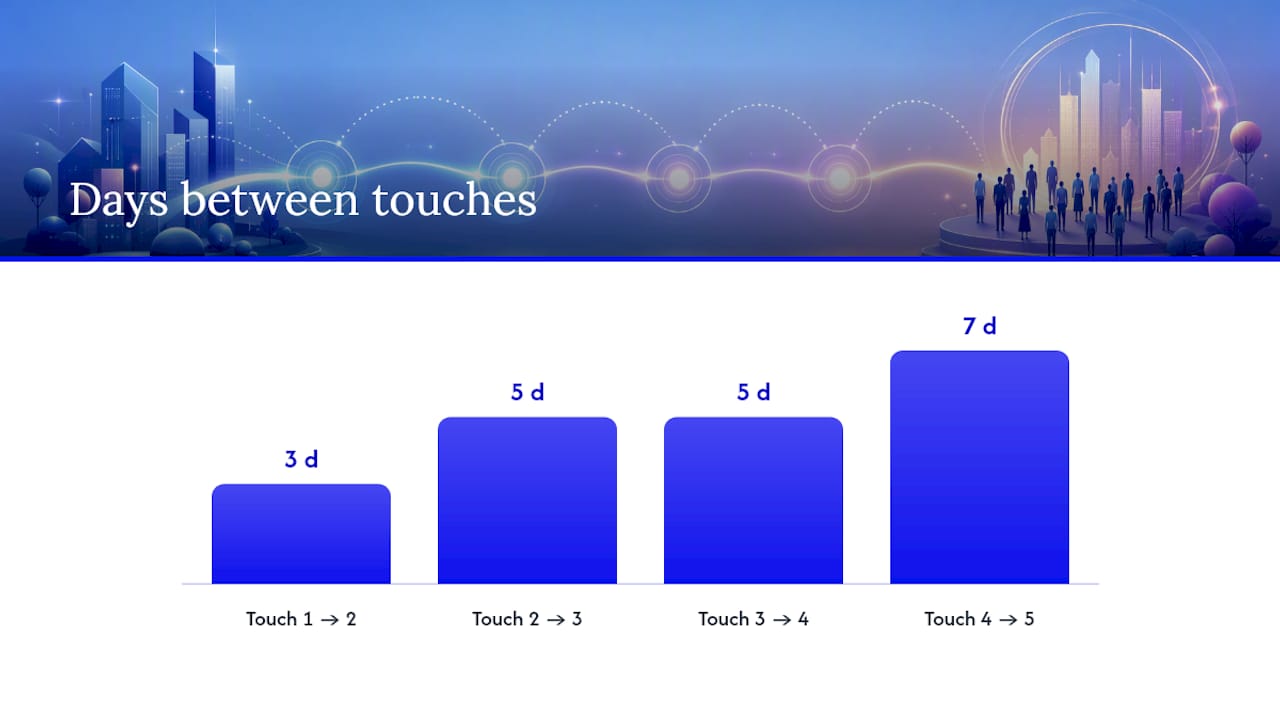
A workable 5-touch sequence over roughly three weeks:
- Day 1: First-touch email, specific deal or partnership angle
- Day 4: Short follow-up referencing the original message
- Day 9: LinkedIn connection request with a one-line note, no pitch
- Day 14: Value-add email (document, checklist, or market data offer)
- Day 21: Breakup email, direct and low-pressure
Vary the angle across touches instead of repeating the same pitch. Open with the deal or opportunity itself, shift to a light form of social proof (recent closings, other lenders you work with), then offer something useful, then close the loop. Repeating the identical ask five times reads as spam even when it technically isn't.
Escalate to a phone call once you get any reply, even a "not right now." A call converts warm interest into a real relationship faster than another email ever will. If a referral partner mentions a specific lender contact, ask for a direct introduction instead of cold emailing that lender blind. Warm intros consistently outperform cold touches at every stage of this funnel.
Run a sequence for at least two full weeks and 50 to 100 sends before deciding it's underperforming. Lending-focused outreach guidance backs a batch-and-measure approach, sending a template to 50 to 150 contacts, then iterating based on results rather than reacting to the first few replies, according to FirstSales.
What Metrics Should You Track and Optimize?
Five numbers tell you whether a campaign is working: inbox placement rate, open rate, reply rate, meeting rate, and funded-deal conversion. Track them in that order, because a problem upstream (bad deliverability) makes every downstream number look worse than your copy actually deserves.
Cold lender outreach without targeting or deliverability optimization typically converts at just 1 to 3 percent reply rate, according to IMISOFTS. Fixing infrastructure and segmentation before scaling volume is what moves that number.
Three A/B tests worth running before you scale any sequence:
- Subject line test. Send two variants to equal-sized segments (25 to 50 contacts each) and compare open rates after 48 hours.
- First-sentence hook test. Keep the subject line constant, change only the opening line, deal specific versus relationship specific, and compare reply rates.
- CTA test. Compare "worth a quick call?" against "mind if I send a one-pager?" to see which ask converts better for your specific audience.
Once a variant wins clearly across at least 50 sends, roll it out as your default template and start testing the next variable. Treat every campaign as a rolling experiment rather than a one-time send.
What Are the Compliance Basics for Cold Emailing Lenders?
Cold email is legal in the United States under the CAN-SPAM Act when you follow a short list of requirements. None of them are complicated, but skipping them creates real legal and deliverability risk.
- Include a working opt-out mechanism in every email and honor unsubscribe requests within 10 business days.
- Display a valid physical postal address somewhere in the message or footer.
- Keep subject lines and header information accurate, no misleading "Re:" tags or fake sender names.
- Never sell or transfer email addresses to someone who won't honor an opt-out request.
TCPA applies separately when your follow-up sequence includes phone calls or SMS, not email. If you're calling or texting prospects, get documented consent before adding a phone number to any automated dialer or texting tool, and keep records of that consent.
A one-line compliance checklist to paste into any campaign doc: opt-out link present, physical address listed, headers accurate, unsubscribes honored within 10 business days, and phone/SMS consent documented separately.
What Do Experienced Brokers Actually Do on Day One?
Two patterns show up repeatedly in broker outreach: fixing segmentation and fixing deliverability produce the fastest visible lift. One common pattern is a broker sending the same generic template to a mixed list of 300 contacts and getting almost no replies, then splitting that list by asset class and loan product and seeing reply rates climb within the same week, simply because each segment received a message written for them. Another common pattern involves a broker discovering their domain had no DKIM record set up, fixing it, and watching open rates roughly double on the next send.
A day-one checklist you can finish in a single morning:
- Pull 50 validated contacts segmented by asset class or loan product
- Set up SPF, DKIM, and DMARC on a dedicated sending domain
- Write one first-touch template and one follow-up
- Confirm your unsubscribe link and postal address are both live
- Schedule a 5-touch sequence across three weeks
- Set a shared tracking sheet for opens, replies, and meetings booked
- Block 30 minutes on day 4 to review early replies before sending touch two
Platforms built for commercial real estate deal flow, like Thecrebrokersconnect, fold a lot of this list-building and tracking work into one workflow instead of spreadsheets and separate tools.
DIY Outreach, Referral Networking, or a Platform: Which Fits You?
DIY cold email wins when you're working a tight, specific list, under 100 contacts, and you want full control over every word. It's slow, but it teaches you what actually resonates with lenders in your niche.
Referral networking outperforms cold email on high-trust, slow-cycle deals, complex construction or large multifamily transactions where a warm introduction from a title rep or attorney carries more weight than any email ever could.
A platform earns its cost once you need to target and batch outreach across dozens of lender relationships at once, especially if you're new to a market and don't yet have the relationship map in your head. If you're spending more hours building lender lists than writing loan packages, that's the signal to look at a tool built for exactly that problem, rather than another spreadsheet.
— Theron
How BrokersConnect Speeds Up Lender Targeting and Outreach
Everything covered above, segmentation, enrichment, deliverability, sequencing, takes real hours to build manually every time you start a new campaign. Thecrebrokersconnect exists to compress that setup into minutes instead of a weekend project.

Platforms can match your deal scenario, property type, loan amount, leverage, credit profile, against a database of verified lenders, so you're not guessing which contacts belong in your first-touch list. They also handle batch outreach templates, a pipeline CRM to track every lender conversation in one place, and a document vault so your value-add attachments are always one click away instead of buried in an old email thread.
DIY outreach still makes sense for a narrow, high-touch list. But once you're trying to cover multiple asset classes or scale past a few dozen contacts a month, rebuilding that targeting and tracking work by hand starts costing more time than it saves. If that's where you are, start a free trial on Thecrebrokersconnect and run your next lender campaign through a system built for exactly this workflow instead of a spreadsheet and a mail client.
Where to Learn More
For the legal baseline, review the FTC's CAN-SPAM compliance guide directly. For deeper template libraries and cadence examples, see FirstSales' lending email templates and GMass's business loan cold email guide. For lender-specific research before you write, start with a guide to finding commercial lenders.
Sources
- CAN-SPAM Act: A Compliance Guide for Business | Federal Trade Commission
- Cold Email Strategy for Lending | Free Sales Guide — FirstSales
- Cold Email for Business Lending: Reach SMBs Who Need Funding — IMISOFTS
- How to Write the Best Business Loan Cold Emails (5 Templates, Tips) — GMass blog
FAQ
What Is the 30/30/50 Rule for Cold Emails?
It's a practitioner heuristic, not a formal study, suggesting roughly 30 percent of your effort go to research, 30 percent to personalization, and 50 percent to follow-up cadence rather than the first send alone.
Why Am I Getting Random Loan Emails?
Lenders and brokers buy or scrape contact lists and send broad cold outreach, which is why unrelated loan pitches show up in inboxes with no prior relationship. It's a sign of the same volume-based tactics this playbook recommends against.
Is Cold Email Illegal?
No. Cold email is legal in the United States under the CAN-SPAM Act as long as you include a working opt-out, a valid postal address, and accurate sender information.
Is Cold Email Still Effective in 2026?
Yes, when it's targeted and personalized. Reply rates on generic lender outreach still sit around 1 to 3 percent, but segmented lists paired with proper deliverability setup consistently outperform that baseline by a wide margin.