
Lender appetite guidelines are the board-approved, measurable rules, loan-to-value limits, debt service coverage thresholds, debt yield floors, and concentration caps, that determine whether a deal fits a lender's book. Appetite differs from risk tolerance: appetite sets the strategic boundary, tolerance governs day-to-day decisions inside it. To win approvals, brokers need a defensible credit box and documentation that lines up with those rules before the first call goes out.
TL;DR:
- Lenders monitor concentration thresholds such as total CRE loans exceeding 300% of capital or land development loans surpassing the institution's total capital, leading to tighter underwriting.
- The four core underwriting metrics are loan-to-value, debt service coverage, debt yield, and loan term, with the dominant metric depending on property type and loan purpose.
- Different asset classes attract varying lender appetite, with multifamily and industrial generally receiving more favorable treatment than office or retail, especially during cycle downturns.
- A clean, well-structured submission with key documents and clear narrative helps shorten approval timelines and improves chances of favorable terms.
- Matching deals to lenders using dedicated platforms reduces wasted efforts and speeds up the process, especially when lender appetite shifts towards concentration thresholds.
Table of Contents
- Lender risk appetite explained: definitions, governance, and frameworks
- Regulatory thresholds and supervisory expectations that shape appetite
- The lender credit box: core underwriting metrics brokers must hit
- How property type and market cycle change lender appetite
- Preparing a lender-ready submission: exact documents and narrative
- Multi-lender submission strategy and sequencing to match appetite
- What lenders expect when loans show stress: accommodations and workouts
- How broker tools help align submissions to lender appetite
- A broker's take on winning approvals this cycle
- A faster way to match deals to lender appetite
- FAQ
- Sources
Lender risk appetite explained: definitions, governance, and frameworks
Risk appetite is the board's statement of the types and levels of risk a lender will accept to pursue its strategy. Risk tolerance operationalizes that appetite into specific limits loan officers apply when they underwrite a file. A limit breach triggers an escalation path: the deal moves up to a credit committee, a regional risk officer, or in extreme cases the board itself.
Boards set appetite once a year or on a rolling basis, then translate it into underwriting policy that loan officers actually use. That policy specifies acceptable property types, maximum concentrations by geography and sponsor, and the metrics that define a passing loan. Stress testing feeds this process: lenders model how their CRE book performs underrate shocks, vacancy spikes, or cap rate expansion, then adjust appetite before conditions force a reaction.
Most regulated lenders also run a three lines of defense structure to keep appetite honest:
- First line: loan officers and underwriters who originate within policy.
- Second line: risk management and compliance teams that test for policy adherence and flag drift.
- Third line: internal audit, which independently verifies the first two lines are doing their job.
For brokers, this structure explains why a loan officer who seems enthusiastic about a deal can still get overruled. The officer operates inside a tolerance band set by people the broker never talks to, and exceptions almost always require a documented business case before they clear committee.
Regulatory thresholds and supervisory expectations that shape appetite

Federal banking regulators do not impose a single numerical cap on commercial real estate lending, but they do watch two concentration indicators closely. The interagency guidance on CRE concentrations directs institutions to identify, monitor, and set internal limits on CRE exposure, with capital and risk management scaled to the portfolio's actual risk rather than a fixed ratio.
Those supervisory indicators commonly referenced in examiner reviews include:
- Construction and land development loans exceeding about the equivalent of the institution’s total capital.
- Total CRE loans exceeding roughly 300% of total capital, combined with 50% portfolio growth over the prior 36 months.
- A rising trend in either ratio even before the threshold is crossed, which draws enhanced scrutiny on its own.
An institution flagged against these concentration indicators faces closer examiner attention and tighter internal underwriting, a shift that often shows up in a broker's submission as a lower maximum leverage or a higher required debt service coverage. The FDIC's advisory on managing CRE concentrations recommends that concentrated institutions maintain stronger capital buffers, appropriate allowances for credit losses, more frequent stress testing, and dedicated workout infrastructure. When a lender crosses these lines internally, loan officers get instructed to raise sponsor equity requirements or tighten debt yield floors rather than reject the asset class outright. Brokers who track which lenders are near these thresholds can anticipate tighter terms before they submit, rather than after a term sheet comes back worse than expected.
The lender credit box: core underwriting metrics brokers must hit
Every lender runs a credit box, a set of measurable thresholds a loan must clear before it reaches committee. Four metrics dominate: loan-to-value, debt service coverage ratio, debt yield, and loan tenor paired with covenant structure. Sponsor and guarantor strength can shift all four, sometimes significantly.
Illustrative ranges by product type (conservative bands for context, not a quote from any single lender):
- Stabilized multifamily: LTV around 65 to 75%, DSCR near 1.20x to 1.35x, debt yield in the 8 to 10% range.
- Bridge and transitional assets: LTV around 60 to 70% of as-is value, with debt yield often the binding constraint at 8 to 10% on in-place income.
- Construction: loan-to-cost near 60 to 70%, with debt yield on projected stabilized income frequently driving sizing more than LTV.
- Office and retail in current conditions: tighter LTV bands, often 55 to 65%, reflecting elevated leasing and vacancy risk.
A strong sponsor with liquid reserves, a clean track record, and a full recourse guarantee can move a lender's acceptable LTV up a few points or soften a debt yield floor. A thin balance sheet or a first-time sponsor usually pushes the lender toward the conservative end of its own range, regardless of the property's fundamentals. For a deeper look at how these two metrics interact, see the broker playbook on debt yield versus LTV.
Which metric governs depends on loan type. Debt yield commonly drives bridge and construction underwriting because it is insensitive to interest rate assumptions. DSCR typically governs stabilized, cash-flowing assets where the lender cares most about ongoing coverage. Readers who want a refresher on how coverage ratios are calculated can check this coverage ratio glossary entry.
Pro Tip: Run your deal against all four metrics before submitting, then lead your pitch with whichever one is strongest; that is usually the one the lender will anchor on first.

How property type and market cycle change lender appetite
Lenders do not apply one appetite across asset classes. Multifamily generally draws the widest pool of willing capital because of stable demand drivers and government-sponsored enterprise liquidity. Industrial has earned similarly favorable treatment in recent cycles due to tenant demand and lower vacancy. Office carries the most caution right now given persistent vacancy and uncertain long-term demand, while retail and hospitality sit in between, varying sharply by submarket and tenant mix. Special-use properties, such as self-storage conversions or single-tenant medical, often require a narrower set of specialized lenders regardless of cycle.
Cycle-driven signals that commonly cause lenders to reprice or pull back include:
- Rising cap rates that compress achievable loan proceeds at a given value.
- Elevated vacancy or slowing rent growth in a specific submarket.
- A lender's own internal concentration approaching its CRE or construction thresholds.
- Interest rate volatility that widens the spread between in-place and projected debt service coverage.
Research on securitized commercial mortgages found that variation in observed loan-to-value ratios across market periods is explained largely by lenders' perceptions of property-specific risk and underlying market fundamentals, not by uniform shifts in underwriting standards. That means two similar deals in different submarkets can get very different leverage from the same lender, and brokers who document the specific risk drivers behind a property's performance stand a better chance of justifying higher proceeds.
Preparing a lender-ready submission: exact documents and narrative
A clean submission package shortens the time between first contact and term sheet. Lenders expect a consistent set of documents, presented in a predictable order, with the ask stated plainly on page one.
- Executive summary: the ask, sponsor background, property snapshot, and why this deal fits this lender.
- Trailing financial statements and current rent roll, ideally no more than 60 days old.
- Sponsor financial statements, including a personal financial statement and schedule of real estate owned.
- Appraisal or broker opinion of value, plus any third-party valuation already in hand.
- Lease abstracts for major tenants, summarizing term, renewal options, and co-tenancy clauses.
- Condominium questionnaire, when the collateral includes condo-titled units.
- Sensitivity and stress-tested cash flow tables showing DSCR and debt yield under a rate-up and vacancy-up scenario.
Lenders read the DSCR, debt yield, and LTV figures first, so present them in a short table near the front rather than buried in an appendix. Flag any known exceptions to policy, a slightly elevated leverage request or a sponsor with a thin track record, and explain the mitigant directly rather than letting underwriting discover it later. A commercial mortgage compliance packaging playbook covers the documentation sequencing in more depth, and the construction lender requirements guide is useful when the deal involves a build or substantial renovation.
Pro Tip: Keep the data room to one folder structure across every lender you approach; reorganizing files for each submission wastes time and makes your package look less finished.
Multi-lender submission strategy and sequencing to match appetite
A targeted funnel of 8 to 12 lenders, filtered by product fit, loan size, geography, and sponsor profile, consistently outperforms a mass blast to every contact in a broker's database. Curated outreach preserves the broker's look-to-book ratio, the proportion of submissions that convert to closed loans, which lenders track and use to decide how seriously to treat future submissions from that broker.
Rules that keep a multi-lender process orderly:
- Reserve the shotgun approach for generic, low-complexity deals; curate tightly for anything with an unusual structure or asset type.
- Disclose to each lender that the deal is being shopped, without naming competitors, to avoid exclusivity disputes later.
- Sequence outreach so the strongest-fit lenders go out first, giving them first look and more time to underwrite before a deadline pressures the process.
- When a deal needs credit committee approval, give the loan officer the sensitivity tables and sponsor liquidity schedule up front. That is the material internal champions need to defend the file without a second information request.
The broker's matching guide to commercial mortgage lenders breaks down typical appetite profiles by lender type, which helps narrow the initial list before outreach even begins.
What lenders expect when loans show stress: accommodations and workouts
When a performing loan starts showing strain, lenders have latitude to grant short-term accommodations without automatically triggering adverse classification, provided the accommodation is well documented. The Federal Reserve's policy statement on prudent CRE loan accommodations and workouts states that examiners will not criticize accommodations built on sound underlying analysis, even when the borrower is under temporary pressure.
A prudent workout plan generally documents:
- A current, third-party valuation reflecting market conditions as of the workout date.
- Updated borrower and guarantor financial statements, not figures from the original closing.
- Evidence of sponsor support, whether that is fresh equity, a curtailment payment, or a liquidity reserve.
- An internal risk rating that reflects the loan's current condition rather than its original underwriting grade.
Regulators have signaled through SR 23-5 that institutions willing to document accommodations properly face less supervisory friction than those that avoid recognizing stress altogether. For brokers presenting a workout or modification request, that means leading with the updated valuation and financials rather than the original loan terms, and framing the ask as a time-limited accommodation tied to a specific recovery plan rather than an open-ended extension.
How broker tools help align submissions to lender appetite
Matching a deal to the right lender used to mean working through spreadsheets of contacts and making cold calls on a hunch. A lender-matching platform narrows that work by filtering a database against the specific variables that drive appetite: property type, loan amount, geography, leverage, sponsor credit profile, and transaction structure.
Capabilities that map directly to the appetite-matching work covered above include:
- Filterable lender database searches by product, size, and location to shortlist likely fits before outreach.
- Submission templates that organize the documents and sensitivity tables lenders expect to see first.
- A secure document vault that keeps the data room consistent across every lender in a multi-lender funnel.
- Conversation tracking that shows which lenders have responded, so brokers can sequence follow-ups without losing track of an active file.
A broader look at how a commercial real estate financing platform speeds up lender matching covers these workflows in more detail. The goal across all of them is the same one this guide has outlined: fewer wasted submissions, faster time to a workable term sheet.
A broker's take on winning approvals this cycle
Three priorities matter most right now: underwriting defensibility, sponsor liquidity, and a targeted lender match.
The lenders tightening appetite fastest right now are the ones nearest their own concentration thresholds, not necessarily the ones with the weakest portfolios. Brokers who read that signal early will keep closing deals while others wonder why their pipeline slowed.
— Theron
A faster way to match deals to lender appetite
Mapping a deal's metrics against dozens of lenders' credit boxes by hand is slow, and a mismatched submission costs a broker time and relationship capital. BrokersConnect filters a database of 289+ verified lenders by property type, loan amount, leverage, and sponsor profile, then organizes submission templates, a document vault, and batch outreach in one place.
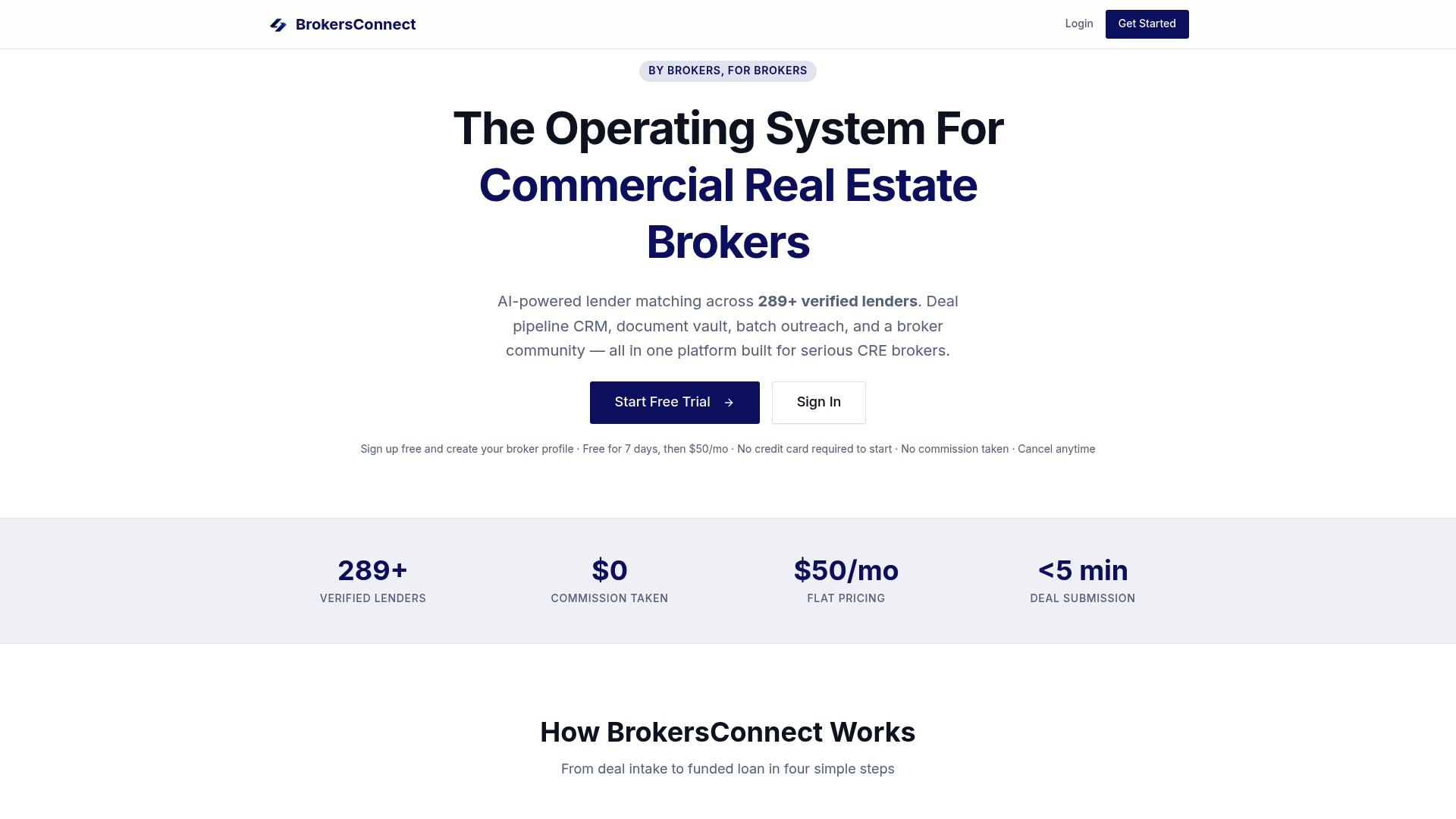
Plans start at $50 per month with a free trial. Visit BrokersConnect to see how deal matching works for your next submission.
FAQ
What is the 3-7-3 rule for a mortgage?
The 3-7-3 rule is a residential mortgage servicing timeline tied to Truth in Lending Act and RESPA disclosure deadlines, not a commercial lending standard. It does not apply to the LTV, DSCR, or debt yield thresholds that govern commercial real estate lender appetite.
What are the 5 C's of lending principles?
The 5 C's are character, capacity, capital, collateral, and conditions, a framework lenders use to judge a borrower's creditworthiness. In commercial real estate, capacity and collateral translate directly into the DSCR, debt yield, and LTV metrics covered in a lender's credit box.
What disqualifies you from getting a loan?
A deal commonly gets disqualified when it falls outside a lender's credit box on a binding metric, such as insufficient debt service coverage, excessive leverage, or a property type outside the lender's current appetite. Weak sponsor liquidity, incomplete documentation, or a concentration limit the lender has already reached can disqualify an otherwise sound deal.
What not to tell a mortgage lender?
Avoid vague or inconsistent statements about income, occupancy, or intended use of proceeds, since discrepancies between the submission narrative and the financial documents slow underwriting or trigger a decline. Never understate known issues, like deferred maintenance or a tenant on month-to-month status, since lenders uncover them during due diligence anyway and treat the omission as a credibility problem.
Sources
- Interagency Guidance on Concentrations in Commercial Real Estate Lending; Sound risk-management practices — Federal Reserve
- Managing commercial real estate concentrations in a challenging economic environment — FDIC