
Debt yield measures net operating income against loan principal and never touches an appraisal; LTV measures the loan against appraised value and moves with cap-rate assumptions. That gap matters because lenders don't pick one. They run both, along with DSCR, and size the loan to whichever test is most restrictive. Model all three before you shop the deal, or a lender will hand you the bad news after you've already pitched a number to your borrower.
TL;DR:
- Debt yield remains unaffected by cap rate changes, making it a reliable measure of property income relative to the loan amount in fluctuating markets.
- Underwriters assess three tests—LTV, DSCR, and debt yield—and limit the loan to the smallest resulting amount, with the binding test varying by market conditions and asset type.
- The selection of the binding constraint depends on factors like market cap rates, interest rate hikes, and asset volatility, especially for transitional or special-use properties.
- Accurately evaluating trailing-12-month NOI and cross-checking appraisals helps prevent distortions in both metrics, potentially avoiding surprises during underwriting.
- Running upfront calculations for debt yield, LTV, and DSCR before submission ensures selection of the most advantageous lender channel and avoids late-stage rejection.
Table of Contents
- Debt Yield vs. LTV: Formulas and What They Actually Measure
- When Debt Yield Binds vs. When LTV Binds
- The Three-Test Underwriting Workflow Lenders Actually Run
- Three Scenarios, Same NOI, Different Binding Test
- Where NOI and Appraisal Assumptions Can Distort Both Metrics
- Case Studies: How the Binding Test Changed the Deal
- Debt Yield and LTV Answer Different Risk Questions
- Property Type and Market Cycle Shift the Interpretation
- How Debt Yield and LTV Feed Into Loan Pricing
- Packaging a Submission for Debt-Yield-Sensitive Lenders
- Modeling Discipline Beats Guessing Every Time
- Sources
Debt Yield vs. LTV: Formulas and What They Actually Measure
Debt yield is net operating income divided by the loan amount, expressed as a percentage. If a property generates $500,000 in annual NOI and the loan request is $6,250,000, debt yield comes out to 8%. LTV is the loan amount divided by appraised value. Same $6,250,000 loan against a $8,333,333 appraised value (implying a 6% cap rate) produces 75% LTV.
Here's the part brokers gloss over: those two numbers came from the exact same NOI, but they answer completely different questions.
- Debt yield asks: how much cash does this property throw off relative to what I'm lending? No appraisal opinion involved.
- LTV asks: how much cushion exists between my loan and the property's market value? That value is a cap-rate judgment call.
- Change the cap rate from 6% to 5.5% and value jumps to $9,090,909. LTV drops to 68.75%, but debt yield stays fixed at 8% because NOI and loan amount haven't moved.
That's the whole reason debt yield exists as a separate test. It's immune to the exact assumption that makes LTV wobble.
When Debt Yield Binds vs. When LTV Binds
Which test controls the loan amount depends entirely on market conditions, and the pattern is predictable enough to plan around.
- Compressed cap rates. When cap rates are low and appraisals run rich, LTV looks fine even on thin cash flow. Debt yield catches what LTV misses, because it ignores the appraisal entirely and grades the deal on income alone.
- Rising interest rates. When rate hikes push debt service up faster than NOI, DSCR usually tightens first. Debt yield often moves in tandem since both are income-driven, but DSCR typically hits its ceiling before debt yield does in a rate spike.
- Aggressive value-add proformas. Sponsors modeling stabilized NOI on a property that's only 70% leased will show a great LTV against projected value. Lenders underwriting to in-place NOI will see a debt yield that tells the real story.
- Transitional or specialty assets. Self-storage lease-ups, hotel conversions, and other assets with volatile trailing income tend to see debt yield swing wildly even when the appraisal barely moves, which flips which test binds mid-negotiation.
Market conditions, not deal structure alone, determine which metric actually controls loan proceeds in any given cycle.
The Three-Test Underwriting Workflow Lenders Actually Run
Underwriters don't pick a favorite metric. They calculate LTV, DSCR, and debt yield against three separate ceilings, then size the loan to whichever result produces the smallest number. That's the binding constraint, and it's rarely the same test twice across different deals.
- Compute maximum loan by LTV cap, typically in a moderate range depending on asset class.
- Compute maximum loan by DSCR floor, generally around 1.2x to 1.35x.
- Compute maximum loan by debt-yield floor, usually between 8% and 10%.
- Take the lowest resulting loan amount. That's your proceeds.
Debt-yield floors vary across lender types. CMBS conduits typically apply floors near eight to ten percent, life insurance companies usually have tighter floors, and agency lenders may offer more flexibility depending on the deal. Knowing which floor applies to which channel before you submit saves you a rejection.
Pro Tip: If debt yield is your binding constraint, don't waste time negotiating LTV. Bring more equity, push for interest-only periods, or route the deal to a lender whose debt-yield floor fits your NOI. Arguing appraisal value won't move a test that ignores appraisals.
Three Scenarios, Same NOI, Different Binding Test
Run the same $600,000 NOI through three cap-rate environments and watch how the binding test shifts.
In the wide cap-rate scenario, debt yield clears easily and LTV becomes the tighter constraint instead. The value-add row shows what happens when a proforma cap rate inflates value beyond what in-place income supports.
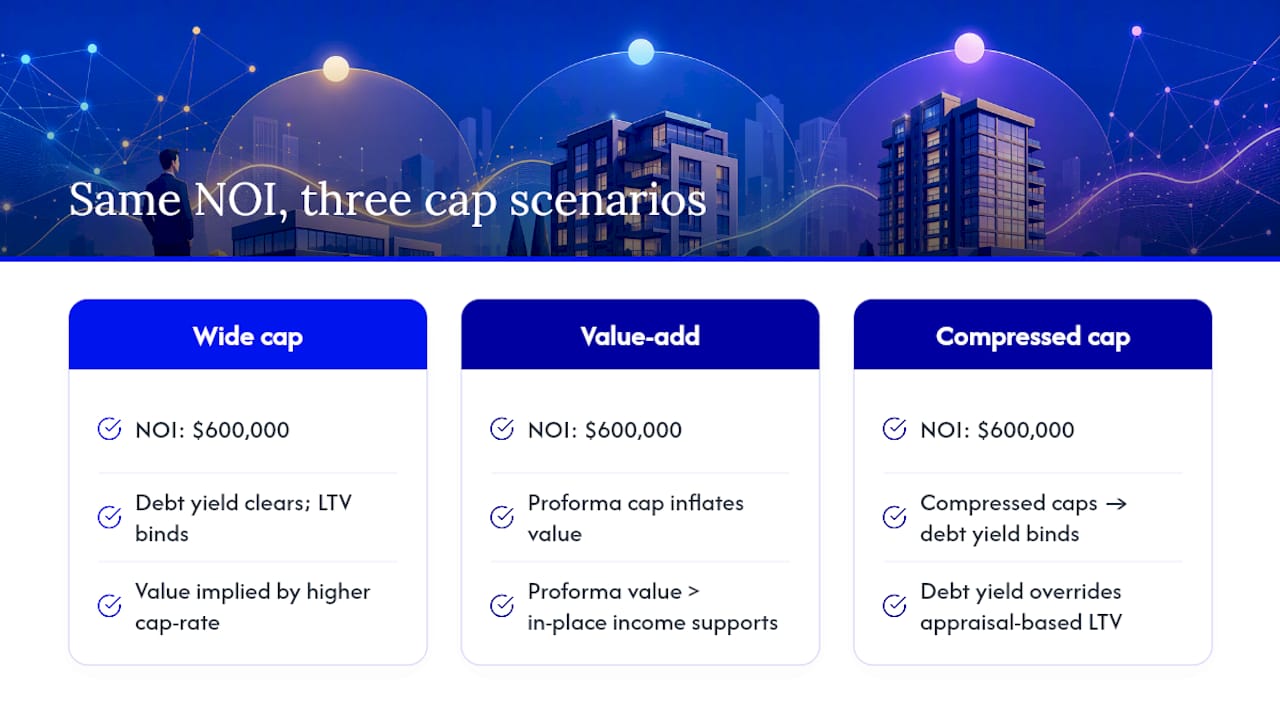
For deal packaging, this means you calculate both metrics before you set the ask. If cap rates in your market are compressed, expect debt yield to override the LTV number you'd get from a straightforward appraisal-based calculation.
Where NOI and Appraisal Assumptions Can Distort Both Metrics
Neither metric is bulletproof, and lenders who've been burned know exactly where to poke.
NOI gets inflated through one-time income spikes, temporary tenant concessions that haven't rolled off yet, or expenses capitalized instead of expensed to flatter the operating statement. Debt yield's NOI dependence is exactly why underwriters push for trailing-twelve-month statements rather than a single strong quarter.
LTV carries its own risk: thin comparable sales, cap-rate compression in a hot submarket, or an appraiser leaning on optimistic proforma rents. The CFPB's explainer on appraisals underscores why appraised value is an opinion, not a fact, and why lenders treat it accordingly.
- Pull trailing-12-month operating statements, not a single trailing quarter.
- Cross-check the rent roll against actual signed leases, not the rent roll's own summary.
- Audit expenses for anything capitalized that should be a recurring cost.
- Request a second appraisal opinion or broker price opinion when comps look thin.
Pro Tip: Ask for the trailing-12 before you ask for the appraisal. A clean T12 tells you more about which test will bind than the appraisal ever will.
Case Studies: How the Binding Test Changed the Deal
A 120-unit multifamily refinance in a compressed cap-rate submarket came in at 68% LTV against a fresh appraisal, well inside the lender's 75% ceiling. The borrower expected full proceeds. The appraisal never lied. The income simply didn't support the number the value implied.
A flex-industrial acquisition showed the opposite scenario. The in-place NOI was strong relative to the purchase price, producing a debt yield above the lender's floor. LTV, however, was relatively high against a conservative appraisal. LTV became the binding constraint, so the broker had to bring in a mezzanine piece to bridge the gap rather than push on debt yield.
A hotel conversion deal showed how fast the binding test can flip. Trailing income was volatile due to a recent renovation, so the lender underwrote to a conservative NOI estimate. Debt yield declined significantly under the lender's haircut, instantly becoming the constraint that LTV had not threatened to be. The broker who modeled the haircut in advance avoided a surprised borrower at term sheet stage.
Debt Yield and LTV Answer Different Risk Questions
LTV measures collateral cushion. If the borrower defaults, how much room exists between the loan balance and what the property could sell for? That's a liquidation-focused risk lens, and it's only as reliable as the appraisal behind it.
Debt yield measures return on lending capital independent of leverage assumptions. It answers a blunter question: if I had to take this property back tomorrow with no financing in place, would the income justify what I lent against it? Wall Street Prep's breakdown notes that debt yield, unlike DSCR, doesn't move with amortization schedules or interest-rate changes. It's a pure income-to-principal ratio.
That independence is exactly why debt yield became standard on CMBS underwriting after the 2008 downturn exposed how easily LTV could be gamed through generous appraisals and short-term rate assumptions. A loan can look conservative on LTV and still be dangerously thin on debt yield if the income doesn't back the collateral story.
For risk assessment purposes, treat LTV as your downside protection metric and debt yield as your cash-flow sufficiency metric. Neither replaces the other. A lender who only checks LTV is trusting an appraiser's opinion; a lender who only checks debt yield is ignoring what happens to loan-to-value if rates rise and cap rates expand. Running both, plus DSCR, is what most institutional underwriting guides recommend as standard practice rather than an optional extra step.
Property Type and Market Cycle Shift the Interpretation
A stabilized multifamily asset in a primary market and a single-tenant industrial building on a 12-year lease can carry identical debt yields and mean very different things. Multifamily income is diversified across dozens of leases, so a given debt yield reads as lower risk than the same number on a single-tenant deal where one vacancy wipes out the entire NOI base.
Hotels and other operating-intensive property types get evaluated on debt yield more heavily than LTV because their income is volatile enough that appraised value swings with the trailing twelve months, not a long-term lease structure. Office in secondary markets has faced the opposite problem recently: appraisals lag behind real leasing weakness, so LTV can look calmer than the actual debt yield, which reflects current rent collections rather than a stale comp set.
Market cycle matters just as much as asset type. In a cap-rate compression cycle, LTV tends to look artificially strong across every property type because values are rising faster than income. In a cap-rate expansion cycle, the reverse happens: values fall, LTV on existing loans creeps up, and debt yield on new originations becomes the tighter screen because lenders know values could still be moving. Brokers packaging deals in 2026's higher-rate environment should expect debt yield to carry more underwriting weight on transitional assets than it did during the low-rate years, simply because lenders trust income-based measures more than appraisal-based ones when values are still finding a floor.
How Debt Yield and LTV Feed Into Loan Pricing
Loan pricing isn't set by one metric in isolation.
Lenders price risk in basis points, and debt yield headroom is one of the clearest signals they use to set that spread. Expect the tighter deal to carry a wider spread, tighter cash management provisions, or both, even when LTV on paper looks identical.
Interest rates and debt yield also move in a feedback loop. Higher rates raise debt service, which pressures DSCR and often forces a smaller loan to hit the DSCR floor. A smaller loan against the same NOI mechanically produces a higher debt yield. That's why in high-rate environments, debt yield sometimes stops being the binding constraint even though it was during the low-rate years, because DSCR sizing already pushed proceeds down far enough to clear the debt-yield floor with room to spare.
Packaging a Submission for Debt-Yield-Sensitive Lenders
Before you send a package anywhere, run the back-of-envelope math yourself so you know which test the lender will flag.
- Pull trailing-12-month NOI and divide by your target loan amount to get a rough debt yield.
- Divide the same loan amount by a conservative value estimate (not the sponsor's proforma) to check LTV.
- Assemble your document set: rent roll, signed leases, trailing operating statements, and capex reserve schedules. A loan document checklist built for this exact purpose saves you a round of follow-up requests.
- If debt yield is tight, route first to agency or bank balance-sheet lenders with more flexible floors before trying CMBS conduits, which tend to hold the line at 8.5% or higher.
- If DSCR looks like the tighter constraint instead, review DSCR-specific underwriting guidance and a DSCR calculator to see how amortization or rate structure changes your number before you submit.
BrokersConnect's lender-matching database sorts by leverage tolerance and property type, so brokers can filter for channels whose debt-yield floors actually fit the deal instead of guessing which conduit to call first.
Modeling Discipline Beats Guessing Every Time
Most brokers still lead with LTV because it's the number clients understand intuitively. That habit gets deals rejected late in the process, after a term sheet has already set expectations. Run debt yield and DSCR on every deal, not just the ones that look thin on the surface, because the tightest constraint is rarely obvious until you've done the math. A five-minute calculation on the front end prevents a renegotiation that damages trust with your borrower.
— Theron
If you're tired of finding out which test binds only after a lender kills your proceeds, BrokersConnect gives you a database of 289+ verified lenders filtered by leverage tolerance, property type, and loan structure, plus AI-powered deal packaging tools built to catch debt-yield and DSCR issues before you submit. Brokers use it to route deals to the right channel the first time, track lender responsiveness, and manage a pipeline without spreadsheets scattered across a dozen tabs.
Sources
- How To Calculate Debt Yield To Underwrite Loans For CRE | Altus Group Insights
- LTV vs. DSCR vs. Debt Yield: Which Metric Best Measures Loan Quality? | CREAnalyst