
A CRE deal one-pager is a single page that tells a lender who the borrower is, what the loan request is, what secures it and why the deal works, so the lender can form a first opinion before opening a single attachment. Put the ask and the headline metrics at the top, the property and sponsor facts under them, the repayment plan after that, and everything else behind the page. This guide shows the fields, the layout and the mistakes that make lenders pause.
TL;DR
- Lead with the request: loan amount, purpose, property type, location, leverage and the exit, in the top third of the page.
- Show DSCR, LTV and debt yield with their inputs so the lender can check the math in seconds.
- Keep rent rolls, leases, the full underwriting file and legal language behind the page, not on it.
- Label assumptions, separate in-place income from projected income and disclose known risks.
- Build the page once as a template, then send it to lenders that fit the deal, so each submission starts from the same clean format.
Table of Contents
- What a one-pager is and when brokers use it
- The fields every lender-facing one-pager needs
- The numbers to show, and how to show them
- Layout: one page, scannable in under a minute
- Mistakes that weaken a deal summary
- Build it once, reuse it on every deal
- Where BrokersConnect fits
- Perspective
- FAQ
- Sources
What a one-pager is and when brokers use it
A one-page deal summary is the front door of a loan submission. Lenders see many scenarios a week, and the first page decides whether they read the second. One broker guide describes the executive summary as the first thing a lender reads, and says it should let the lender form a preliminary opinion before opening attachments.
You will use it in three places:
- First outreach. The page is the body of the email or the first attachment, so the lender can say yes, no or "send more" quickly.
- Top of a full package. It sits in front of the financials, the property documents and the borrower materials.
- Internal alignment. Writing it forces you to confirm the borrower, the numbers and the story before any lender sees them.
It is not a teaser. A teaser is a shorter, often anonymous piece meant to provoke an inquiry. A lender-facing one-pager names the property and the request and carries enough numbers to underwrite a first reaction.
The fields every lender-facing one-pager needs
Start from what a lender's own intake form asks for. A published deal summary form from a commercial lender asks for the borrower and borrowing entity, broker contact, property name and address, property type and description, and the requested loan amount and purpose. Build your page around the same fields and you answer the questions before they are asked.

The request
Put this block first:
- Loan amount, purpose (purchase, refinance, bridge, construction, cash-out) and requested term.
- Target leverage, rate expectations if you have them, amortization and prepayment preferences. The broker guide above lists LTV, rate, term, amortization and prepayment among the requested terms a summary should state.
- Target closing date.
The property
- Name, address, property type, size, unit count or square footage, year built, and current condition.
- Occupancy and a one-line description of the tenancy or the business plan.
- Location context in a sentence: submarket, demand drivers, anything that explains why this asset works there.
The borrower and sponsor
- Borrower name and entity structure.
- Relevant experience, in two or three lines. Lenders want to know who is executing the plan.
- Your contact information, in its own field, so the next step is obvious.
Transaction details by deal type
For a purchase, the lender form asks for the price, any seller credit, the equity and where it comes from, and the closing date. For a refinance, it asks for estimated value, original cost and date, existing debt and lender, status, use of proceeds and closing date. Include the one that applies and drop the other. A lender should never have to hunt for how the borrower got into the deal.
The numbers to show, and how to show them
The same lender form asks for the purchase price or estimated value, the requested amount, income and NOI history, occupancy, loan amount per square foot and forecast DSCR, plus sources and uses and a plan for repayment. These are the lines a lender checks first.
Three ratios carry most of the conversation. One lender's loan calculator page defines them as follows:
| Metric | Formula | What it tells the lender |
|---|---|---|
| DSCR | NOI divided by annual debt service | Whether the property income covers the payment |
| LTV | Loan amount divided by appraised value | How much cushion sits under the loan |
| Debt yield | NOI divided by loan amount | Income relative to the loan, regardless of rate or amortization |
A worked example
Say a multifamily property has $620,000 of in-place NOI, a $7,500,000 appraised value and a requested loan of $5,000,000 with annual debt service of $400,000. These are illustrative numbers, not a market quote.
- LTV: $5,000,000 / $7,500,000 = 66.7%
- DSCR: $620,000 / $400,000 = 1.55x
- Debt yield: $620,000 / $5,000,000 = 12.4%
On the page, that becomes one compact block: request, value used, NOI, and the three ratios. State where the value comes from (purchase contract, broker opinion or appraisal), because an LTV with no stated value invites a question and a delay.
In-place versus projected
Show current NOI first. If the deal depends on a pro forma, show it in a separate column, label it as projected and say what has to happen to reach it. Never present projected rent as collected income. Lenders downgrade a page when the two blur.
Layout: one page, scannable in under a minute
A workable order, top to bottom:
- Header. Property name, location, asset type, loan request in one line.
- Key terms table. Loan amount, purpose, LTV, DSCR, debt yield, term, target close.
- The thesis. Two to four sentences: what the asset is, what the plan is, how the loan gets repaid.
- Property snapshot. Size, occupancy, condition, location.
- Sponsor. Entity, experience, liquidity if relevant.
- Sources and uses. A small table that ties to the loan amount.
- Risks and mitigants. Two or three lines, specific.
- Contact and next step. Your name, phone, email and what you can send on request.
Detailed underwriting files, rent rolls, lease abstracts, inspection records and legal disclaimers belong in the package behind the page. The one-pager points to them and lists what is available. If you are putting a full rent roll on the page, you are writing the wrong document.
Make the investment case specific to the property. Show how the plan moves from acquisition through the improvements or lease-up to repayment, so the lender does not have to infer how the deal succeeds. "Strong submarket with growth" says nothing; "92% occupied, 14 of 40 units renovated at a $175 monthly premium" says something.
If your one-pager feeds a longer package, check it against your loan document checklist so the attachments it promises are really in the folder.
Mistakes that weaken a deal summary
Missing information. A lender's own guidance on debt packages says gaps lead lenders to make negative assumptions or stall with questions. A complete page lets them evaluate the business plan instead of the holes. The same logic applies when you are pitching specialized programs: a lender reviewing a mixed-use deal on mixed-use wholesale lender programs will be looking for property use mix, income by use and the plan stated plainly.
Wrong or imprecise numbers. A lender-package document from a commercial brokerage warns that incomplete, imprecise or incorrect loan request data can jeopardize an otherwise attractive loan. Make sure the loan amount, the sources and uses and the closing costs tie out. Our guide to tie-outs and templates in loan submissions goes through the checks.
Hiding the weak spot. If the current cap rate is thin, say so and show why the pro forma is supportable. If repairs are needed, disclose them and tie them to the budget. Lenders find these items in diligence anyway, and an undisclosed one costs you the file.
A page that says nothing. Dense, generic prose and adjectives instead of figures read as filler. Every sentence should hold a number, a name or a decision.
Sending it to the wrong lender. A perfect page sent to a lender whose box does not fit the deal still goes nowhere. Before you send, test the deal against each lender's property types, size range and leverage limits. Our lender shortlist criteria start with DSCR and LTV for that reason.

Build it once, reuse it on every deal
The one-pager is a template problem. The structure never changes; only the inputs do. Keep a master version with locked headings and fixed table layouts, and fill the same fields in the same order every time. Lenders learn where to look, and you stop rebuilding the page from scratch.
A simple routine:
- Collect the borrower, property and request inputs on an intake sheet.
- Calculate DSCR, LTV and debt yield from those inputs, never from memory.
- Fill the template, read it as the lender would, then cut anything that does not help a yes or no.
- Match the deal to lenders that fit, and send the page with a short cover note. Our workflow for contacting commercial lenders shows how to do this without cold calls.
- Log the response, then follow up on the lender's questions promptly.
Where BrokersConnect fits
BrokersConnect is a subscription platform for commercial real estate brokers. It includes deal templates, AI tools for deal packaging and underwriting, deal scenario submission, batch lender outreach, a deal pipeline CRM and a secure document vault. The lender matching runs on a database of 289+ verified lenders across the major CRE asset classes and loan types.
In practice, that means the one-pager, the attachments, the lender list and the follow-up live in one place for each deal. The plan is $50 per month with a free trial, and there are no commissions or transaction fees.
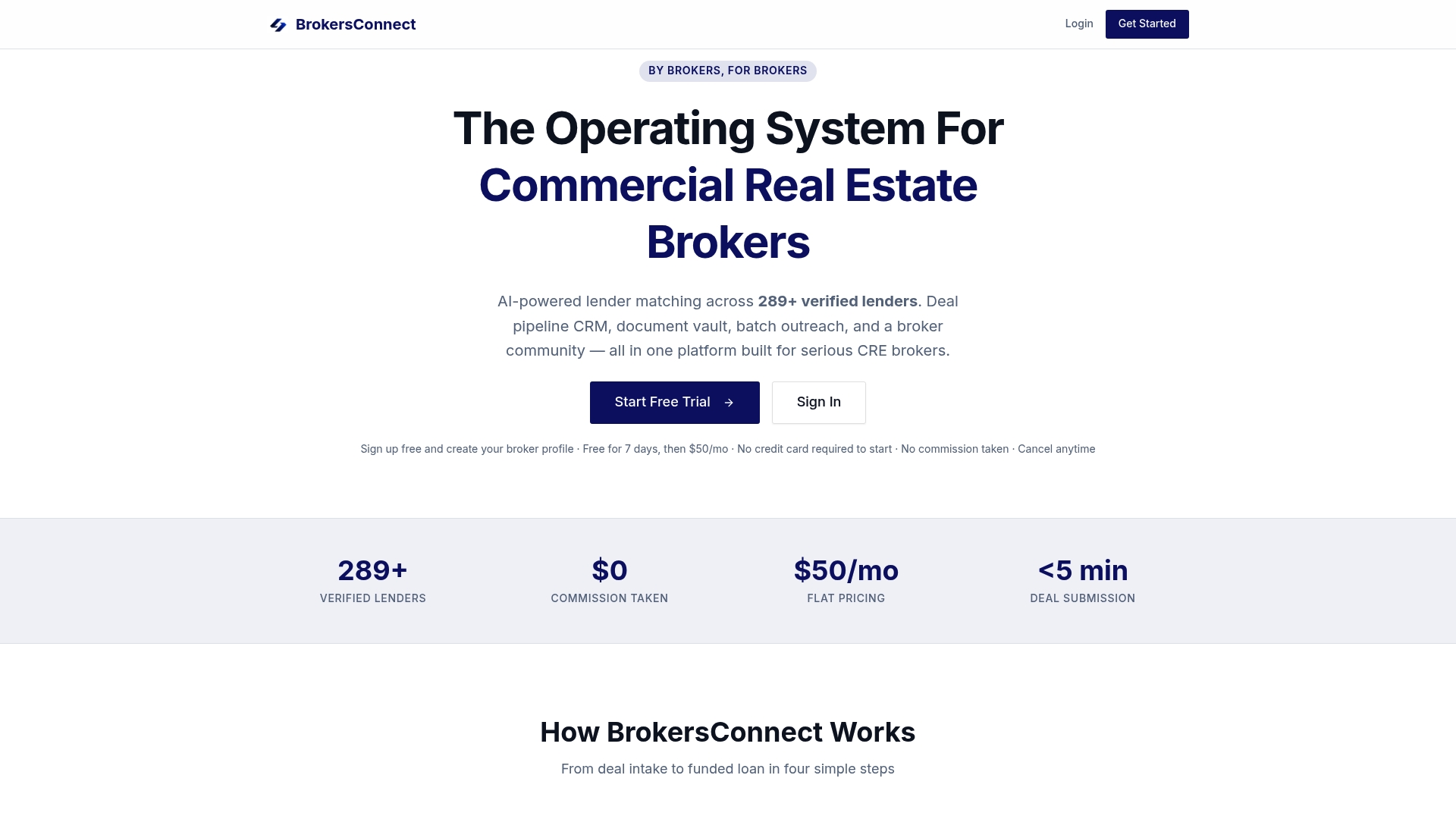
If you want the template, the lender match and the pipeline in one workspace, you can start with BrokersConnect.
Perspective
A one-pager is a sorting tool for the lender and a discipline for the broker. The page that works is the one written after the deal is understood, not before.
We built BrokersConnect around the idea that the page and the lender list belong together. A clean summary sent to the wrong lender is wasted work, and a perfect lender match with a muddled summary is wasted too. That is why our platform pairs AI-powered lender matching with deal templates, packaging tools and batch outreach, all inside the same pipeline.
Brokers, especially new ones, lose hours rebuilding the same page for each deal and searching lender lists by hand. A repeatable template, a verified lender database and one place to track every conversation take that routine off your desk, so your time goes into the part only you can do: understanding the borrower and structuring the deal.
Theron
FAQ
How long should a CRE deal one-pager be?
One page, and a lender should be able to scan it in about a minute. Lead with the request and the key ratios, then give the property, sponsor and repayment plan in a few lines each. Anything longer goes into the package behind it.
Is a one-pager the same as an executive summary?
Often, yes. An executive summary can be a standalone page that circulates quickly or the opening of a longer offering memorandum or loan package. A teaser is different: it is shorter, often anonymous, and meant only to prompt an inquiry.
Which metrics matter most on the page?
Purchase price or estimated value, requested loan amount, NOI, occupancy, DSCR, LTV and debt yield. Show the inputs next to each ratio, and keep in-place and projected figures apart so the lender can see which numbers are real today.
Should I mention risks on the one-pager?
Yes, briefly and specifically, with the mitigant next to each. Lenders find tenancy issues, repairs and thin yields in diligence anyway, and stating them early protects your credibility and speeds the review.
When should I send the one-pager?
Send it at first outreach, once the borrower, numbers and loan request are confirmed, and only to lenders whose property types, loan sizes and leverage fit the deal. Our lender questions checklist helps you confirm that fit.
Sources
- Deal summary form with required borrower, property and loan fields
- Loan submission package guide for mortgage brokers
- DSCR, LTV and debt yield definitions
- What lenders want to see in CRE debt packages
- Lender package guidance on loan request accuracy
- Mixed-use wholesale lender programs