
The strongest lender shortlists rank candidates on eight factors: all-in cost, current appetite, underwriting fit, execution speed, recourse and covenant profile, capacity and program fit, property-type or geographic specialization, and documentation readiness. Most deals are better served by a shortlist of three to six lenders, contacted in staggered tiers rather than all at once. The sections below break down each criterion, show how to weight them by deal type, and lay out a repeatable workflow.
TL;DR:
- Ask lenders what they closed in your asset class during the last 30 days; recent activity and concentration limits can override published criteria.
- Match priorities to financing type: bridge deals favor speed, construction favors capacity and draw administration, while stabilized multifamily favors total cost and recourse terms.
- Send a one page snapshot to your top three candidates before preparing full submissions, including leverage, in place DSCR, sponsor credit, and closing timeline.
- Confirm appraisal dates early because lender guidance generally expects reports to be current, commonly within six months of origination, and compliant with USPAP standards.
- Bridge and DSCR term sheets often take three to five weeks; order appraisals, environmental reports, and entity documents while negotiating.
Table of Contents
- Checklist: What to Verify for Each Lender-Fit Criterion
- Weighting the Criteria to Match Your Deal Type
- Pre-Underwriting the Deal Like a Lender Would
- The Step-by-Step Shortlist and Outreach Workflow
- Why a Curated Shortlist Beats a Mass Blast
- Putting the Checklist to Work Inside BrokersConnect
- FAQ
- Sources
Checklist: What to Verify for Each Lender-Fit Criterion
Treat this as a scoring sheet, not a gut check. Each item below has a specific question attached to it, and the answer determines whether a lender belongs on the shortlist at all.
- All-in cost: compare rate, origination points, exit or prepayment fees, and any recapture language together, since a lower rate with a stiff prepayment penalty can cost more over a three-year hold than a slightly higher rate with none.
- Underwriting fit: check the lender's typical DSCR floor, LTV ceiling, and debt yield target against your deal's actual numbers, not the sponsor's optimistic projections.
- Appetite right now: a lender's published criteria and its current willingness to deploy capital are two different things, and the gap between them is where wasted submissions happen.
- Speed and execution certainty: ask directly about appraisal turnaround, environmental review timing, and typical days to close, since these vary widely by lender type.
- Recourse and covenants: read the term sheet for carve-outs, financial covenants, and reporting requirements before you compare headline pricing.
- Capacity and program fit: confirm your loan amount sits comfortably inside the lender's stated minimum and maximum, not at the edge of it.
- Specialization: a lender heavy in multifamily may underwrite industrial conservatively simply because it is unfamiliar territory for their credit committee.
- Communication track record: recent responsiveness on similar deals is a better predictor of a smooth closing than years in business.
Underwriting standards for qualifying commercial real estate loans require lenders to document appraisal recency, loan-to-value and debt service coverage expectations, and environmental review as part of their underwriting standards. That same guidance generally expects appraisals to conform to USPAP and to be current, commonly within six months of origination, which is worth confirming before you submit a deal to any lender on your list.
Bank loan policy, including portfolio concentration limits and LTV guidance, is laid out in detail in the Comptroller's Handbook, and it explains why two lenders with similar published criteria can price the same deal very differently. For a deeper look at DSCR mechanics specifically, our DSCR loan guide walks through sizing from a broker's side of the desk, and third-party sizing guidance covers the same math from a brokerage's perspective.
Pro Tip: Ask every lender on your initial call what they closed in the last 30 days in your asset class. The answer tells you more about real appetite than anything on their website.
Weighting the Criteria to Match Your Deal Type
Not every criterion deserves equal weight, and the right weighting depends on what you're financing.
- Sort checklist items into three buckets: must-haves (deal dies without them, like minimum loan size or asset type eligibility), negotiables (covenant terms, some fee structure), and preference signals (communication style, platform ease).
- For a bridge loan, weight speed and execution certainty highest, since a slow closer can blow the exit timeline that made the bridge pencil in the first place.
- For ground-up construction, weight capacity, draw administration, and specialization heaviest, because inexperienced construction lenders create disbursement delays that stall the job.
- For stabilized multifamily, weight all-in cost and recourse terms highest, since execution risk is lower and the deal is really a long-term cost comparison.
- Run a one-page pre-test before full submission: property type, loan amount, requested leverage, in-place NOI, and sponsor credit summary sent to your top three matches to confirm appetite before you build a full package.
Construction deals carry their own documentation layer worth checking early, covered in our construction lender requirements guide. If your deal might need a hybrid capital stack, understanding the tradeoff between mezzanine and bridge structures before you shortlist helps you avoid pitching the wrong product to the wrong lender entirely.
Pro Tip: When a deal straddles two asset classes, like a mixed-use property, shortlist separately for each component and compare which lender treats the secondary use as a strength versus a liability.
Pre-Underwriting the Deal Like a Lender Would
Before you pick up the phone, run the deal through the same filters a credit committee will use. That means confirming appraisal recency, calculating DSCR using the lender's likely expense assumptions rather than the sponsor's, flagging any environmental concerns, verifying sponsor equity in the deal, and cross-checking the rent roll against trailing financials. CREFC's underwriting framework identifies collateral cushion, sponsor equity, and stable cash flow as the attributes that make a loan lower risk in a lender's eyes, and surfacing those clearly in your submission framework speeds up the lender's own review.

Appetite and concentration signals matter just as much as the numbers on the page. A lender near its internal concentration limit for a given property type or geography may pass on a deal that fits every published criterion, which is why tracking recent closings matters as much as reading rate sheets.
A one-page submission snapshot built around lender-facing fields does the heavy lifting here:
| Field | Why it maps to a lender criterion |
|---|---|
| Property type and location | Matches specialization and concentration appetite |
| Loan amount and requested leverage | Matches capacity and LTV policy |
| In-place and projected DSCR | Matches underwriting fit |
| Sponsor credit and net worth summary | Matches minimum qualification standards |
| Requested term and recourse preference | Matches covenant and recourse profile |
| Timeline to close | Matches execution speed expectations |
This platform organizes exactly these fields inside each deal scenario, which is how its matching engine surfaces lenders whose stated appetite lines up with your numbers instead of making you guess. Appetite-tracking tools and pipeline views help you see which lenders have been active in a given asset class recently, and a lender responsiveness leaderboard adds a data point most brokers only learn by trial and error.
The Step-by-Step Shortlist and Outreach Workflow
- Compile a broad universe of 15 to 25 lenders active in the relevant product and property type.
- Run the one-page pre-test snapshot past your top candidates to confirm live appetite before building a full package.
- Narrow to three to six lenders based on the pre-test responses and your weighted criteria.
- Stagger outreach in tiers, sending full submissions to your top two or three first and holding the rest in reserve.
- Track term sheet timing against product norms: bridge and DSCR deals often move in three to five weeks, construction and larger commercial mortgages typically take longer.
- Keep documentation moving in parallel: appraisal orders, environmental reports, and entity documents should be queued while term sheets are still being negotiated.
- Select a lead lender once terms are comparable, and keep two backups warm in case financing falls through late.
Our DSCR submission checklist and notes on reading covenant language are useful references once term sheets start arriving and you need to compare them quickly.
Why a Curated Shortlist Beats a Mass Blast
Sending a deal to every lender you can think of feels like diligence, but it usually signals the opposite. Lenders who sense they're one of twenty submissions price defensively or stop responding altogether, while a focused shortlist of genuinely good-fit candidates gets taken seriously and gives you real leverage to negotiate terms. The habit worth building is simple: limit your first wave of outreach to the three lenders whose recent activity and stated criteria best match your deal, confirm appetite with a one-page snapshot before you send the full package, and expand only if those three don't pan out. It's a slower-feeling start that almost always finishes faster.
— Theron
Putting the Checklist to Work Inside BrokersConnect
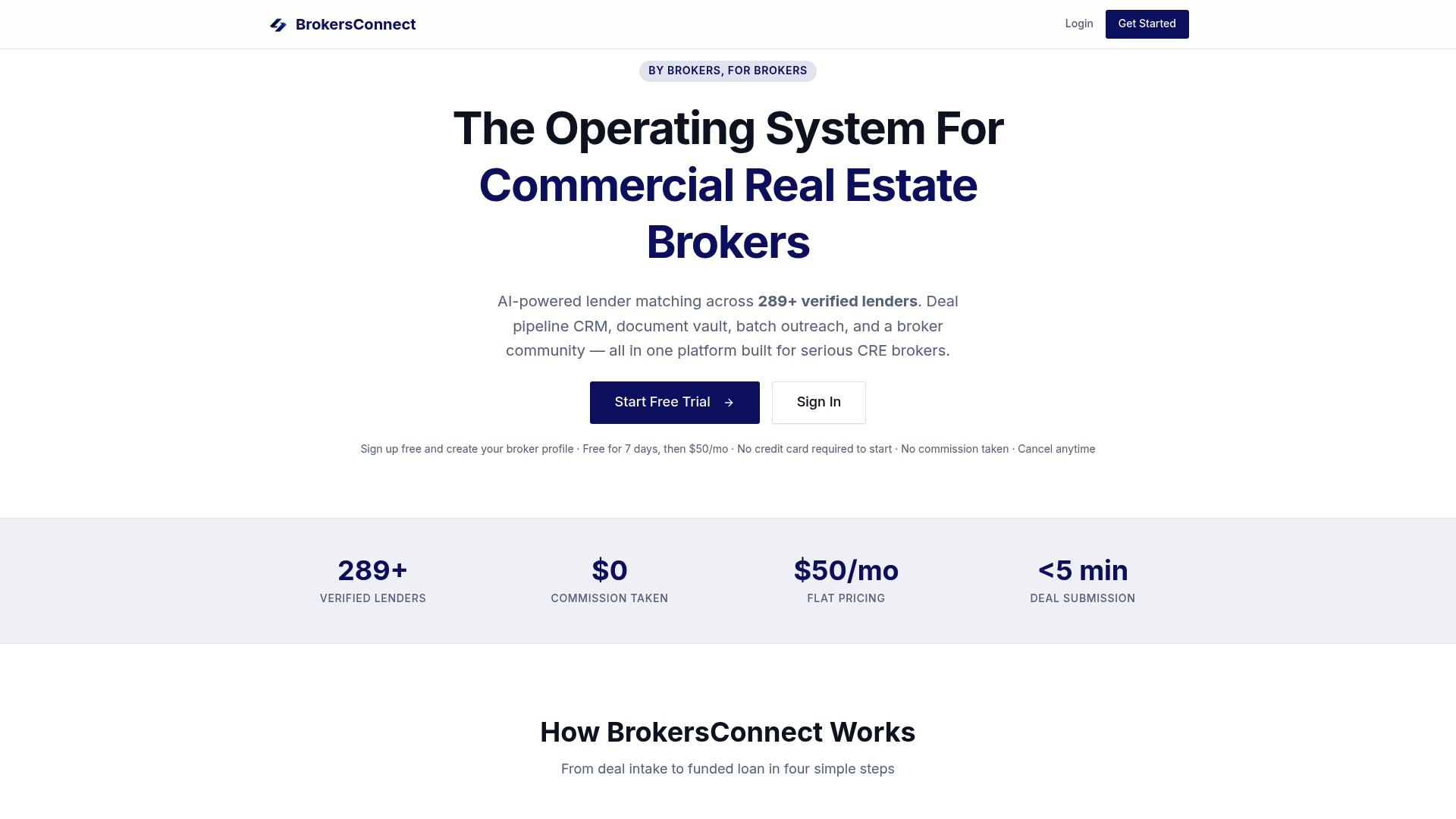
Running this checklist manually across dozens of lender websites and cold calls is exactly the work BrokersConnect was built to cut out. We record each deal's property type, loan amount, leverage, credit profile, loan purpose, and transaction structure once, then match it against a large database of verified lenders rather than asking you to retype the same scenario into a dozen inboxes.
- One-page submission templates built around the fields lenders actually ask for.
- Appetite tracking so you can see which lenders are actively deploying in your asset class.
- A lender responsiveness leaderboard that flags who closes fast and who goes quiet.
- Pipeline tools that keep every conversation and document organized in one place.
If you're shortlisting lenders for an active deal right now, start a free trial at BrokersConnect and run your scenario through the matching engine before your next round of outreach.
FAQ
How many lenders should be on a typical shortlist?
Three to six lenders is usually the right range for a single deal, sequenced in tiers rather than contacted all at once. A tighter initial list of your top two or three matches, confirmed with a one-page pre-test, preserves negotiating leverage better than a mass submission.
What is the most overlooked lender-fit criterion?
Current appetite is the one brokers skip most often, relying on published criteria instead of recent activity. A lender near its internal concentration limit for your property type may decline a deal that fits every stated guideline, a dynamic explained in the Comptroller's Handbook.
How does BrokersConnect help with lender shortlisting?
BrokersConnect matches deal scenarios against verified lenders using property type, loan amount, leverage, credit profile, and transaction structure, then tracks lender responsiveness over time. A BrokersConnect subscription is $50 per month with a free trial period to test the matching and pipeline tools.
How recent does an appraisal need to be for lender submission?
Regulatory and supervisory guidance generally expects appraisals to be current, commonly within six months of origination, and to conform to USPAP standards as described in underwriting requirements. Confirming appraisal recency before submission avoids a late-stage request for a new report.
What documentation speeds up lender review the most?
A clean one-page snapshot with DSCR calculated using realistic expense assumptions, sponsor credit summary, and rent roll validation tends to move fastest. CREFC's underwriting principles note that disclosing assumptions and cash-flow sensitivity upfront reduces diligence friction, as outlined in its underwriting framework.
Sources
- eCFR :: 12 CFR 1234.17 -- Underwriting standards for qualifying CRE loans
- Commercial real estate lending (Comptroller's Handbook)
- CREFC – Principles‑based underwriting framework