
NOI measures what a property actually earns before debt enters the picture. DSCR takes that number and asks a sharper question: does it cover the loan payment? NOI drives valuation and cap rate math; DSCR drives loan approval. Get the NOI calculation right first, because every DSCR number a lender quotes you starts there.
TL;DR:
- Many lenders set minimum DSCR thresholds around 1.25, but calculations are sensitive to whether debt service includes taxes, insurance, and dues.
- Accurate NOI calculation is crucial, as small errors can significantly affect DSCR, especially when adjusting for vacancy or management fees.
- Lenders often rebuild NOI by applying conservative assumptions like vacancy reserves and management fees, reducing the self-reported income figures.
- Small increases in vacancy rates or interest rates can lower DSCR below approval thresholds, making deal approval highly sensitive to these variables.
- Proper document reconciliation and pre-screening with verified lender criteria can prevent deal delays and improve approval chances.
Table of Contents
- DSCR vs. NOI: How the Debt Service Coverage Ratio Actually Works
- NOI Explained: The Number Everything Else Depends On
- Comparing DSCR and NOI in Real Underwriting
- How Lenders Underwrite NOI and DSCR (And Why Their Number Is Lower)
- A Worked Example: From Rent Roll to DSCR
- Common Pitfalls That Quietly Kill Your DSCR
- A Broker's Checklist for DSCR and NOI Submissions
- Why Brokers Get DSCR Wrong More Than NOI
- Package DSCR Loans Faster With Verified Lender Matching
- Sources
DSCR vs. NOI: How the Debt Service Coverage Ratio Actually Works
DSCR is the ratio lenders use to decide whether a property's income can support its debt payments. The formula is simple: DSCR = annual NOI ÷ annual debt service. A property generating $125,000 in NOI against $100,000 in yearly debt service has a DSCR of 1.25, expressed to two decimals for underwriting purposes.
The tricky part is what counts as "debt service." Some lenders use principal and interest only (P&I). Others use PITIA, which folds in taxes, insurance, and association dues. That single choice can swing your ratio meaningfully, since DSCR calculations built on PITIA run lower than the same deal calculated on P&I alone.
Statistic Callout: Most commercial lenders set minimum DSCR requirements between 1.15 and 1.35, with 1.25 as the most common underwriting floor.
- A DSCR below 1.0 means the property isn't generating enough income to cover its own debt.
- A DSCR of exactly 1.0 breaks even, with zero cushion for vacancy or a bad month.
- A DSCR of 1.25 or higher gives lenders room to breathe and usually unlocks better pricing.
NOI Explained: The Number Everything Else Depends On
NOI is effective gross income minus operating expenses, full stop. It ignores financing entirely. J.P. Morgan's framework for calculating net operating income excludes debt service, income taxes, depreciation, and capital expenditures because NOI is meant to measure the property's own earning power, not the owner's financing choices or tax situation.
Income side includes rent, parking fees, laundry income, and any other recurring revenue the property throws off. Expenses include property management, repairs, insurance, property taxes, utilities the landlord covers, and reserves.
- Included in NOI: rental income, ancillary fees, operating expenses, management fees, insurance, property taxes.
- Excluded from NOI: mortgage payments, capital improvements, depreciation, income taxes.
Cap-rate valuation runs directly off NOI. Investors divide NOI by a market cap rate to estimate value, which is exactly why a sloppy NOI number corrupts both your purchase price analysis and your DSCR calculation downstream.
Comparing DSCR and NOI in Real Underwriting
NOI feeds directly into DSCR, but the two metrics answer different questions for different audiences. Here's how the math and the decision-making actually connect:
- Start with NOI. Every DSCR calculation begins with an accurate NOI figure. Get this wrong and the ratio that follows is meaningless, no matter how carefully you compute it.
- Divide by annual debt service. A $10,000 swing in NOI on a $500,000 debt service base moves DSCR by roughly 0.02, while the same $10,000 swing from a rate increase on the debt side can move it by 0.05 or more. Debt service assumptions are more sensitive than most brokers expect.
- Recognize the split in purpose. NOI drives valuation, cap rate comparisons, and investor return calculations. DSCR drives loan sizing and approval. A property can have excellent NOI growth and still fail DSCR if the buyer overpays and inflates the required loan amount.
- Watch for pro forma inflation. Sellers often present forward-looking pro forma NOI that assumes rent increases or lease-up that hasn't happened yet. Lenders almost always underwrite against trailing, verified NOI instead.
How Lenders Underwrite NOI and DSCR (And Why Their Number Is Lower)
Lenders rarely accept a borrower's NOI at face value. They rebuild it using their own assumptions, and those assumptions tend to be conservative by design.
- Appraisers frequently substitute market rent for actual in-place rent, which can cut income if current leases are below market.
- Underwriters add a vacancy reserve, typically 5% to 10%, even on a fully leased property.
- Many lenders impute a management fee (often 3% to 5% of income) even when the owner self-manages.
- Reserves for replacement (roof, HVAC, parking lot) get deducted before the lender's final NOI number.
Community banks tend to have more underwriting flexibility on these add-backs than CMBS shops, which apply standardized, asset-class-specific floors. TrueCap's underwriting research found these adjustments can shrink a borrower's self-calculated DSCR by 5% to 15% once a lender rebuilds the numbers.
Pro Tip: Ask every lender upfront whether they underwrite on P&I or PITIA, and whether they impute a management fee. That one question tells you more about your real DSCR than any spreadsheet you build alone.
A Worked Example: From Rent Roll to DSCR
Take a 20-unit multifamily property renting for $1,200 per unit per month.
- Gross potential rent: 20 units × $1,200 × 12 months = $288,000.
- Apply a 7% vacancy allowance: $288,000 × 0.93 = $267,840 effective gross income.
- Subtract operating expenses (management, repairs, insurance, taxes, utilities) totaling $107,840, leaving NOI of $160,000.
- Calculate debt service. Assume a loan with monthly P&I of $10,500, or $126,000 annually.
- Divide: $160,000 ÷ $126,000 = 1.27 DSCR.
Statistic Callout: A 1.27 DSCR clears most conventional lender floors, which commonly sit around 1.25, but bump vacancy to 10% and NOI drops to roughly $146,880, pulling DSCR down to about 1.17, below many program minimums.
That sensitivity is the whole game. Small changes in vacancy or interest rate assumptions can flip a deal from approvable to declined.
Common Pitfalls That Quietly Kill Your DSCR
The most frequent mistake brokers make is running DSCR off gross rent instead of NOI, which overstates the ratio and sets up a bad surprise when the lender's underwriter runs the real numbers.
- Using gross rent instead of NOI inflates DSCR and misleads everyone in the deal.
- Ignoring the lender's vacancy or management add-backs means your number and theirs won't match.
- Modeling off a teaser interest rate instead of the fully indexed rate overstates coverage.
- Failing to reconcile rent roll figures against tax returns raises red flags during underwriting.
Pro Tip: Pull the property's T-12 operating statement and the current rent roll before you touch a DSCR calculator. Lenders will ask for both, and matching them ahead of time saves a week of back-and-forth.
A Broker's Checklist for DSCR and NOI Submissions
Before you submit a DSCR loan scenario to any lender, reconcile the three versions of NOI you're likely to encounter: the seller's trailing twelve months, the buyer's pro forma, and the underwritten NOI a lender will actually use. They rarely match, and knowing why they diverge saves you from resubmitting.
- Gather the rent roll, signed leases, trailing operating statements, and the amortization schedule before submission.
- Run DSCR under both P&I and PITIA so you know your floor before a lender tells you.
- Filter lenders by DSCR tolerance and product type first. A property at 1.18 doesn't belong in front of a lender with a 1.25 floor.
- Reconcile the rent roll against tax filings to head off underwriter questions before they're asked.
BrokersConnect's own DSCR loan guide for brokers walks through this reconciliation process in more detail, alongside a rent roll analysis framework for pulling clean NOI inputs in under an hour.
Why Brokers Get DSCR Wrong More Than NOI
The biggest gap I see isn't in the math. It's in sequencing. Brokers model DSCR before they've locked down NOI, then get blind sided when the lender's underwriter rebuilds the income statement with a vacancy reserve and a management fee nobody budgeted for. Fix the NOI inputs first, then stress-test DSCR against a higher rate and a fatter vacancy assumption before you ever call a lender. Two habits separate brokers who close fast from brokers who don't: tight document control on rent rolls and tax returns, and pre-screening lenders by DSCR tolerance instead of pitching everyone the same deal.
— Theron
Package DSCR Loans Faster With Verified Lender Matching
Some platforms aim to reduce the time spent guessing which lenders will accept a marginal DSCR ratio. Brokers can filter a database of verified lenders by DSCR tolerance, property type, and loan structure before submitting loan scenarios.
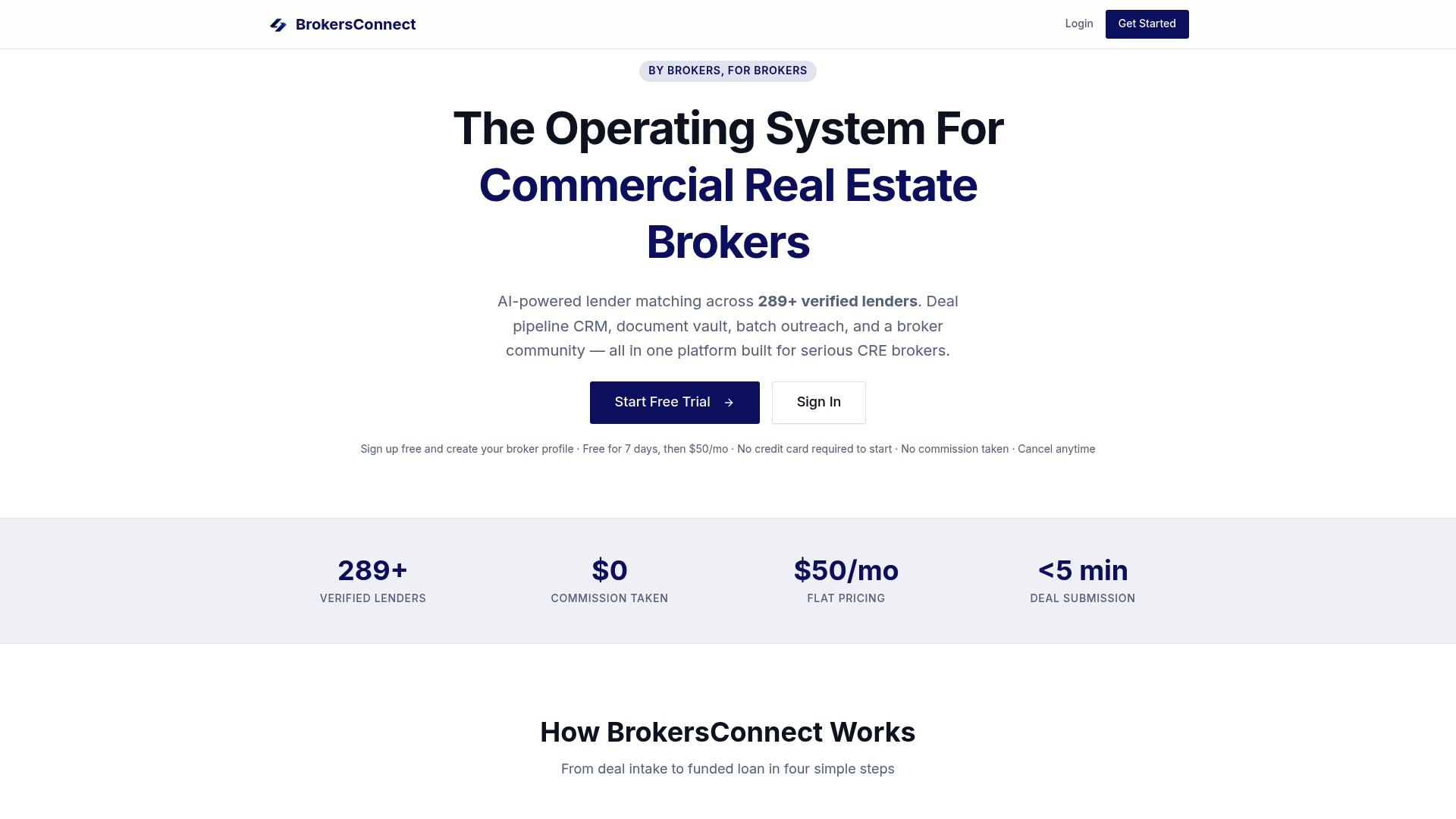
Such platforms can help identify lenders whose programs accept specific DSCR ranges to avoid submitting deals that will be declined due to strict minimum floors. Additionally, these services may provide tools like deal pipeline CRMs and secure document vaults to help brokers stay organized with their underwriting documents. Pair that with the platform's debt yield and LTV playbook for deals where DSCR alone won't tell the whole underwriting story.
Start a free trial at Thecrebrokersconnect and run your next DSCR scenario against verified lender criteria before you make a single call.
Sources
- Debt service coverage ratio — Wikipedia
- Calculating net operating income and cash flow — J.P. Morgan
- Debt-Service Coverage Ratio (DSCR): How to Use and Understand It — Investopedia
- How to calculate DSCR — TrueCap