
The fastest way to contact commercial lenders is to match your deal to lenders by appetite first, then submit a lender-ready package to a shortlist through batch outreach with a tracked follow-up cadence. Some platforms build this exact sequence into one workflow: identify fit, prepare the file once, then reach several lenders at once instead of cold-calling one at a time. Brokers who follow this order get faster first responses and more term sheets per submission.
TL;DR:
- Focusing on lenders with property type, loan amount, and geographic limits aligned to your deal increases the chance of quick responses and funding.
- A clear, concise executive summary and a complete, well-organized document package accelerate underwriter approval and reduce back-and-forth.
- Personalizing batch outreach with a specific reason for each lender improves engagement, response times, and term sheet rates.
- Regulatory rules often restrict lender appetite based on asset class or region, making qualification and disclosure crucial before submission.
- Using a dedicated platform that tracks responses and streamlines matching and outreach speeds up deal progress and saves time compared to manual methods.
Table of Contents
- Quick Checklist: Qualify and Prioritize Lenders Before Outreach
- Lender-Ready Submission Template: What to Include
- How to Batch Lender Outreach Without Losing the Personal Touch
- Why Lenders Decline Deals: Portfolio and Regulatory Constraints
- Theron's Perspective: Operational Tips and What Actually Speeds Deals Up
- The Real Lesson on Contacting Commercial Lenders
- How BrokersConnect Helps You Contact Commercial Lenders Faster
- Primary Sources and Further Reading
- Sources
- FAQ
Quick Checklist: Qualify and Prioritize Lenders Before Outreach
Sending a deal to twenty lenders when only six are realistic wastes everyone's time, including yours. The lenders who aren't a fit still have to read the email, decide it isn't right, and either ignore you or send a polite pass. That's dead time you could spend on the six who might actually fund it.
Screen every lender against these criteria before you send a single email:
- Property type and loan amount fit. A lender that caps industrial deals at $5 million isn't going to stretch for your $12 million warehouse deal, no matter how good the numbers look.
- Loan product match. Bridge, DSCR, construction, agency, CMBS, and permanent-mortgage lenders each have different appetite cycles; confirm which bucket your deal falls into before pitching.
- LTV and DSCR ranges. If your deal pencils at 75% LTV and a lender's sweet spot tops out at 65%, that's a fast no.
- Recourse profile. Some lenders only write non-recourse paper above a certain loan size; others require recourse below it.
- Hold-versus-sell posture. Portfolio lenders and those originating loans for sale to investors document and underwrite loans differently, which affects turnaround time and flexibility on structure.
- Geographic and concentration limits. A lender heavy in Sunbelt multifamily may be closed to new deals in that market regardless of quality.
Once you've filtered the list, rank the survivors by likely responsiveness, not just by loan size or brand name. A regional bank that answers in two days beats a national lender that takes three weeks to say no.
Pro Tip: Keep a running note on which lenders reply fast and which go quiet. Over a few deals, that pattern tells you more about who's actually worth contacting than any rate sheet.
Lender-Ready Submission Template: What to Include
A submission that forces an underwriter to hunt for basic numbers gets set aside. A submission that leads with the metrics they need gets read the same day. ABA training on loan structuring and documentation stresses matching your paperwork to what the underwriter already expects to see, and that starts with sequencing.
Build every submission in this order:
- One-page executive summary. Lead with loan amount, property type, requested LTV/DSCR, exit strategy, and sponsor experience. Put the numbers a lender screens on in the first three lines, not buried on page four.
- Document package. Rent roll, trailing 12 to 24 months of operating statements, two to three years of tax returns, borrower personal financial statement, a lease abstract or title snapshot, and current insurance summary.
- Underwriting outputs. Stabilized NOI, LTV and DSCR calculations, a sensitivity table showing rate and vacancy stress, and a one-page downside scenario.
- Borrower global-credit summary. A short paragraph on the sponsor's other holdings and overall financial condition. Skipping this is one of the most common reasons submissions get an instant pass, since lenders weigh the borrower's full picture, not just this one deal.
- File naming and single point of contact. Use consistent file names (Property_RentRoll_2026, not "Final_v3"), PDF format for financials, and list one broker as the contact so lenders aren't emailing three different people.
Pro Tip: Attach the sensitivity table even if nobody asks for it. Underwriters mention that pre-stressed numbers cut their own diligence time, and that alone can move your deal ahead of someone else's in the queue.
How to Batch Lender Outreach Without Losing the Personal Touch
Sending the identical email to forty lenders reads as a mass blast, and lenders can tell. The fix isn't to abandon batch outreach. It's to template the body and personalize the opening line: one sentence naming why this specific lender fits (their published appetite, a past deal type, a specific market they're active in), followed by the same executive summary everyone else gets.
Track every outreach in a simple pipeline with these status columns:
- Contacted (date and channel)
- Opened or acknowledged
- Interested, requesting more information
- In underwriting
- Term sheet issued
- Declined (with reason, if given)
Follow a fixed cadence so nothing falls through the cracks: initial email with the one-page summary attached, a follow-up email at three to five business days if there's no response, then a direct call. If a lender goes quiet after expressing early interest, that's your escalation trigger to call rather than email again.
Three numbers matter more than gut feel here: response rate, time-to-first-response, and term-sheet conversion. Lenders with fast first responses and higher conversion rates deserve more of your next deal's attention than ones with the biggest name but the slowest desk.
Why Lenders Decline Deals: Portfolio and Regulatory Constraints
Plenty of declines have nothing to do with your deal quality. Federal regulators reminded banks to maintain prudent underwriting and watch concentration risk in CRE lending, and that guidance shapes how much appetite a given institution has left for your property type on any given week.
The 2006 interagency guidance on CRE concentrations pushed banks toward formal concentration limits and market analysis, which is why two lenders with near-identical rate sheets can have completely different appetite for the same asset class.
Watch for these constraint patterns before you submit:
- Asset-class caps (a bank quietly full on multifamily exposure)
- Geographic concentration limits in a specific metro
- Construction and ADC exposure ceilings, which tend to tighten faster than permanent-loan limits
- Seasoning requirements on refinances
If a lender is near a concentration limit, disclosing other exposures upfront and proposing a mitigation like a participation or co-lending structure can sometimes turn a likely decline into underwrite interest. A curt, generic decline email with no reason given is often a sign the lender is capped out, not that your deal is weak. Pivot to the next lender on your ranked list rather than reworking a deal that was never going to fit.
Theron's Perspective: Operational Tips and What Actually Speeds Deals Up
Deals stall less often because of weak numbers and more often because the package forces a lender to chase missing pieces. Pair a tight executive summary with a stress-tested sensitivity table and you skip a full round of back-and-forth most brokers never see coming.
Negotiating leverage comes from having options, not from pushing harder on one lender. A broker running five qualified conversations at once negotiates fees and terms differently than one waiting on a single yes. That's the practical case for batch outreach done right: it's not about volume, it's about giving yourself room to compare term sheets before you commit.

BrokersConnect's lender matching database and pipeline tracking build this exact discipline into daily use, turning what used to be a spreadsheet and a stack of cold emails into a repeatable system.
The Real Lesson on Contacting Commercial Lenders
Most advice on this topic focuses on finding more lenders, as if the problem were a shortage of contacts. It isn't. The actual bottleneck is qualification and packaging. A broker with fifteen well-matched lenders and a tight submission outperforms one blasting two hundred cold names with a half-finished file.
The conventional wisdom to "cast a wide net" wastes lender goodwill and burns your own time on dead ends. The regulatory reality backs this up: banks operate under real concentration and underwriting constraints, which means a huge share of your list was never going to say yes regardless of deal quality.
Prioritize fit and package quality over reach. Build the one-page summary and sensitivity table once, reuse them across every submission, and track responsiveness like it's a metric that matters, because it does. The brokers closing the most deals aren't the ones with the biggest lender list. They're the ones with the tightest process.
— Theron
How BrokersConnect Helps You Contact Commercial Lenders Faster
BrokersConnect replaces the spreadsheet-and-cold-email routine with one system: match your deal against a database of verified lenders by property type, loan amount, LTV/DSCR, and structure, then push a standardized submission to your shortlist through batch outreach.
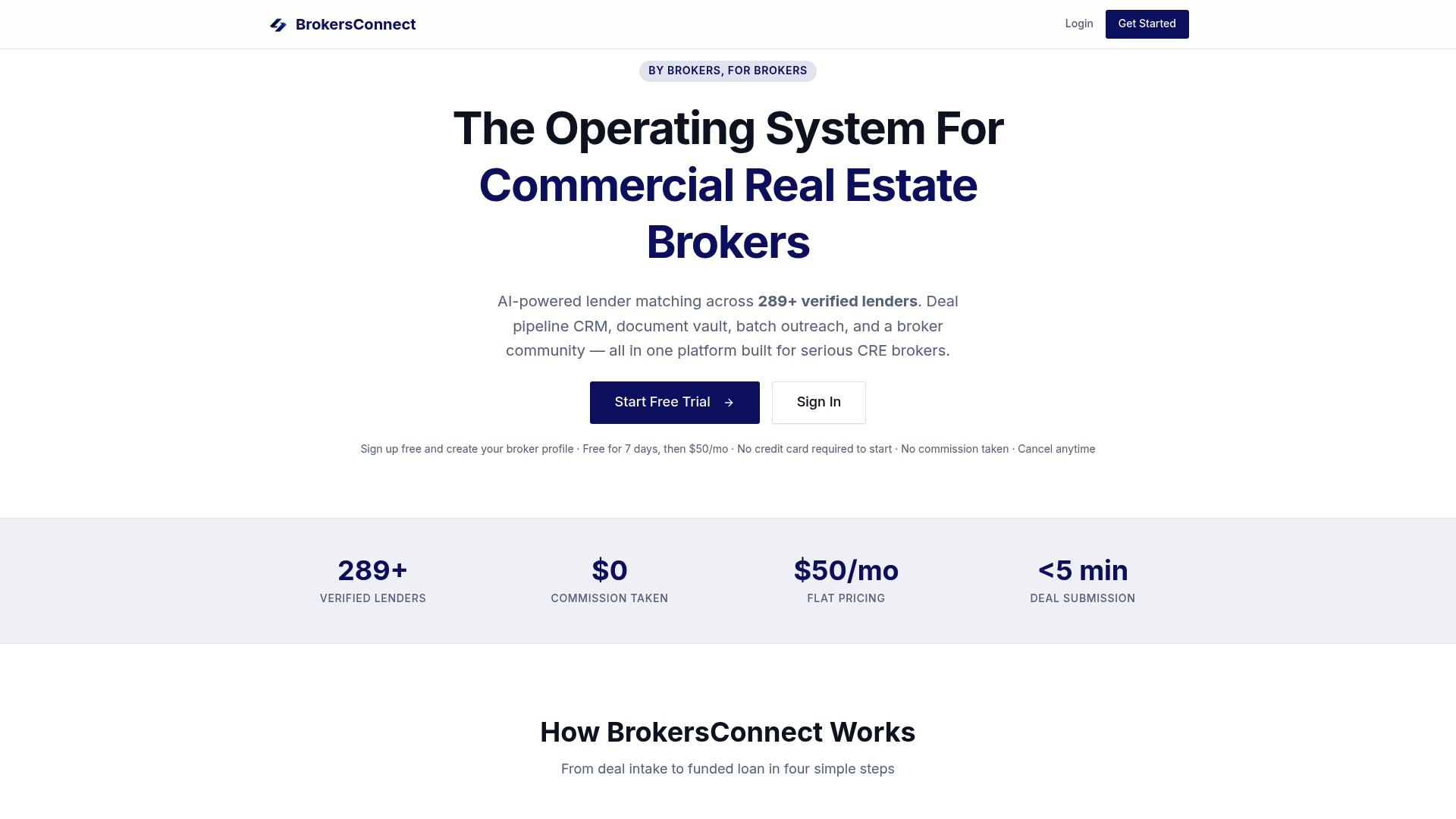
The platform tracks every lender conversation in one pipeline, so you see response rates and time-to-first-response instead of guessing which lender to follow up with next. It also includes deal templates, an AI-assisted underwriting toolkit, a fee calculator, and a broker community for the questions a template can't answer. Pricing is flat and transparent at a monthly fee, with no commissions on top, and a free trial lets you run a real deal through the BrokersConnect platform before committing. Start a trial, load your next deal scenario, and see your first lender matches the same day.
Primary Sources and Further Reading
For deeper reference on the regulatory and underwriting standards behind this workflow, see the interagency statement on CRE risk management, the 2006 concentration guidance, ABA's loan structuring and documentation training, and CCIM's commentary on deal costs and market analysis.
Sources
- Loan Structuring, Documentation, Pricing & Problem Loans Suite | American Bankers Association
- The Rising Cost of the Deal | The CCIM Institute
FAQ
How Many Lenders Should I Contact Per Deal?
There's no fixed number, but a ranked shortlist of eight to fifteen well-matched lenders usually beats a mass send to fifty. Quality of fit, not volume, drives your response rate and term-sheet conversion.
What Documents Do Commercial Lenders Require First?
Most lenders want a one-page executive summary, rent roll, trailing operating statements, borrower financials, and a lease or title snapshot before they'll engage further. Standardizing this package once and reusing it across submissions, an approach BrokersConnect's templates are built around, cuts weeks off the process.
How Long Does It Take to Hear Back From a Lender?
Initial responses typically arrive within three to five business days if your submission is complete and matches the lender's stated appetite. Slower responses often signal a lender near a concentration limit or evaluating fit against internal caps.
Why Do Lenders Decline Deals That Look Financially Sound?
Portfolio and regulatory constraints, not deal quality, cause many declines. Regulators direct banks to monitor CRE concentration risk, so a lender can be capped out on your asset class or region regardless of how strong your numbers are.
What Does BrokersConnect Cost?
BrokersConnect is $50 per month with a flat fee and no commissions, available through a free trial before you subscribe. The subscription includes lender matching, submission templates, batch outreach, and pipeline tracking in one platform.