
Speeding up underwriting starts with one habit: build a reconciled package that ties net operating income directly to the rent roll, surface DSCR, LTV, and debt yield up front, and send it only to lenders whose appetite actually matches that profile. Standardized templates and a final tie-out before delivery cut the back-and-forth that stalls most files.
TL;DR:
- Building a reconciled package linking net operating income to key metrics like DSCR, LTV, and debt yield and sharing it only with fitting lenders speeds up underwriting.
- Organizing documents into four clear categories and labeling files consistently helps underwriters locate information instantly and reduces delays.
- Clearly sourced and calculated core metrics, with supporting variance analysis and guarantor summaries, establish trust and streamline approval.
- Pre-verifying lender criteria and matching deals to lender appetite before submission prevents rejections and saves time.
- Using templates, AI lender matching, and centralized document management tools maintains consistency and minimizes back-and-forth during underwriting.
- ✓Organize your deal pipeline
- ✓Prepare loan submissions
- ✓Match scenarios with verified lenders
- ✓Track lender conversations
Table of Contents
- What belongs in the document checklist and how to organize it
- How to present DSCR, LTV, and debt yield so underwriters trust the numbers
- Matching your loan profile to the right lender appetite
- Timing the submission: quote stage versus the final underwriting package
- Red flags that get escalated and how to fix them first
- Tools and templates that put these practices into daily use
- Quick habits that separate fast-closing submissions
- How BrokersConnect helps you put this into practice
- FAQ
- Sources
What belongs in the document checklist and how to organize it
Lenders and their examiners expect a specific set of documents before they will move a file forward, and the organization matters almost as much as the content. Regulators' exam standards call for complete documentation, including the recorded mortgage or deed, the signed note, guaranties, title opinion or insurance, evidence of appropriate insurance, and assignments of leases, along with the credit-analysis backup that supports the underwriting decision.
Organize the package into four clear buckets so an underwriter can find anything in seconds:
- Legal and closing documents: note, mortgage or deed of trust, guaranties, title commitment, and assignment of leases.
- Credit and borrower documents: personal financial statements, tax returns, entity formation documents, and a guarantor summary.
- Property documents: rent roll, three years of operating statements (or a written explanation for any gap), and current lease abstracts.
- Valuation and environmental reports: appraisal, Phase I environmental report, and any property condition assessment.
A short cover letter should sit on top of the stack, summarizing loan purpose, requested terms, and the one or two points most likely to raise underwriter questions. Checking that the rent roll is dated within the last 30 days, before it ever reaches a lender, prevents the single most common bounce-back request. A separate loan document checklist is worth keeping on hand so nothing gets left out of the stack.
Pro Tip: Label every file with the property name and document type (for example, "123 Main St, Rent Roll") so reviewers never have to open a file to know what it is.

How to present DSCR, LTV, and debt yield so underwriters trust the numbers
Underwriters move fastest when the three core metrics are calculated the same way they would calculate them and clearly sourced. OCC underwriting guidance expects measurable LTV limits and minimum DSCR or debt yield thresholds tied to loan and property type, along with documented borrower and guarantor financial condition.
Build the exhibit so each figure traces back to a source document:
- DSCR: net operating income from the reconciled operating statement divided by annual debt service.
- LTV: loan amount divided by the appraised value shown in the valuation report.
- Debt yield: net operating income divided by loan amount, useful as a cross-check against DSCR.
A simple variance table that flags any line item moving more than a small percentage year over year, with a one-line explanation for each, builds an audit trail that answers questions before they're asked. Guarantor global cash flow deserves its own short summary page rather than being buried in a personal financial statement. A DSCR calculator can confirm the ratio before the number ever reaches a lender's desk, and the DSCR loan guide covers packaging specifics for that loan type in more depth.
Underwriters anticipating added value: brokers who include sensitivity analysis and address vacancy or rollover risk in the narrative tend to move through underwriting faster, since that analysis answers questions before a reviewer has to ask them.
Matching your loan profile to the right lender appetite
Sending a strong package to the wrong lender wastes the work. Match the deal to lender criteria before any outreach goes out:
- Confirm the lender actively finances the property type and loan purpose in the deal.
- Check that the requested LTV and DSCR fall inside the lender's published or known range.
- Verify recourse expectations and geographic coverage match the borrower's situation.
- Draft a one-paragraph credit story plus a three-line metric summary (DSCR, LTV, debt yield) for the cover note.
- Reserve full relationship-team outreach for deals that fit cleanly, and use batch submission for broader market testing.
Pre-checking lender policy against the deal, rather than discovering a mismatch after submission, avoids the rejections that eat into a broker's turnaround time.
Pro Tip: Keep a running note of each lender's stated LTV and DSCR comfort zone so future deals can be filtered in minutes instead of re-researched from scratch.
Timing the submission: quote stage versus the final underwriting package
Quote-stage materials and the final underwriting package serve different purposes, and treating them the same slows everything down. A quote package needs just enough to price the deal: rent roll, trailing operating statement, basic property description, and requested terms. The final package needs everything an underwriter will test against.
- Submit quote materials first to confirm interest and pricing before investing in a full package.
- Order third-party reports (appraisal, environmental) as soon as a lender commits to proceed, since these take the longest lead time.
- Run an internal QC pass against the Freddie Mac Loan Submission Template standard: fill every field completely, tie the rent roll to underwritten NOI, and use comments to explain any deviation.
- Do a final tie-out across every exhibit (rent roll, operating statement, and loan application) before uploading, since mismatched figures are a leading cause of validation errors on template-based submissions.
- Deliver the final package with a short transmittal note confirming what changed since the quote stage.
Red flags that get escalated and how to fix them first
Underwriters escalate the same handful of issues again and again, and most are fixable before a file ever leaves the broker's desk.
- Undated or inconsistent rent rolls: replace with a rent roll dated within 30 days that reconciles to the operating statement.
- Unexplained proforma increases: add a short variance note tying any projected increase to a signed lease or capital improvement.
- Incomplete guarantor documentation: attach a notarized guarantor statement and global cash flow summary.
- Appraisal gaps: supplement with additional comparable sales rather than disputing the appraiser's conclusion.
- Title or insurance exceptions: disclose the exception up front with a proposed cure, rather than leaving the lender to find it.
Presenting each mitigant on the same page as the issue, instead of scattering explanations across the file, lets underwriters accept exceptions without a follow-up call.
Tools and templates that put these practices into daily use
Most of this comes down to repeatable templates rather than reinventing a package every time. Deal templates and AI lender matching can be built around standard checklists and metric presentations, so a broker filling in a template is already following the format lenders expect.
- AI lender matching narrows the lender list to those whose stated appetite fits the loan's property type, size, and leverage.
- Pipeline CRM tracks which lenders have seen a deal and what stage it's in, so nothing gets re-sent by mistake.
- Secure document vault keeps every exhibit in one labeled, shareable location instead of scattered email threads.
| Practice | Manual approach | Template-driven approach |
|---|---|---|
| Lender selection | Cold-call lender lists | AI matching against verified lender criteria |
| Document tracking | Email folders | Secure document vault |
| Deal status | Spreadsheet notes | Pipeline CRM |
For construction and value-add deals specifically, the construction lender requirements guide and the compliance packaging playbook cover the extra documentation those loan types require.
Quick habits that separate fast-closing submissions
The brokers whose deals clear underwriting fastest all share one habit: a one-page submission summary sitting on top of the package, followed by a final tie-out pass the morning before delivery. Catching one mismatched number before a lender does save a week.
— Theron
How BrokersConnect helps you put this into practice
Some platforms provide AI lender matching against a database of verified lenders, deal templates that follow the documentation order underwriters expect, and a pipeline CRM that tracks every submission in one place.
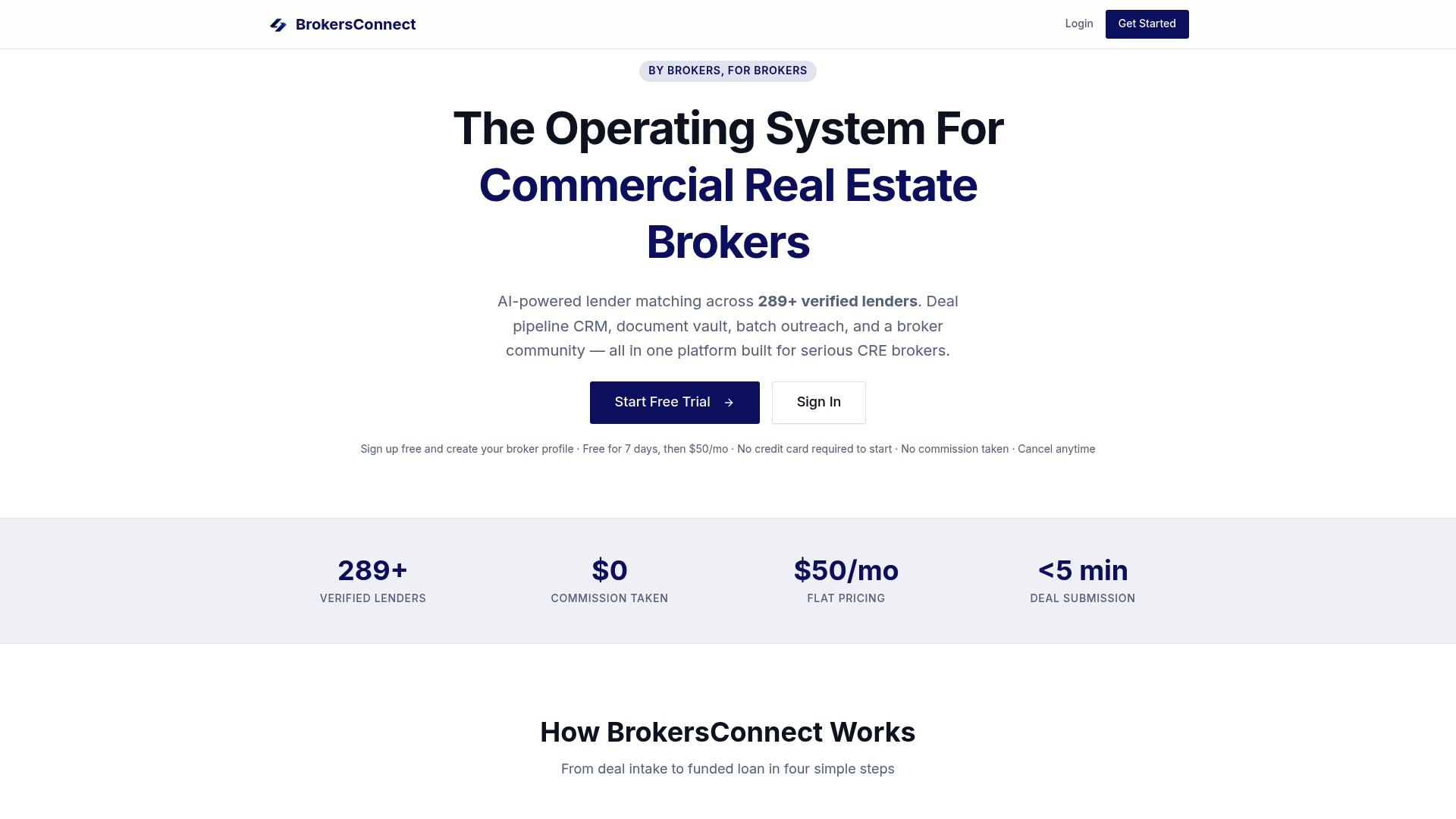
- AI lender matching can help narrow outreach to lenders whose appetite fits the deal.
- Deal templates can keep submissions consistent, labeled, and ready for underwriting.
- Pipeline CRM and document vault features help keep lender conversations and files in one record instead of scattered inboxes.
Start a free trial at BrokersConnect or pull the Loan Document Checklist first to see the format in action. Plans run at a monthly fee after the trial, with no commission or transaction fees.
FAQ
What documents does a CRE loan submission need?
A complete submission includes legal documents (note, mortgage, guaranties, title), credit documents (tax returns, financial statements), property documents (rent roll, operating statements), and valuation reports. Regulatory exam guidance lists these as the baseline documentation lenders and examiners expect in a loan file.
How should brokers calculate DSCR for a submission?
DSCR is net operating income from the reconciled operating statement divided by annual debt service, and it should be shown alongside the source document it was pulled from. Lenders set minimum DSCR thresholds by loan type, so underwriting standards expect that figure to be traceable and consistent with the rent roll.
How current does a rent roll need to be for submission?
Lenders generally expect a rent roll dated within 30 days of submission, reconciled against the operating statement and underwritten NOI. Freddie Mac's submission guidance lists this timing as a standard check before a file moves into underwriting.
What causes the most delays in loan submissions?
Undated rent rolls, unexplained jumps in proforma income, and incomplete guarantor documentation are the most common causes of underwriter follow-up requests. Fixing each with a standardized template, a variance note, or a notarized guarantor statement before submission prevents most of the back-and-forth.
How does BrokersConnect fit into the submission process?
BrokersConnect provides AI lender matching, deal templates, and a pipeline CRM that follow the same documentation order and metric presentation underwriters expect. Brokers use it to match a deal to lenders whose stated appetite fits the loan profile, then track the submission through a single dashboard.
Sources
- Commercial real estate lending (FDIC risk management manual)
- Commercial real estate lending (Comptroller's Handbook, OCC)
- Loan Submission Essentials (Freddie Mac)
- CCIM insights — broker professional differentiation