
Mezzanine financing is subordinated capital that sits between senior debt and equity, letting a borrower raise money without selling more of the company or the deal. Sponsors use it to close a funding gap on an acquisition, recapitalization, or growth plan while keeping ownership intact. Pricing typically runs within a range of current-pay interest on commercial real estate deals, often blended with a smaller slice of payment-in-kind interest, according to industry pricing data from ClearHouse Lending.
Key Takeaways
Mezzanine financing works by trading a higher coupon and modest dilution for capital that preserves ownership control and closes gaps senior debt won't cover.
| Point | Details |
|---|---|
| Subordinated position defines the cost | Mezzanine sits behind senior debt and ahead of equity, which explains its typical pricing band. |
| Structure choice shapes cash flow | Cash interest, PIK interest, and warrants each hit the borrower differently; PIK preserves cash but compounds the payoff. |
| Documentation drives outcomes | The intercreditor agreement and UCC equity pledge determine what happens in a default, not just the coupon. |
| Timeline runs 30 to 90 days | Complex intercreditor negotiations with the senior lender are the most common source of delay. |
| Sourcing efficiency matters | Thecrebrokersconnect matches deal scenarios to verified mezzanine and private-credit lenders and centralizes submission documents to speed placement. |
Table of Contents
- What Is Mezzanine Debt and Why Does It Exist?
- Where Does Mezzanine Sit in the Capital Stack?
- How Do Mezzanine Instruments and Structures Actually Work?
- What Does Mezzanine Financing Cost in 2026?
- When Do Sponsors Actually Use Mezzanine Financing?
- What Are the Pros and Cons of Mezzanine Financing?
- What Documents and Deal Terms Should Borrowers Expect?
- Operating Company or Holding Company: Where Should Mezzanine Sit?
- How Long Does a Mezzanine Deal Take to Close?
- How Should a Borrower Evaluate a Mezzanine Offer?
- How Do Brokers Source Mezzanine Lenders Efficiently?
- How BrokersConnect Speeds Up Mezzanine Lender Placement
- Sources
What Is Mezzanine Debt and Why Does It Exist?
Mezzanine debt is a hybrid instrument: legally it's debt, but it behaves like equity when things go wrong, because it gets repaid only after senior lenders are made whole. That subordinated position is exactly why it exists. Once a company or property has maxed out what a bank or agency lender will provide against cash flow or loan-to-value limits, mezzanine fills the remaining gap so the owner doesn't have to sell down equity to close the deal.
In the U.S. market, three groups show up most often as mezzanine borrowers:
- Private equity sponsors financing a leveraged buyout
- Middle-market operating companies funding growth or an acquisition
- Commercial real estate sponsors bridging the space between a first mortgage and their own equity check
Mezzanine financing lets these borrowers raise material liquidity without giving up board control or diluting ownership the way a straight equity raise would.
Where Does Mezzanine Sit in the Capital Stack?
Picture a simple ladder. Senior debt sits at the bottom, first in line for repayment and lowest in cost. Mezzanine sits above it. Preferred equity sits above that. Common equity, the owner's own money, sits at the top, absorbing losses first and capturing upside last.
On a typical deal, that stack might break down something like this:
- Senior debt: 55%–65% of total capitalization, priced lowest, repaid first
- Mezzanine: 10%–20% of the stack, subordinated to senior but ahead of equity
- Common equity: the remaining 20%–30%, riskiest position, highest potential return
Mezzanine lenders accept more risk than a senior bank because they get paid after it in a default. They accept less upside than equity holders because they get paid before them. That middle position is the entire logic of the instrument, and it's why pricing sits between the two.
How Do Mezzanine Instruments and Structures Actually Work?
Mezzanine capital isn't one product. Lenders structure it several ways depending on the borrower's tax position, growth plans, and how much dilution the sponsor will tolerate.
- Subordinated notes: pay cash interest, PIK interest, or a blend, typically maturing in 5 to 8 years as a bullet payment rather than amortizing.
- Preferred equity or redeemable preferred stock: functions economically like mezzanine debt but sits legally as equity, which changes tax treatment and remedies.
- Warrants and conversion rights: give the lender a small equity stake alongside the debt, often called an "equity kicker," which can dilute the cap table modestly at exit.
The cash versus PIK distinction matters more than most first-time borrowers expect. On a $10 million mezzanine note at 12% all cash, the borrower pays $1.2 million a year out of operating cash flow. Swap half of that to PIK interest, and only $600,000 hits cash flow annually. The rest accrues and compounds onto the principal balance, due at maturity or refinance.
What Does Mezzanine Financing Cost in 2026?
Pricing on U.S. mezzanine deals has held in a fairly consistent band. Current-pay rates commonly run within a range, with an additional portion in PIK interest layered on top, producing all-in yields that vary depending on asset class and leverage, per ClearHouse Lending's market data.
Four factors drive where a specific deal lands in that range:
- Subordination level: the more senior debt ahead of the mezzanine piece, the higher the mezzanine coupon.
- Asset class and property type: development and transitional deals price higher than stabilized, income-producing assets.
- Sponsor track record: repeat borrowers with a clean history get tighter pricing than first-time sponsors.
- Leverage: as combined loan-to-value climbs, so does the mezzanine rate.
When Do Sponsors Actually Use Mezzanine Financing?
Three scenarios cover most mezzanine deals in the U.S. market.
- Leveraged buyouts and acquisitions: sponsors use mezzanine to reduce the equity check required, which can lift the private equity fund's overall IRR on the deal.
- Recapitalizations: a minority owner or founder wants partial liquidity without a full sale, and mezzanine funds the buyout of that stake.
- Commercial real estate gap financing: a sponsor's first mortgage covers, say, 60% of a property's value, but the sponsor only wants to fund 15% to 20% in cash equity. Mezzanine fills the remaining space, whether the deal is a ground-up development or a stabilized acquisition.
What Are the Pros and Cons of Mezzanine Financing?
For a borrower, mezzanine preserves control. You keep your board seats, your ownership percentage stays largely intact, and interest is generally tax-deductible in a way preferred equity distributions are not, which makes debt-structured mezzanine more economically efficient than raising the same capital as equity. Interest-only terms buy time to stabilize a property or grow into the debt load before principal comes due.
The tradeoffs are real. The coupon is meaningfully higher than senior debt, covenants can restrict operating flexibility, and warrants attached to the deal dilute the cap table at exit even if they don't touch day-to-day control.
For the lender, the appeal is a blended return that beats senior debt through cash interest, PIK accrual, and equity kickers. The risk is a subordinate claim: if the deal goes sideways, the mezzanine lender absorbs losses before the equity is wiped out but well after the senior lender is repaid in full.
What Documents and Deal Terms Should Borrowers Expect?
The paperwork on a mezzanine deal does more to determine outcomes in a workout than the interest rate does. Three pieces matter most.
- Intercreditor agreement: this document sets cure rights, purchase options, and priority between the senior lender and the mezzanine lender, and it shapes exactly what each party can do if the borrower defaults.
- Equity pledge: in commercial real estate, mezzanine debt is usually secured by a UCC Article 9 pledge of the ownership interests in the property-owning LLC, not a second mortgage on the real estate itself.
- Covenants and fees: expect financial covenants, default triggers, prepayment penalties, and arrangement fees layered into the loan documents, often mirroring the senior loan's structure for consistency.
Read the intercreditor agreement closely before signing. It determines who controls the workout if the deal underperforms, not the mezzanine note itself.
Operating Company or Holding Company: Where Should Mezzanine Sit?
Placement matters more than borrowers often realize. Mezzanine issued at the operating company level sits closer to actual cash flow. Mezzanine issued at a holding company depends on dividends flowing up from below, a structure lenders call structural subordination, and it usually costs more because that cash flow path carries extra risk.

Security choices vary too: unsecured subordinated notes, a UCC equity pledge, or a second-lien position each carry different remedies and different pricing.
Pro Tip: Ask upfront whether your mezzanine sits at the operating company or the holding company. A quarter-point rate difference often traces straight back to that one structural decision.
How Long Does a Mezzanine Deal Take to Close?
- Term sheet to funding typically runs 30 to 90 days, longer when intercreditor negotiation with the senior lender gets complicated.
- Fees: arrangement fees, legal fees, and due-diligence costs are usually borne by the borrower, layered on top of the mezzanine coupon itself.
- Diligence package: lenders will request historical financials, the senior loan documents, third-party appraisals, and a clear business or property plan before issuing a term sheet.
How Should a Borrower Evaluate a Mezzanine Offer?
Before signing anything, run the numbers on your actual exit or refinance path, not just the immediate capital need.
- Confirm there's a credible path to refinance into senior debt or exit the investment before the mezzanine's bullet maturity comes due.
- Ask exactly how much of the coupon is cash versus PIK, since PIK accrual compounds your total repayment at maturity.
- Get specifics on warrant size and any conversion rights before agreeing to terms, since that's where dilution actually happens.
- Clarify cure rights, purchase options, and prepayment penalties in the intercreditor structure.
Watch for red flags: heavy PIK weighting that balloons the payoff balance, aggressive warrant coverage relative to deal size, and covenants so tight they leave no room for a normal operating hiccup.
How Do Brokers Source Mezzanine Lenders Efficiently?
Mezzanine capital typically comes from three channels: dedicated mezzanine funds, private credit platforms, and broker networks that specialize in subordinated debt. Because minimum deal sizes often run into the millions, given the fixed legal and structuring costs involved, brokers waste real time cold-calling funds that don't fit the deal's size or asset class.
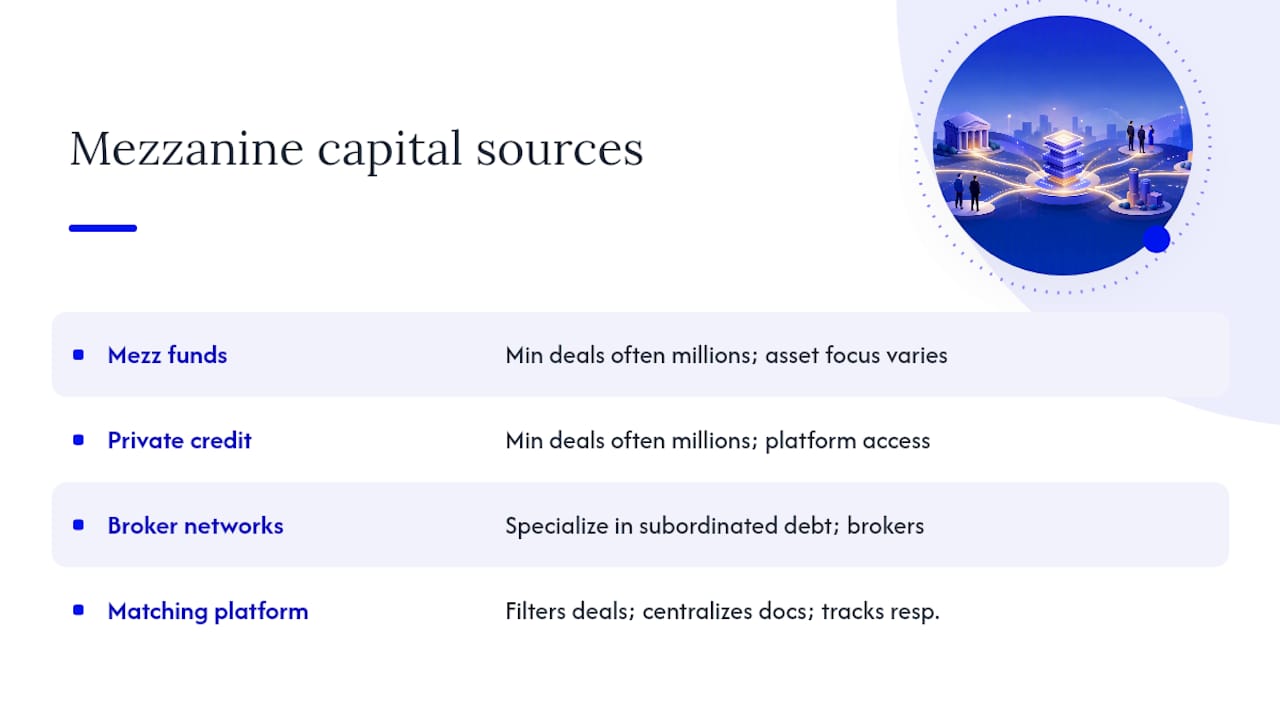
A lender-matching platform narrows that search by property type, leverage, and transaction structure before outreach even starts, which centralizes documents and tracks who actually responds. That combination of private lender sourcing and standardized deal packaging cuts the time between a signed engagement letter and a live term sheet.
When Does Mezzanine Actually Make Tactical Sense?
Mezzanine earns its cost when there's a clear, measurable path to refinance into cheaper senior debt or exit the deal within the note's term, not as a permanent fix for a capital shortfall. The real tradeoff isn't cost versus dilution alone. It's cost and covenant burden versus how much control the sponsor is willing to trade away.
How BrokersConnect Speeds Up Mezzanine Lender Placement
Sourcing mezzanine capital manually means combing through fund websites and cold-calling contacts who may not even lend in your asset class this quarter. Thecrebrokersconnect cuts that search down by matching your deal scenario against a database of 289+ verified lenders based on property type, leverage, loan purpose, and transaction structure, so you're not pitching a stabilized multifamily mezzanine piece to a fund that only does ground-up construction.
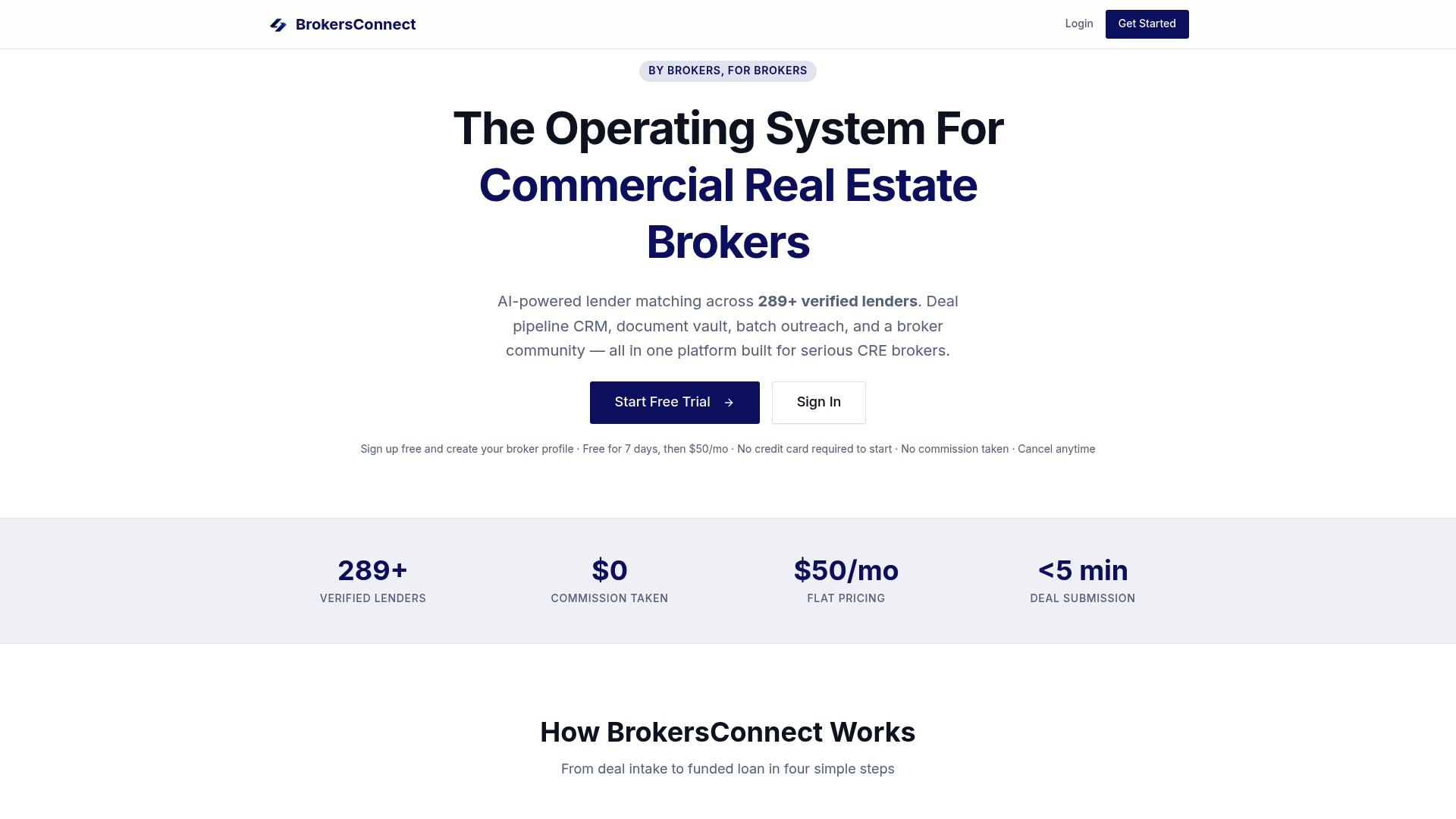
The platform's deal packaging templates and secure document vault mean your submission package, financials, senior loan terms, and appraisals sit in one place instead of scattered across email threads. Pipeline CRM tools track every lender conversation, and the lender responsiveness leaderboard shows which funds actually reply before you spend a week waiting. Start a free trial with BrokersConnect and get your next mezzanine scenario in front of qualified lenders this week.
Sources
- What is Mezzanine Financing? - PGIM
- What is Mezzanine Financing? - Investopedia
- Mezzanine Financing 2026: Rates by Deal Size, Capital Stack & vs Preferred Equity | PeerSense
This article is general information, not a substitute for advice from a qualified financial advisor. Consult a qualified financial professional about your own circumstances before acting on anything here.