
An intercreditor agreement (ICA) is the contract that determines who controls collateral, who gets paid first, and who can pull the enforcement trigger when a borrower goes into distress. It is not a subordination agreement with extra steps. It is the operational rulebook that governs every lender's rights from the moment a default notice lands until the collateral is sold or the debt is restructured. When a borrower files for bankruptcy, the ICA often becomes the controlling document, not the underlying loan agreement.
The first three things to check in any ICA: the payment waterfall, the standstill period, and the enforcement-control clause. Those three provisions will tell you, faster than anything else, whether a junior lender has any practical leverage or is simply along for the ride. Bankruptcy Code Section 510(a) enforces subordination agreements to the same extent they are valid under non-bankruptcy law, which means a well-drafted ICA survives the automatic stay and binds every party in a Chapter 11 proceeding.
- Payment waterfall: defines the order in which cash flows to each creditor class.
- Standstill period: blocks junior lenders from taking enforcement action for a defined window (typically a defined window after a senior default).
- Enforcement-control clause: designates which lender class directs the collateral agent to act.
Table of Contents
- What is an intercreditor agreement, and how does it differ from a subordination agreement?
- Who signs an ICA and what structures do lenders use?
- What are the core provisions every lawyer reads first?
- How do U.S. bankruptcy courts treat an intercreditor agreement?
- What do senior and junior lenders actually negotiate?
- Model language and plain-English annotations for key ICA clauses
- How does an ICA play out in real transactions?
- What practitioners actually say about negotiating ICAs
- Key Takeaways
- The ICA is the deal, not the paperwork
- How Thecrebrokersconnect helps brokers prepare ICA-sensitive deals
- Authoritative sources and further reading
What is an intercreditor agreement, and how does it differ from a subordination agreement?
A subordination agreement does one thing: it changes the priority of one debt claim relative to another. The Legal Information Institute defines it as a contract that guarantees senior debt is paid before subordinated debt if the debtor becomes bankrupt. That is the full scope of a simple subordination instrument.
An ICA goes considerably further. It governs the operational relationship among lenders across payments, enforcement control, distribution of insurance and condemnation proceeds, collateral releases, cure rights, and amendment thresholds. Priority is just the starting point.
Subordination agreement vs. intercreditor agreement at a glance:
- Subordination agreement: establishes lien or payment priority only; no enforcement mechanics; common in consumer real estate and simple two-lender structures.
- Intercreditor agreement: establishes priority AND sets operational rules for enforcement, standstill periods, cure rights, proceeds allocation, DIP financing treatment, and amendment consent thresholds.
- Scope of parties: a subordination agreement typically binds two lenders and a borrower; an ICA can bind multiple lender classes, a collateral agent, a trustee, and guarantors.
- Bankruptcy relevance: a subordination agreement is largely passive in bankruptcy; an ICA actively controls which lender class can vote, credit bid, and consent to a plan.
Transactions that require a full ICA rather than a simple subordination instrument include: commercial real estate deals with layered senior and mezzanine debt, leveraged buyouts with first-lien and second-lien tranches, construction loans with split-collateral structures, and any deal where a first-out/last-out arrangement divides a single lender class into economic sub-tiers.
Governing law matters here. New York law governs the majority of U.S. commercial ICAs, and New York courts have consistently enforced payment-block and standstill provisions as written. Delaware courts apply similar deference to express contractual terms. Choosing a jurisdiction with less developed ICA case law introduces interpretive risk that careful counsel will flag at term sheet stage.
Who signs an ICA and what structures do lenders use?
Typical parties
Every ICA names at least a senior lender (or senior agent acting for a syndicate), a junior lender, and the borrower. In more complex deals the party list expands:
- Senior lender / first-lien agent: holds the controlling enforcement position; typically a bank, insurance company, or CMBS trust.
- Junior lender / second-lien agent: holds a subordinate lien; often a debt fund, mezzanine lender, or preferred equity provider.
- Mezzanine lender: secured by a pledge of equity interests in the borrower entity rather than a direct property lien, creating a parallel collateral structure.
- Collateral agent or trustee: holds liens on behalf of all secured parties; acts only on instruction from the controlling class.
- Borrower and guarantors: bound by the ICA's restrictions on permitted payments and asset dispositions.
- Indenture trustee: present in bond-financed structures where public or Rule 144A notes sit in the capital stack.
Common structural variations
The deal structure shapes every ICA term. There is no universal template.
- First-lien/second-lien: the most common U.S. structure; senior lender holds a first-priority lien on all collateral; junior lender holds a second-priority lien on the same collateral. The Terran Orbital first-lien/second-lien ICA filed with the SEC illustrates how this structure separates lien priority from payment subordination — the agreement expressly states "no payment subordination" while still subordinating second-lien enforcement rights.
- Split-collateral: each lender class holds a first-priority lien on a different collateral pool (e.g., real property vs. equipment vs. receivables). Enforcement rights are asset-specific, which complicates cross-collateral releases.
- First-out/last-out: a single lender class is divided into economic sub-tiers; the first-out tranche receives all principal and interest payments before the last-out tranche sees a dollar. Common in revolving credit facilities and construction loans.
- Payment subordination only: junior lender's lien is not subordinated, but its right to receive payments is blocked until senior debt is satisfied. Less common but appears in certain CRE preferred equity structures.
- Crossover/pari passu with enforcement split: lenders share equal lien priority but one class controls enforcement decisions. Used in club deals where two lenders want economic parity but one demands operational control.
When each structure fits: first-lien/second-lien suits LBOs and large CRE acquisitions where a single collateral pool supports both tranches. Split-collateral works for construction or manufacturing deals with discrete asset classes. First-out/last-out appears most often in revolving facilities or construction draws where cash flow timing creates natural economic separation.
What are the core provisions every lawyer reads first?
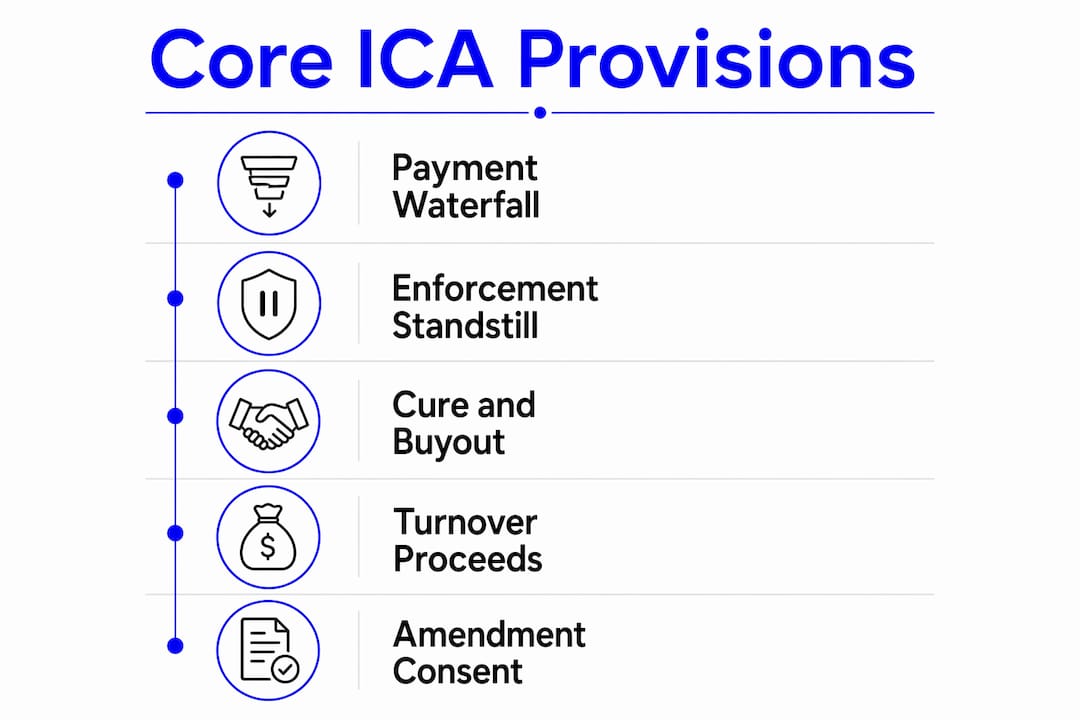
Payment waterfall and payment stops
The waterfall clause specifies the exact order in which available cash is distributed: senior interest, senior principal, fees, junior interest, junior principal, and then equity. The payment-stop (or payment-block) provision is the waterfall's enforcement mechanism. Once a senior default is declared and a blockage notice is delivered, the junior lender cannot receive any payment for the duration of the blockage period, typically a few months, with a cap on the number of blockage periods per year.

A common drafting trap is failing to define permitted payments and payment-block triggers with precision. Juniors can unintentionally lose cash flow at the exact moment the borrower needs liquidity most. Carve-outs for scheduled interest payments, tax distributions, and operating expenses must be explicit.
Enforcement standstill
The standstill clause prohibits the junior lender from taking any "enforcement action" for a defined period after a senior default. The definition of "enforcement action" is where deals get litigated.
Pro Tip: Define "enforcement action" narrowly and exhaustively. A definition broad enough to cover filing a proof of claim or voting in a bankruptcy plan converts lien subordination into de facto payment subordination and strips the junior lender of its bankruptcy rights entirely. Courts have split on whether overly broad standstill language waives a junior lender's right to vote on a reorganization plan.
Cure and buyout rights
Junior lenders typically negotiate the right to cure a senior default (paying arrears to stop enforcement) and a buyout option (purchasing the senior debt at par plus accrued interest). The buyout option is the junior lender's most valuable protective right. Pricing, notice periods, and the window to exercise the option are all heavily negotiated. A buyout right that expires in 10 business days after notice is functionally worthless in a complex restructuring.
Turnover of proceeds
If a junior lender receives any payment in violation of the ICA, it must hold those funds in trust and turn them over to the senior lender. This turnover obligation survives bankruptcy and is one of the provisions courts most consistently enforce under Section 510(a).
Release mechanics
When senior lenders release collateral (in connection with a sale or refinancing), the ICA typically requires junior lenders to release their liens on the same collateral simultaneously, even without their consent. This "automatic release" provision is commercially necessary for senior lenders but must be carefully scoped to exclude releases that are not commercially reasonable or that occur outside an arm's-length transaction.
Amendment and consent thresholds
Most ICAs require unanimous consent to amend core economic terms (interest rate, maturity, principal amount) and a majority-in-interest vote for operational amendments. The threshold for amending the ICA itself is usually higher than the threshold for amending the underlying loan documents, which creates a drafting alignment risk if the two documents use different defined terms for the same concepts.
DIP financing and anti-layering
In bankruptcy, the senior lender often seeks to provide debtor-in-possession (DIP) financing that primes all existing liens. The ICA should address whether junior lenders consent in advance to DIP priming, what the cap on priming DIP debt is, and whether junior lenders retain the right to object to DIP terms in court. Anti-layering provisions prevent the borrower from incurring additional debt that would sit between the senior and junior tranches without both parties' consent.
How do U.S. bankruptcy courts treat an intercreditor agreement?
The Section 510(a) foundation
Section 510(a) of the Bankruptcy Code provides that a subordination agreement is enforceable in a bankruptcy case to the same extent it is enforceable under applicable non-bankruptcy law. Courts have applied this provision broadly to enforce payment-block clauses, standstill periods, and turnover obligations as written, provided the agreement is clear and unambiguous.
Key bankruptcy concepts and ICA interaction
Automatic stay: the stay halts all collection actions against the debtor but does not prevent the ICA's internal mechanics from operating between lenders. A junior lender cannot use the automatic stay as a shield against its own contractual obligations to the senior lender.
DIP financing: senior lenders frequently seek to provide DIP financing that primes junior liens. Courts apply a balancing test under Section 364(d), but a well-drafted ICA consent to DIP priming significantly reduces the junior lender's ability to object.
Cramdown: in a Chapter 11 plan, a dissenting class can be crammed down if the plan is fair and equitable. ICAs affect cramdown by controlling which class is deemed to have accepted or rejected a plan and by restricting junior lenders' ability to vote their claims independently.
Equitable subordination: under Section 510(c), courts can equitably subordinate a claim if the creditor engaged in inequitable conduct that harmed other creditors. A senior lender that uses its ICA enforcement rights to strip value from junior lenders in bad faith risks equitable subordination, though courts apply this remedy sparingly.
Illustrative case law
Courts have consistently held that clear standstill and payment-block provisions in intercreditor agreements are enforceable in bankruptcy under Section 510(a), but ambiguous definitions of "enforcement action" or "proceeds" create litigation risk that can unravel carefully negotiated priority structures at the worst possible moment.
In re Ion Media Networks, Inc. (Bankr. S.D.N.Y. 2010) is frequently cited for the proposition that second-lien lenders who consented in their ICA to DIP priming could not later object to a DIP facility that primed their liens, even when the DIP terms were unfavorable. The court enforced the advance consent as written.
In re Erickson Retirement Communities (Bankr. N.D. Tex. 2010) illustrated the limits of standstill enforcement: where the ICA's definition of "enforcement action" was broad enough to arguably cover filing a proof of claim, the court declined to read it that way, finding that stripping a creditor of its right to participate in a bankruptcy proceeding required explicit, unambiguous language.
In re MPM Silicones, LLC (2d Cir. 2015) addressed cramdown and the absolute priority rule in a context where ICA provisions shaped which creditor classes could be treated as accepting or rejecting a plan. The case reinforced that ICA voting restrictions bind creditors in plan confirmation proceedings.
Practice tip: draft carve-outs from the standstill for filing proofs of claim, voting on a plan, and objecting to DIP financing terms that exceed the pre-agreed cap. These carve-outs preserve junior lenders' bankruptcy rights without materially undermining senior enforcement control. Courts are far more likely to enforce a standstill that expressly preserves these rights than one that appears to waive them by silence.
What do senior and junior lenders actually negotiate?
Negotiation tradeoffs
Negotiating an ICA is both an art and a science. Leverage, collateral type, and credit market conditions shape outcomes more than any template. The table below maps the standard opening positions.
| Provision | Senior lender wants | Junior lender wants |
|---|---|---|
| Standstill period | 180 days, no carve-outs | 90 days, carve-outs for plan voting and proof of claim |
| Payment block | Triggered by any default; unlimited blockage periods | Triggered only by payment default; one blockage period per year |
| Enforcement control | Sole and exclusive; no junior consent required | Shared control after standstill expires |
| Buyout option | No buyout right; or par plus fees | Par plus accrued interest only; 30-day exercise window |
| DIP consent | Advance consent to any DIP up to agreed cap | Right to object to DIP terms exceeding cap |
| Amendment threshold | Majority of senior lenders sufficient | Unanimous consent for any change to ICA economic terms |
| Release mechanics | Automatic release on any commercially reasonable sale | Release only on arm's-length sale at fair market value |
| Collateral scope | All assets, present and after-acquired | Carve-outs for specific operating assets |
Drafting and due-diligence checklist
- Confirm the collateral description in the ICA matches the collateral description in both the senior and junior loan documents exactly.
- Verify that "enforcement action" is defined narrowly and that carve-outs for bankruptcy participation are explicit.
- Check that payment-block trigger events are limited to payment defaults, not technical covenant breaches.
- Confirm the buyout option exercise window is commercially realistic (minimum 20 business days after notice).
- Verify that DIP financing consent is capped at a specific dollar amount and that junior lenders retain the right to object above the cap.
- Confirm that amendment consent thresholds in the ICA are consistent with those in the underlying loan agreements.
- Check that turnover obligations apply only to payments received in violation of the ICA, not to all payments received after a default notice.
- Verify that the governing law clause is consistent across the ICA, the senior loan agreement, and the junior loan agreement.
- Confirm that notice periods for cure rights and buyout options are triggered by written notice to a specific address, not by constructive notice.
- Check that anti-layering provisions define "permitted debt" consistently with the senior loan agreement's negative covenants.
For brokers preparing lender submissions: understand the loan origination process well enough to flag which deal features will require an ICA rather than a simple subordination agreement. Prepare a one-page collateral summary, a draft capital stack diagram, and a list of any existing liens or subordination agreements before approaching lenders. Lenders who receive a clean, organized submission with ICA-relevant facts already surfaced move faster to term sheet.
Model language and plain-English annotations for key ICA clauses
Payment waterfall
Model language: "All proceeds of Collateral received by the Collateral Agent shall be applied: first, to the payment of all outstanding Senior Obligations (including principal, interest, fees, and expenses) until paid in full; second, to the payment of all outstanding Junior Obligations until paid in full; and third, to the Borrower or as a court of competent jurisdiction may direct."
Annotation: The waterfall must cover not just cash proceeds but also insurance proceeds, condemnation awards, and proceeds of any sale under Section 363 of the Bankruptcy Code. Omitting non-cash proceeds creates a gap that junior lenders will exploit in distress.
Enforcement standstill
Model language: "During the Standstill Period, the Junior Lender shall not commence or join in any Enforcement Action with respect to the Collateral. 'Enforcement Action' means any foreclosure, sale, or other realization upon the Collateral, but shall not include (i) filing a proof of claim in any bankruptcy proceeding, (ii) voting on any plan of reorganization, or (iii) objecting to any DIP financing that exceeds the DIP Cap."
Annotation: The carve-outs in clauses (i) through (iii) are non-negotiable from a junior lender's perspective. Without them, the standstill arguably waives the junior lender's right to participate in the bankruptcy, which courts may or may not enforce depending on the jurisdiction.
Cure and buyout rights
Model language: "At any time during the Standstill Period, the Junior Lender shall have the right, exercisable upon not less than [20] Business Days' prior written notice to the Senior Agent, to purchase all (but not less than all) of the Senior Obligations at a price equal to the outstanding principal amount thereof, plus all accrued and unpaid interest, fees, and expenses."
Annotation: "All but not less than all" prevents a junior lender from cherry-picking favorable tranches. The notice period should be long enough to allow the junior lender to arrange financing for the buyout.
Turnover of proceeds
Model language: "If the Junior Lender receives any payment or distribution in respect of the Junior Obligations at a time when such payment is prohibited under this Agreement, the Junior Lender shall hold such payment in trust for the Senior Lender and shall promptly remit such payment to the Senior Agent."
Annotation: The trust language is critical. It creates a constructive trust that survives the junior lender's bankruptcy and prevents the payment from becoming property of the junior lender's estate.
DIP financing carve-out
Model language: "Notwithstanding anything to the contrary herein, the Junior Lender hereby consents to any DIP Financing provided by the Senior Lender in any Insolvency Proceeding, provided that the aggregate principal amount of such DIP Financing does not exceed $[___] (the 'DIP Cap'), and the Junior Lender retains the right to object to any DIP Financing that exceeds the DIP Cap."
Annotation: Always negotiate the DIP Cap at closing, not in bankruptcy. A blank or uncapped DIP consent gives the senior lender unlimited priming authority.
Pro Tip: Align every defined term in the ICA with the corresponding defined term in the senior loan agreement and the junior loan agreement. A mismatch between "Event of Default" in the ICA and "Default" in the loan agreement can create a gap where the ICA's payment-block never triggers, or triggers too early. Run a defined-terms cross-reference check before signing.
How does an ICA play out in real transactions?
Example 1: Commercial real estate layered financing
A sponsor acquires a $50 million office building using a $35 million senior mortgage from a bank and a $10 million mezzanine loan from a debt fund. The mezzanine lender holds a pledge of equity interests in the property-owning entity rather than a direct lien on the property. The ICA governs the relationship between the bank and the debt fund.
When the property's occupancy drops and the borrower misses a debt service payment, the ICA's timeline controls:
- Day 1: Senior lender delivers a default notice to the borrower and a blockage notice to the mezzanine lender.
- Days 1–90: Standstill period. Mezzanine lender cannot foreclose on the equity pledge. It may file a proof of claim if a bankruptcy is filed.
- Day 60: Mezzanine lender delivers a cure notice, paying the senior lender's arrears to stop the standstill clock.
- Day 75: Mezzanine lender exercises its buyout option, purchasing the senior debt at par plus accrued interest.
- Day 90+: Mezzanine lender, now holding the senior position, controls enforcement and negotiates directly with the borrower.
For brokers working CRE deals with layered capital, understanding this timeline is the difference between a deal that closes and one that falls apart when a lender discovers mid-process that its enforcement rights are blocked for 90 days.
Example 2: LBO with mezzanine financing
A private equity sponsor acquires a manufacturing company using a $200 million first-lien term loan, a $50 million second-lien term loan, and $30 million in mezzanine notes. The first-lien/second-lien ICA governs the relationship between the two bank tranches; a separate ICA (or a tri-party agreement) governs the mezzanine notes.
In distress, the first-lien lenders control enforcement. The second-lien lenders' standstill runs 180 days. The mezzanine lenders' standstill runs 270 days. By the time the mezzanine lenders can act, the first-lien lenders have typically already negotiated a sale or restructuring that leaves the mezzanine with little or no recovery.
- Key ICA event: first-lien lenders propose a Section 363 sale. Second-lien lenders object that the sale price is below the value of their collateral. The ICA's credit bid provision determines whether second-lien lenders can submit a competing bid.
- Practical consequence: second-lien lenders who negotiated a credit bid right in the ICA have real leverage in the 363 process; those who did not are passive observers.
Example 3: Construction financing with split collateral
A developer finances a mixed-use project with a $40 million construction loan secured by the land and improvements and a $15 million equipment financing facility secured by the construction equipment. The construction lender and the equipment lender execute a split-collateral ICA.
- Each lender holds a first-priority lien on its own collateral pool.
- The ICA governs what happens to insurance proceeds if the building is damaged (does the construction lender get all proceeds, or are they split?).
- If the developer defaults, the construction lender can foreclose on the land and improvements without the equipment lender's consent, but cannot sell the equipment.
- The ICA's proceeds-allocation clause determines whether the construction lender can credit bid for the entire project or only for its collateral slice.
Brokers presenting construction deals to lenders should disclose any existing equipment liens or ground leases upfront. A split-collateral structure that is not disclosed until due diligence will delay closing by weeks.
What practitioners actually say about negotiating ICAs
Practitioners at firms like Lowenstein Sandler and Dorsey consistently make the same point: the ICA is not a closing formality. It is the document that will govern the deal if anything goes wrong, and in insolvency it often becomes the controlling document, with enforcement and release provisions determining creditor rights in bankruptcy.
Treat the intercreditor agreement as a 'life-or-death' document from origination. The loan agreement governs the good times; the ICA governs everything else. Practitioners who negotiate the ICA as an afterthought to the loan documents consistently find themselves litigating ambiguities that could have been resolved in a two-hour drafting session at closing.
The non-obvious tactics that experienced counsel use:
- Preserve junior rights without harming senior recovery: negotiate carve-outs for plan voting, proof of claim filing, and adequate protection objections. These rights cost the senior lender nothing in a solvent deal and are worth everything to the junior lender in bankruptcy.
- Time the buyout trigger carefully: a buyout right that is triggered by any default (including technical defaults) gives the junior lender maximum optionality. A buyout right triggered only by acceleration gives the senior lender time to cure the default before the junior can act.
- Use the ICA to control the 363 sale process: negotiate credit bid rights and the right to submit a stalking horse bid. A junior lender with a credit bid right can effectively set a floor on the sale price.
- Align the ICA's definition of "Collateral" with the UCC financing statements: a mismatch between the ICA's collateral description and the filed UCC-1 creates a perfection gap that a bankruptcy trustee can exploit.
Top 6 must-fix items before signing:
- Define "Enforcement Action" narrowly; carve out bankruptcy participation rights explicitly.
- Cap the DIP financing consent at a specific dollar amount.
- Confirm the buyout option exercise window is at least 20 business days.
- Verify that payment-block triggers are limited to payment defaults, not all events of default.
- Align all defined terms across the ICA and the underlying loan documents.
- Confirm that the governing law clause is consistent across all transaction documents.
Key Takeaways
An intercreditor agreement is the operational rulebook that controls enforcement, payment priority, and creditor rights in distress, and its enforceability under Bankruptcy Code Section 510(a) makes it the most consequential document in any multi-lender capital structure.
| Point | Details |
|---|---|
| ICA vs. subordination agreement | An ICA governs enforcement, cure rights, and proceeds allocation; a subordination agreement only establishes priority. |
| Section 510(a) enforcement | Bankruptcy courts enforce clear ICA provisions, including standstill and payment-block clauses, to the same extent valid under non-bankruptcy law. |
| Drafting the standstill | Define "enforcement action" narrowly and carve out plan voting and proof-of-claim rights to preserve junior lender bankruptcy participation. |
| Negotiation priorities | Senior lenders seek broad standstill and payment-block rights; junior lenders should push for buyout options, DIP caps, and carve-outs. |
| Thecrebrokersconnect for brokers | Thecrebrokersconnect helps brokers surface ICA-sensitive deal facts early, organize lender submissions, and match deals to lenders who understand layered capital structures. |
This article is general information, not legal advice. Confirm current rules and ICA drafting requirements with qualified counsel for your specific transaction.
The ICA is the deal, not the paperwork
The conventional wisdom in commercial lending treats the loan agreement as the deal and the intercreditor agreement as the administrative paperwork that follows. That framing is backwards, and it costs lenders real money.
Every significant credit loss I have seen in multi-lender structures traces back to an ICA provision that was negotiated carelessly or not at all. The standstill that was copied from a prior deal without adjusting the definition of "enforcement action." The DIP consent that had no cap. The buyout option with a five-business-day exercise window that expired before the junior lender could arrange financing. These are not exotic edge cases. They are the standard failure modes of deals where the ICA was treated as a formality.
The credit markets have moved toward more complex capital structures, not simpler ones. First-out/last-out arrangements, split-collateral deals, and mezzanine-over-senior structures are more common now than they were a decade ago. Each one requires a bespoke ICA that reflects the actual collateral structure and the actual negotiating leverage of the parties. A form agreement that worked for a plain first-lien/second-lien deal will not work for a construction loan with three collateral pools and a preferred equity tranche.
Brokers who understand ICA mechanics well enough to flag issues at the term sheet stage are genuinely more valuable to lenders than those who surface problems at closing. Platforms like Thecrebrokersconnect that centralize deal metadata, collateral descriptions, and lender preferences make it easier to identify ICA-sensitive deal features before they become closing delays.
How Thecrebrokersconnect helps brokers prepare ICA-sensitive deals
Brokers working layered capital structures spend too much time chasing lenders who are not equipped for the deal in front of them. The real cost is not the time spent on cold calls. It is the closing delays that happen when a lender discovers mid-diligence that the deal has a mezzanine tranche, a split-collateral structure, or an existing subordination agreement that was never disclosed.
Thecrebrokersconnect gives brokers a faster path from deal scenario to lender match. The platform's database of 289+ verified lenders is searchable by property type, loan amount, leverage, and transaction structure, so brokers can identify lenders who are already comfortable with layered capital structures before the first conversation. The document vault and deal templates help brokers prepare clean, organized submissions that include the collateral summary, capital stack diagram, and existing lien disclosures that ICA-sensitive lenders need to move quickly.
The platform also supports deal pipeline management, direct lender messaging, and a lender responsiveness leaderboard that helps brokers prioritize outreach. For brokers preparing submissions on construction loans, mezzanine deals, or any transaction where an ICA will be required, Thecrebrokersconnect reduces the time from deal packaging to lender engagement.
This is not legal advice. Qualified counsel should draft and negotiate the intercreditor agreement for your transaction. Start a free trial and see how the platform fits your deal workflow.
Authoritative sources and further reading
The sources below are the primary references for ICA drafting, litigation research, and bankruptcy analysis in U.S. commercial finance.
| Source | What it covers | Best used for |
|---|---|---|
| Bankruptcy Code Section 510(a) | Statutory authority for enforcing subordination agreements in bankruptcy | Grounding enforceability arguments in court |
| Practical Law (Thomson Reuters) | Model ICA clauses, negotiation notes, and comparative analysis | Drafting and clause-by-clause negotiation |
| LexisNexis UK Intercreditor Guide | Introductory guide to ICA purpose, parties, and key provisions | Cross-checking clause lists and understanding LMA precedents |
| Lexology (intercreditor and bankruptcy) | Practitioner summaries of ICA enforceability and bankruptcy court rulings | Quick case law research and enforcement analysis |
| Barnes Walker legal glossary | Plain-English explanation of ICA provisions and common drafting traps | Due diligence and client education |
| Lowenstein Sandler LLP (2023 article) | Practitioner analysis of ICA negotiation as art and science | Negotiation strategy and term-sheet preparation |
| Dorsey practitioner note (2025) | Analysis of ICA role in insolvency and enforcement | Bankruptcy preparation and distressed deal analysis |
| SEC EDGAR (Terran Orbital ICA) | Real-world first-lien/second-lien ICA with full operative language | Reviewing actual market-standard drafting |
A note on primary authorities: always consult the Bankruptcy Code directly and review current case law in your circuit before relying on any secondary source for litigation strategy. ICA enforceability can turn on circuit-specific interpretations of Section 510(a) and the automatic stay. Engage qualified restructuring counsel for any transaction where bankruptcy is a realistic scenario.