
A loan holdback is a portion of loan proceeds a lender withholds at closing until specific, verifiable conditions are met. Lenders use holdbacks when work isn't finished or risk isn't fully resolved at closing, most often in construction financing, commercial lease-up deals, and residential purchases requiring repairs. Release depends on objective proof, not lender opinion, and that distinction shapes everything else in this guide.
TL;DR:
- Holdback percentages typically range from 5% to 20%, with higher amounts in riskier construction projects and durations spanning 30 to 360 days.
- Effective documentation, such as lien waivers, inspection reports, and permits, accelerates release and minimizes delays in fund disbursement.
- Negotiating objective trigger conditions, partial milestone releases, and a fixed outside date improves holdback handling and reduces administrative delays.
- Centralizing all invoice, waiver, and inspection document management through a platform helps brokers avoid release stalls caused by disorganization.
- Most disputes over holdback releases stem from vague contract language rather than the payment amounts, making clarity and specific conditions essential.
Table of Contents
- What A Loan Holdback Is (And How It Differs From Retainage, Draws, And Escrow)
- Where Holdbacks Show Up: Construction, Leasing, And Residential Repairs
- How Holdback Releases Actually Get Processed
- What A Holdback Typically Costs You In Time And Dollars
- The Paperwork That Actually Gets Your Money Released
- The Real Risk To Borrowers, And How To Negotiate Around It
- How Brokers Keep Holdback Releases From Stalling
- Where To Verify The Details Yourself
- Why Most Holdback Disputes Are Preventable
- Sources
- FAQ
What A Loan Holdback Is (And How It Differs From Retainage, Draws, And Escrow)
A holdback is money the lender keeps back from the loan amount until the borrower proves something specific got done. It's the umbrella term for the whole practice. Below that umbrella sit a few terms that get used loosely but mean different things:
- Escrow holdback: funds sit with a neutral third party (an escrow agent or title company) rather than the lender directly, which limits the lender's control and gives both sides a documented release process.
- Retainage: a percentage withheld from each progress payment to a contractor, common on construction jobs, released after final completion and lien waivers clear.
- Draw schedule: the sequence of partial fundings released as construction milestones are hit; it's the delivery mechanism, while the holdback is the money sitting on the sidelines until conditions clear.
The practical difference shows up on funding day. If a title company holds the money, the lender can't unilaterally decide it's satisfied and release funds without following the written escrow instructions. If the lender holds it directly, release depends entirely on internal sign-off, which is exactly why negotiating objective triggers matters so much.
Where Holdbacks Show Up: Construction, Leasing, And Residential Repairs
Holdbacks aren't one-size-fits-all. The trigger event and paperwork change depending on the deal type:
- Construction and renovation loans: retainage (commonly 5% to 10% per draw) accumulates until the general contractor delivers final lien waivers and passes municipal inspection.
- Tenant improvement and leasing commission holdbacks: commercial lenders often hold back a chunk of proceeds until a tenant actually signs the lease or takes occupancy, since projected rent isn't real income yet.
- Fix-and-flip and bridge loans: renovation funds get held back and released against contractor invoices as work progresses, protecting the lender from advancing cash for work that never happens.
- Residential repair escrows: when an appraisal flags deferred maintenance, like a missing handrail or a failed roof inspection, closing proceeds anyway with a portion escrowed until the repair is verified.
Each version exists for the same reason: the lender is financing a promise, not a finished product, and wants proof before releasing the rest of the cash.
How Holdback Releases Actually Get Processed
The process starts long before closing and follows a fairly predictable sequence.
- Documentation at commitment. The holdback amount, trigger conditions, and who controls the funds all get spelled out in the term sheet and again on the closing statement. Vague language here creates disputes later.
- Funding day math. The borrower receives the loan amount minus the holdback. If a loan carries a repair escrow, the borrower nets less than the full loan amount at the table, with the holdback amount sitting in escrow.
- Defining the release condition. Good agreements name a specific, checkable standard: a licensed inspector's certification, a certificate of occupancy, or a signed lien waiver, not a phrase like "lender satisfaction."
- Requesting release. The borrower (or contractor, on construction deals) submits invoices, inspection reports, and waivers to the escrow agent or lender's loan servicing team.
- Verification and disbursement. Most escrow agents process complete, clean submissions within 5 to 10 business days; incomplete lien-waiver packages are the most common cause of delay.
- Escalation if funds are disputed. Commercial loan agreements typically spell out an arbitration or independent-inspector path if the borrower and lender disagree on whether the trigger was met.
Pro Tip: Submit lien waivers and inspection reports as a single, labeled package rather than piecemeal. Escrow agents process complete submissions faster, and partial packages are the single biggest reason releases stall past 30 days.
What A Holdback Typically Costs You In Time And Dollars
Holdback size and duration vary by deal type, but the common percentage range cited in commercial closings runs roughly 5% to 20% of the relevant loan or contract amount, with higher percentages reserved for riskier construction scenarios.
By the numbers: Residential repair escrows are frequently smaller, sometimes a few thousand dollars tied to a single line item, while construction retainage can run for the life of the build and take another 30 to 90 days to release after final completion. Time limits generally fall somewhere between 30 and 360 days depending on the complexity of the work being verified.
Loan purpose drives the range more than lender type does. A bridge lender financing a light rehab will hold back less proportionally than a construction lender funding vertical development, because the completion risk is smaller.
The Paperwork That Actually Gets Your Money Released
Lenders and escrow agents ask for specific, checkable documents, not general assurances that work is done:
- Contractor invoices paired with unconditional lien waivers, proving the contractor was paid and won't file a claim against the property.
- Municipal inspection reports, permits, and the certificate of occupancy, which confirm the work meets code, not just that it looks finished.
- Photographs and manufacturer warranties, especially for items like roofing or HVAC systems tied to a repair escrow.
- Signed acceptance from the borrower or property manager, confirming the work matches what was scoped.
- Written escrow agent instructions, spelling out exactly which documents trigger disbursement and the timeline for paying out once they're received.
Assembling this before requesting release, rather than scrambling afterward, is the single biggest lever borrowers have over how fast they get paid.
The Real Risk To Borrowers, And How To Negotiate Around It
Holdbacks protect lenders, but they create real exposure for borrowers if the terms aren't tight. The most common problems are a cash-flow squeeze when contractors expect payment before the holdback releases, delay costs stacking up while paperwork sits unprocessed, and the administrative burden of chasing inspectors and lien waivers on top of running the project.
The single worst term to accept is open-ended "lender satisfaction" language, since it gives the lender total discretion over when, or whether, to release funds. Negotiate against that specifically:
- Demand objective triggers. Replace subjective standards with a named inspector's certification, a permit number, or a specific lease execution date.
- Push for step-down releases. Ask for partial disbursements as milestones clear, rather than one lump release at the very end.
- Cap the duration. Set an outside date after which unreleased funds either pay out automatically (with proof submitted) or convert to a different remedy.
- Ask for interest on the escrowed balance. It's a reasonable request when a lender is holding six figures for months.
Pro Tip: Raise these four points at term-sheet stage, not at closing. Once the closing statement is drafted, lenders are far less willing to renegotiate holdback mechanics. A term sheet negotiation checklist built around these points gives you leverage before you're locked in.
How Brokers Keep Holdback Releases From Stalling
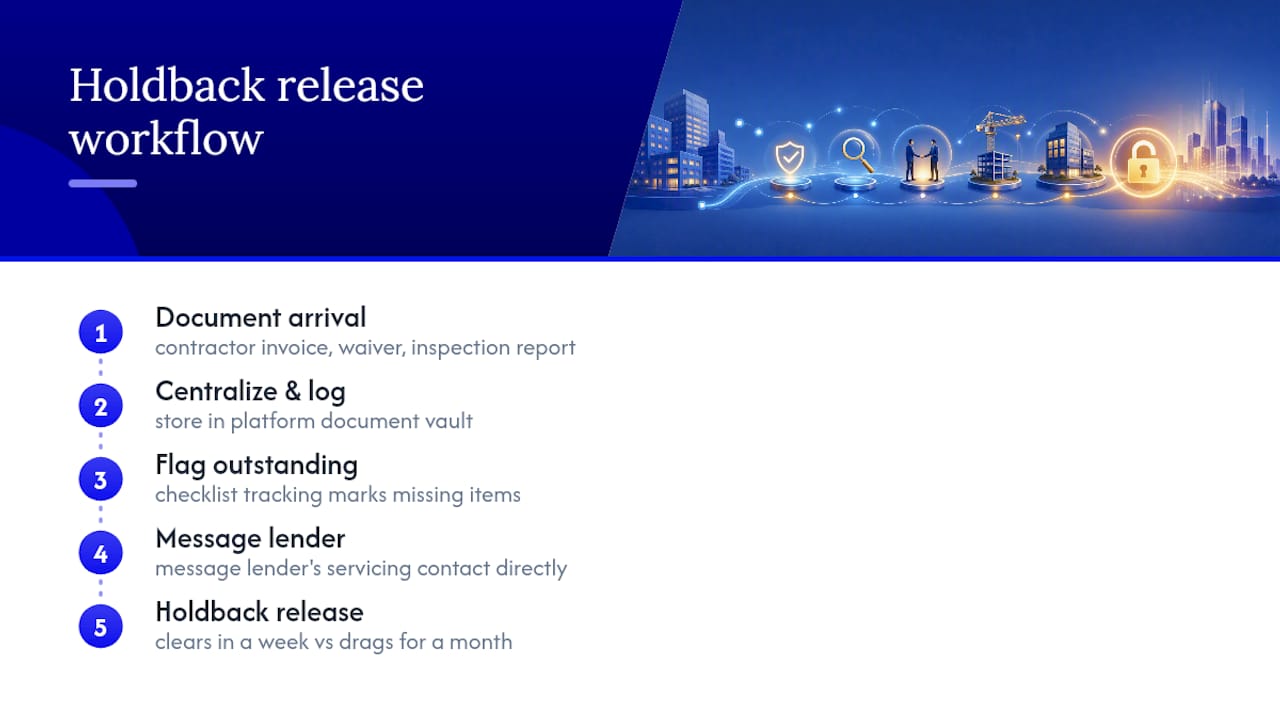
Brokers managing several deals at once tend to lose track of which lien waiver or inspection report is missing for which property, and that's usually what stalls a release past its expected window. Centralizing invoices, waivers, and inspection reports in one place, rather than scattered across email threads, cuts the back-and-forth significantly.
A commercial real estate financing platform gives brokers a document vault for exactly this purpose, alongside checklist tracking and direct lender messaging so nothing gets buried. A broker managing a construction loan holdback can log every contractor invoice and waiver as it arrives, flag what's outstanding, and message the lender's servicing contact directly instead of waiting on a general inbox. That kind of organized handoff is often the difference between a release that clears in a week and one that drags for a month.
Where To Verify The Details Yourself
For federally backed residential rehab loans, HUD's 203(k) rehabilitation mortgage insurance program spells out exactly how escrowed repair funds move and what documentation triggers disbursement. Consumer mortgage escrow protections more broadly fall under the Truth in Lending Act's Regulation Z, which is worth reading if you want to understand how residential rules differ from commercial holdback agreements. For a plain-language walkthrough of what a repair escrow means at a home closing, Amerisave's glossary entry covers the buyer's side clearly.
Why Most Holdback Disputes Are Preventable
Most holdback fights aren't really about the money. They're about vague language that let two sides read the same contract two different ways. The lenders who write "subject to lender's satisfaction" aren't necessarily acting in bad faith, but that phrase hands them discretion they'll use conservatively, especially in a market where they're managing risk across dozens of loans.
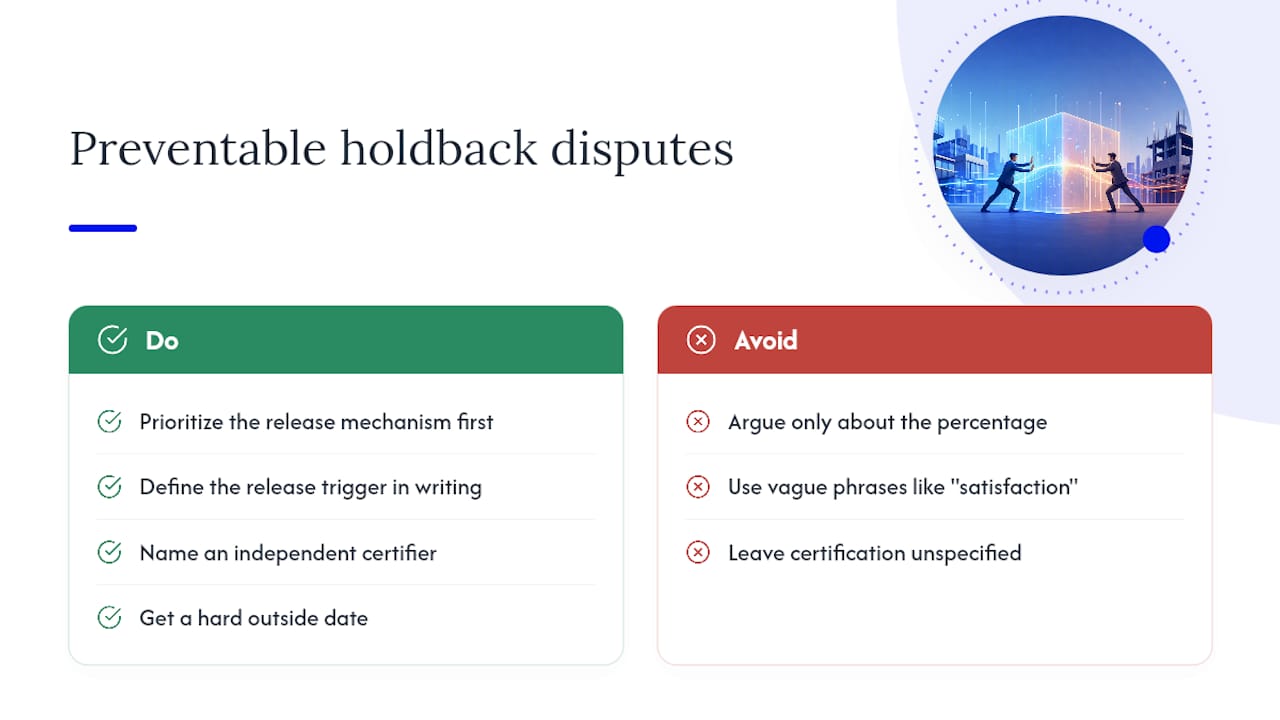
The advice that gets repeated most often, "just negotiate a lower holdback percentage," misses the point. Size matters less than clarity.
If you're a broker or borrower walking into a term sheet with a holdback provision, prioritize the release mechanism before you argue about the percentage. Get the trigger defined in writing, get an independent certifier named, and get a hard outside date. Everything else, the dollar amount included, is easier to live with once those three things are locked down.
— Theron
Sources
- Holdback & Escrow Provisions — Commercial Loans
- HUD 203(k) rehabilitation mortgage insurance program
- Escrow requirements under the Truth in Lending Act (Regulation Z)
- Escrow Holdback: What It Means for Home Buyers in 2026
FAQ
What Is A Loan Holdback?
A loan holdback is a portion of approved loan funds that the lender or an escrow agent withholds at closing until the borrower meets a specific condition, such as finishing repairs or securing a signed lease. It protects the lender against financing work that never gets completed.
How Does A Holdback Work?
The lender advances the loan amount minus the holdback at closing, and the withheld portion sits with the lender or an escrow agent until the borrower submits proof, like inspection reports or lien waivers, that the trigger condition was met. Release typically follows within 5 to 10 business days of a complete submission, though construction retainage can take longer.
Do Lenders Allow Escrow Holdbacks?
Yes, escrow holdbacks are common in both residential and commercial lending, particularly when an appraisal flags incomplete repairs or a construction project isn't finished at closing. HUD's 203(k) program is a well-documented example on the residential side.
What Is A Holdback Payment And How Does It Work?
A holdback payment is the disbursement released once the borrower proves the trigger condition, like a certificate of occupancy or a signed lease, has been satisfied. The borrower or contractor submits documentation to the lender or escrow agent, who verifies it before releasing the withheld funds.