
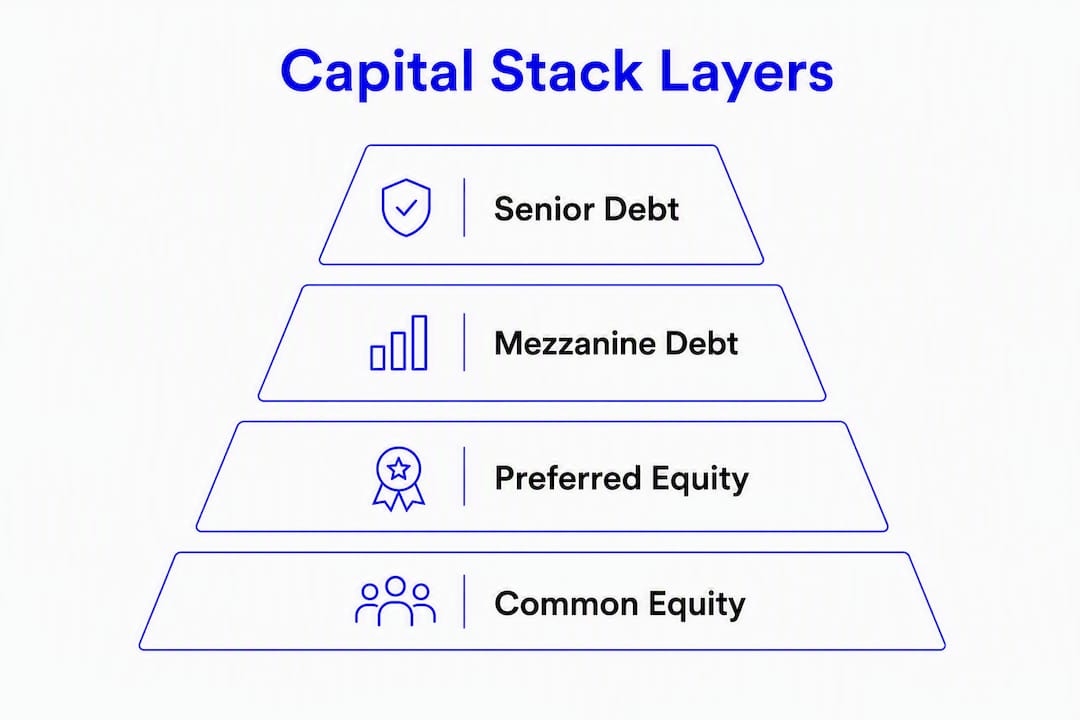
A capital stack is the ranked list of every debt and equity claim on a commercial property, ordered by who gets paid first. On a $50M acquisition, a typical stack might look like: senior debt at $32M (64% LTV), mezzanine at $9M (18% of stack), and sponsor equity at $9M (18% of stack), as shown in the PeerSense worked example. Senior lenders get paid first in any scenario — operating cash flow, refinance, or sale. Equity sits at the bottom and absorbs losses before anyone else sees a haircut.
That ordering is everything. It determines your risk exposure, your expected return, and your leverage in a negotiation. JPMorgan notes that not every deal uses all four layers, and payment priority maps directly to risk and return across the stack.
Key metrics to know upfront: Senior debt typically targets a debt service coverage ratio (DSCR) of 1.20x–1.35x. CMBS lenders commonly cap loan-to-value (LTV) at 64–65% on stabilized assets, as seen in the PeerSense and 2026 hotel stack example. Mezzanine coupons typically run 12% current pay plus 2% PIK accrual, as illustrated in the same example.
Table of Contents
- What are the four layers of a capital stack?
- Real capital stack examples by deal type
- How does stack position change your actual returns?
- What legal documents actually govern the stack?
- How do you compare competing term sheets?
- Common mistakes that cost deals time and money
- Key Takeaways
- The part of stack structuring most brokers underestimate
- Thecrebrokersconnect gives brokers a faster path to the right lender
- Useful sources
What are the four layers of a capital stack?
According to Midwood Asset Management, senior debt typically represents the majority of total capital, mezzanine or preferred equity a smaller intermediate portion, and common equity the remaining portion depending on deal type. Here is what each layer actually means in practice.
Senior debt
Senior debt holds a first-lien mortgage on the property. It is the cheapest capital in the stack and the first to be repaid. Stabilized multifamily and office deals typically see senior LTV ratios around two-thirds, with CMBS lenders often targeting a DSCR at or above 1.25. Amortization schedules vary: agency loans (Fannie Mae, Freddie Mac) often require 30-year amortization, while CMBS and bank loans may be interest-only for a period. Covenants typically include DSCR maintenance tests, reserve requirements, and restrictions on additional debt.
Mezzanine debt
Mezz sits between senior debt and equity. Critically, mezzanine lenders typically secure their position via a UCC pledge of the equity interests in the property-owning LLC rather than a second mortgage — a distinction that changes foreclosure mechanics entirely. Coupons typically run in the low double digits with possible PIK accrual on top. Sponsors use mezz to fill the gap between what a senior lender will fund and the equity they want to deploy. Underwriters track "attachment LTV" (where mezz begins) and "detachment LTV" (where it ends) to size exposure.
Preferred equity
Preferred equity behaves like debt in priority but sits in the equity structure. It carries a fixed preferred return, typically 8–12%, and has capped upside — preferred equity investors do not participate in appreciation above their return threshold. Control provisions matter here: preferred equity agreements often include control triggers that allow the preferred investor to step in if the sponsor misses a distribution or breaches a covenant.
Common equity
Common equity is split between the general partner (GP) and limited partners (LPs). Sponsors typically contribute about 18% of the total stack as GP (as seen in the PeerSense $50M hotel example), with LPs funding the rest. Adventures in CRE explains that waterfall tiers typically flow: return of capital, 8% preferred return to LPs, GP catch-up, then above-hurdle promote splits. A sponsor's promote can be 20–30% of profits above the hurdle — but only after LPs have been made whole. Model waterfalls explicitly rather than assuming pro rata splits; the difference can be several hundred basis points of realized LP return.
Pro Tip: Negotiate intercreditor terms in parallel with economic terms. Adding mezz or preferred equity late in a deal timeline — after the senior lender has issued a commitment — can stall closing by weeks while intercreditor provisions are hammered out.
Real capital stack examples by deal type
The table below summarizes representative CRE scenarios with typical capital allocations and underwriting benchmarks, which can vary by market and deal specifics. These are representative ranges, not guarantees, and actual sizing depends on market conditions, asset quality, and sponsor track record.
Representative CRE deal types often feature capital stacks with senior debt typically sized at 64–65% (as in hotel deals, per PeerSense), mezzanine at 18%, and sponsor equity at 18%. Senior DSCR targets typically range 1.20x–1.35x, with senior rates varying by loan type and risk profile.
The $50M hotel worked example in detail. PeerSense's worked example structures the deal with senior CMBS, mezzanine with current pay plus PIK, and sponsor equity contributions. Over a multi-year hold, this arrangement targets a levered IRR notably higher than the unlevered yield, reflecting increased risk and leverage. Combined leverage is high relative to total capitalization, aligning with typical loan-to-cost caps used in institutional hotel financing.

Scenario notes. A stabilized multifamily deal rarely needs mezz — agency financing at 65–70% LTV often covers the stack efficiently. Value-add deals introduce bridge debt and sometimes a mezz tranche to reduce the sponsor equity check while the business plan executes. Ground-up development stacks lean on construction loans at 55–65% loan-to-cost, with mezz or preferred equity filling the gap; private money lenders often fill that gap position when institutional mezz is unavailable or too slow.
How does stack position change your actual returns?
Position in the stack is the single biggest driver of risk-adjusted return. Here is the math in plain terms.
-
Unlevered yield vs. debt cost. If a stabilized property yields 6.0% unlevered and senior debt costs 6.5%, adding more debt is not accretive — you are borrowing above your yield. Mezz at 12% is only accretive when the marginal equity return it frees up exceeds that 12% coupon. Run this spread check before adding any subordinate capital.
-
Cash-on-cash impact. On the $50M hotel: $9M mezz at 12% current pay costs $1.08M annually. That comes off net operating income before the sponsor sees a dollar of cash flow. In a lean year, mezz debt service can compress cash-on-cash to near zero even when the property is performing.
-
Levered IRR math. The same hotel with no mezz (sponsor equity at $18M, 36% of stack) might target 13–15% levered IRR. Adding $9M mezz reduces the sponsor equity check to $9M (18% of stack) and, if the business plan executes, pushes levered IRR toward 19.4% as in the PeerSense worked example — but the downside is steeper. A 10% NOI shortfall that barely touches a no-mezz sponsor can wipe out cash flow entirely when mezz debt service is fixed.
-
Exit sensitivity. Senior lenders get par plus accrued interest at sale or refinance. Mezz lenders get their principal plus any PIK accrual. Preferred equity investors get their preferred return plus return of capital. Common equity gets what is left. In a compressed-cap-rate exit, that residual can be substantial. In a distressed sale, common equity can be zeroed out while senior and mezz lenders walk away whole.
Pro Tip: Model a downside scenario where NOI is 15% below underwriting and the exit cap rate is 50 basis points wider than your base case. If that scenario wipes out common equity but leaves mezz whole, you have correctly sized the risk each layer is taking.
What legal documents actually govern the stack?
The economics of a capital stack are only as good as the documents behind them. Three agreements define who controls what when things go sideways.

Intercreditor agreement. When mezz sits alongside senior debt, the senior lender requires an intercreditor agreement. The American Bar Association's real estate finance guidance confirms that these agreements set the teardown order of remedies, define control triggers, and allocate notice and cure mechanics. Key provisions: the mezz lender's right to cure a senior default (typically 10–30 days after senior lender notice), standstill periods, and the mezz lender's right to purchase the senior loan at par. Failing to align these provisions with the business plan creates closing friction and downstream risk.
Subordination, Non-Disturbance, and Attornment (SNDA). SNDA agreements govern the relationship between a lender and existing tenants. Subordination means the tenant's lease is junior to the mortgage. Non-disturbance means the lender agrees not to disturb the tenant's possession if it forecloses. Attornment means the tenant agrees to recognize a new owner post-foreclosure. For office and retail assets with anchor tenants, SNDA negotiations can take weeks and directly affect lender enforcement rights.
Preferred equity agreements. These documents define the preferred return, the control trigger conditions, and the liquidation preference. A control trigger might activate if the sponsor misses two consecutive quarterly distributions or if DSCR falls below 1.0x. Once triggered, the preferred investor can remove the GP — a provision that changes the risk profile of the deal entirely.
For a deeper look at intercreditor agreement drafting, including bankruptcy considerations and cure-period mechanics, that resource covers the negotiation points brokers need to flag early.
Broker checklist — confirm these before closing:
- Intercreditor term sheet received and reviewed by senior lender
- Cure periods defined (mezz lender's right to cure senior default)
- Control triggers in preferred equity agreement mapped to business plan milestones
- SNDA status confirmed for all major tenants
- Origination fees, exit fees, and prepayment penalties modeled into returns
- Standstill period duration acceptable to mezz lender
How do you compare competing term sheets?
Not all term sheets quote costs the same way. Convert everything to all-in cost before comparing.
| Term | What to ask | Why it matters |
|---|---|---|
| Effective rate | Is the coupon current pay, PIK, or blended? | PIK accrues — your actual cost compounds |
| Amortization | Interest-only period? Full amortization schedule? | IO periods inflate cash-on-cash early, compress it later |
| DSCR covenant | Maintenance test or incurrence test? | Maintenance tests can trigger default mid-hold |
| Prepayment | Step-down, yield maintenance, or defeasance? | Exit costs can erase 50 bps of IRR |
| Maturity / extensions | How many extension options? What are the conditions? | A tight maturity with no extension is refinance risk |
| Attachment / detachment LTV | Where does mezz begin and end? | Defines mezz lender's loss exposure |
| Reporting | Monthly, quarterly? Audited financials required? | Compliance burden affects operating costs |
| Sponsor covenants | Net worth, liquidity, guaranty requirements? | Personal guaranty exposure changes sponsor risk profile |
To convert terms into comparable metrics: calculate blended cost of debt (weighted average of senior and mezz rates by dollar amount), then run projected cash-on-cash under base and downside scenarios. A mezz tranche that looks cheap at 11% can be more expensive than a 13% bridge loan if the bridge has no PIK and a clean prepayment structure.
For DSCR lender selection and how DSCR targets affect senior sizing, that resource walks through lender-by-lender underwriting criteria.
Common mistakes that cost deals time and money
Over-leveraging against the business plan. Stacking senior debt plus mezz to 85% LTC on a value-add deal leaves no margin for construction overruns or lease-up delays. Underwrite a refinance stress case at a higher cap rate before committing to the stack.
Ignoring intercreditor timing. Proskauer's real estate finance practice notes flag mezzanine execution risk as primarily operational: negotiating the intercreditor agreement is often the gating item that delays closing more than pricing. Start intercreditor conversations the day the mezz term sheet is signed.
Mismatching debt term with the business plan. A 2-year bridge loan on a 3-year value-add plan creates refinance risk in year two. Match maturity (with extensions) to the realistic execution timeline, not the optimistic one.
Failing to model PIK accruals separately. PIK interest compounds. A $9M mezz tranche at 2% PIK on top of 12% current pay (the PeerSense hotel example) adds roughly $180,000 in year-one accrual that does not appear in cash flow statements but does appear on your payoff at exit. Model it as a separate line.
Underestimating fees. Origination fees (1–2%), exit fees (0.5–1%), and legal costs for intercreditor negotiation can add 150–200 basis points to the all-in cost of mezz capital. Include them in your IRR model from day one.
A note on tax treatment. Debt interest (senior and mezz) is generally deductible, which reduces the after-tax cost of those layers. Preferred equity returns and common equity distributions are typically treated as equity income, not interest — consult a tax advisor for the specific treatment on your deal structure.
Key Takeaways
A capital stack's layer order determines who gets paid, who bears first loss, and what return each investor should realistically expect — getting that order wrong costs deals.
| Point | Details |
|---|---|
| Stack ordering drives economics | Senior debt (64–65%) is cheapest; common equity (18%) takes first loss and highest upside, as demonstrated in the $50M hotel example. |
| Use mezz only when it's accretive | Mezz at 12% current pay plus 2% PIK only improves levered IRR when the marginal equity return exceeds the mezz coupon, as discussed in the PeerSense worked example. |
| Intercreditor is the gating risk | Negotiate intercreditor and SNDA terms in parallel with economic terms to avoid closing delays. |
| Convert all terms before comparing | Calculate blended cost of debt and model PIK accruals; quoted rates rarely reflect true all-in cost. |
| Thecrebrokersconnect accelerates lender matching | Brokers use the platform to match deal scenarios with verified lenders and organize term sheets in one place. |
The part of stack structuring most brokers underestimate
There is a tendency in CRE finance to treat the capital stack as a math problem. Get the percentages right, hit the DSCR target, and the deal closes. That framing misses the part that actually kills transactions.
The intercreditor negotiation is not a formality. It is a negotiation between two lenders with genuinely competing interests, and the senior lender has no obligation to approve mezz terms quickly or at all. Deals that close on time are the ones where the broker flagged intercreditor requirements before the senior commitment was issued, not after. The same logic applies to SNDA: a retail anchor tenant with a well-drafted lease can hold up a closing for 30 days while their counsel reviews non-disturbance language.
The other underestimated variable is waterfall mechanics. Sponsors often present LP investors with a projected 15% IRR and a clean promote structure. What the model sometimes obscures is that the catch-up provision can redirect a significant share of early distributions to the GP before LPs reach their hurdle. Model the waterfall at multiple exit scenarios — not just the base case — and show LPs what they actually receive at a 1.5x multiple versus a 2.0x multiple. That transparency builds trust and closes equity faster.
Thecrebrokersconnect gives brokers a faster path to the right lender
Sourcing the right capital for a complex stack — senior, mezz, preferred, and equity — means reaching the right lenders in the right order, fast. Thecrebrokersconnect matches your deal scenario against a database of 289+ verified lenders across every major CRE asset class, filtering by property type, loan amount, leverage, and transaction structure. Instead of cold-calling mezz funds or guessing which CMBS shop is active in your market, you submit once and get matched.
The platform also keeps your deal organized: a secure document vault for intercreditor term sheets and loan submissions, a pipeline CRM to track lender conversations, and AI tools to package deals and prepare submissions faster. When intercreditor timing is the gating risk on your deal, having every document and every lender conversation in one place reduces the friction that delays closings.
Start matching your deal scenarios with verified lenders today — or explore the commercial mortgage lender guide to see how brokers are using the platform to source capital across deal types.
Useful sources
- What Is a Capital Stack in Real Estate? | JPMorgan Chase — Clear definitions of each layer and how payment priority maps to risk; a solid starting point for CRE-specific context.
- $50M Hotel Capital Stack Worked Example | PeerSense — The most detailed publicly available numeric example of a hotel stack, including CMBS sizing, mezz coupon with PIK, and levered IRR calculation.
- Capital Stacks Explained: Who Gets Paid and When | Midwood Asset Management — Practical layer-by-layer breakdown with typical percentage ranges and return profiles for common deal types.
- Capital Stack Structure: Debt and Equity | Corporate Finance Institute — Corporate finance perspective on senior/subordinated debt and equity roles; useful for understanding how CRE stacks relate to broader capital structure theory.
- Intercreditor and Real Estate Finance Guidance | American Bar Association — Authoritative guidance on intercreditor agreement provisions, cure periods, and remedy rights in CRE transactions.
- Mezzanine Finance Practical Notes | Proskauer — Detailed practitioner notes on UCC pledge mechanics, foreclosure remedies, and intercreditor negotiation points for mezz lenders.
- Waterfall and Promote Explanation | Adventures in CRE — Practical walkthrough of common equity waterfall tiers, GP catch-up mechanics, and how promote structures affect LP returns.
- Capital Structure Components | Business LibreTexts — Academic foundation for capital structure concepts including debt, equity, and preferred stock; useful background for readers newer to the topic.