
Bank first for stabilized, fully documented commercial real estate. Private debt funds first for bridge, construction, or time-sensitive and complex credits. That split holds in most cases, but portfolio appetite, sponsor track record, and how fast the deal needs to close can flip the answer. Before committing to either path, compare the all-in economics and the certainty that funding actually shows up when you need it.
TL;DR:
- Private debt funds are preferable for fast, complex, or nonconforming deals, but they charge higher interest rates and stricter covenants than banks.
- Banks are best suited for stabilized, well-documented assets, offering lower costs, longer amortizations, and more predictable covenants, but may be limited by portfolio capacity.
- Successful deal placement requires tailoring submissions: banks demand proof of existing cash flow and stability, while funds require a credible business plan and clear exit strategy.
- Speed and certainty depend on verifying lender appetite and capacity upfront, with platforms using AI to match properties to the most suitable lender type.
- Risks of private debt funds include funding opacity and capacity constraints; always request recent draw history and proof of capital before committing.
Table of Contents
- Banks vs debt funds: underwriting, speed, pricing, and risk at a glance
- When to place a deal with a bank
- When to place a deal with a private debt fund
- Building an apples-to-apples economics worksheet
- Covenant and risk differences worth negotiating
- Packaging submissions that match what each lender wants
- Questions to ask lenders before you start marketing a deal
- A broker's heuristic for choosing between a bank and a fund
- How a platform speeds up finding the right capital source
- FAQ
- Sources
Banks vs debt funds: underwriting, speed, pricing, and risk at a glance
The two lender types solve different problems, and the gap shows up in four places: how they underwrite, how fast they move, what they charge, and how much control they keep over your deal.
- Underwriting: banks lean on policy-driven DSCR, LTV, and debt-yield tests with limited exceptions; debt funds negotiate terms around the business plan and sponsor.
- Pricing: banks typically offer a lower coupon when the deal fits their box; funds price higher for the flexibility and speed they provide, according to the IMF Global Financial Stability Report.
- Speed: bank decision cycles run through committee and compliance checks; funds can move faster because capital allocation decisions sit closer to the credit team.
- Control: banks monitor through standard covenants and reporting; funds often add step-in rights, cash sweeps, and tighter draw conditions.
A stabilized multifamily refinance with clean books fits a bank. A ground-up construction deal with a six-month timeline fits a fund.
When to place a deal with a bank
Banks are the right first call when the asset already performs and the file is clean. Stabilized net operating income, conservative leverage, a guarantor with demonstrated capacity, and complete underwriting documentation are the core signals. The OCC's Comptroller's Handbook on commercial real estate lending lays out what examiners expect banks to verify: DSCR, debt yield, LTV, borrower equity, guarantor strength, interest reserves, and stress-test outcomes. Build your package around those items and the review moves faster.
Even a strong file can stall for reasons that have nothing to do with the deal itself. Regulatory guidance pushes banks toward stricter concentration limits and capital discipline on CRE books, which means a well-underwritten loan can still get declined if the bank is near its portfolio cap.
Portfolio capacity, rather than file quality, is the most common reason a qualified deal gets declined at a bank, according to interagency guidance on CRE concentrations. Ask about appetite and concentration limits before you submit.
- Lower all-in cost and longer amortization when the deal fits bank policy.
- Standard covenant structures and more predictable servicing.
- Slower approval cycles and limited flexibility for construction, lease-up, or nonconforming collateral.
When to place a deal with a private debt fund
Funds earn the first call when speed, structural flexibility, or custom draw mechanics matter more than the lowest possible rate. Bridge loans on a transitional asset, ground-up or value-add construction, and sponsors with a complex or nonconforming profile all tend to clear faster through a fund than through a bank's policy-constrained process. Fed survey data shows banks have tightened standards for construction and land-development loans more than for stabilized categories, which pushes more of that volume toward private capital.
That flexibility comes at a cost. Private credit runs more expensive than bank debt, and funds attach tighter structural protections, draw conditions, and reporting requirements to offset the risk they are taking on a less-seasoned asset.
- Faster underwriting and closing timelines than a typical bank committee process.
- Custom terms built around the business plan rather than a standard product box.
- Higher coupon, more fees, and stricter covenants in exchange for that flexibility.
Before you commit a sponsor to a fund, verify where its capital actually comes from and whether it has a track record of funding draws on schedule, since private credit funds often raise closed-end institutional capital and can be opaque about leverage and funding capacity.
Pro Tip: Ask for two or three recent deal references where the fund funded draws on the committed schedule, not just a signed term sheet.
Building an apples-to-apples economics worksheet
A lower headline rate does not always mean a lower total cost. Build a worksheet that captures every fee and reserve so you can compare quotes on equal terms.
- Spread over the index, plus origination points and any exit or extension fees.
- Unused-funds fees on undrawn construction or bridge facilities.
- Interest reserve sizing and whether it is funded at closing or drawn over time.
- Legal, appraisal, and servicing fees charged by each lender type.
- Rate floors and caps that change the effective cost if rates move.
Draw-based facilities carry costs that shift with how fast the sponsor actually uses the money, while term loans lock in a flatter cost profile from day one. Model the expected hold period and exit scenario, then compute the expected cash cost against how certain the takeout financing actually is.
Total commercial and multifamily lending activity rose sharply through 2025, according to MBA data, with depositories still the largest capital source even as investor-driven lenders gained ground, meaning both bank and fund capital are actively competing for the same deals.

Covenant and risk differences worth negotiating
The covenant package tells you as much about a loan as the rate does. Banks generally monitor through standard financial covenants, periodic reporting, and DSCR tests tied to the loan agreement. Funds frequently add step-in rights, tighter cash sweeps, and stricter draw conditions that give them more control if the project underperforms.
- Recourse varies widely: full recourse, partial recourse carve-outs, and nonrecourse structures all show up at both bank and fund lenders depending on leverage and sponsor strength.
- Guarantor expectations tend to track leverage: higher leverage draws stronger personal guarantees regardless of lender type.
- Fund servicing capability matters as much as pricing. Confirm how the fund has handled a workout or extension on a prior deal before you rely on it for a time-sensitive closing.
- Capital adequacy and concentration guidance shapes how conservatively a bank enforces its covenants once a loan is on the books.
Packaging submissions that match what each lender wants
Banks and funds read a submission differently, and tailoring the package to the audience saves weeks. A bank wants proof the deal already works: DSCR schedules, a stabilized pro forma, guarantor financials, appraisal, environmental and title reports, rent rolls, and stress scenarios that show the loan survives a downturn. Our loan document checklist covers the full list brokers assemble for this kind of file.
A fund wants proof the plan is credible: a clear business plan, a capex budget, a draw schedule, an exit or takeout plan, and a milestone timeline that shows how the project gets from today's condition to stabilized value. Our construction lender requirements guide breaks down what that monitoring looks like once the loan closes.
| Package element | Bank expects | Fund expects |
|---|---|---|
| Core proof | Stabilized DSCR and rent roll | Business plan and capex budget |
| Risk check | Stress-tested cash flow | Draw schedule and milestones |
| Exit | Standard refinance or sale | Documented takeout plan |
- A platform that matches deal characteristics to lender appetite cuts down on submissions that were never going to land.
- Tracking which lenders respond and how fast helps you route the next deal to the right type of capital sooner.
Questions to ask lenders before you start marketing a deal
A few minutes of diligence up front saves weeks of wasted submissions later.
- What is your current appetite and concentration capacity for this asset type?
- What is your realistic approval timeline from submission to term sheet?
- Where does your funding come from, and do you have backup funding if your primary source slows?
- What are your prepayment, extension, and exit fee terms?
- What covenants and reserves will the loan carry, and how are they tested?
- Can you share a sample term sheet and a recent closed deal similar to this one?
Treat vague answers on committed capital, undefined covenants, or an unclear servicing plan as a reason to pause before marketing the deal further.
Pro Tip: Keep a running log of lender answers to these questions; it turns into your fastest filter the next time a similar deal crosses your desk.
A broker's heuristic for choosing between a bank and a fund
Run every deal through one question first: does the asset already perform, or does it need to get there? Stabilized, clean-file deals belong at a bank. Bridge, construction, and anything with a tight clock or a complicated sponsor belong at a fund. A value-add multifamily deal with a nine-month lease-up plan is a fund deal even if the sponsor has excellent credit, because the bank's policy box does not bend for the lease-up risk, no matter how strong the file looks otherwise.
— Theron
How a platform speeds up finding the right capital source
Matching a deal to the right lender type faster means fewer wasted submissions and less time spent chasing lenders who were never going to say yes. That is the problem this type of platform solves: matching your deal scenario against a large database of verified lenders using property type, loan amount, leverage, credit profile, and transaction structure, then helping you package the submission for whichever lender type fits.
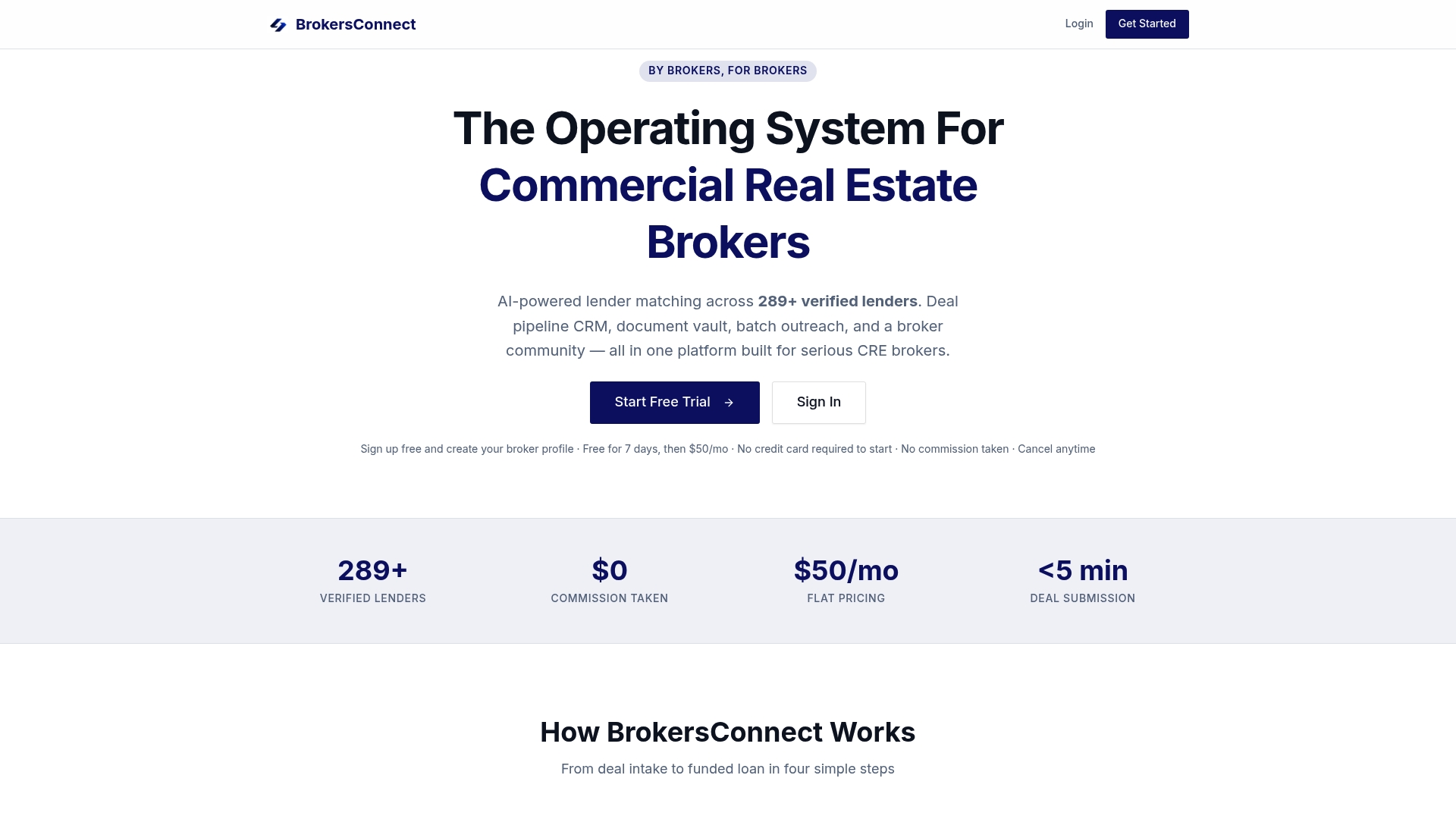
- AI-powered lender matching helps identify banks and funds whose appetite fits the deal.
- Deal templates and packaging tools adapt the submission to what a bank wants versus what a fund expects.
- Tools to track lender responsiveness show which lenders actually close, so your next submission goes to the right desk first.
Start a free trial at BrokersConnect and see how much faster the right lender match comes together.
This article is general information, not a substitute for advice from a qualified financial advisor. Consult a qualified financial professional about your own circumstances before acting on anything here.
FAQ
Is a bank or a debt fund cheaper for a CRE loan?
A bank is usually cheaper when the deal fits its underwriting box, since banks generally offer a lower coupon on stabilized, well-documented assets. Private credit runs more expensive than bank debt in exchange for faster execution and custom terms, according to the IMF.
Why would a broker choose a debt fund over a bank?
Funds make sense when speed, flexible draw mechanics, or a nonconforming sponsor profile matter more than the lowest rate. Bank lending standards have tightened for construction and land-development loans in particular, per the Federal Reserve's SLOOS, which pushes more of that volume toward private capital.
What does a bank look for in a CRE loan submission?
Banks focus on DSCR, debt yield, LTV, guarantor strength, interest reserves, and stress-tested cash flow, as outlined in the OCC's commercial real estate lending handbook. A complete package addressing each of these moves through underwriting faster.
How can a platform help a broker decide between a bank and a fund?
A matching platform compares your deal scenario against verified lender criteria and surfaces whether a bank or a fund is more likely to respond, based on leverage, property type, and sponsor profile. That cuts down on submissions sent to lenders who were never going to say yes.
What is the biggest risk when placing a deal with a debt fund?
The biggest risk is funding uncertainty: some funds are financed through closed-end institutional capital and can be opaque about their draw authority and track record, per the IMF. Confirm committed capital evidence and recent comparable closings before relying on a fund for a time-sensitive deal.
Sources
- IMF Global Financial Stability Report, Chapter on private credit (April 2024)
- OCC Comptroller's Handbook: Commercial Real Estate Lending
- FDIC Advisory: Managing Commercial Real Estate Concentrations in a Challenging Economic Environment (FIL-64-2023)
- Mortgage Bankers Association Quarterly Survey of Commercial/Multifamily Mortgage Bankers Originations (3Q 2025)