
AI loan packaging automates extraction, reconciliation, and exception handling to cut validation time and reduce errors, when piloted with proper governance. The core functions are consistent across tools: pull data from borrower and property documents, cross-check that data against other files in the package, and flag what does not line up for a human to review. None of it replaces underwriting judgment. It removes the manual comparison work that eats the hours before judgment can even start.
TL;DR:
- Properly governed AI loan packaging can reduce validation time by up to 85 percent, with some cases validating a full package in hours instead of days.
- Cross-document discrepancy detection focuses on identity, property, and financial fields, with structured exception logs that trace back to specific document locations.
- Industry recommendations emphasize narrow pilot programs that measure turnaround time, exception rates, and accuracy before broad deployment.
- AI tools must comply with FFIEC regulations by maintaining traceability, human review thresholds, and audit logs to ensure transparency and control.
- Integration challenges include data format compatibility, multiple document storage locations, and secure handling of sensitive borrower information.
Table of Contents
- Core Capabilities: Extraction, Validation, and Audit Trails
- Agentic Workflows That Reconcile a Full Loan Package
- Compliance and Model Governance Under FFIEC Guidance
- A 6-Step Pilot Checklist to Start Small and Measure Results
- Measured Benefits and Where Human Oversight Still Matters
- What Documents AI Tools Parse and How Completeness Gets Checked
- How AI Loan Packaging Vendors Differ in Practice
- Where Integration With Existing Systems Gets Difficult
- Data Privacy and Security Considerations Specific to This Use Case
- Common Pitfalls and How to Avoid Them During Adoption
- Training and Change Management for Staff Adopting These Tools
- Regulatory Variations Beyond FFIEC Guidance
- What Brokers and Underwriters Should Take From This
- How BrokersConnect Fits Into a Broker's AI Packaging Workflow
- Where to Read More on Governance and Industry Benchmarks
- Sources
- FAQ
Core Capabilities: Extraction, Validation, and Audit Trails
Most AI loan packaging tools break the work into four linked functions. Document extraction uses optical character recognition paired with large language model interpretation to pull borrower, property, and financial fields out of files that rarely share a common format: scanned appraisals, PDF tax returns, spreadsheet rent rolls. Hybrid OCR and LLM parsing handles this better than older template-based extraction because it adapts to document layout instead of breaking when a lender changes a form, a point Fannie Mae's own guidance on document processing supports.
Once fields are extracted, the system cross-references them across every document in the package. That is where discrepancy detection happens.
- Identity fields: borrower name, Social Security or tax ID number matched across application, credit report, and title documents.
- Property fields: address and legal description checked against the appraisal, insurance policy, and title report.
- Financial fields: loan amount, income figures, and dates reconciled between the application, bank statements, and tax filings.
Every mismatch becomes a structured exception on a task list instead of a note buried in a reviewer's memory. The audit trail matters as much as the flag itself: each finding should trace back to the specific document and location it came from, which is what lets a compliance reviewer reproduce the check later rather than take the software's word for it.
Agentic Workflows That Reconcile a Full Loan Package
Agentic AI, in this context, means several purpose-built agents that share the same loan context and hand work off to one another instead of running as one monolithic model. Each agent does one job well, then passes structured output to the next.
- Ingest: documents land in a shared repository and get classified by type.
- Extract: fields are pulled from each document using OCR and LLM parsing.
- Validate: extracted fields are checked for completeness and format.
- Reconcile: values are cross-referenced across the full package for consistency.
- Escalate: unresolved discrepancies route to a human underwriter with full context attached.
Industry research on non-bank mortgage lending recommends introducing agentic AI as narrow, high-impact agents that solve one reconciliation task well, according to Cognizant and HFS Research, rather than attempting broad orchestration on day one. The human-in-the-loop step is not a fallback bolted on for compliance. It is where the agent chain is supposed to stop, every time a confidence threshold is not met, and hand control back to a person before the package moves further into an LOS or document vault.
Compliance and Model Governance Under FFIEC Guidance
Regulators do not treat AI models as a black box exception to normal control expectations. The FFIEC IT Examination Handbook states that management must proactively test and validate AI and machine learning systems and ensure transparency, to avoid both compliance and operational risk. That means documentation of what a model does, how it was tested, and how its outputs get reviewed is not optional paperwork. It is the control.
In practice, that translates into a short list of controls a lender or brokerage should expect from any AI loan packaging tool:
- Traceability: every extracted field links to a source document identifier and its location in that document.
- Human-review thresholds: any discrepancy below a defined confidence score routes to a person, not an automatic pass.
- Exception monitoring: a running log of flagged issues and how each was resolved, available for audit.
FFIEC guidance requires institutions to test and validate AI and machine learning models before relying on their output in lending decisions, a standard that applies whether the tool is built in-house or licensed from a vendor. Keeping pointers to source document identifiers and byte offsets with every extracted field, as the handbook effectively requires, is what lets an examiner reproduce a flagged discrepancy months after the fact instead of trusting a summary.
A 6-Step Pilot Checklist to Start Small and Measure Results
The tools that succeed in production are the ones that were piloted narrowly first. Six steps cover most of what that pilot needs.
- Define scope and KPIs: pick turnaround time, exception rate, and field-level accuracy as your measures before you start.
- Select three representative deals: choose files that reflect your typical package mix, and prepare gold-standard annotations by hand for comparison.
- Integrate to a staging environment: connect the tool to a test instance of your loan origination system and document vault, with logging turned on from the first run.
- Run human-in-the-loop tests: have underwriters review every flagged discrepancy and record where the tool was right, wrong, or unclear.
- Measure time saved and error reduction: compare pilot turnaround and exception rates against your manual baseline to calculate ROI.
- Iterate and document governance artifacts: fix what failed, keep the audit records the pilot generated, and use them as the basis for a rollout plan.
Pro Tip: Annotate 20 to 50 representative pages per document type by hand before the pilot starts. That gold-standard set is what turns "the tool seemed fast" into a measurable accuracy number.
Measured Benefits and Where Human Oversight Still Matters
One widely cited product example shows AI validating a complete loan package in 2 to 4 hours versus 3 to 5 days for manual review, according to V7's mortgage processing case study, an 85% reduction in validation time for that specific workflow. Treat it as an illustrative case, not a guarantee for every package type or lender.
Non-bank lenders expect automation in certain mortgage workflows to increase significantly over the next two years, according to Cognizant and HFS Research, a trajectory that signals where investment is heading rather than a finished state. AI delivers its clearest return on repetitive cross-document checks. It still needs a person for judgment calls on borrower intent, unusual deal structures, and anything the model flags as low confidence.
What Documents AI Tools Parse and How Completeness Gets Checked
The documents these tools handle in practice are fairly consistent across vendors: loan applications, credit reports, tax returns, bank statements, appraisals, title reports, insurance policies, and legal agreements tied to the transaction. Product pages from tools like V7's loan package analysis list this same set as the baseline for what gets parsed and cross-checked, which reflects what a typical commercial or residential package actually contains.
Completeness checking is a separate function from field extraction, and brokers sometimes conflate the two. Extraction pulls data out of documents that are present. Completeness checking compares the package against a required document list for the loan type, whether that is a DSCR loan, a bridge loan, or a conventional commercial mortgage, and flags what is missing before the package ever reaches a lender's desk. A package missing a current rent roll or an updated insurance certificate stalls review regardless of how clean the extraction was on everything else. Tools that combine both functions catch two different categories of problem: data that is wrong, and data that is simply absent.
For brokers, package completeness is often the lower-hanging fruit. A loan document checklist built for the specific loan type, checked before submission, catches gaps that would otherwise surface only after a lender's underwriter starts the review, adding days to the process for a problem that took minutes to prevent.
How AI Loan Packaging Vendors Differ in Practice
Vendors in this space generally split along a few technical lines rather than competing on identical feature sets. Some focus narrowly on document extraction and validation, positioning their product as a layer that plugs into an existing loan origination system rather than replacing it. Others build toward fuller agentic orchestration, chaining extraction, validation, and reconciliation into a single workflow that hands off to a human only at defined checkpoints.
The practical differences worth checking before adopting any tool: how the vendor handles document types outside a narrow template set, whether audit trails trace to specific document locations or just summarize findings, and whether human-review thresholds are configurable or fixed. A tool built around agentic orchestration, as described in the Cognizant and HFS Research analysis, tends to deliver more value on complex commercial packages with many interdependent documents. A narrower extraction tool can still be the right fit for a brokerage that mainly needs faster data capture rather than end-to-end reconciliation.
Vendors focused purely on GenAI copilots for document summarization are a different category from tools built specifically for cross-document reconciliation in lending. Surveys tracking GenAI adoption in retail lending show rising budgets across both categories, with security and governance still cited as the top barriers to broader deployment. That distinction matters when evaluating a tool: a copilot that drafts summaries is not the same product as one that reconciles a loan package against itself.

Where Integration With Existing Systems Gets Difficult
Connecting an AI packaging tool to a loan origination system rarely goes as smoothly as a vendor demo suggests. The first friction point is data format: LOS platforms structure loan data differently, and a tool built to output clean JSON may still need a custom mapping layer to write back into fields the LOS expects.
The second friction point is document vaults. Many brokerages and lenders store files across multiple systems, a document management platform for closed loans, a shared drive for in-process deals, an email inbox for anything still coming in from a lender. An AI tool that only watches one of those locations misses documents that arrive somewhere else, which quietly breaks completeness checking even when extraction is working perfectly on what it does see.
The third is staging versus production risk. Running a pilot directly against a live LOS instance, without a staging environment, means a misconfigured integration can write bad data into records that matter. A staging integration with full logging, as outlined in the pilot checklist above, exists specifically to catch that kind of failure before it touches production.
Brokers preparing submissions can reduce their own share of this friction by standardizing how packages are assembled before they ever reach an AI tool or a lender's underwriter. An attachment map and cover letter that lists every document included, in a consistent order, gives both a human reviewer and an extraction tool a predictable structure to work against.

Data Privacy and Security Considerations Specific to This Use Case
Loan packages contain some of the most sensitive data a borrower will ever hand over: Social Security numbers, full tax returns, bank account details, and property records tied to a specific address. An AI tool processing that data introduces a new point where it can be exposed, whether through a vendor's cloud infrastructure, an API call to a third-party model, or a logging system that retains more than it should.
The practical questions worth asking before adopting any tool: where is data processed and stored, does the vendor retain documents after processing completes, and does the tool use a shared model that could expose one client's data patterns to another. Surveys on GenAI adoption in lending consistently name security and governance as the top barrier to broader deployment, according to Celent's research, which reflects a real and unresolved concern rather than caution for its own sake.
Encryption in transit and at rest, role-based access controls limiting who can view extracted fields, and a documented data retention policy are baseline expectations, not advanced features. A vendor that cannot answer basic questions about where borrower data lives after processing is not ready for a lending workflow, regardless of how accurate its extraction claims are.
Common Pitfalls and How to Avoid Them During Adoption
The most common mistake is automating in isolation. Running an AI tool on document classification alone, without connecting it to reconciliation and exception handling, produces a small efficiency gain that looks good in a demo and does little for actual turnaround time. Practitioners studying non-bank mortgage lending have specifically warned against isolated pilots, according to HFS Research, recommending instead that AI be tied into workflows with measurable business outcomes from the start.
A second pitfall is skipping the gold-standard comparison step. Without a hand-annotated baseline, it is nearly impossible to know whether the tool's accuracy is improving, degrading, or simply inconsistent across document types.
A third is treating the human-in-the-loop step as a formality rather than a real checkpoint. If underwriters rubber-stamp every AI flag without genuinely reviewing it, the audit trail exists but the control it was meant to provide does not. Mitigating this means building review time into the workflow explicitly, not assuming it will happen informally, and tracking how often reviewers actually override or confirm what the tool flags.
Training and Change Management for Staff Adopting These Tools
Underwriters and loan officers do not need to become data scientists to use these tools well, but they do need to understand what the tool is checking and what it is not. Training should cover how extraction confidence scores work, what triggers an escalation, and how to read an audit trail back to its source document, since that is the skill that makes review meaningful rather than mechanical.
Change management matters as much as the training content. Staff who see the tool as a threat to their role will look for reasons it fails, while staff who see it as removing the tedious comparison work tend to adopt it faster and give better feedback during a pilot. Framing the rollout around what gets removed from someone's day, the repetitive line-by-line document comparison, rather than what gets automated in the abstract, tends to land better with the underwriters who will use it daily.
A short reference document showing what fields the tool extracts, what confidence thresholds mean in practice, and who to contact when something looks wrong reduces the early confusion that otherwise slows adoption in the first few weeks.
Regulatory Variations Beyond FFIEC Guidance
FFIEC guidance sets the baseline expectation for testing and validating AI and machine learning models, but it is not the only regulatory layer that applies. State-level lending and privacy laws vary in what they require for data handling and borrower notification, particularly around automated decision-making disclosures, and those requirements differ enough between states that a national lender or brokerage cannot assume one compliance framework covers every jurisdiction it operates in.
Federal fair lending laws, including requirements tied to the Equal Credit Opportunity Act, apply regardless of whether a human or an AI tool flags an application for further review, which means an AI packaging tool's exception flagging logic needs to be defensible against disparate impact concerns, not just accurate. Executive teams surveyed on mortgage priorities increasingly treat this as an operational modernization issue rather than a pure cost-cutting exercise, according to KPMG's 2025 mortgage executive research, which frames AI governance as core to how lenders reduce friction while managing risk, not a separate compliance afterthought.
A brokerage or lender operating across multiple states should treat state-specific requirements as an addition to FFIEC expectations, not a substitute, and confirm with counsel or a compliance officer how automated decision disclosure rules apply in each state where loans are originated.
What Brokers and Underwriters Should Take From This
Underwriting judgment stays with the person, always. AI's job is removing the hours spent manually comparing documents that should agree with each other and flagging the ones that do not. Brokers who send cleaner, more standardized submissions get more accurate AI output on the lender side, since a well-organized package with a clear document checklist gives extraction tools less ambiguity to resolve. Start any pilot with a narrow scope and specific numbers to measure, turnaround time and exception rate, not a vague sense that things feel faster.
— Theron
How BrokersConnect Fits Into a Broker's AI Packaging Workflow
Brokers running an AI packaging pilot still need somewhere to organize the deals, lenders, and documents that pilot touches. A commercial real estate financing platform can match a loan scenario against a database of verified lenders based on property type, loan amount, leverage, and transaction structure, helping brokers identify which lenders may be worth submitting to. Deal templates, a secure document vault, and pipeline tracking can provide consistent structure and recordkeeping to support extraction, reconciliation, and governance during a pilot.
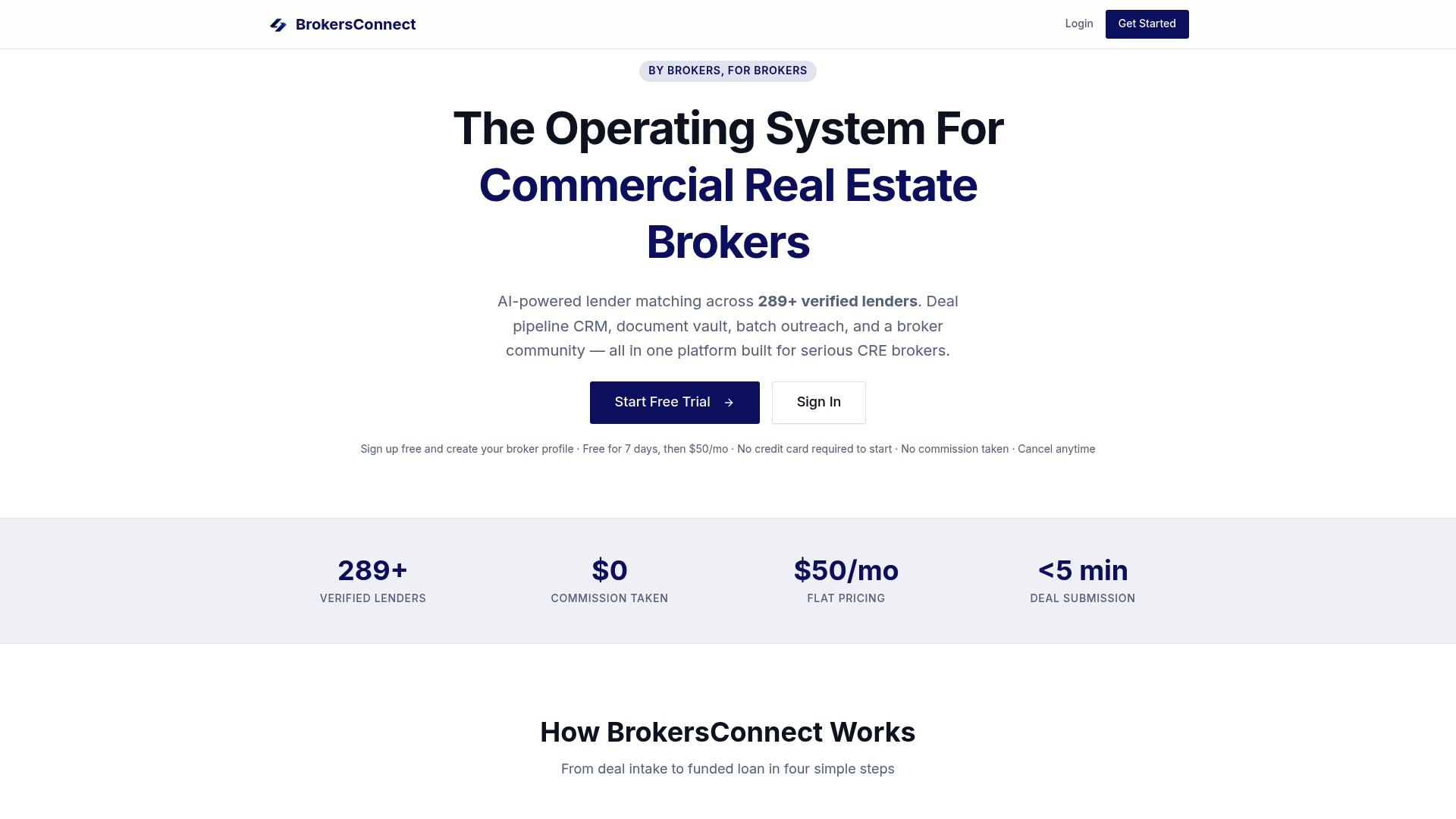
Some platforms offer subscription pricing with no commissions or transaction fees, aiming to replace spreadsheets, lender lists, and cold outreach with centralized deal management. Brokers preparing a small pilot batch, or just tired of cold-calling lenders one at a time, can start with BrokersConnect and see how a matched lender list changes a submission's odds.
Where to Read More on Governance and Industry Benchmarks
The sources behind this article go deeper into regulatory expectations and adoption trends than any single post can cover.
- FFIEC IT Examination Handbook: the governing framework for testing, validating, and documenting AI and machine learning models in a lending context, linked in the compliance and governance section.
- Cognizant and HFS Research: industry analysis on automation trends and agentic AI adoption in non-bank mortgage lending.
- KPMG's mortgage executive research: survey data on how lenders prioritize AI-enabled underwriting and process modernization.
- V7's product use-case pages: illustrative examples of document types processed and time-savings from AI package validation.
For readers interested in agentic workflow patterns outside of lending specifically, Haio covers practical AI orchestration approaches that inform how chained-agent systems like the one described above get built.
Sources
- AI Loan Package Analysis | Automate with V7 Go
- FFIEC IT Examination Handbook - VII.D Artificial Intelligence and Machine Learning
FAQ
What does loan packaging mean?
Loan packaging is the process of assembling and organizing all the documents a lender needs to evaluate and approve a loan, including the application, financial statements, appraisals, and title records. A well-packaged loan file presents every required document in a consistent, complete format that speeds up a lender's review.
What are AI loans?
"AI loans" typically refers to loans processed using artificial intelligence tools for tasks like document extraction, data validation, and underwriting support, rather than a distinct loan product. The AI handles data extraction and cross-document reconciliation while a human underwriter retains the final lending decision.
What is considered a red flag in a loan application?
Common red flags include mismatched information across documents, such as a borrower's name, income figures, or property address that differ between the application, tax returns, and supporting files. AI loan packaging tools are built specifically to catch these cross-document discrepancies and route them to an underwriter for review.
What credit score do you need to get a $30,000 loan?
Credit score requirements for a loan of that size vary by lender, loan type, and other factors like income and collateral, so there is no single threshold that applies universally. Borrowers should check directly with a specific lender or loan program for the credit criteria that apply to their situation.