
AI for loan brokers now does three things well: it standardizes intake, speeds underwriting, and matches deals to lender appetite in minutes instead of days. That combination cuts manual packaging time and lets a broker run more deals without adding staff. The immediate move is small: pilot an AI-driven intake and lender-matching workflow on your next three deals, or start a trial with a platform built for it.
TL;DR:
- AI-driven document extraction can reduce manual data entry time from 4 to 8 hours per deal, increasing efficiency.
- Lender matching based on live appetite data speeds responses and decreases rejected submissions, maximizing deal success.
- AI underwriters generate risk scores and proformas in minutes, enabling faster assessment and decision-making.
- While AI enhances speed and accuracy, human oversight remains crucial for final underwriting judgment and deal qualification.
- Using AI tools requires verifying accuracy, explainability, current lender data, integration capabilities, and favorable pricing before adoption.
Table of Contents
- What AI Actually Does for a CRE Broker
- How Do You Build an AI Workflow for Loan Deals?
- What Should You Look for in an AI Broker Tool?
- Why Brokers Who Adopt AI Win the Next Cycle
- Where BrokersConnect Fits Into This Workflow
- Sources
- FAQ
What AI Actually Does for a CRE Broker
The value isn't abstract. It shows up in four specific places in a broker's day, and each one maps to a task you're already doing manually.
Document extraction and financial spreading. Feeding rent rolls, tax returns, and operating statements into a spreadsheet by hand is the single biggest time sink in deal packaging. Manual processing typically eats 4 to 8 hours per deal, and AI extraction tools cut that down by automating validation and mapping the numbers straight into lender-ready formats. A tool built for this, like the one covered in this AI document extraction overview, removes the retyping without removing your review of the output.
Lender matching against live appetite data. Instead of cold-calling a list you built two years ago, AI systems track lender behavior and current appetite, then surface the capital sources actually likely to say yes. That kind of dynamic matching produces faster responses and fewer submissions that go nowhere.
Underwriting outputs: scores, stress tests, proformas. AI models generate DSCR calculations, sensitivity tables, and draft proformas in the time it takes to grab coffee, giving you a starting analysis to sharpen rather than build from a blank sheet.
Fewer resubmissions, more credibility. Clean, structured packages mean lenders spend less time asking for clarifications, which speeds up their side and makes you look sharper on the next deal too.
The scale of the shift is notable: commercial mortgage originations are projected at $806 billion in 2026, a 27% jump over 2025, and brokers who've adopted AI underwriting report throughput gains as high as 400% with 50 to 75% faster time-to-decision.
- Document extraction: saves 4 to 8 hours per deal on manual data entry
- Lender matching: reduces wasted outreach through live appetite tracking
- Underwriting: produces risk scores and scenario stress tests in minutes
- Packaging: fewer resubmissions, faster lender feedback loops
How Do You Build an AI Workflow for Loan Deals?
Most brokers try to bolt AI onto their existing process and end up frustrated. It works better as a rebuilt sequence, with a human check at every handoff point.
- Set up intake flows that request lender-specific documents automatically. Configure your intake so borrowers upload rent rolls, financials, and entity documents in the format a specific lender type expects, rather than collecting a generic folder you have to sort later.
- Run document extraction and pre-map financials to lender templates. Let the AI pull the numbers and populate lender-ready spreadsheets, then have a human verify the outputs before anything goes out the door. This is where the AI underwriting layer earns its keep, since it turns raw statements into structured inputs a credit committee can actually use.
- Run lender matching, shortlist targets, and generate tailored credit memos. Narrow your list to lenders whose current appetite fits the deal's property type, leverage, and loan purpose, then draft a memo tuned to each one instead of sending the same generic write-up to twenty contacts.
- Batch outreach and track lender responses. Send to your shortlist at once, log who responds and how fast, and use that feedback to refine which lenders you prioritize on the next deal.
Pro Tip: Pre-structuring your package before it hits a lender's desk matters more than most brokers realize. Deals submitted in a lender's own template format tend to move through intake faster, because the lender's underwriting team isn't reformatting your work before they even start reviewing it.
Track three numbers as you roll this out: hours saved per deal, time-to-term-sheet, and submission hit rate, meaning how many of your submissions actually generate a term sheet response. Hit rate matters more than raw submission volume. Sending fifty packages that go nowhere isn't progress. Sending twelve that convert at twice your old rate is.
What Should You Look for in an AI Broker Tool?
Not every AI tool marketed to brokers is worth your subscription fee. Before you commit, run it through a short checklist built around what actually breaks in practice.
Accuracy first. Test the tool's OCR and financial-spreading output against a deal you already know cold. If it misreads a rent roll or miscalculates a debt service ratio on a file you understand, walk away.
Explainability matters as much as accuracy. You need to defend a DSCR figure or risk score to a skeptical loan committee, so the tool has to show its work with an audit trail rather than hand you a black-box number. Explainable scoring with a clear audit log is a commercial requirement, not a nice extra, for anyone who has to defend numbers to lenders and sponsors.
Lender coverage and freshness. A matching engine is only as good as how current its appetite data is. Ask how often lender profiles get updated, and how many active lenders sit in the database.
Integration with your existing stack. Check whether the tool connects to your email, lender portals, CRM, and document storage, or whether it becomes one more disconnected tab.
Commercial fit. Look at pricing structure, how long implementation actually takes, and whether a free trial or live demo is available before you commit budget.
| Evaluation criterion | What to check |
|---|---|
| Accuracy | OCR and financial-spread reliability on a known deal |
| Explainability | Visible audit trail behind every score |
| Lender data | Coverage breadth and update frequency |
| Integration | Email, CRM, portals, document vault |
| Commercial terms | Pricing model, setup time, trial availability |
Red flags: a score with no visible logic behind it, no audit trail, or extraction accuracy that requires you to redo the work manually anyway.
Why Brokers Who Adopt AI Win the Next Cycle
AI is an analyst layer, not a replacement for judgment. It builds the spread, flags the risk factors, and drafts the memo, but deciding which deal is actually fundable and which lender relationship to burn a favor on still belongs to you. Practitioners tracking this shift describe it as freeing junior staff from spreadsheet-building toward interrogating assumptions, which is a better use of a smart analyst's time regardless of headcount.
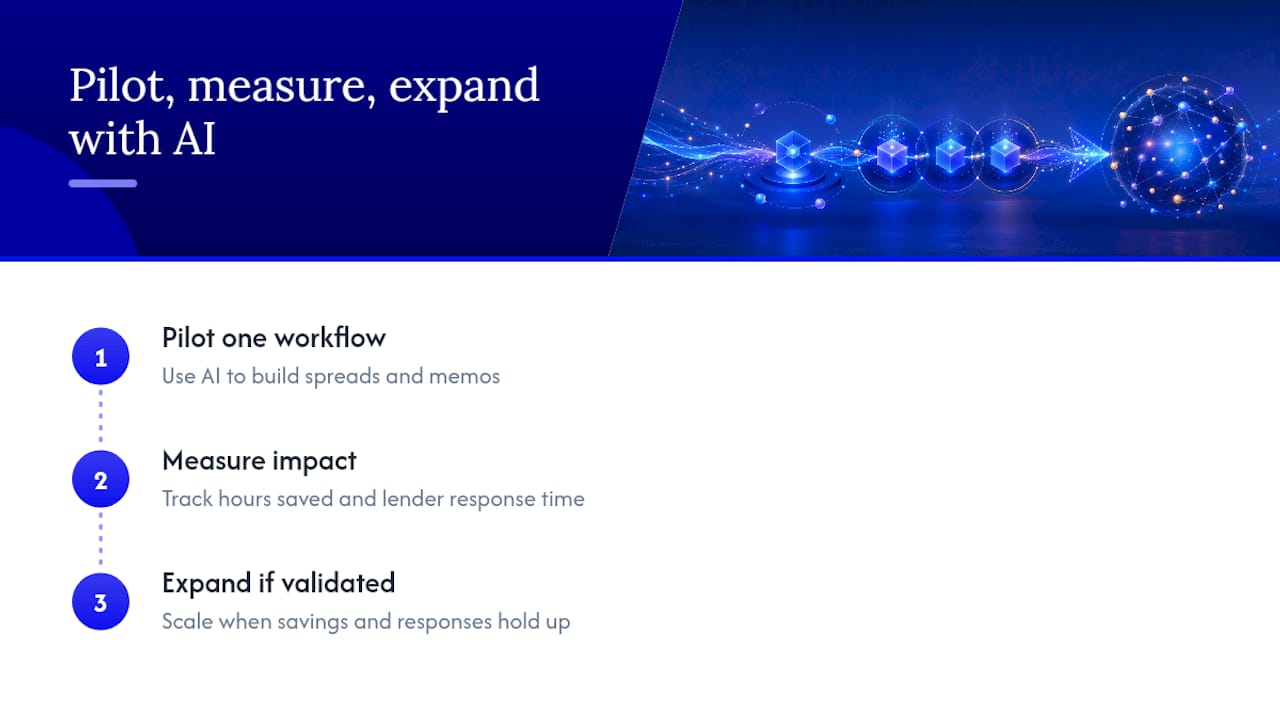
The brokers who win the next cycle won't be the ones submitting the most deals. They'll be the ones curating fewer, better-positioned deals and using AI to make each one obviously fundable before it lands on a lender's desk. Start with one workflow, measure hours saved and lender response time, then expand once the numbers hold up.
— Theron
Where BrokersConnect Fits Into This Workflow
Everything covered above, the intake automation, the lender matching, the packaging discipline, is exactly what Thecrebrokersconnect built its platform around. BrokersConnect matches your deal scenario against a database of 289+ verified lenders based on property type, loan amount, leverage, and structure, so you skip the cold-call phase entirely.
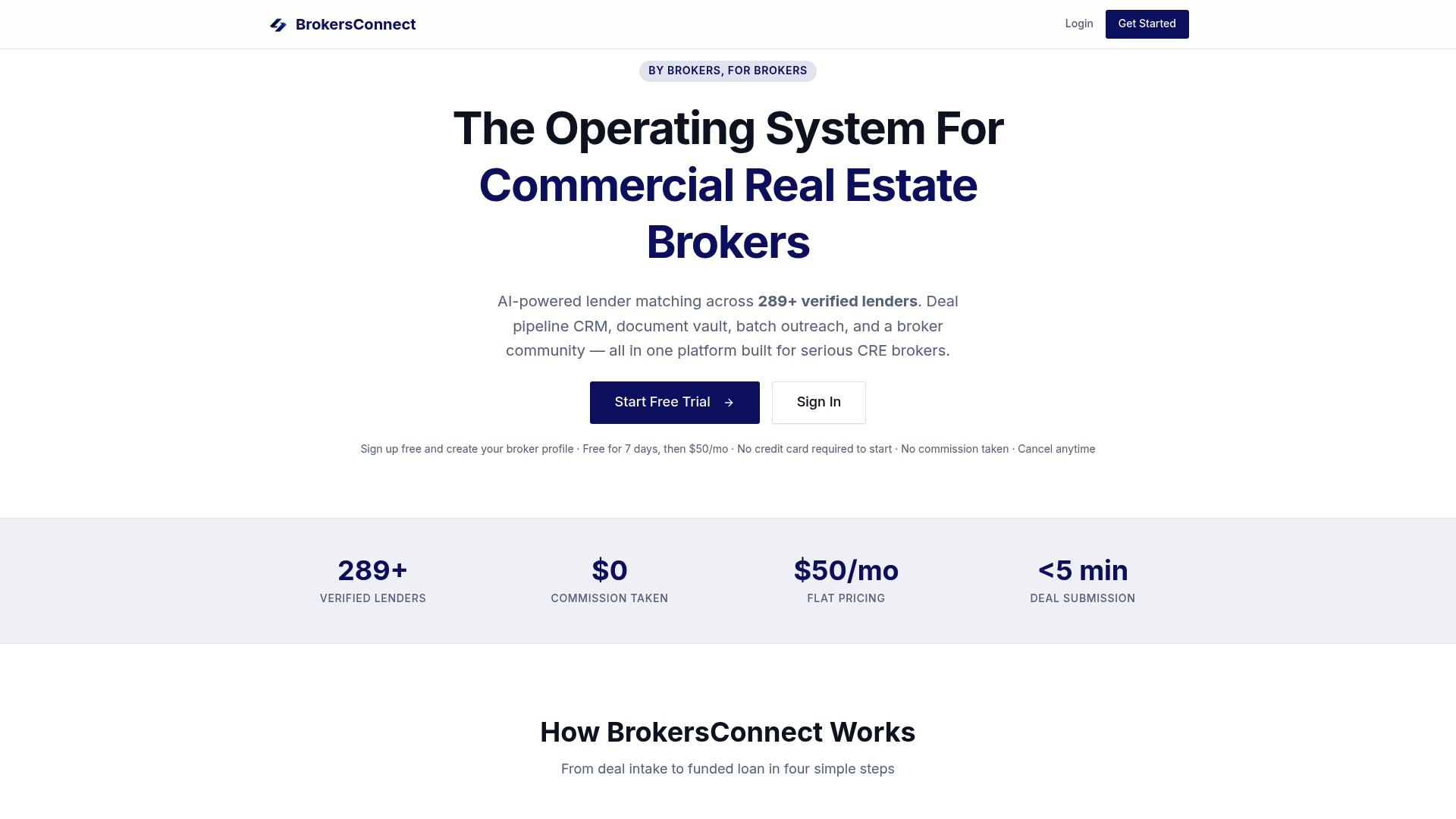
The platform covers the loan types most brokerages actually work: bridge loans, DSCR loans, construction financing, fix-and-flip, multifamily, commercial mortgages, private money, and equity opportunities. Beyond matching, you get a deal pipeline CRM, a secure document vault, batch lender outreach, a lender responsiveness leaderboard so you know who actually replies fast, and AI tools for deal packaging built to keep your submissions clean. It runs at a flat $50 per month, no commission cut on your closings. If you've been running lender searches out of a spreadsheet and a stack of old email threads, start a free trial at BrokersConnect and run your next deal through it before you decide.
Sources
The figures and practitioner guidance in this piece draw from industry origination forecasts and AI underwriting data, analysis on automated document extraction, and practitioner commentary on where commercial lending is headed. For a deeper look at property-level analytics feeding into underwriting decisions, see this piece on leaseback deal analysis.
- Building an AI loan underwriter
- How AI automates data entry
- How AI is transforming commercial real estate lending
- Commercial loan broker software: How AI helps close more deals | Crediflow AI
- The future of commercial lending: Trends every broker needs to know
FAQ
Does AI replace a broker's underwriting judgment?
No. AI speeds up data extraction, scoring, and matching, but experienced brokers still make the final call on deal structure and lender fit, since human oversight remains central to sound underwriting.
How much time does AI actually save on a typical deal?
Manual document processing runs 4 to 8 hours per deal, and AI extraction tools cut most of that time by automating validation and financial spreading.
What should I check before trusting an AI risk score?
Look for a visible audit trail behind the score. If the tool can't show how it calculated a DSCR or risk rating, you can't defend that number to a lender or loan committee.
Is BrokersConnect built for this kind of AI workflow?
Yes. BrokersConnect combines AI lender matching, document intake, a pipeline CRM, and batch outreach in one platform for $50 per month, covering bridge, DSCR, construction, multifamily, commercial mortgage, and private money deals.
What metric matters most when piloting AI tools?
Submission hit rate, meaning how many submissions convert to a term sheet, matters more than raw volume. A higher hit rate signals the tool is improving deal quality, not just deal count.