
A sources and uses statement is the one-page balancing schedule that shows exactly where closing capital comes from and exactly how it will be spent. The rule is absolute: Total Sources must equal Total Uses, down to the cent.
Two things make this schedule indispensable on any deal:
- What it contains: On the Uses side, purchase price (or equity value after netting rollover), debt payoffs, transaction fees, minimum cash, and escrows. On the Sources side, senior term debt, mezzanine or preferred equity, a revolver draw if applicable, sponsor equity, and rollover equity.
- What it does at closing: It reconciles the purchase agreement, the financing documents, and the funds flow memo into a single, executable table. Every wire on closing day traces back to a line in this schedule.
Wall Street Prep treats this schedule as the mandatory sanity check for any LBO or M&A model. U.S. GAAP adds a layer of complexity: transaction advisory fees are typically expensed at acquisition, while debt issuance costs are capitalized and amortized against the debt's carrying amount, per Wall Street Prep's debt accounting guidance. Getting that distinction wrong distorts both the income statement and the closing cash calculation. Thecrebrokersconnect centralizes the lender matching, fee register, and funds flow templates that make this schedule executable, not merely theoretical.
Table of Contents
- What does a sources and uses schedule cover, and when do you build it?
- How do you break down the uses of funds?
- How do you break down the sources of funds?
- How do you build a balanced sources and uses table?
- How do you set up the Excel template and formulas?
- How does the schedule tie to closing execution?
- What are the most common modeling mistakes and how do you catch them?
- Key Takeaways
- The equity cushion is the one line item worth arguing for
- Thecrebrokersconnect speeds lender matching and closing execution
- Useful sources for further reading
What does a sources and uses schedule cover, and when do you build it?
The schedule is more than a summary table. It is a living document that gets built in three distinct stages and feeds at least four other model tabs before closing day.
Stage 1: Initial diligence. You build a rough version the moment you have an indicative enterprise value and a preliminary financing structure. At this point, precision is less important than getting the capital stack directionally right so the deal team can stress-test leverage and equity returns.
Stage 2: Term sheet and commitment stage. Once lenders issue commitment letters and fee letters, every debt tranche gets its actual par amount, OID, and upfront fee. The Uses side gets updated with confirmed advisory, legal, and accounting fee estimates. This is when the schedule starts to look like a closing document.
Stage 3: Closing dry run. Forty-eight hours before funding, the schedule should be locked to the cent, reconciled to every payoff letter, and mapped to the funds flow memo. Any discrepancy at this stage is a closing risk.
Where it sits in the model:
| Model Tab | What It Feeds Into the Schedule |
|---|---|
| Valuation / equity bridge | Enterprise value, equity value, rollover amount |
| Debt schedule | Par amounts, OID, upfront fees per tranche |
| Fee register | Advisory, legal, RWI, filing fees with payee flags |
| Closing balance sheet | Minimum cash, escrows, holdbacks |
Pro Tip: Build the Sources & Uses tab as its own standalone page that pulls from the other tabs via direct cell references, never hardcoded values. When a lender revises OID two days before closing, you want one input cell to update the entire schedule, not a manual hunt through formulas.
The schedule sits adjacent to the equity bridge and the funds flow memo. The equity bridge converts enterprise value to cash to seller; the funds flow memo converts the Sources & Uses table into payee-level wire instructions. Commitment letters and fee letters are the legal documents that govern what each debt tranche can fund, which is why the schedule must be traceable to those documents line by line.
How do you break down the uses of funds?
The Uses side is where most modeling errors originate. The line items fall into five categories, and each has its own classification rule.
Purchase price mechanics
Enterprise value is the starting point, but what actually flows to the seller is equity value: EV minus net debt, adjusted for the working capital peg or locked-box mechanism. Under a working capital peg, the purchase price adjusts post-close based on actual working capital at closing versus a target; under a locked-box structure, the price is fixed at a historical balance sheet date and the seller retains economic risk from that date forward. Rollover equity reduces cash to seller directly: if management rolls $20M of equity, the cash the sponsor wires to the seller drops by $20M.
Debt payoffs
Existing debt payoffs require a payoff letter from each lender. The payoff letter specifies the outstanding principal, accrued interest to the expected closing date, any prepayment premium or make-whole, and a per-diem interest figure for each day the closing slips. Miss the per-diem and your wire is short. Miss the make-whole and the existing lender will not release the lien.
Balance-sheet items at close
Minimum cash is the amount the business needs in its operating account on day one. It is not a cost of the deal; it is a use of capital that must be funded. Escrows and holdbacks serve a different purpose: they are amounts withheld from the seller pending resolution of indemnification claims, regulatory approvals, or earnout conditions. Option and RSU cash-outs, and any 280G gross-up payments, belong here too when the deal involves a management incentive plan.
Payee mapping
OID is not a payee item. It reduces the cash proceeds the borrower receives from a debt tranche but does not flow to a third party. Upfront lender fees, by contrast, are cash uses with a payee (the lender or its agent). Confusing the two produces a wire that does not match the payoff letter.
How do you break down the sources of funds?
The Sources side is where the capital stack becomes concrete. Each tranche has a net proceeds formula, and the equity line is the plug that makes the schedule balance.
Debt tranches and net proceeds
Every debt tranche contributes net proceeds, not par value, to the Sources side. The formula is straightforward:
Net proceeds = Par amount − OID − Upfront fees
A $300M term loan with 1% OID ($3M) and $2M in upfront fees contributes $295M to Sources. The $5M difference is a Use (upfront fees as a cash payee item) and a reduction in proceeds (OID). Revolvers are typically undrawn at close unless the deal requires a working capital draw; if drawn, include only the funded amount, not the full commitment.
Mezzanine debt and preferred equity structures follow the same net-proceeds logic. Mezzanine vs. preferred equity differs primarily in legal seniority and control rights, but both appear on the Sources side at net cash proceeds after any OID and arrangement fees.
Ticking fees and commitment fees accrue from the commitment date to the funding date. They are typically a Use (a cash cost), not a reduction in proceeds, because they are paid to the lender in exchange for holding the commitment open.
Equity layers
Sponsor equity is the residual: it is whatever is left after debt proceeds, rollover, and any pre-positioned cash cover the total Uses. That is the equity plug, and it is the number that drives the sponsor's equity check at closing.
Rollover equity is unusual because it appears on both sides of the schedule. On the Uses side, it reduces cash to seller (the seller is not receiving cash for the rolled portion). On the Sources side, it is a funding source that covers part of the purchase price. The net effect is that rollover is equity-neutral to the sponsor's cash outlay.
Joint venture equity sits at the bottom of the capital stack as first-loss capital and typically carries a promote structure that gives the GP a disproportionate share of upside above a preferred return. When JV equity appears on the Sources side of a real estate transaction, the sponsor must account for the promote's effect on projected returns and size the equity cushion accordingly. Commercial real estate advisory guidance on JV structures emphasizes that typical GP/LP contribution splits and promote waterfalls need to be modeled explicitly before the Sources side is finalized.
Permitted-use constraints
Commitment letters and credit agreements specify which tranches can fund which uses. A common restriction: OpCo-level secured debt cannot fund HoldCo-level fees or distributions. If your advisory fee is being paid at the HoldCo level, you cannot fund it with the OpCo term loan. Violating a permitted-use restriction is not a modeling error you can fix after closing. Check every Use against the permitted-use language in the relevant commitment letter before the schedule is finalized.
Numbered checklist for Sources-side build:
- Pull par amounts and OID from the commitment letter for each tranche.
- Calculate net proceeds per tranche (par minus OID minus upfront fees).
- Include revolver only if drawn at close; use the funded amount.
- Enter rollover equity as both a Use reduction and a Source.
- Calculate the equity plug: Total Uses minus all debt net proceeds minus rollover minus pre-positioned cash.
- Verify each tranche's permitted uses against the commitment letter.
How do you build a balanced sources and uses table?
The Corporate Finance Institute and Wall Street Prep both recommend the same sequence: build Uses first, then fill Sources, and let the equity line be the plug. Here is a worked numeric example.
Inputs:
- Debt accounting & treatment of financing fees | Wall Street Prep
- Sources and Uses | Formula + Calculator
- Sources and Uses of Cash | Corporate Finance Institute
- LBO Sources and Uses: Downloadable Excel Template with deal-specific tweaks | Investment Banking Analysts
- Sources and Uses of Funds Statement | Purdue Agriculture
- Joint Venture Equity - Lender Tribune
- Commercial Real Estate Advisory Services | Mandri Capital
Step 1: Build Uses
| Uses | Amount |
|---|---|
| Cash to seller (EV − net debt − rollover) | $425M |
| Debt payoff (existing net debt) | $50M |
| Transaction fees | $15M |
| Minimum cash to balance sheet | $10M |
| Escrow / holdback | $5M |
| Upfront lender fees (term loan + mezz) | $15M |
| Total Uses | $508.5M |
Cash to seller = $500M EV − $50M net debt − $25M rollover = $425M.
Step 2: Fill Sources
| Sources | Amount |
|---|---|
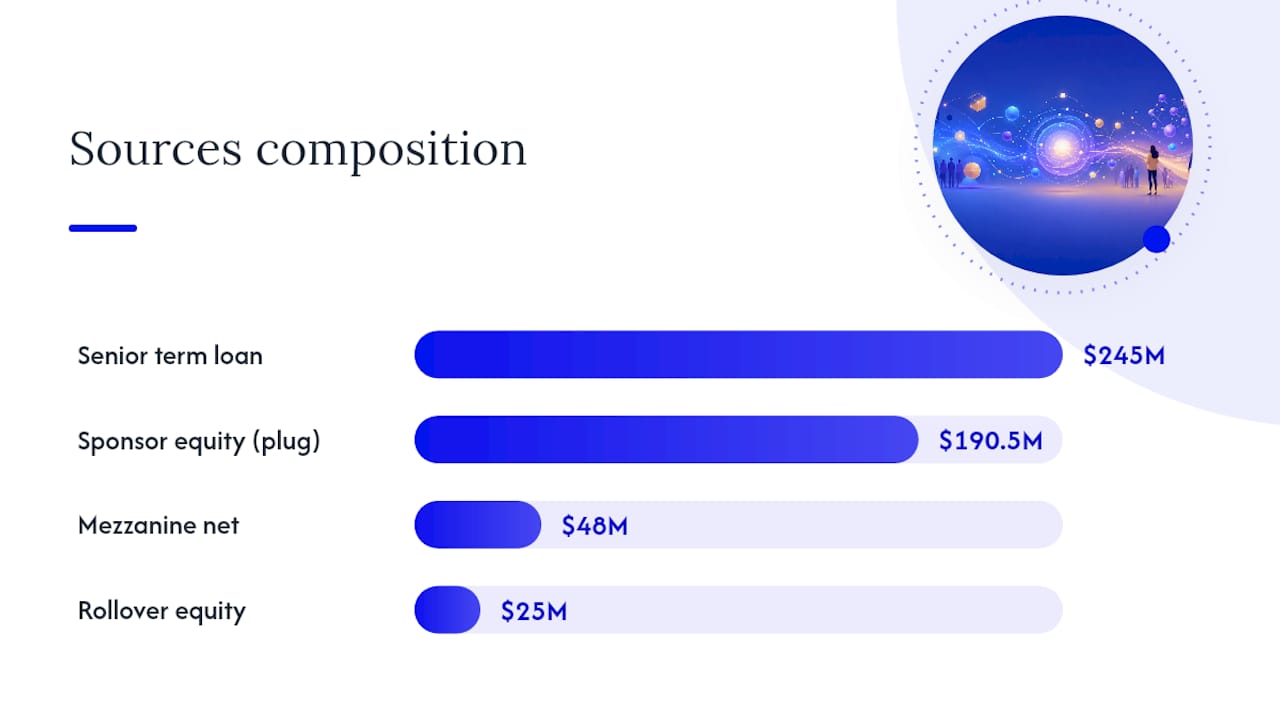
| Senior term loan net proceeds ($250M − $2.5M OID − $2.5M fees) | $245M |
| Mezzanine net proceeds ($50M − $1M OID − $1M fees) | $48M |
| Rollover equity | $25M |
| Sponsor equity (plug) | $190.5M |
| Total Sources | $508.5M |
The equity plug is $508.5M minus $245M minus $48M minus $25M, which equals $190.5M. Total Sources equals Total Uses. The schedule balances.
Equity plug formula: Sponsor equity = Total Uses − Senior net proceeds − Mezz net proceeds − Rollover − Pre-positioned cash
The LBO Sources and Uses downloadable template from Investment Banking Analysts walks through a similar structure with deal-specific tweaks and is worth downloading alongside the worked example above.
How do you set up the Excel template and formulas?
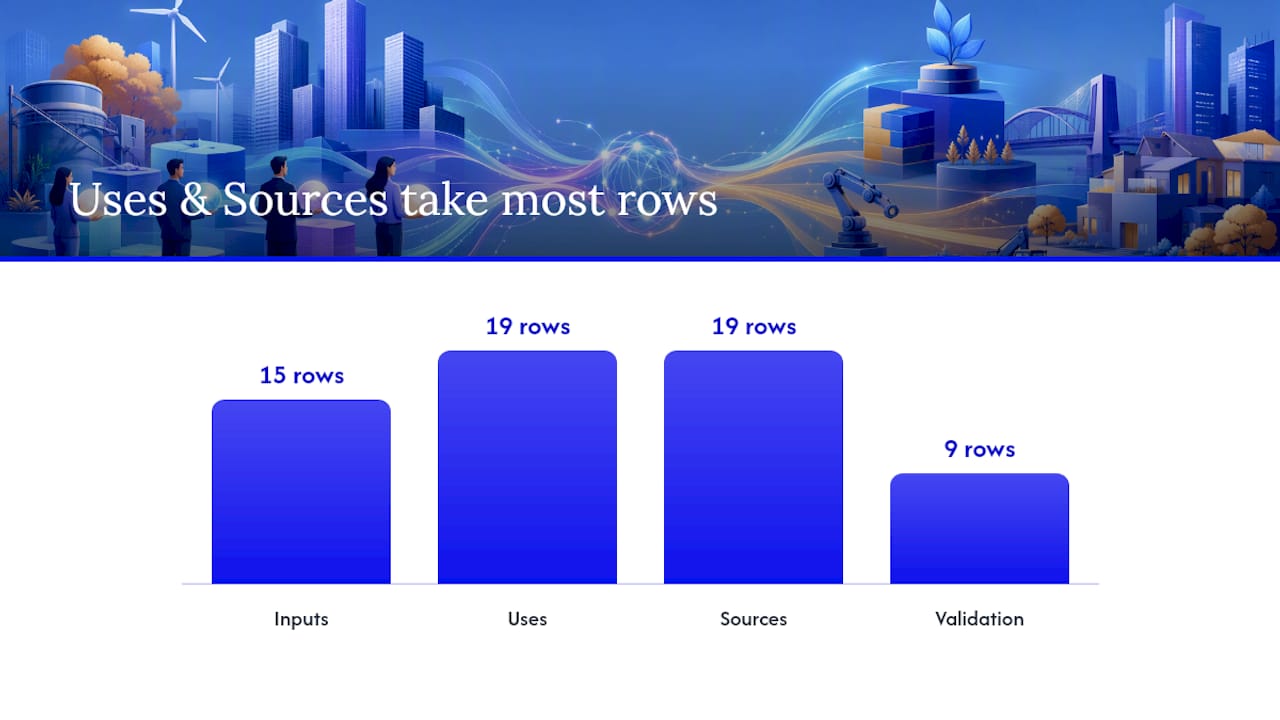
A clean Sources & Uses tab has four blocks: an inputs block, a Uses block, a Sources block, and a validation block. Every number in the Uses and Sources blocks should be a formula referencing either the inputs block or another model tab. No hardcoded values in the calculation rows.
Recommended tab layout:
- Rows 1–15 (Inputs): EV, net debt, rollover amount, each debt tranche's par/OID/fee, transaction fee line items, minimum cash, escrow amounts.
- Rows 17–35 (Uses): Each use line with a formula pulling from inputs. Last row: Total Uses (SUM).
- Rows 37–55 (Sources): Net proceeds per tranche (par − OID − fees), rollover, equity plug formula. Last row: Total Sources (SUM).
- Rows 57–65 (Validation): Check cell = Total Sources − Total Uses (must equal $0). Link check to equity bridge. Payee count reconciliation.
Key formulas:
- Net proceeds per tranche:
= Par − OID_amount − Upfront_fees - Cash to seller:
= EV − Net_debt + Swept_cash − Rollover - Equity plug:
= Total_Uses − SUM(all_debt_net_proceeds) − Rollover − Pre_positioned_cash - Validation check:
= Total_Sources − Total_Uses(conditional format red if ≠ $0)
Macabacus and Wall Street Prep model templates both use a similar four-block layout and are standard references for linking the Sources & Uses tab to the equity bridge and the debt schedule. The validation check cell is the most important formula in the entire tab: if it reads anything other than zero, the model is not ready to send to counsel.
Pro Tip: Lock every cell that references a commitment letter or payoff letter with a comment showing the source document, page number, and date. When the lender revises terms at 11 PM the night before closing, you will know exactly which cells to update and which to leave alone.
Downloadable Excel templates are available from Wall Street Prep and Investment Banking Analysts (links in the Useful Sources section below). Plug in your commitment letter terms in the inputs block and let the formulas propagate.
How does the schedule tie to closing execution?
The Sources & Uses table is a model output. The funds flow memo is its execution artifact: it converts every Use into a payee, a bank account number, and a wire amount. The two documents must match to the cent.
Payee mapping table:
| Use Line Item | Payee | Document Source |
|---|---|---|
| Cash to seller | Seller / escrow agent | Purchase agreement |
| Existing debt payoff | Existing lender / agent | Payoff letter |
| Advisory fee | Investment bank | Engagement letter |
| Legal fees | Deal counsel | Invoice |
| RWI premium | Insurance carrier | Binder |
| Upfront lender fee | New lender / agent | Fee letter |
| Minimum cash | Borrower operating account | Credit agreement |
| Escrow / holdback | Escrow agent | Escrow agreement |
OID has no payee row in the funds flow memo. It reduces proceeds at the lender level before cash is wired to the borrower. Every other Use needs a payee and a wire instruction.
The equity bridge connects to the Sources side: it starts at enterprise value, subtracts net debt, subtracts rollover, and arrives at cash to seller. That cash-to-seller figure must match the corresponding Use line exactly.
Closing checklist:
- Confirm payoff letter per-diem interest for the expected closing date, plus one business day as a buffer.
- Verify escrow instructions match the escrow agreement, not just the purchase agreement.
- Run a mock funds-flow dry run at least 48 hours before closing to catch wire discrepancies.
- Confirm lien release timing with existing lenders: some require receipt of funds before releasing, others release simultaneously.
- Size a small equity cushion (typically $1M–$5M depending on deal size) to absorb per-diem slippage or minor fee revisions without reopening the commitment letter.
Pro Tip: Run the dry run with actual bank account numbers and wire amounts, not placeholders. A wire that fails because of a wrong account number on closing day is a one-day delay at minimum and a potential default trigger under the purchase agreement.
What are the most common modeling mistakes and how do you catch them?
Most Sources & Uses errors fall into four categories: OID misclassification, permitted-use violations, rounding failures, and fee accounting errors. A structured QA checklist catches all of them before the model goes to counsel.
Validation tests to run before sign/close:
- Total Sources − Total Uses = $0 (to the cent, not just to the dollar).
- Net proceeds per tranche reconcile to the commitment letter par, OID rate, and fee schedule.
- Cash to seller reconciles to the equity bridge output.
- Every Use line with a dollar amount has a corresponding payee in the fee register.
- Permitted-use check: each tranche's funded uses are within the permitted-use language of the commitment letter.
- Payoff letter math: principal plus accrued interest plus premium plus per-diem equals the wire amount.
- Escrow math: escrow amount in the schedule matches the escrow agreement.
Red flags that delay closings:
- Using revolver capacity for a Use that the credit agreement restricts to term loan proceeds only.
- Funding HoldCo-level advisory fees with OpCo-secured debt when the credit agreement prohibits it.
- Listing OID as a payee item in the funds flow memo (OID has no payee; it reduces proceeds).
- Omitting per-diem interest from the existing lender payoff, resulting in a short wire.
- Misclassifying an expensed transaction fee as a capitalized debt cost, which inflates the post-close debt carrying amount.
The debt-to-equity ratio framework is useful here: once you have the Sources side finalized, check that the implied leverage multiple and equity contribution percentage are consistent with what the commitment letter underwrote. A Sources side that implies 7.5x leverage when the lender committed at 6.5x is a signal that something is misclassified.
Modeling best practices:
- Maintain a separate fee register tab with columns for payee, amount, expensed/capitalized flag, and source document.
- Lock cells linked to commitment letters and payoff letters; use comments to document the source.
- Use conditional formatting on the validation check cell: red for any non-zero value, green for zero.
- Never hardcode OID amounts; always calculate them as a percentage of par so they update when par changes.
Key Takeaways
A sources and uses statement balances to zero by design: build Uses first, derive the equity plug last, and reconcile every line to its governing document before closing day.
| Point | Details |
|---|---|
| Balance rule is absolute | Total Sources must equal Total Uses to the cent; any non-zero check cell means the model is not ready. |
| Build Uses before Sources | Construct all Uses lines first, then fill debt tranches at net proceeds, and let sponsor equity be the plug. |
| Net proceeds, not par | Each debt tranche contributes par minus OID minus upfront fees; OID has no payee and does not appear in the funds flow memo. |
| Run a 48-hour dry run | Map every Use to a payee and wire amount at least 48 hours before closing to catch per-diem and account errors. |
| Thecrebrokersconnect | The platform centralizes lender matching, fee register templates, and funds flow checklists to reduce manual reconciliation errors at close. |
The equity cushion is the one line item worth arguing for
The conventional wisdom in deal modeling is to minimize sponsor equity because every extra dollar of equity reduces IRR. That logic is correct in a spreadsheet and dangerous in a closing room.
The Sources & Uses schedule is a snapshot of a transaction at a point in time. By the time you are 48 hours from closing, the purchase agreement is signed, the commitment letters are out, and the only variable left is execution. A $2M equity cushion that you argued against in the term sheet negotiation is now the difference between a clean close and a one-day delay that triggers a per-diem charge, a lender waiver request, or a seller termination right.
The same logic applies to permitted uses. Sponsors sometimes push for maximum flexibility in the credit agreement, wanting the ability to fund as many Uses as possible from the cheapest tranche. That flexibility has a cost: it creates complexity in the payee mapping, increases the risk of a permitted-use violation, and gives lenders more surface area to push back during the closing dry run. Clean permitted uses, even at a slightly higher blended cost of capital, tend to close faster and with fewer last-minute amendments.
Size the equity cushion. Keep the permitted uses clean. The IRR difference is marginal; the execution difference is real.
Thecrebrokersconnect speeds lender matching and closing execution
Sourcing the right debt and equity for a transaction is only half the work. The other half is managing the commitment terms, fee register, payoff letters, and wiring instructions without losing track of which version is current.
Thecrebrokersconnect gives commercial real estate brokers and deal teams a single platform to match loan scenarios with 289+ verified lenders, collect and organize commitment terms, and manage the closing checklist from term sheet to funding. Instead of maintaining a manual spreadsheet of lender contacts and fee schedules, you get AI-powered lender matching based on property type, loan amount, leverage, and transaction structure, plus deal templates that map directly to the Sources & Uses workflow described in this guide.
For brokers comparing internal tooling against a dedicated platform: the difference is speed of lender outreach and the reduction in manual reconciliation errors. Batch outreach to matched lenders, a centralized document vault for payoff letters and commitment letters, and a built-in fee register with expensed/capitalized flags are all available in one place.
Start a free trial at Thecrebrokersconnect and see how quickly a deal scenario moves from lender search to funded.
Useful sources for further reading
The resources below are the primary references used throughout this guide. Each covers a distinct aspect of Sources & Uses construction and execution.
- Wall Street Prep: Sources and Uses Formula + Calculator — The primary procedural reference for building the schedule in LBO and M&A models, including the build-Uses-first methodology and worked examples.
- Wall Street Prep: Debt Accounting and Treatment of Financing Fees — Authoritative guidance on expensed vs. capitalized treatment of transaction and debt issuance costs under U.S. GAAP; essential for the fee register.
- Corporate Finance Institute: Sources and Uses of Cash — Step-by-step explanation and a general worked example covering LBOs, recapitalizations, and restructurings.
- Investment Banking Analysts: LBO Sources and Uses Downloadable Excel Template — A practical downloadable template with deal-specific tweaks; useful for mapping debt proceeds, equity checks, and rollover to the equity bridge and funds flow memo.
- Purdue Agriculture: Sources and Uses of Funds Statement — An authoritative example of the schedule applied outside corporate LBOs, demonstrating that the balancing rule holds across project finance and agricultural transactions.
- Lender Tribune: Joint Venture Equity — Covers JV equity as first-loss capital, typical GP/LP splits, and promote structures relevant to sizing the equity layer on the Sources side.
- Mandri Capital: Commercial Real Estate Advisory Services — Practical advisory perspective on JV equity contribution splits and promote waterfalls for real estate sponsors.