
The most dangerous private-lender risks are almost never the interest rate on page one. They're hidden fees, capital sources nobody will name, and term-sheet language that gives the lender total discretion. If you spot fee opacity, an undisclosed capital source, vague underwriting conditions, cash-management traps, or a lender who won't return calls, stop advancing non-refundable money immediately. Demand written, itemized terms and verifiable references before you move another dollar toward closing.
TL;DR:
- Hidden fees like layered origination, success fees, and non-refundable deposits often mask the true cost of private lending.
- Undisclosed or unverifiable capital sources and vague, subjective term-sheet language signal potential scam or deal risk.
- Layered exit fees, default interest, and poorly defined draw schedules can significantly inflate the effective cost beyond the headline rate.
- High-pressure tactics, slow responsiveness, and reluctance to provide clear documentation indicate poor lender reliability or a predatory intent.
- Prioritize verifying the lender’s capital source, licensing, and references before progressing, as these are key to avoiding dangerous private loans.
Table of Contents
- Checklist: The Specific Private Lender Red Flags to Watch For
- How to Verify Each Red Flag
- Mapping Term-Sheet Costs to Real Exit Risk
- If You Spot Red Flags: Negotiation, Remediation, and Alternatives
- What to Keep in the File for Sponsors
- How BrokersConnect Helps You Screen Out Bad Lenders
- Hidden or Excessive Interest Rate Mark-Ups
- Signs of Aggressive or High-Pressure Sales Tactics
- Lack of Transparency About Track Record and Previous Defaults
- Unwillingness to Provide Clear Documentation and Disclosures
- The Real Lesson Behind Most Private Lender Red Flags
- Speed Up Vetted Lender Sourcing Without the Cold-Call Grind
- Sources
Checklist: The Specific Private Lender Red Flags to Watch For
Every broker who has moved a bridge loan under deadline pressure knows the feeling: the term sheet looks fine, the rate looks competitive, and something still feels off. Usually that instinct is correct. The following signals show up across most private lender scams and problem deals, and they're worth screening for before you invest another hour on a sponsor's behalf.
- Fee opacity and layered pricing. Origination points, legal fees, appraisal costs, exit fees, and "success fees" stacked on top of each other with no cap, plus non-refundable deposits collected before real underwriting begins.
- Undisclosed or unverifiable capital source. You can't tell whether you're dealing with a direct balance-sheet lender or a broker fronting for someone else's money, and the lender won't say.
- Vague term-sheet language. Phrases like "subject to committee approval" or "subject to underwriting" with no defined timeline or objective standard give the lender unlimited room to reprice or walk.
- Broad recourse and springing guaranty triggers. Carve-outs written so loosely that ordinary operating decisions can trigger full personal liability.
- Prepayment penalties and lockouts that make an early sale or refinance prohibitively expensive, killing exit flexibility exactly when the sponsor needs it most.
- Cash-management and reserve mechanics that hand the lender control over rents, reserves, or disbursements beyond what the risk profile justifies.
- Ambiguous draw schedules on construction or rehab loans, where the lender has open-ended discretion over inspection timing and disbursement approval.
- No-shop and exclusivity clauses with no lender performance deadlines attached, which lock you in without requiring anything back from the lender.
- Slow, noncommittal underwriting contacts and a track record of walking away near the closing table.
- No licensing, no references, no verifiable closed-deal history anyone can check.
None of these alone kills a deal automatically. Two or three together on the same term sheet should.
How to Verify Each Red Flag
Spotting a red flag is the easy part. Confirming whether it's a dealbreaker or just sloppy drafting takes a specific set of documents and direct questions. Work through these before you let a sponsor sign anything.
- Request a written fee grid. Every fee should be itemized, capped, and marked refundable or non-refundable in writing, not described verbally on a call.
- Confirm the capital source. Ask directly whether you're dealing with the lender or an intermediary, and where the money actually comes from. Refusing to disclose capital source is one of the clearest signs that something is being hidden.
- Redline vague conditions. Replace "subject to underwriting" with a defined list of remaining items and a hard date for resolving them.
- Quantify guaranty exposure. Put a number on worst-case personal liability and negotiate caps or narrower carve-outs before signing.
- Get at least two recent closed-deal references and call them. Verifying past transactions through direct references catches problems a polished pitch deck never will.
- Request a detailed draw schedule with inspection turnaround times and a dispute-resolution process in writing, not "we'll handle it."
- Verify licensing through state filings where required, and ask directly for license numbers.
- Confirm servicing and assignment terms. Ask whether the loan gets sold or transferred after closing, and to whom.
- Designate one underwriting contact and log every call and email with a timestamp.
Pro Tip: Keep a single running email thread with the lender's underwriting contact for each deal. If that person goes quiet or gets replaced mid-process without explanation, treat it as an early warning, not a scheduling hiccup.
Mapping Term-Sheet Costs to Real Exit Risk
A term sheet's headline rate tells you almost nothing about what a loan actually costs a sponsor by the time it closes. The gap between the quoted number and the real number lives in the fee grid, the reserve requirements, and what happens if the deal runs long.
Before anyone signs, model these line items against the sponsor's actual hold and exit timeline:
- Origination points, legal fees, appraisal, underwriting fees, inspection costs, broker fees, success or exit fees, extension fees, default interest, and insurance requirements.
- Reserve requirements: interest reserve, tax and insurance escrow, tenant improvement and capital expenditure reserves, and who controls release of those funds.
- Prepayment structure: flat percentage penalty, yield maintenance, or defeasance, and how each one changes the cost of an early sale or refinance.
Run the numbers under three timelines: on schedule, 60 days late, and 120 days late. Stress-testing the loan against delay reveals how extension fees and default interest compound, often turning a workable bridge loan into something closer to a liquidity trap. A loan with a competitive quoted rate but layered exit fees and default interest after a delay can carry an effective cost significantly higher than the headline rate once you model the delay realistically. That's the number that matters, not the number on page one of the term sheet.
If You Spot Red Flags: Negotiation, Remediation, and Alternatives
Finding a red flag doesn't automatically mean walking away. Some are negotiable friction; others are dealbreakers. Knowing which is which protects your sponsor and your reputation.
Push for these changes before accepting a flawed term sheet:
- Cap fees or add a true-up mechanism so costs can't silently stack.
- Replace subjective conditions with objective, dated extension tests.
- Narrow carve-outs and require written notice obligations before any guaranty trigger fires.
- Escrow refundable deposits with a neutral third party instead of the lender directly.
- Require a signed funder commitment letter, not a verbal assurance of available capital.
Walk away when a lender demands a large non-refundable deposit with no commitment letter attached, can't or won't substantiate their capital source, or wants broad exclusivity while accepting zero performance obligations themselves. At that point, re-market the deal to other verified private money lenders rather than absorbing the risk on the sponsor's behalf. If a deposit or exclusivity clause is already on the table, bring in counsel or an independent review of the loan documents before anyone signs.
What to Keep in the File for Sponsors
Sponsors trust brokers to catch problems before they become expensive. That trust depends on having a paper trail, not a memory of a phone call.
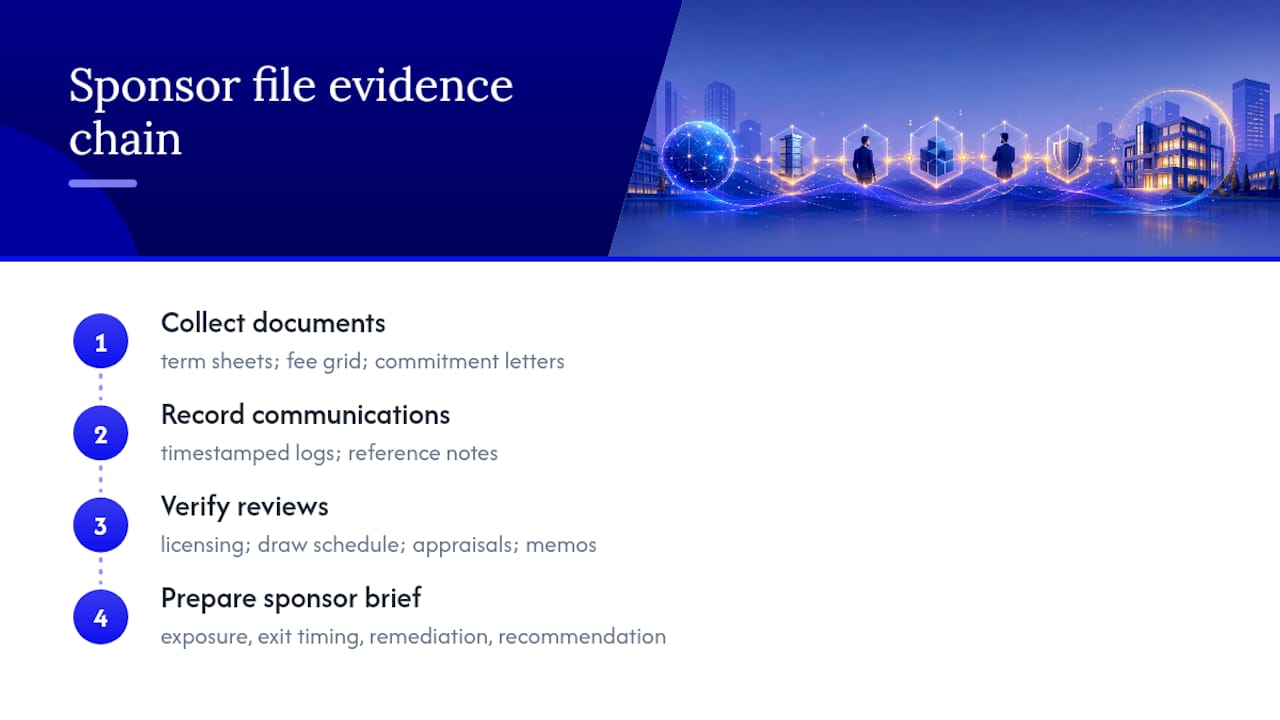
Keep every version of the term sheet, the fee grid, any funder commitment letter, timestamped communication logs, reference notes, licensing documentation, the draw schedule, appraisal and property condition results, and any third-party review memos. When you brief a sponsor, summarize it in four points: the specific financial exposure, the exit timing risk, what remediation you requested, and your recommended next step. Flag any time-sensitive deposit deadlines clearly, and keep originals of everything, especially anything related to money already advanced.
How BrokersConnect Helps You Screen Out Bad Lenders
Vetting takes time most brokers don't have mid-deal. A verified lender database, lender responsiveness leaderboard, and deal-matching filters give you a starting shortlist of lenders with track records instead of cold-call guesses. The secure document vault keeps fee grids, term sheets, and reference notes organized in one place for every active deal, while deal submission templates make it faster to request the documentation outlined above from multiple lenders at once. Ongoing coverage on a relevant blog walks through real negotiation language and closing pitfalls brokers run into regularly, giving you a reference point beyond whatever any single lender tells you about themselves.
Hidden or Excessive Interest Rate Mark-Ups
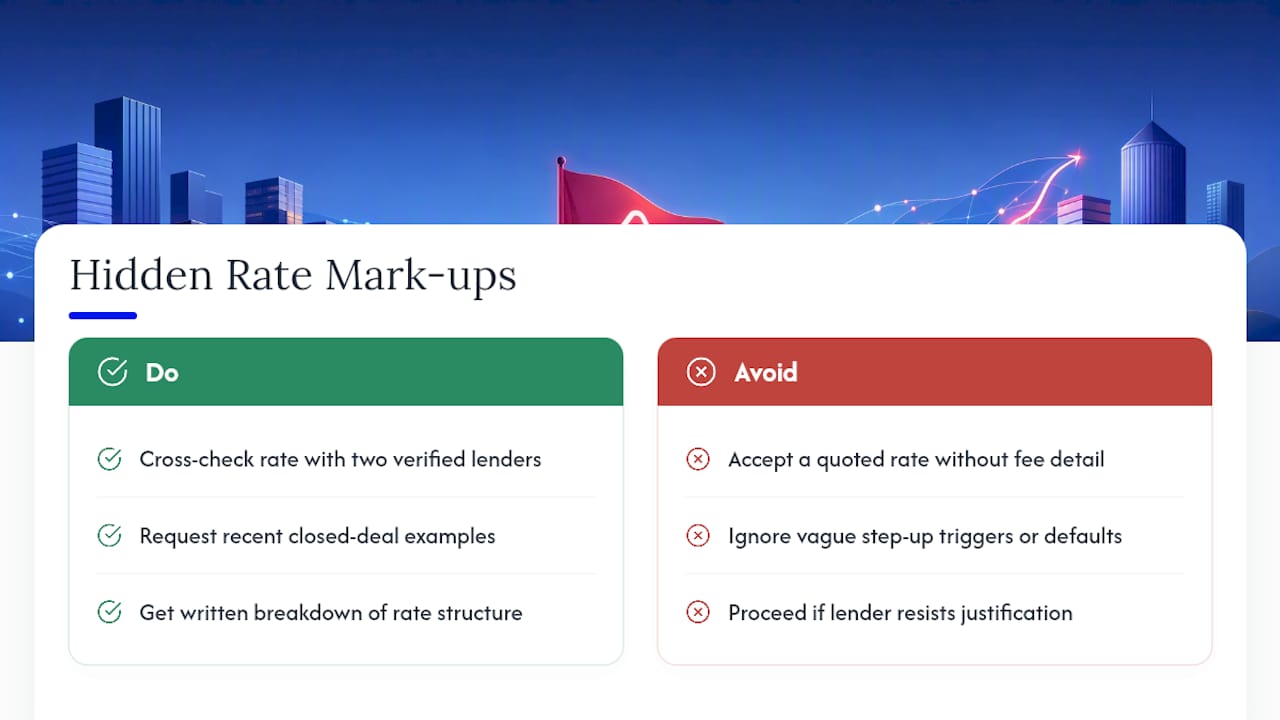
A quoted rate that looks competitive at signing can turn predatory once you account for how it's structured. Watch for a base rate that seems reasonable paired with steep default interest, aggressive rate step-ups tied to vague trigger events, or a "rate lock" that quietly disappears if closing slips by even a few days.
The real danger sits in the spread between what a lender claims the market rate is and what comparable deals are actually pricing at. Predatory structures tend to combine pricing opacity with broad discretionary clauses rather than announcing a high rate outright. That means a lender might quote something close to market on paper while reserving the right to adjust it upward through fees, extension charges, or default provisions buried three pages deep.
Cross-check any quoted rate against at least two other verified lenders working similar asset classes and loan sizes before assuming it reflects the actual market. If a lender resists explaining how their rate compares to recent closed deals, or gets defensive when asked to justify the spread over benchmark rates, that reluctance itself is informative. Legitimate lenders can usually point to recent transactions that support their pricing. Lenders relying on markup rather than volume tend to change the subject.
Signs of Aggressive or High-Pressure Sales Tactics
Pressure tactics are one of the easiest red flags to catch because they show up in tone before they show up in paperwork. A lender who insists you sign a term sheet within 24 hours "or the rate goes away," pushes for a non-refundable deposit before any real underwriting has happened, or frames every question you ask as a sign you're wasting their time is telling you something about how they'll behave post-closing.
Legitimate private lenders understand that brokers represent sponsors who need time to review terms, run numbers, and sometimes consult counsel. A lender who treats that normal diligence process as an obstacle, rather than a standard part of the transaction, is often compensating for weak underlying terms with urgency. Watch specifically for lenders who discourage you from getting independent legal review, who frame every deadline as immovable with no stated reason, or who escalate pressure specifically around deposit collection rather than around actual underwriting milestones.
The fix is simple, if not always comfortable: slow down. A lender with real capital and a genuine desire to close a good deal rarely needs to manufacture urgency to get a signature.
Lack of Transparency About Track Record and Previous Defaults
Ask any private lender how many deals they've closed in the past 12 months and how many of those loans went into default or forbearance. The answer, or the lack of one, tells you almost everything you need to know.
A lender confident in their history will usually share recent closed-deal examples and put you in touch with sponsors who can vouch for the experience. Requesting references and verifying past transactions directly is one of the fastest ways to separate a lender with a real track record from one relying on a well-designed pitch deck. A lender who deflects, offers only vague volume claims, or provides references that turn out to be unreachable or unrelated to commercial deals is asking you to take their reliability on faith.
Past defaults aren't automatically disqualifying. Every active lender has had a deal go sideways at some point. What matters is whether they're willing to discuss what happened and how it was resolved. A lender who gets defensive or dismissive about a direct question on defaults is telling you they haven't thought carefully about their own risk management, or don't want you looking too closely at it.
Unwillingness to Provide Clear Documentation and Disclosures
If a lender resists putting basic terms in writing, that resistance is the red flag, not a formality to work around. This shows up in small ways at first: a fee grid described over the phone but never sent as a document, a verbal promise about reserve release timing that never makes it into the term sheet, or licensing information that gets deferred "until later in the process."
A lender operating in good faith has no structural reason to withhold documentation. Checking whether a lender holds proper state licensing and is willing to provide proof is a basic verification step, and a lender who hesitates or gets vague about it is signaling that the paperwork won't hold up to scrutiny. The same logic applies to fee grids, draw schedules, and reserve mechanics: if it's not written down and specific, assume it can change without notice.
Push for every material term in writing before advancing money or committing a sponsor's time. A detailed loan closing checklist helps you track exactly which documents are outstanding at any point in the process, so nothing gets waved through on a promise that never gets formalized.
The Real Lesson Behind Most Private Lender Red Flags
Most advice on this topic treats red flags as a list to memorize. That's backward. The pattern underneath almost every bad private lending outcome is the same: vague discretion plus an unverifiable capital source. Everything else, the fee stacking, the pressure tactics, the disappearing underwriting contact, tends to trail behind those two root problems rather than stand apart from them.
Conventional advice also overrates the headline rate and underrates operational signals. A responsive, consistent underwriting contact and a lender willing to hand over a commitment letter predict how a closing will go far better than the coupon on page one ever will. If you take one thing from this checklist, prioritize the capital source question over the rate comparison. Everything downstream, recourse, prepayment, draw control, gets easier to evaluate once you know who you're actually borrowing from.
Brokers who skip that question because a deal is moving fast are the ones who end up explaining a blown closing to a sponsor.
— Theron
Speed Up Vetted Lender Sourcing Without the Cold-Call Grind
Chasing references and licensing checks on every unfamiliar lender eats hours you don't have mid-deal. A platform gives brokers a faster starting point: a database of verified lenders matched to your specific deal scenario, so you're screening candidates with a track record instead of starting from a cold list.
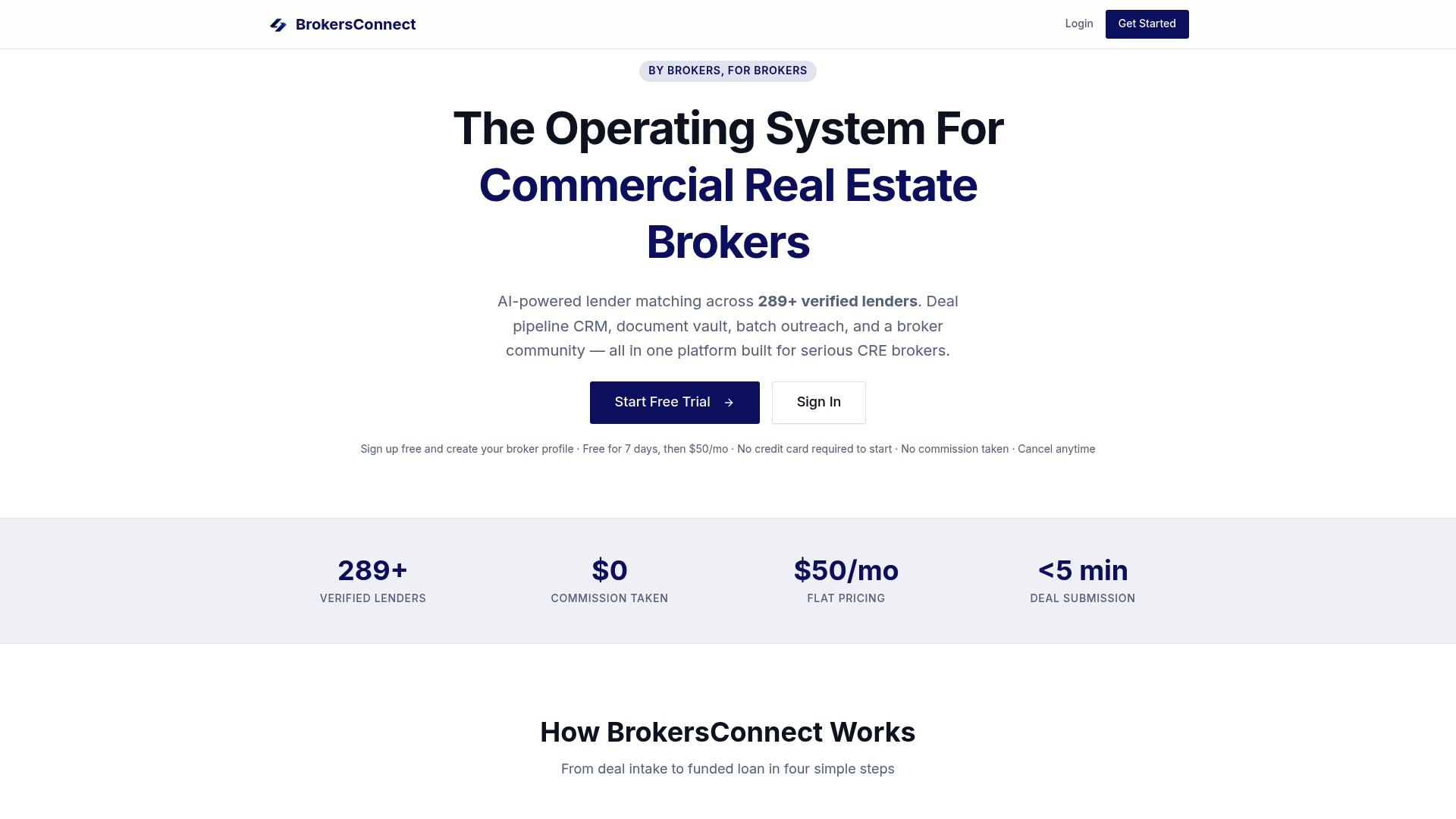
The lender responsiveness leaderboard flags who actually answers and closes, which cuts down the risk of chasing a non-refundable deposit toward a lender who walks near the finish line. Deal submission templates and a secure document vault keep your fee grids, term sheets, and reference notes organized for every active file, so nothing gets lost between the first call and closing. If you're tired of vetting lenders from scratch on every new deal, start a free trial with BrokersConnect and see how much faster verified matches move when the groundwork is already done.
Sources
- How to vet private money lenders for real estate investing — HousingWire
- How To Avoid Predatory Commercial Real Estate Lenders — Financely Group
- Toxic Loans: How to Spot, Avoid, and Survive Predatory Financing in Real Estate — LIC Support
- How to Choose a Commercial Real Estate Financing Company: 12 Questions to Ask — Avana Capital