
Mezzanine debt is a subordinated loan secured by a UCC pledge of the ownership interests in the property entity. Preferred equity is an equity class with contractual priority but no statutory foreclosure right. That single legal distinction drives almost everything else: pricing, enforcement speed, tax treatment, and whether your senior lender will even permit the structure.
Here's the rule of thumb that actually holds up across deals:
- Choose mezzanine when your senior lender's loan documents allow it and you want faster enforcement plus tax-deductible interest.
- Choose preferred equity when the senior lender or agency program prohibits equity pledges, or when you need leverage a mezzanine lender won't underwrite.
- Everything downstream, legal remedies, intercreditor mechanics, pricing spreads, and exit timing, flows from that senior-lender constraint.
The sections below walk through the legal mechanics, market pricing, intercreditor negotiation points, and a practical checklist you can run during underwriting.
Key Takeaways
Senior lender and agency restrictions decide the mezzanine versus preferred equity question more often than pricing does, and enforcement speed drives most of the spread between them.
| Point | Details |
|---|---|
| Legal foundation differs completely | Mezzanine is a UCC Article 9 pledge with foreclosure rights; preferred equity is a contractual equity stake with no statutory remedy. |
| Enforcement timeline gap is the key risk driver | Mezzanine foreclosure runs 30 to 60 days; contested preferred equity remedies can take 6 to 18 months or longer. |
| Senior lender approval gates the decision | Agency programs commonly prohibit mezzanine pledges, making preferred equity the practical default on those deals. |
| Pricing reflects enforcement risk | Preferred equity typically prices 100 to 200 basis points wider than comparable mezzanine debt. |
| Tax and leverage treatment diverge | Mezzanine interest is generally deductible and counts as debt; preferred equity distributions are not deductible and typically book as equity. |
Table of Contents
- Preferred Equity vs. Mezzanine: The Legal Foundation
- What Preferred Equity Actually Is
- Preferred Equity vs. Mezzanine Debt: What Actually Decides the Deal
- When Mezzanine Debt Is the Better Fit
- When Preferred Equity Is the Better Fit
- Structuring the Deal: Intercreditor Negotiation Points
- Pricing and Returns: What the Market Actually Pays
- Risks and Liquidity: What Can Go Wrong
- A Deal-Level Checklist: Mezzanine or Preferred Equity?
- How Thecrebrokersconnect Supports Subordinate Capital Deals
- How Preferred Equity and Mezzanine Show Up on the Balance Sheet
- Comparing Risk for Mezzanine Lenders and Preferred Equity Investors
- Control and Voting Rights: What Each Investor Actually Gets
- How Sponsors Should Actually Decide
- The Real Decision Isn't About Rate
- Sources
Preferred Equity vs. Mezzanine: The Legal Foundation
Mezzanine debt sits at the entity level, not the property level. The lender takes a pledge of the membership or partnership interests in the entity that owns the real estate, secured under UCC Article 9 rather than a mortgage. That structural choice is deliberate: it lets the mezzanine lender foreclose on the equity interests without triggering the due-on-sale or transfer restrictions baked into the senior mortgage.
Three things define a typical mezzanine structure:
- Security: A UCC-1 financing statement against the pledged equity interests, filed and perfected separately from the senior mortgage.
- Economics: A stated interest rate, often split between a current-pay component and a PIK (payment-in-kind) accrual that compounds until maturity.
- Remedies: Foreclosure rights under UCC Article 9, which move considerably faster than a judicial mortgage foreclosure.
None of that works without the senior lender's blessing. Nearly every senior loan agreement requires an intercreditor or recognition agreement before a mezzanine pledge can even be created, and many senior lenders, particularly agency lenders, refuse outright; for a detailed explanation of why some lenders restrict subordinate structures, see Services | WeFinanceU. That single approval gate is why mezzanine appeals to sponsors who qualify for it: faster remedies if things go wrong, deductible interest that lowers the after-tax cost of capital, and a creditor's clear standing rather than an equity holder's murkier one.
What Preferred Equity Actually Is
Preferred equity is not a loan dressed up in different paperwork. It's a real equity interest in the property-owning entity, governed entirely by the operating agreement rather than a note and mortgage. There's no UCC filing, no statutory foreclosure right, and no automatic path to seize control when the deal underperforms.
Returns get structured a few common ways:
- Hard pay: a fixed preferred return paid currently from operating cash flow, similar in feel to a coupon.
- Soft pay: unpaid preferred return that accrues rather than gets paid, often compounding until a capital event.
- Upside participation: a kicker on top of the base preferred return, tied to sale proceeds or refinance proceeds above a threshold.
When a sponsor stops paying, the preferred equity investor doesn't foreclose. Remedies live entirely in the operating agreement: the right to remove the general partner, force a buyout at a negotiated formula, or step into a controlling role. Enforcing any of that usually means litigation or, more realistically, negotiated cooperation from a sponsor who doesn't want the fight. That's a meaningfully weaker enforcement position than a UCC pledge, which is exactly why preferred equity remedies rely on contract and litigation rather than statutory foreclosure. Sponsors like it precisely because that friction buys them operational room, and agency lenders tend to accept it where they won't accept a mezzanine pledge.
Preferred Equity vs. Mezzanine Debt: What Actually Decides the Deal
Strip away the marketing language from both products and four variables decide which one you can actually use: enforcement speed, creditor status, tax treatment, and price.
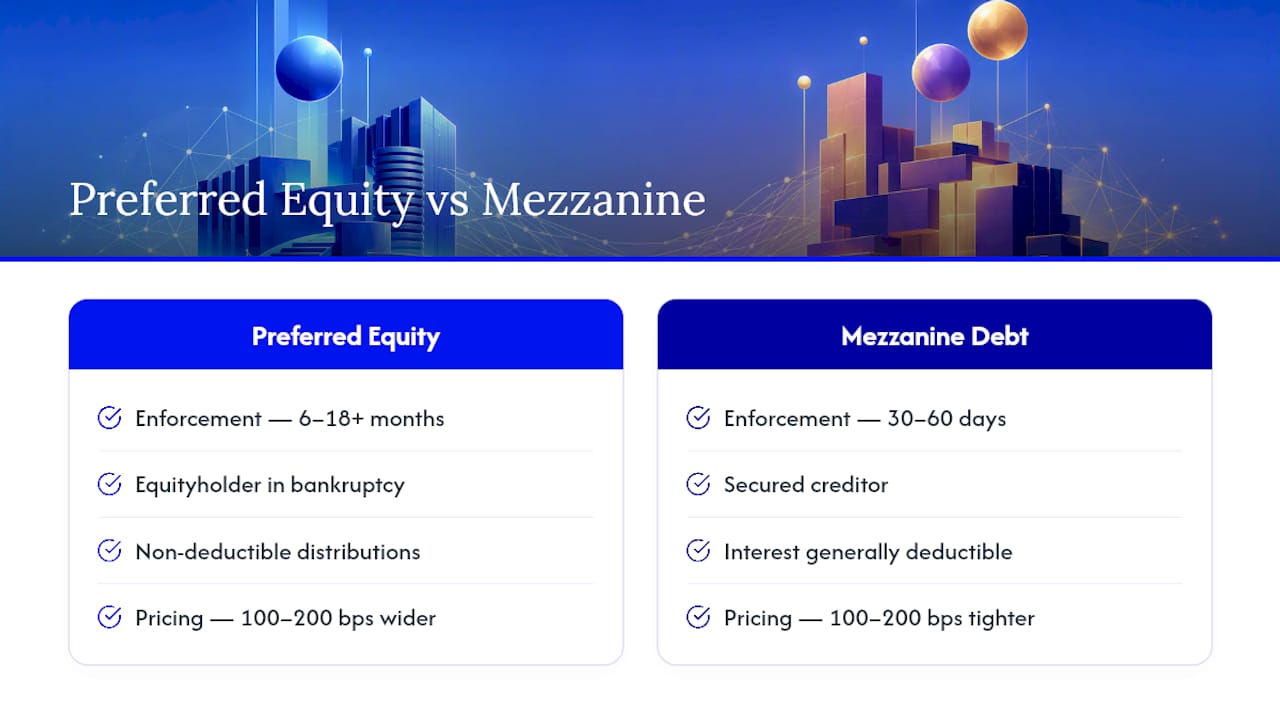
Enforcement timeline. Mezzanine lenders foreclose under UCC Article 9, a process that typically runs 30 to 60 days. Preferred equity holders pursuing contractual remedies, GP removal, forced buyouts, litigation, are looking at 6 to 18 months or longer if the sponsor contests it. That gap alone explains most of the pricing difference between the two products.
Creditor status and bankruptcy. A mezzanine lender is a secured creditor with a defined claim against pledged collateral. A preferred equity holder is an equityholder, full stop, even in "debt-like" hard preferred structures engineered to mimic a loan's cash flow. Those structures remain equity in a bankruptcy proceeding, which matters enormously if the deal ever gets there.
Tax treatment. Mezzanine interest is generally deductible to the borrower, which lowers the after-tax cost of that capital. Preferred equity distributions are equity returns, not deductible interest, so the sponsor's blended cost of capital calculation looks different even when the headline rates are close.
Pricing spread. Preferred equity typically prices 100 to 200 basis points wider than comparable mezzanine, and that spread isn't arbitrary.
Why the spread exists: Investors in preferred equity are pricing in slower enforcement, weaker recovery mechanics in a downside scenario, and longer expected hold periods. It's compensation for risk, not a random markup.
When Mezzanine Debt Is the Better Fit
Mezzanine works when three conditions line up, and it falls apart fast when even one doesn't.
- Your senior lender allows it. Check the loan agreement's intercreditor provisions before you shop mezzanine capital, not after. Balance-sheet and CMBS lenders are often flexible here; agency lenders usually aren't.
- Tax-deductible interest actually moves the sponsor's after-tax return. On highly leveraged deals with thin equity checks, that deduction compounds meaningfully across a multiyear hold.
- Your capital partner wants the security of UCC foreclosure rights. Some mezzanine funds simply won't write a check without that remedy on the table, and rightly so given the risk they're taking on a subordinated position.
The disqualifying red flag is straightforward: if your senior debt is a Fannie Mae or Freddie Mac execution, stop shopping mezzanine and go straight to preferred equity conversations.
Pro Tip: Get your senior lender's intercreditor position in writing before you spend weeks negotiating mezzanine terms. A verbal "should be fine" from a loan officer is not an approval, and finding out otherwise at closing kills deals.
When Preferred Equity Is the Better Fit
Preferred equity earns its place on deals where mezzanine simply isn't an option, or where the sponsor values flexibility over the lowest headline rate.
- Agency-backed loans. Fannie Mae and Freddie Mac multifamily programs commonly prohibit the equity pledges mezzanine debt requires, which makes preferred equity the only practical subordinate capital available on those deals.
- High-leverage structures. When combined loan-to-cost climbs toward 85% and above, many mezzanine lenders pull back entirely. Preferred equity can be sized to reach 90%-plus combined LTC, though it demands a higher return and tighter covenants in exchange.
- Sponsors who want breathing room. Slower enforcement cuts both ways. A sponsor navigating a rough lease-up or a temporary cash-flow dip generally prefers an investor whose remedies run through negotiation rather than a 45-day foreclosure clock.
- Investors who can tolerate illiquidity. Preferred equity positions typically lock up capital for 3 to 7 years with no meaningful secondary market, so the investor side of this trade needs a longer time horizon and a higher required yield to compensate.
Structuring the Deal: Intercreditor Negotiation Points
Whichever product you use, the intercreditor or recognition agreement is where the deal actually gets made or broken. Senior lenders typically insist on a defined set of protections before they'll recognize subordinate capital at all.
- Standstill periods. The senior lender usually requires the subordinate holder to wait a defined period, often 90 to 180 days, before exercising any remedy after a default.
- Cure rights. Subordinate capital typically gets the right to cure a senior default, protecting its position without needing the senior lender's cooperation.
- Purchase option rights. Many agreements give the subordinate holder the right to buy out the senior loan at par plus costs if a default isn't resolved, preserving its ability to protect the asset.
- Recognition of the subordinate interest. Agency lenders in particular scrutinize this closely, since they need assurance the preferred equity structure won't interfere with their servicing and foreclosure rights.
A practical sequence for sponsors: confirm the senior lender's consent mechanics first, size the subordinate tranche to avoid overlapping cure triggers, lock down clear buyout mechanics with defined step-up returns, and then test bad-boy recourse and environmental carveouts so they're capped rather than open-ended. The clause that most often derails a deal late in negotiation is an uncapped recourse carveout the subordinate investor won't accept. A well-drafted intercreditor agreement resolves most of these fights before they reach the closing table.
Pricing and Returns: What the Market Actually Pays
Representative all-in pricing runs mezzanine debt around 11% to 16%, with preferred equity total returns landing around 11% to 18%, and preferred equity typically sitting 100 to 200 basis points above comparable mezzanine on similar risk profiles.
The structure within those ranges matters as much as the headline number. A current-pay mezzanine loan at 12% draws real cash out of operations every month. A soft-pay preferred equity structure at 14% with a PIK accrual might cost the sponsor nothing in monthly cash flow, with the full return settling at exit. On a stabilized asset with tight cash flow, that difference can decide which structure a sponsor can actually service. Asset class, leverage level, and sponsor track record all move pricing within these bands, sometimes by several hundred basis points on either side.
Risks and Liquidity: What Can Go Wrong
Enforcement speed is the risk variable that matters most in practice. Mezzanine foreclosure under UCC Article 9 typically wraps up in 30 to 60 days. Preferred equity remedies, when contested, can stretch to 6 to 18 months or longer, and every month of delay is a month of continued exposure to a deteriorating asset.
- Bankruptcy priming. Preferred equity holders sit behind all creditors, secured and unsecured, in a bankruptcy waterfall, regardless of how "debt-like" the structure is drafted to appear.
- Illiquidity. Private preferred equity has no meaningful secondary market, and early exits, when they happen at all, usually come at a negotiated discount.
- Mitigants exist on both sides. Bad-boy recourse carveouts, sponsor indemnities, and step-up returns that increase after a defined trigger date all give subordinate capital some protection short of full foreclosure rights.
None of these risks are reasons to avoid either product. They're reasons to price the structure correctly and negotiate the mitigants before signing, not after a default.
A Deal-Level Checklist: Mezzanine or Preferred Equity?
Run these questions in order. The first one usually eliminates half the decision on its own.
- Does the senior loan agreement permit an equity pledge? If it's agency financing, the answer is almost always no, and preferred equity becomes your default path.
- What's your combined loan-to-cost target? Above roughly 85%, mezzanine lenders start pulling back; preferred equity can stretch to 90%-plus with tighter covenants.
- Does tax-deductible interest change your sponsor economics meaningfully? If yes, and mezzanine is available, it usually wins on cost.
- What enforcement speed does your capital partner require? Investors who need fast, statutory remedies should push toward mezzanine structures.
- What clauses should you push for? Prioritize defined cure periods, capped recourse carveouts, and clear buyout mechanics over marginal rate improvements.
Pro Tip: Ask counsel one specific question early: "Does our senior lender's intercreditor form have a template for this structure, or are we drafting from scratch?" A lender with an existing template moves in weeks; one drafting from zero can add a month or more to your timeline.
How Thecrebrokersconnect Supports Subordinate Capital Deals
Sourcing the right mezzanine lender or preferred equity investor is its own project, separate from structuring the deal itself. Thecrebrokersconnect matches your loan scenario against a database of 289+ verified lenders by property type, leverage, and transaction structure, so you're not cold-calling capital sources that don't write subordinate debt or preferred positions at all.
- Package your deal once and route it to multiple qualified subordinate capital sources through batch outreach.
- Track every lender conversation and document exchange in one pipeline instead of scattered emails.
- Use the platform to compare lender responsiveness before you commit time to a relationship that goes nowhere.
How Preferred Equity and Mezzanine Show Up on the Balance Sheet
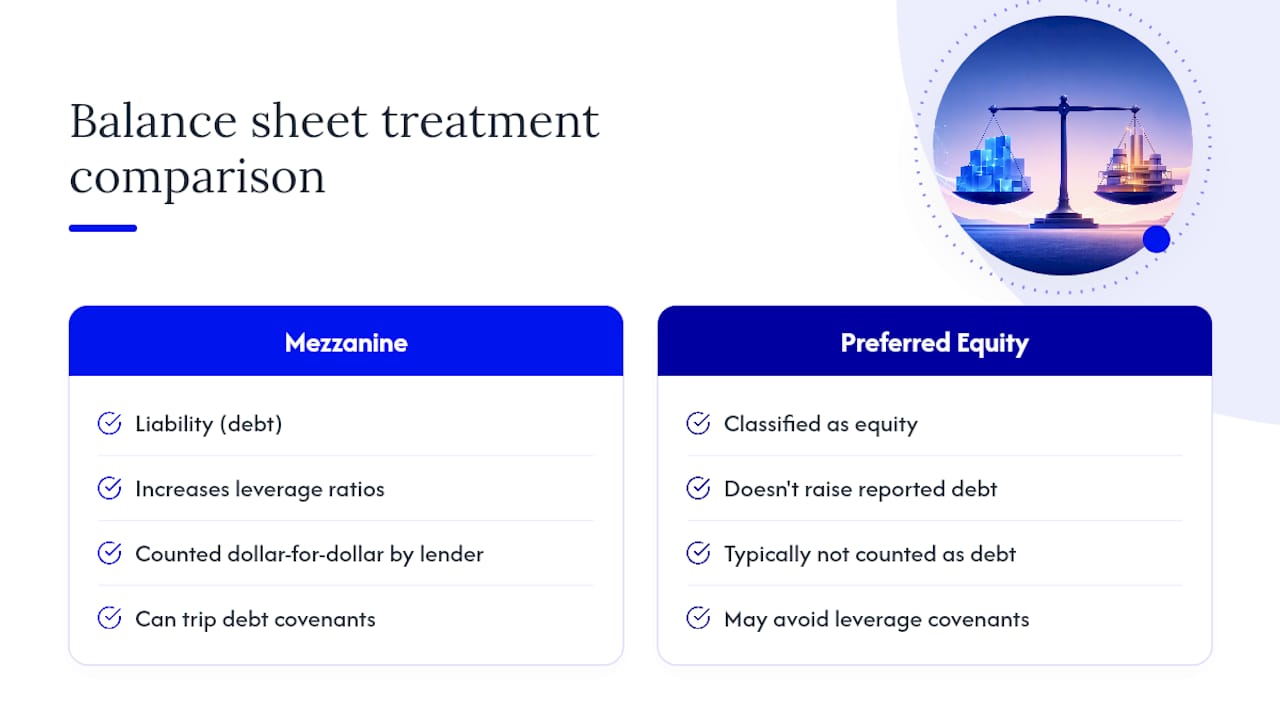
Mezzanine debt is a liability. It shows up on the balance sheet as debt, increases the entity's leverage ratios, and gets included in any debt service coverage or debt yield calculation a senior lender runs. That's not a technicality. A senior lender computing combined debt yield or DSCR on the whole capital stack will count mezzanine dollar-for-dollar as debt, which can trip covenants if the stack gets too aggressive.
Preferred equity is typically classified as equity, not debt, under standard accounting treatment, even in "hard pay" structures designed to behave like a loan. That classification is exactly why sponsors reach for it on leverage-constrained deals: it lets the capital stack go deeper without technically increasing the entity's debt-to-equity ratio or tripping a senior lender's maximum leverage covenant.
That accounting distinction has real consequences for how outside parties read the deal. A lender, rating agency, or joint-venture partner reviewing the entity's financials sees a materially different leverage picture depending on which instrument fills the subordinate slot, even when the two structures cost the sponsor nearly the same amount in current-year cash flow. Loan covenants tied to maximum leverage ratios, minimum net worth, or liquidity tests all read differently depending on how the subordinate capital gets classified. Sponsors managing multiple properties across a fund or platform should model both structures against every covenant in their senior loan documents and any fund-level reporting requirements before assuming preferred equity is the "leverage-free" option. It reduces reported debt. It does not reduce financial risk.
Comparing Risk for Mezzanine Lenders and Preferred Equity Investors
The two investor bases are underwriting fundamentally different risks, even when the return targets overlap.
A mezzanine lender is underwriting collateral risk and enforcement mechanics. Their downside protection comes from the UCC pledge and the ability to foreclose relatively fast if the sponsor defaults. Their primary risk is that the collateral, the equity interests in the property entity, ends up worth less than the loan balance by the time they can exercise remedies. Because that timeline runs 30 to 60 days, the exposure window is comparatively short.
A preferred equity investor is underwriting sponsor risk and asset performance risk over a much longer window. Without a foreclosure right, their protection depends almost entirely on the sponsor's willingness to honor the operating agreement or on a court eventually enforcing it. If the sponsor stops cooperating, the preferred equity investor's realistic options are a buyout negotiation, a GP removal fight, or litigation, any of which can run 6 to 18 months or longer. That extended exposure window is the core reason preferred equity demands a higher return than mezzanine debt priced against similar underlying risk.
Both investor types also face different recovery outcomes in a downside scenario. A mezzanine lender who forecloses on the equity pledge steps into ownership of the entity, subject to the senior loan remaining in place. A preferred equity investor who wins a buyout fight or GP removal claim ends up in a similar ownership position, but only after a materially longer and more expensive process, with litigation costs eating into whatever recovery remains.
Control and Voting Rights: What Each Investor Actually Gets
Neither instrument typically grants day-to-day control while the deal performs, but the two diverge sharply once trouble starts.
Mezzanine lenders generally have no voting rights or management control during the life of the loan. They're creditors, not owners, and their leverage comes entirely from the pledge sitting behind the entity. Only on default, when they can foreclose on the equity interests, does a mezzanine lender step into an ownership and control position.
Preferred equity holders often negotiate more active governance rights up front, precisely because they lack a foreclosure remedy to fall back on. Common provisions include consent rights over major decisions, capital calls, or refinancing; a defined board or major-decision veto for the preferred holder; and a springing right to remove the general partner if payment defaults or covenant breaches persist past a cure period. These rights are entirely a function of what gets negotiated into the operating agreement, so they vary enormously deal to deal.
That negotiation dynamic matters for sponsors evaluating the two products beyond pure cost. Mezzanine debt generally preserves more day-to-day operational control for the sponsor precisely because the lender's only real lever is foreclosure, an outcome few lenders want to pursue if they can avoid it. Preferred equity investors, lacking that hammer, tend to build more granular oversight into the operating agreement from day one, which sponsors should weigh against the flexibility that structure otherwise offers.
How Sponsors Should Actually Decide
The decision rarely comes down to a spreadsheet comparing two interest rates side by side. Senior lender constraints eliminate one option before the sponsor even gets to compare pricing, which is why the first question in any subordinate capital search should always be about permissibility, not cost.
Beyond that gating question, sponsors weigh a few strategic trade-offs. A sponsor prioritizing the lowest after-tax cost of capital, with a senior lender willing to permit it, generally leans mezzanine. A sponsor who needs to stretch leverage past what mezzanine lenders will underwrite, or who is running an agency execution, has effectively already decided on preferred equity, whether or not the pricing looks attractive.
Portfolio-level sponsors add another layer: repeated use of one structure across multiple deals builds relationships with a known set of subordinate capital providers, which speeds future closings even if the pricing isn't always the cheapest available. That relationship value rarely shows up in a rate sheet, but experienced sponsors weigh it heavily when it comes time to renegotiate terms on the next deal in the pipeline. A private money lender relationship built over several transactions often closes faster than a first-time subordinate capital search, regardless of which structure gets used.
The Real Decision Isn't About Rate
Most sponsors walk into the mezzanine versus preferred equity conversation asking the wrong first question. They want to know which one is cheaper, when the honest answer is that the senior loan documents usually decide the question before pricing ever enters the conversation. If your agency lender's covenants prohibit an equity pledge, the mezzanine rate you could theoretically get is irrelevant.
Where conventional advice falls short is treating this as a rate-shopping exercise. The sharper approach treats it as a permissions exercise first, an enforcement-risk exercise second, and a pricing exercise a distant third. Sponsors who confirm intercreditor mechanics before they start negotiating terms close faster and avoid the expensive experience of renegotiating a structure mid-process because the senior lender says no at the eleventh hour.
If there's one thing worth prioritizing above all else, it's reading your senior loan agreement's subordinate debt provisions before you pick up the phone to shop capital. Everything else, the rate, the PIK component, the buyout mechanics, is negotiable. Whether the structure is even permitted usually isn't.
Sources
- Preferred Equity: Comparing alternatives and managing legal risks | Mayer Brown
- Mezzanine vs Preferred Equity | PeerSense
- Preferred equity in real estate investing explained | Angel Investors Network
- Debt-like preferred equity in real estate financing | Katten