
Loan covenants are the written promises inside a credit agreement that require a borrower to do certain things, forbid others, and set hard financial thresholds the deal must keep meeting. For a broker, the covenant package is what actually determines how much room your sponsor has to operate, and how fast a lender can step in if performance slips.
- Maintenance vs. incurrence shapes everything: maintenance covenants get tested on a fixed calendar (often quarterly), while incurrence covenants only trigger when the borrower attempts a specific action, like taking on new debt.
- Financial covenants, especially DSCR and leverage, are the most actively monitored and most frequently violated terms in a commercial loan.
Before you pitch a deal to a lender, check the testing cadence and the covenant definitions first. That's where deals quietly fall apart later.
Key Takeaways
Covenant design, not the headline interest rate, usually determines how much flexibility a borrower keeps and how fast a lender can intervene when performance slips.
| Point | Details |
|---|---|
| Testing cadence drives risk | Maintenance covenants test quarterly; incurrence covenants only trigger on a specific action like new debt. |
| Watch the definitions | EBITDA and NOI add-backs can make an identical ratio threshold mean very different things across two loans. |
| Breach isn't automatic disaster | Most lenders prefer a waiver or amendment, often with fees, over acceleration or foreclosure. |
| Negotiate before closing | Push for cure rights, grace periods, and step-down thresholds at the term sheet stage, not after. |
| Match lenders to covenant appetite | BrokersConnect filters its verified lender database by covenant preference alongside leverage and property type. |
Table of Contents
- What Are Loan Covenants and Why Do Lenders Use Them?
- How Do Loan Covenants Actually Work Day to Day?
- Which Financial Covenants Show Up Most in CRE Loans?
- What Happens When a Borrower Breaches a Covenant?
- How Can Brokers Negotiate Better Covenant Terms?
- How Should Sponsors Monitor Covenant Compliance?
- What Do Covenant Breaches Look Like in Real Numbers?
- Where BrokersConnect Fits Into Covenant-Sensitive Deals
- Where Did Loan Covenants Come From?
- Do Syndicated Loans, Bonds, and Private Credit Use Covenants Differently?
- Do Loan Covenants Affect Credit Rating and Cost of Capital?
- How Do Covenants Shape Borrower Flexibility and Strategy?
- How Do Covenants Compare to Other Risk Mitigation Tools?
- What Do Real Covenant Breaches Look Like in Practice?
- A Note From Theron on Covenant Literacy
- Match Your Next Deal to a Lender Who Actually Fits the Covenant Profile
- Frequently Asked Questions
- Sources
What Are Loan Covenants and Why Do Lenders Use Them?
A loan covenant is a binding condition in the credit agreement, and it falls into one of three buckets. Affirmative covenants require the borrower to take action, like maintaining insurance, delivering financial statements, or paying property taxes on time. Negative covenants restrict behavior, blocking additional debt, asset sales, or dividend payouts above a set limit. Financial covenants set numeric thresholds, like a minimum debt service coverage ratio, that the borrower must keep clearing.
Lenders write covenants to align incentives and catch trouble early, not to make life difficult for sponsors. A breach is treated as a technical default under the credit agreement, which gives the lender contractual leverage well before a missed payment ever happens. That early warning system is the entire point.
There's a real trade-off, though. Covenant packages that are too tight can strangle a borrower's ability to run the property normally, and covenants that are too loose leave the lender exposed. Both sides negotiate around that tension.
- Affirmative: insurance, tax payments, reporting deadlines
- Negative: caps on additional debt, restrictions on distributions, limits on asset sales
- Financial: DSCR minimums, leverage caps, loan-to-value ceilings
Pro Tip: When you get a term sheet, scan the covenant section before the rate. A 25 basis point rate difference matters less than a DSCR covenant set so tight the sponsor breaches it in year two.
How Do Loan Covenants Actually Work Day to Day?
Covenant enforcement runs on two different clocks. Maintenance covenants get checked on a set schedule, usually quarterly, using trailing financial data compared against the required threshold. Incurrence covenants sit dormant until the borrower tries to do something specific, like refinance, sell an asset, or draw more debt. At that moment, the lender runs a pro forma test to see if the transaction is permitted.
Measurement dates, add-backs to net operating income or EBITDA, and how much "cushion" or headroom exists above the required ratio all matter more than the headline number itself. Two loans with an identical 1.25x DSCR requirement can behave completely differently depending on how NOI is defined.
- Bank loans and private credit facilities lean toward maintenance testing because lenders want frequent check-ins.
- Broadly syndicated term loans increasingly skip maintenance tests entirely, a structure known as cov-lite.
Testing cadence simply means how often, and under what circumstance, a covenant gets checked. Get that wrong in your underwriting and you'll misjudge how much runway a sponsor actually has.
Which Financial Covenants Show Up Most in CRE Loans?
Five metrics dominate commercial real estate loan agreements, and each one tells the lender something different. Debt Service Coverage Ratio (DSCR) measures net operating income against debt payments. Loan-to-Value (LTV) compares loan size to appraised property value. Loan-to-Cost (LTC) does the same against total project cost, which matters more on construction deals. Total Leverage looks at aggregate debt against income or value. Interest Coverage Ratio isolates whether income covers interest payments alone, useful on interest-only structures.
Threshold ranges vary by asset class, sponsor strength, and lender program, so treat any number as a starting point for negotiation, not a fixed rule.
DSCR minimums typically fall between 1.15x and 1.50x depending on the lending program and asset class, which is why matching a sponsor's actual cash flow profile to the right lender program matters more than chasing the lowest rate. If you're sourcing capital for a DSCR-heavy deal, DSCR-focused lenders often price threshold flexibility differently than balance-sheet banks.
- DSCR and leverage covenants get watched most closely because they respond fastest to income disruption.
- LTC matters more than LTV on ground-up construction, where cost overruns hit before value stabilizes.
What Happens When a Borrower Breaches a Covenant?
A covenant breach is a technical default, distinct from a payment default where the borrower simply misses a debt service payment. Technical defaults trigger contractual rights for the lender even when every payment has been made on time. That distinction confuses a lot of first-time sponsors.
Lender responses fall along a spectrum, and most lenders prefer negotiation over immediate escalation:
- Informal forbearance, especially for a minor, short-term miss
- A waiver, usually accompanied by a fee
- An amendment that resets thresholds, often with tighter terms going forward
- Increased reporting requirements or a rate step-up
- Suspension of further advances on a construction facility
- Acceleration of the full loan balance
- Collateral enforcement or foreclosure in severe, unresolved cases
Where a lender lands on that spectrum depends on breach severity, how strong the sponsor relationship is, collateral quality, and broader market conditions. A single quarter DSCR miss during a tenant transition gets treated very differently than a leverage breach caused by a collapsing rent roll.
How Can Brokers Negotiate Better Covenant Terms?
Covenant language gets negotiated at the term sheet stage, and that's the only leverage point a broker really has. Push on these levers before the deal moves to closing documents:
- Definitions first. Nail down how NOI, EBITDA, and add-backs get calculated. Vague definitions can make a strict-looking ratio meaningless in practice.
- Cure rights. Ask for an equity cure period that lets the sponsor inject capital to fix a covenant miss before it counts as a default.
- Grace periods. A 10 to 30 day grace window before a technical default is declared gives the sponsor room to fix a timing issue.
- Step-down thresholds. Negotiate covenants that loosen over time as the property stabilizes, rather than a flat requirement for the full loan term.
- Carve-outs and baskets. Secure specific dollar baskets for permitted distributions or additional debt, rather than a blanket restriction.
- Request pro forma testing language for any incurrence-based covenant tied to future transactions.
- Confirm measurement dates align with your sponsor's actual reporting calendar, not an arbitrary quarter-end.
None of this is legal advice, but flagging these terms early saves your sponsor from a lawyer discovering them during closing week.
How Should Sponsors Monitor Covenant Compliance?
Covenant monitoring is a discipline, not a one-time checklist item at closing. Set it up right and a shortfall never becomes a surprise.
- Build a rolling covenant tracker that updates monthly, even if testing is quarterly, so trends show up before they become breaches.
- Assign ownership internally, usually the CFO or controller, and require them to sign the compliance certificate the lender receives.
- Model a rolling 12-month forecast against every active covenant, not just the trailing period being tested.
- The moment a forecast shows a likely shortfall, contact the lender before the testing date, not after.
Truist's guidance on covenant management notes that proactive reporting and early communication reduce the chance of escalation once a lender sees a problem coming rather than discovering it after the fact.
Pro Tip: When you package a submission on behalf of a sponsor, include a one-page covenant summary with testing dates and current headroom. Lenders move faster on deals where they can see the numbers already work.
What Do Covenant Breaches Look Like in Real Numbers?
Say a loan carries a 4.5x maximum total leverage covenant, tested quarterly. The property's trailing EBITDA drops 15% after a major tenant vacates. If outstanding debt stays flat, leverage climbs past 4.5x at the next test date, triggering a maintenance breach even though the sponsor never missed a payment.
Now compare that to an incurrence covenant on the same 4.5x threshold. The sponsor never gets tested unless they try to refinance, sell a partial interest, or add debt. They can keep operating above the metric indefinitely, as long as they don't attempt a triggering transaction.
Sample maintenance-test language: "Borrower shall maintain, as of the last day of each fiscal quarter, a Total Leverage Ratio not exceeding 4.50 to 1.00."
Sample incurrence-test language: "Borrower may not incur additional Indebtedness unless, after giving pro forma effect thereto, the Total Leverage Ratio would not exceed 4.50 to 1.00."
- Notice the second version only activates around a specific action, "incur."
- Always check how EBITDA add-backs are defined before modeling either scenario. That single definition often decides who wins the negotiation.
Where BrokersConnect Fits Into Covenant-Sensitive Deals
Matching a deal to the right lender means matching covenant appetite, not just rate and leverage. BrokersConnect filters its database of verified lenders by structure preferences, so brokers can shortlist lenders more likely to accept a specific maintenance or incurrence profile instead of guessing.
- Deal packaging templates that surface covenant terms clearly for lender review
- A secure document vault for compliance certificates and covenant tracking files
- A lender responsiveness leaderboard that shows which lenders actually engage on covenant-heavy structures
This guide comes from Theron, who covers commercial real estate financing mechanics for the BrokersConnect blog, with further reading available across the platform's resource library.
Where Did Loan Covenants Come From?
Covenants predate modern commercial lending by centuries. English common law recognized covenants as enforceable promises within contracts as early as the 1600s, and the concept migrated directly into American lending practice as banks formalized credit agreements in the 19th and early 20th centuries.
The modern financial covenant, tied to a numeric ratio rather than a general promise, became standard practice as syndicated lending expanded in the 1980s. Leveraged buyouts of that era relied heavily on maintenance covenants because multiple lenders needed a shared, objective trigger for coordinated action. A dozen banks in a syndicate couldn't rely on informal trust the way a single relationship lender might.
The 2000s changed that balance. Private equity sponsors, flush with negotiating leverage during competitive credit cycles, pushed hard for incurrence-only structures. Cov-lite loans, once rare, now dominate large portions of the broadly syndicated leveraged loan market, a shift that traded lender oversight for borrower flexibility.
Commercial real estate lending followed a parallel but distinct path. Because CRE loans are secured by a specific, appraisable asset rather than an operating business, lenders leaned more heavily on asset-level metrics like LTV and DSCR from the start, rather than the enterprise-level leverage ratios common in corporate lending. That asset-backed structure is part of why CRE covenant packages still skew toward maintenance testing even as corporate loan markets moved toward cov-lite. The lender's recovery depends on the property performing, not on the sponsor's broader balance sheet.
Do Syndicated Loans, Bonds, and Private Credit Use Covenants Differently?
Covenant structure changes dramatically depending on who's holding the paper. Syndicated bank loans, especially broadly syndicated term loans sold to institutional investors, have trended heavily toward cov-lite structures, since sponsors with strong credit profiles can push maintenance testing out of the deal entirely.
High-yield bonds have almost always been incurrence-only. Bondholders are dispersed, often anonymous, and rarely positioned to actively monitor a borrower quarter to quarter, so the market settled on transaction-triggered covenants decades ago rather than the periodic check-ins a bank might demand.
Private credit runs the opposite direction. Direct lenders, often a single fund or a small club, hold the loan on their own balance sheet rather than distributing it. Private-credit lenders and bank revolvers are far more likely to insist on maintenance testing, because that direct relationship gives them both the incentive and the access to monitor closely.
Commercial real estate financing sits closest to the private credit model in practice. Bridge lenders, debt funds, and regional banks writing CRE loans usually retain the loan rather than syndicating it broadly, which is exactly why maintenance covenants remain the norm on most CRE bridge and construction facilities, even as corporate borrowing trends elsewhere loosen. A sponsor negotiating a construction loan should expect quarterly testing as the default assumption, not the exception.
- Syndicated corporate loans: increasingly cov-lite, driven by sponsor leverage in competitive markets
- High-yield bonds: incurrence-only by market convention
- Private credit and CRE bridge/construction loans: maintenance testing remains standard
Borrowers with genuinely strong credit profiles, or access to competitive lender demand, can sometimes negotiate incurrence-only packages even within these norms, but that leverage is earned through sponsor track record, not assumed by default.
Do Loan Covenants Affect Credit Rating and Cost of Capital?
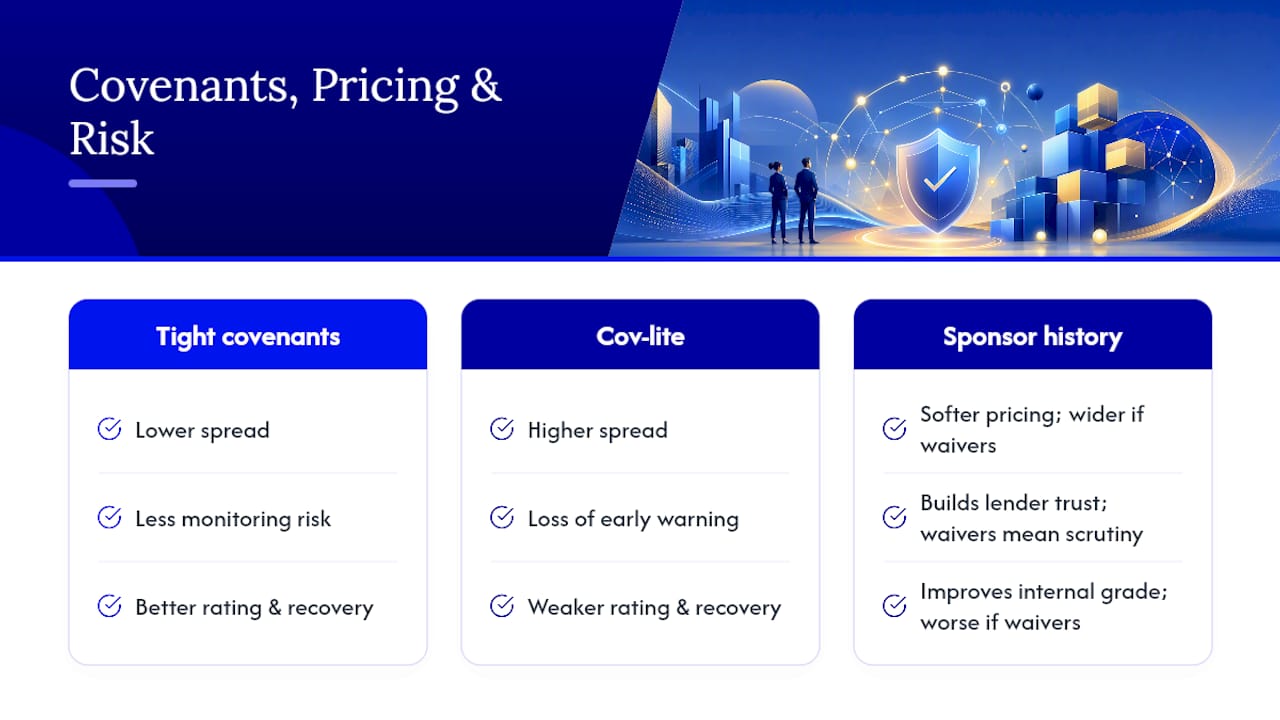
Covenant structure and cost of capital move together, though not always in the direction borrowers expect. A tighter covenant package, with frequent maintenance testing and low leverage caps, often earns a borrower a better rate. The lender is taking on less monitoring risk, and they price that reduced risk into the spread.
Loosen the covenants, and the math flips. Cov-lite structures typically carry a pricing premium because the lender loses early warning ability and has to compensate for that blind spot with higher yield. This is precisely why aggressive incurrence-only borrowers in the syndicated loan market often pay more in spread than a comparably rated maintenance-covenant deal, not less.
For borrowers who carry a formal credit rating, whether corporate or through a rated CMBS structure, covenant strength factors directly into how rating agencies assess default probability and expected recovery. A loan with strong maintenance covenants and tight definitions typically supports a better recovery assumption than one with loose incurrence-only language and generous add-back definitions, even at identical leverage levels.
For CRE sponsors without a formal rating, the effect shows up differently: through the lender's internal risk grading. A sponsor with a track record of clean covenant compliance across multiple loans builds a reputation that speeds up future underwriting and can soften pricing on the next deal. A sponsor with a history of waivers and amendments faces more scrutiny, more conservative leverage assumptions, and often a wider spread, regardless of the specific property's fundamentals.
The practical lesson for brokers: covenant compliance history is itself a credit signal, even when no formal rating exists.
How Do Covenants Shape Borrower Flexibility and Strategy?
Every covenant is a constraint on future decisions, which means covenant design shapes what a sponsor can actually do with the property over the loan term, not just what happens if something goes wrong.
A distribution restriction tied to a DSCR trigger, for example, can prevent a sponsor from pulling cash out during a temporary dip, even if the sponsor has other capital sources and the dip is clearly short-term. A leverage covenant with no step-down provision can block a value-add sponsor from refinancing out equity once renovations are complete, forcing them to hold the original loan longer than the business plan intended.
This is where negotiation upfront matters more than most sponsors realize. A construction loan with rigid draw covenants tied to strict completion percentages can slow down a project if the sponsor wants to sequence work differently than the lender's schedule assumes. Baskets and carve-outs negotiated at the term sheet stage, covered earlier in this guide, exist specifically to preserve that operational room.
The strategic trade-off is straightforward: tighter covenants generally buy a lower rate, but they also reduce how much the sponsor can adapt if the business plan needs to change midstream. Sponsors running a straightforward buy-and-hold strategy on a stabilized asset can usually accept tighter covenants without much cost. Sponsors running a more active value-add or repositioning strategy need to negotiate harder for flexibility, because the whole thesis depends on being able to pivot.
How Do Covenants Compare to Other Risk Mitigation Tools?
Covenants aren't the only lever lenders pull to manage risk, and understanding the alternatives helps brokers explain why a lender is asking for what they're asking for.
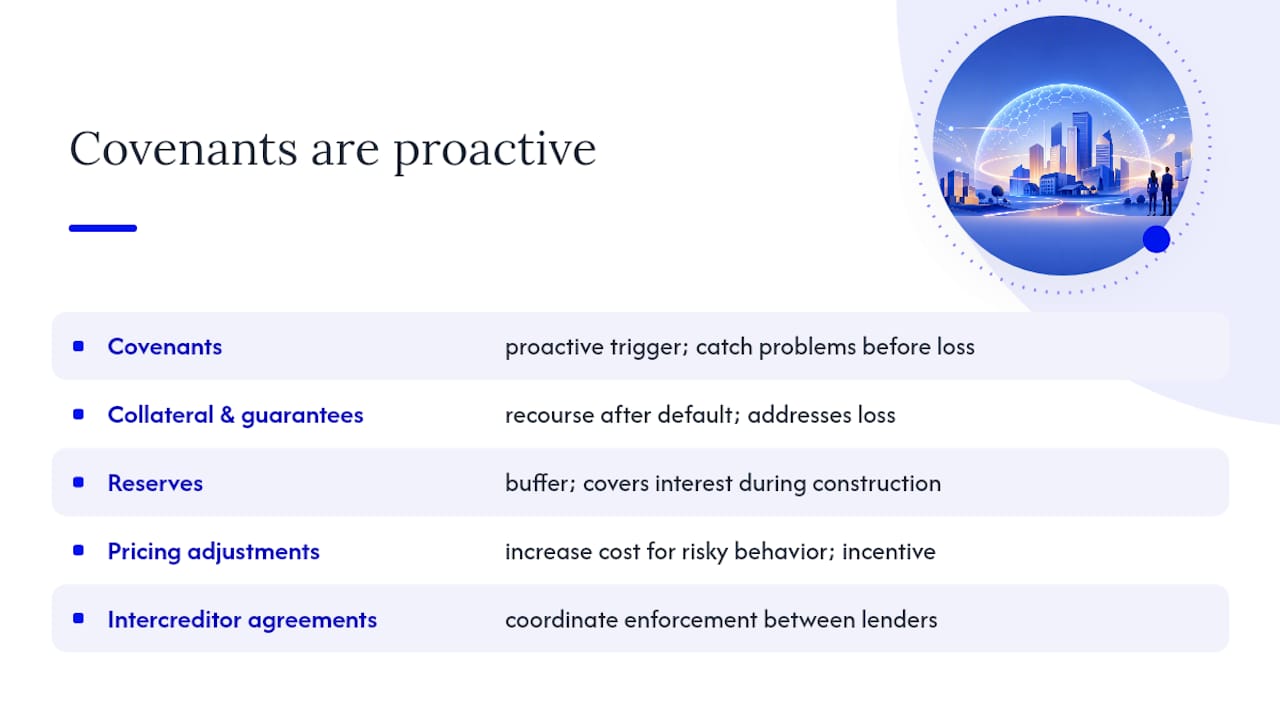
Collateral and guarantees work differently than covenants. A personal guarantee or cross-collateralized asset pool gives the lender recourse after something has already gone wrong. Covenants, by contrast, are designed to catch problems before they reach that point. Brokers structuring deals with multiple secured assets should understand how cross-collateralization interacts with the covenant group, since a covenant test measured only against one property in a portfolio can miss trouble brewing elsewhere in that portfolio.
Reserves, including interest reserves common on construction loans, function as a buffer rather than a trigger. An interest reserve sets aside loan proceeds specifically to cover interest payments during a construction or lease-up period when the property isn't yet generating income to service debt. It doesn't test anything or restrict behavior. It simply removes a specific default risk from the equation for a defined window, which is a fundamentally different mechanism than a DSCR covenant testing actual performance.
Pricing adjustments, like rate step-ups tied to leverage tiers, sit somewhere in between. They don't block an action outright the way a negative covenant does, but they make certain behaviors more expensive, nudging the borrower toward the lender's preferred outcome without an outright prohibition.
Intercreditor agreements become relevant the moment more than one lender sits in the capital stack. They govern how covenant enforcement and remedies get coordinated between senior and subordinate lenders, which matters enormously in multi-tranche CRE deals. A senior lender's covenant breach and a mezzanine lender's rights don't automatically align, and intercreditor terms determine who acts first.
Covenants remain the most proactive tool in this mix because they're the only mechanism designed to catch a problem before it becomes a loss, rather than manage the loss after the fact.
What Do Real Covenant Breaches Look Like in Practice?
The pattern repeats across property types more than most brokers expect. Technical default, even though every debt service payment cleared on time.
What typically happens next follows the remediation path lenders default to. The sponsor's advisor or broker gets ahead of the test date, delivers a forecast showing the dip is temporary and tied to lease-up concessions rather than permanent NOI erosion, and proposes a short covenant waiver in exchange for a fee and slightly tighter reporting. The lender, weighing the cost of foreclosure against a clearly temporary shortfall, grants the waiver. Waivers commonly carry fees and modestly tightened terms rather than triggering acceleration, which is exactly what happens in the vast majority of first-time maintenance breaches on otherwise sound assets.
Construction deals show a different failure pattern. A leverage covenant tied to LTC gets breached when material costs spike mid-build, pushing total project cost above the original underwriting. Here the resolution often requires an actual amendment, not just a waiver, because the underlying economics of the deal have genuinely shifted, and the lender needs updated numbers before advancing further draws.
The common thread across both scenarios: the sponsors who communicated early with data in hand got flexibility. The ones who waited for the lender to notice got tighter terms and less goodwill.
A Note From Theron on Covenant Literacy
The broker mistake I see most often isn't misreading a covenant. It's not reading it at all until the lender flags it during underwriting. Model the covenant scenarios before you pitch the deal, not after a lender pushes back.
Reach out through the platform if you need a covenant-specific lender match for your next submission.
Match Your Next Deal to a Lender Who Actually Fits the Covenant Profile
Finding a lender willing to accept a specific maintenance or incurrence structure usually means hours of cold calls and guesswork about who's even active in that space right now. BrokersConnect cuts that step out by filtering its database of 289+ verified lenders by covenant appetite alongside property type, leverage, and loan purpose, so you're pitching lenders who are actually a fit before you pick up the phone.
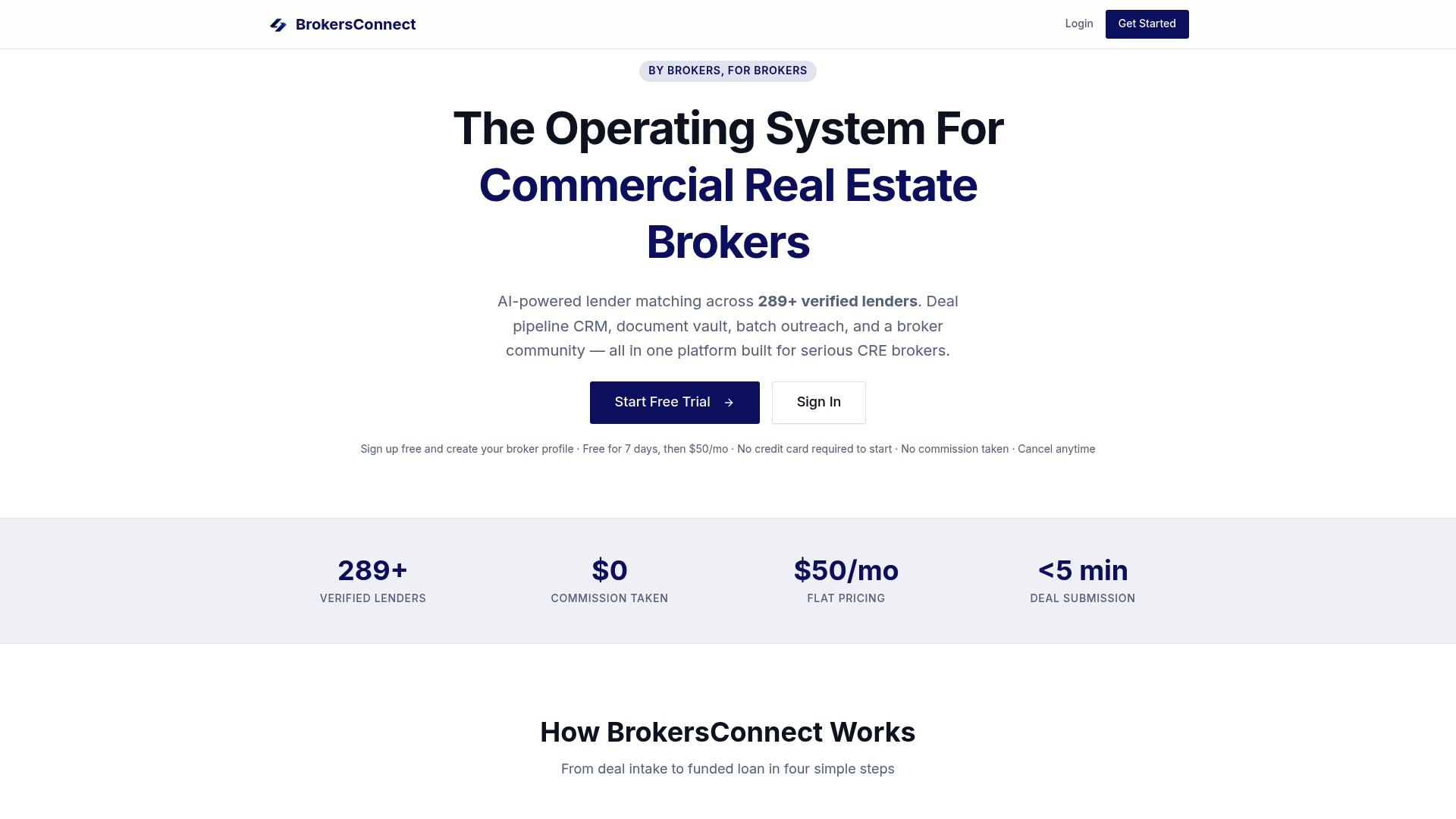
The platform gives you deal packaging templates built to surface covenant terms clearly, a document vault for compliance certificates and lender correspondence, and batch outreach tools so you can shop a covenant-sensitive deal to multiple matched lenders at once instead of one at a time. Start a free trial and submit your next scenario to see which lenders on the BrokersConnect platform actually match your sponsor's covenant needs.
Frequently Asked Questions
What is the simplest way to explain loan covenants? Loan covenants are conditions in a credit agreement that require, restrict, or measure borrower behavior. They give lenders contractual triggers to act before a loan actually defaults on payment.
What is an interest reserve in a construction loan? An interest reserve sets aside a portion of loan proceeds to cover interest payments during construction, before the property generates income to service the debt itself.
How do maintenance covenants differ from incurrence covenants? Maintenance covenants get tested on a regular schedule, often quarterly. Incurrence covenants only get tested when the borrower attempts a specific action, like taking on new debt or selling an asset.
What is a typical DSCR covenant for a commercial real estate loan?
What happens immediately after a covenant breach? Most lenders start with a conversation, not a legal filing. Early communication and a clear forecast usually lead to a waiver or amendment rather than acceleration.
Can a borrower negotiate covenant terms before closing? Yes, and the term sheet stage is the best window to do it. Pushing on definitions, cure rights, and grace periods before the loan documents get drafted preserves far more flexibility than trying to renegotiate after closing.
This article is general information, not a substitute for advice from a qualified financial advisor. Consult a qualified financial professional about your own circumstances before acting on anything here.
Sources
- Loan covenant | Corporate Finance Institute (CFI)
- Debt covenants | Wall Street Prep
- Loan covenants explained | Capital XO