
The fastest path to a term sheet is sponsor-first outreach: target lenders whose stated credit box actually fits the deal, lead with sponsor execution proof rather than deal size or rate chatter, and follow a short, escalating cadence that ends in a direct ask. Brokers who skip the sponsor framing and blast generic packages tend to collect polite silence instead of indicative terms.
TL;DR:
- Prioritize lenders with recent similar deals and published guidelines that match your deal parameters to increase the likelihood of a quick, favorable response.
- Start outreach with sponsor credibility and a concise deal snapshot, avoiding deal size or rate focuses to establish trust and relevance upfront.
- Maintain a structured cadence of three to five touches over two weeks, combining email and phone calls, and stop pursuing lenders after two unanswered attempts or clear disqualification.
- Ensure a complete submission package including rent roll, financials, and an underwriting summary, with auditability details when automated outputs are involved.
- Use referrals, industry relationships, and targeted discovery tactics to build a network of reliable lender contacts rather than relying solely on cold outreach.
Table of Contents
- Quick lender-outreach checklist before you hit send
- How to identify and prioritize the right lenders for this deal
- What to say in the first contact with a lender
- Outreach cadence and escalation that actually moves deals
- Minimum submission package and what auditability means now
- Measure outreach performance with a simple postmortem
- Effective communication channels and frequency for lender outreach
- Common pitfalls in lender outreach and how to avoid them
- Tips for leveraging referrals and networking in lender outreach
- Author perspective: balancing relationships and process
- How BrokersConnect supports this outreach playbook
- Sources
- FAQ
Quick lender-outreach checklist before you hit send
Before any name hits your outreach list, the submission itself needs to be ready. A rushed first contact wastes the one good impression you get with a lender who could fund the deal.
- Sponsor summary: net worth, liquidity, and at least three completed deals with outcomes stated plainly.
- One-page deal snapshot: property type, loan amount, conservative LTV, and DSCR, built on realistic assumptions rather than optimistic pro forma.
- Document list ready: rent roll, trailing financials, and a provenance note for anything generated by software.
- One clear ask: a term sheet or a 15-minute call, with a stated timeline for the lender to respond.
Lenders at the 2025 Fall Finance Forum described sponsor quality as their primary filter, which is why the sponsor summary belongs at the top of the list, not buried in an appendix.
How to identify and prioritize the right lenders for this deal
Start by mapping the deal's credit box: loan amount, leverage, property type, geography, and recourse preference. Any lender missing two or more of those attributes is a low-probability call, no matter how friendly the relationship.
Signals worth checking before you reach out:
- Recent closed deals: a lender who closed something similar in the last six to twelve months is a better bet than one who merely lists the asset class.
- Stated credit box: published guidelines, rate sheets, or program pages that match your leverage and DSCR target.
- Referrals and trade chatter: a warm introduction from another broker often beats a cold list entirely.
- Public filings and press: recent capital raises or fund closings suggest a lender has money to deploy right now.
Prioritize by execution history over marketing claims. A lender who "talks fast" on the first call is not the same as one who moves fast to closing, and the Commercial Observer's bridge-lending guidance points out that this distinction predictably shapes what happens on the second call. Tools built for credit box matching can cut this screening step from hours to minutes, and pre-deal intelligence platforms like AddBack can help confirm a lender's recent activity before you make contact. Weigh private capital against agency programs based on timeline: agencies move on a slower, more procedural clock, while private and bridge lenders can move faster but expect sponsor proof up front.
What to say in the first contact with a lender
Open with sponsor credibility, not loan terms. A lender scanning a crowded inbox decides in seconds whether the sponsor behind the deal is worth a second look, so that information goes first.
- Subject line: name the property type and ask directly, such as "Multifamily Bridge, Experienced Sponsor, Seeking Term Sheet."
- Opener: one sentence on the sponsor's track record and one sentence on why this deal fits the lender's known box.
- Snapshot: loan amount, target LTV, property type, and NOI or DSCR in three lines, not a paragraph.
- CTA: ask for an indicative term sheet or a short call, with a specific day and time suggested.
For private lenders, attach a condensed one-pager immediately since speed is their selling point. For agency or bank lenders, hold the full package until they confirm interest, since their process runs on checklists rather than instinct.
Pro Tip: Change two sponsor or deal points per lender, such as the sponsor's relevant prior deal and the specific metric that lender cares about most, rather than sending one identical note to everyone on the list.
Outreach cadence and escalation that actually moves deals
A workable cadence runs three to five touches over about two weeks, mixing channels so the lender notices the deal without feeling chased.
- Touch one: email with the sponsor-first snapshot, sent midweek morning.
- Touch two: a short call three to four days later if there is no reply, referencing the email directly.
- Touch three: a follow-up email with one new detail, such as an updated rent roll or a sponsor reference.
- Touch four or five: a direct ask for a yes or no, giving the lender an easy exit if the deal is not a fit.
When a lender asks for the full package, respond within a day with organized, labeled documents rather than a disorganized folder dump. Batch outreach works when each message still carries one or two tailored details rather than a form-letter feel, which is the same discipline covered in a five-touch cold email sequence built for reaching multiple lenders without sounding mass-produced. Stop pursuing a lender once they miss two scheduled responses or explicitly state the deal falls outside their box: chasing past that point rarely changes the outcome and costs time better spent on a better-fit lender.
Minimum submission package and what auditability means now
Most lenders expect a baseline package before they will issue anything indicative: rent roll, trailing twelve months of financials, sponsor financial statement, organizational chart, and a conservative underwriting summary. Agency and GSE lenders typically add appraisal order forms, environmental reports, and borrower-signed authorizations earlier in the process than private lenders require.
- Core documents: rent roll, T-12 financials, sponsor net worth and liquidity statement.
- Underwriting summary: conservative LTV, DSCR, and debt yield assumptions clearly labeled.
- Provenance log for automated outputs: file name, date created, the tool used, input sources, and the analyst responsible, attached as a single document when software generated key figures.
- GSE-specific confirmation: verify the lender's required delivery workflow before sending borrower documents.
Commercial Observer reporting on AI underwriting notes that lenders increasingly require auditability and provenance for automated outputs, with MISMO's new AI governance certifications pushing the market toward deterministic, traceable tools rather than unverified generic outputs. On the GSE side, Freddie Mac's updated guidance can remove brokers from the due diligence chain entirely in some cases, so confirming the lender's exact submission workflow before sending anything avoids a disqualification that has nothing to do with the deal itself.
Measure outreach performance with a simple postmortem
Track four numbers for every outreach round: response rate, term-sheet rate, time-to-term-sheet, and funding rate. Each tells you something different: response rate measures your messaging, term-sheet rate measures your lender targeting, and funding rate measures whether the lenders you are winning actually close.
- Response rate: how many lenders replied at all within the cadence window.
- Term-sheet rate: how many responses converted into an indicative term sheet.
- Time-to-term-sheet: days from first contact to a written indication.
- Funding rate: how many term sheets actually closed.
Brokers who run structured 30/60/90-day postmortems tend to improve outreach results over time by identifying which lender types and message variants actually produce term sheets, rather than guessing at what worked. Log qualitative notes too: which lenders asked sharp underwriting questions, which ghosted after requesting a package, and which closed on schedule. Feed those notes back into your lender list and messaging before the next round.
Effective communication channels and frequency for lender outreach
Email remains the backbone of lender outreach because it creates a record and lets a lender forward the deal internally without retyping anything. A phone call works best as a follow-up to a sent email rather than a cold open, since most lenders will not engage seriously on a deal they have not seen in writing yet.
Frequency matters more than volume. One well-timed touch every three to five business days keeps a deal visible without becoming noise, and spacing touches further apart than a week usually means the lender has mentally filed the deal away. For time-sensitive bridge deals, compress that spacing to two or three days, since bridge lenders expect speed from brokers the same way brokers expect speed from them.

Text messages have a place once a relationship is established, mainly for quick status checks rather than first contact. LinkedIn messages can work for warming up a new lender contact before the first formal email, especially when a referral or mutual connection gives you a reason to reach out. Avoid mixing too many channels on the same touch: sending an email and a text and a LinkedIn note all on the same day reads as pressure rather than professionalism.
Match the channel to the lender type. Banks and agency lenders tend to prefer formal email with attachments following their own checklist order. Direct lenders and credit funds often respond faster to a short email followed by a direct call, since their underwriters have more discretion to move quickly on a deal that looks right.
Common pitfalls in lender outreach and how to avoid them
The most common mistake is leading with deal size or rate expectations instead of sponsor credibility, which gives a lender no reason to trust the numbers that follow. Fix this by moving the sponsor summary to the first paragraph of every submission, not an attachment.
A second pitfall is submitting to lenders whose credit box obviously does not match the deal, which wastes outreach volume and trains lenders to skim your emails. Screening against a clear credit box before sending, rather than after a lender asks clarifying questions, avoids this entirely.
Over-promising on rate or close timelines is a third pitfall that damages relationships permanently once a lender discovers the gap between pitch and reality. State conservative ranges and let the lender's own underwriting confirm or improve on them.
Sending disorganized or incomplete document packages after a lender expresses interest is a fourth common failure point, and it is often where deals stall late rather than at first contact. Keep a standing, labeled document folder ready before outreach begins so there is no scramble when a lender says yes.
Finally, many brokers stop too early or too late with a given lender: either abandoning a slow but genuinely interested lender after one unanswered email, or chasing a lender who has already passed. Set a clear rule, such as two missed responses within the cadence window, and apply it consistently rather than case by case.

Tips for leveraging referrals and networking in lender outreach
A warm introduction from another broker, a sponsor, or a title company contact consistently outperforms a cold list, because it arrives with implied credibility the lender did not have to verify themselves. Ask every closed lender relationship for one or two names of colleagues who cover adjacent property types or geographies.
Relationships built during tighter lending cycles tend to carry the most weight later, since lenders remember which brokers and sponsors performed when capital was harder to place. That history becomes a referral asset years after the specific deal closes.
Industry events and finance forums remain useful for exactly one thing: getting a name and a direct line rather than pitching a deal on the spot. Follow up within a day or two with a short, specific note referencing the conversation, then let the sponsor-first outreach process take over from there.
Brokers who want a repeatable system for identifying and vetting new lender relationships, rather than relying only on who they happen to meet, can build a more structured approach using the discovery tactics covered in finding commercial lenders that actually close. Treat every closed deal, even a small one, as a referral-generating event: ask the lender directly whether they know others active in that asset class, and ask the sponsor whether they have worked with other lenders worth a call.
Author perspective: balancing relationships and process
Relationships get you the first reply, but they do not survive a messy package or a sponsor summary that does not hold up. Sponsor-forward framing filters out the lenders who were never going to say yes, which saves everyone time. As institutional lenders tighten their standards around auditability, the brokers who track their own outreach and document their sources will be the ones still getting calls returned in a harder market.
— Theron
How BrokersConnect supports this outreach playbook
Running this playbook by hand across dozens of lenders is where most brokers lose time: matching credit boxes, tracking who responded, and keeping documents organized for each submission. BrokersConnect is built around that specific workflow rather than general CRM features.
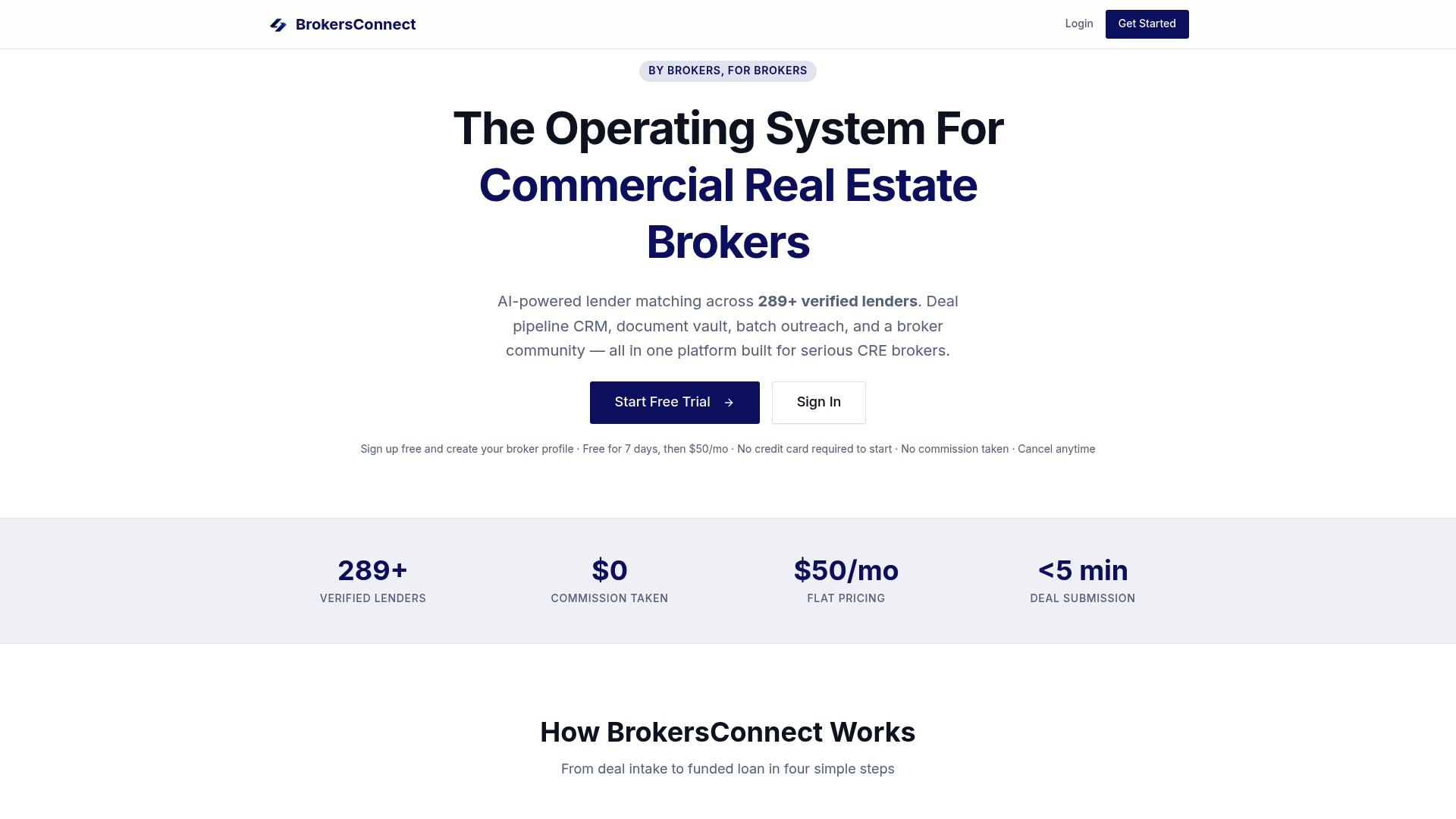
- Lender matching: scenario inputs are matched against a database of verified lenders by property type, leverage, and loan purpose.
- Deal packaging: AI tools help assemble the sponsor summary and underwriting snapshot before outreach begins.
- Batch outreach: send tailored submissions to multiple matched lenders without rebuilding the package each time using streamlined tools.
- Pipeline tracking: a CRM built for loan scenarios logs responses, timelines, and lender behavior to help evaluate outreach results.
Brokers who want to see how the matching and tracking tools fit their own deal flow can start at BrokersConnect.
FAQ
What should the first email to a lender include?
Lead with a one-sentence sponsor credibility statement, then a three-line deal snapshot covering loan amount, target LTV, and DSCR. Close with a direct ask for a term sheet or a short call rather than a vague request for feedback.
How many times should I follow up with a lender?
A practical cadence runs three to five touches over about two weeks, mixing email and a phone call rather than repeating the same email. Stop after two missed responses within that window, since further follow-up rarely changes a lender's interest.
Why do lenders care about sponsor quality more than deal structure?
Lenders at the 2025 Fall Finance Forum described sponsor quality as their primary underwriting filter, since an experienced sponsor can often secure funding even with a complex structure. A weak sponsor profile makes even a clean deal harder to move through underwriting.
What documents do lenders expect before issuing a term sheet?
Most lenders expect a rent roll, trailing twelve months of financials, and a sponsor financial statement before issuing anything indicative. Agency and GSE lenders typically require additional items earlier, including authorizations tied to their own due diligence workflow requirements.
Can software replace manual lender outreach entirely?
Software can speed up credit box matching, document packaging, and batch outreach, but sponsor-first framing and relationship judgment still drive which lenders actually respond. Platforms like BrokersConnect are built to accelerate those steps rather than replace the broker's own outreach decisions.